Once I was a clever boy learning the arts of Oxford... is a quotation from the verses written by Bishop Richard Fleming (c.1385-1431) for his tomb in Lincoln Cathedral. Fleming, the founder of Lincoln College in Oxford, is the subject of my research for a D. Phil., and, like me, a son of the West Riding. I have remarked in the past that I have a deeply meaningful on-going relationship with a dead fifteenth century bishop... it was Fleming who, in effect, enabled me to come to Oxford and to learn its arts, and for that I am immensely grateful.


Saturday, 7 July 2012

Relics of St Thomas of Canterbury


Today is the feast of the Translation of St Thomas of Canterbury, an event which occured in 1220, and led to the tradition of the Jubilee of St Thomas every fifty years at Canterbury - in 1420 the claims associated with it caused a few riased Papal eyebrows on the part of Martin V in respect of Archbishop Chichele.
The bones of the martyr Archbishop may have been destroyed in 1538, but, as is documented in the recent book The Quest for Becket's Bones, they may have survived at Canterbury. In the arguable absenc eof primary relics there are some remarkable secondary relics of St Thomas Becket.

At Sens cathedral, where St Thomas spent part of his time in exile in the 1160s there are preserved vestments which are believed to be those of St Thomas.

In May the New Liturgical Movement editor Shawn Tribe posted this piece about them:

" I came across the very interesting website of Dr. Genevra Kornbluth which, amongst other treasures, contains her photographs of vestments which are said to have been used by the 12th century saint, Thomas à Becket, and which are housed in the Treasury of the Cathedral of Sens.

Some of you will have no doubt seen some images of a reproduction of this particular chasuble, but these are the first high quality images I have seen of the original itself -- not to mention photographs of other period medieval vestural elements as well.

I am pleased to reprint them here with the kind permission of Dr. Kornbluth. (Please click each image to enlarge them for more detail.)
The chasuble with its famous orphrey pattern

A more detailed view of the orphrey

Alb. Take note of the ornamental apparel as well as the ornamental cuffs. 


The apparel which would have attached to the amice.

Maniple and stole. The cuffs and apparels on the alb are also more visible here.

Pontifical Sandals

You can see more details here.

Photos reprinted with permission. www.KornbluthPhoto.com "


The New Liturgical Movement followed this up more recently with this post by Fr Lawrence Lew, O.P.:


"This mitre, belonging to the treasury of Westminster Cathedral, is currently on display in the Victoria and Albert Museum. It dates to c.1160-1220, and so, is contemporaneous with the life of St Thomas Becket.

Since the 19th century it has been associated with the relics and mitre of St Thomas Becket at Sens Cathedral, although this association is now disputed. The lappets do not match because the one embroidered with an apostle was formerly attached to another mitre, c.1180-1210 also at Sens Cathedral; the floriate lappet is original.

In form and decoration, this mitre does resemble the famed Becket Mitre. The scrolls and floriate embroidery are silver-gilt thread worked on padded white silk. The circular compartments in the embroidery and the red band of silk would have been ornamented with jewels and enamels but these have been removed.

The mitre is 27cm x 23.5cm with a 3cm-wide lappet (extending to 6.5cm at the base) that is 44cm long."

Friday, 6 July 2012

Pictures of the Holywell Pilgrimage


There are some pictures of the Latin Mass Society's Holywell Pilgrimage, about which I posted recently, on the LMS Chairman's blog at the following two posts Bishop Rifan in Holywell and Bishop Rifan in Holywell: more pictures.


Prince William Earl of Strathearn KT


Yesterday the Queen presided at the service of the Order of the Thistle in St Giles's Cathedral in Edinburgh and installed Prince William as a Knight of the Order in the Thistle Chapel.

   Prince William attends the  Thistle Ceremony at St Giles Cathedral in Edinburgh
Prince William in the green and purple robes of the Order of the Thistle

Image: Daily Telegraph
 
The Daily Telegraph has a report on the events of the day at Queen makes Prince William Knight of the Thistle  and there is a series of photographs of the procession and the Knights which can be viewed at Knight of the Thistle.
 
This was, I think, the first official occasion in Scotland where teh Prince has appeared in his capacity of Earl of Strathearn.
 

Wednesday, 4 July 2012

Alice at 150


Today is the 150th anniversary of the boat trip and picnic on a ""golden afternoon" from Oxford to Godstow on July 4th 1862 which inspired Charles Dodgson, othewise known as Lewis Carroll, to tell the stories to Alice Liddell which he published in 1865 as Alice's Adventures in Wonderland, and followed in 1871 with  Through the Looking Glass.They are stories I was brought up on as a child and which retain their appeal to adults because of their depth and sheer delight and quirkiness. How often do we not refer to images that derive from these two childeren's stories in commenting on the world around us?The inspiration Dodgson found in his life in and around Christ Church as a mathematics don and in the life of the Liddell family and their friends and contacts can be discerned and give both books their continuing appeal to different age groups - the have become part of our wider heritage across the English speaking world.

http://www.atelier-rc.com/Atelier.RC/b-dayCalendar/02.28-SirJohnTenniel-Alice.jpg

The Mad Hatter's Tea Party
Sir John Tenniel's illustration

Image:atelier-rc.com

Mind you, although I am sure the Rev. Mr Dodgson's interest in childen  was entirely innocent I fear that in today's Nanny State he would run the risk of a visit from the Thames Valley Police, the Child Proterction Agency and Social Services.

Tuesday, 3 July 2012

A heretic abroad


Christopher Howse's article in last Saturday's Daily Telegraph featured the sad story of Richard Atkins from Ross on Wye and his fairly single-minded determination to come to a sticky end for his heretical ideas in 1581. You can read the story at The man of Ross cheerful to burn.

It is interesting in that it shows the reluctance of the authorities to proceed against a man who appears to have been deranged, and that he was shown kindness by those whose ideas he so clearly rejected.

The author of the book which Christopher Howse is reviewing is Michael Tavinor, the Dean of Hereford, whom I knew slightly when he was Vicar of Tewkesbury. In both of those great churches he has done much to enhanc the appearance of the buildings and their worship, and to reconnect them with their Catholic origins and practices

Hugh Capet and the establishment of his dynasty


Today is the 1025th anniversary of the coronation of Hugh Capet as King of the Franks - Rex Francorum - at Noyon following his election to the throne. With his accession and coronation his family, the Capetians, became the rulers of France, and all the subsequent Kings have been his descendants, whether designated as Capetian, Valois or Bourbon by historians and genealogists.


A 12th century portrayal of Hugh Capet

Image: Wikipedia

The success of the family in transmitting the Crown directly in the male line from father to son until 1316 is no mean achievement in terms of human biology: in political terms it ensured the creation and maintenance of the French monarchy and nation. The events of 987 were to prove crucial to the later history of France.

There is an online biography of King Hugh here.

Monday, 2 July 2012

Pilgrimage to Holywell


Yesterday I travelled with my friend David Forster to attend the Latin Mass Society's Pilgrimage to St Winefride's Well at Holywell in Flintshire.

Last time I visited Holywell it was as child  in 1958, when the reigning Sovereign Pontiff was Pope Pius XII, and all I have as memory of that occasion is of standing by the well in what seemed a somewhat dank chamber. Other than that I know the shrine from photographs and by its historical significance as the one continuous place of pilgrinmage to survive from before the reformation, and as a remarkable piece of late medieval architecture.

There is an introduction to the history of the shrine here  and there is both pilgrimage information and more pictures from the Shrine's own website here.

Thomas Charles-Edwards life of St Winefride from the Oxford Dictionary of National Biography can be read here.

Pilgrims over the centuries have included King Henry V, King Edward IV, Fr Garnett and the wive sof the Gunpowder Plotters and King James II and Queen Mary Beatrice. An early nineteenth century visitor, if not actually apilgrim, was the future Queen Victoria. The beautiful shrine chapel and well chamber dates from the years afrter 1500 and is ascribed to either, or both, Lady Margaret Beaufort, who had estates in the area, and to Abbot Thomas Pennant of Basingwerk abbey, which controlled the shrine, and was a Cistercian house just below the shrine on the coast.


    http://www.holywell-town.gov.uk/images/uploads/well.jpg

The shrine chapel and well with the ancient parish church above and to the left.
The buildings to the left and on the right of the foreground are nineteenth century

Image: holywell-town.gov.uk

St Winefride's Well and the vaulted chamber

Image : Wikipedia


http://northwalestoday.com/image-files/holywell-well-web.jpg

The Holy Well, looking towards the outer pool

Image:northwales today.comhttp://andybullmultimedia.webs.com/winefride1.JPG

A pilgim bathes her feet in the pool in front of the well

Image: andybullmultimedia.webs.com
We made good speed on the journey and had plenty of time before the Pilgrinage Mass to visit the Well, light candles, look at the excellent Shrine information display and at the shop befre walking up the hill to the nineteenth century Catholic church to begin our formal devotions. The celebrant at the Mass was Bishop Rifan from Campos in Brazil, and the Mass itself was that of the Precious Blood.

There was a large congregation which filled the church - devotion to St Winefride is clearly still strong in the area and region - and there were several familiar faces from Oxford amongst the schola.


https://blogger.googleusercontent.com/img/b/R29vZ2xl/AVvXsEjPzoKF_CXiGt1j9ra-xgpZ0Q6OxFL2QOv8mEklh2STLr-NGngvuFiielgMiuGGmclwHJeiM5T-oFSekN2EOkEdXC0IwN2WNr-K8_8KRrsrsnRueZJrx3ojIrm6j2uUiitZfh41dWxvcHGv/s320/Holywell+LMS+July+2008+001.jpg

The Catholic church in Holywell where the Pilgrimage Mass was celebrated

Image: maggieclitheroe-dontknowwhatimdoing.blogspot .com

After the Mass we formed up as a Rosary procession to walk dowm to the Shrine for the hymn and prayers to St Winefride, to venerate her surviving relic - part of a finger bone -and to be blessed by it, and to be individually greeted by Bishop Rifan.

St Winefride's Well

The Relic of St Winefride in its silver monstrance.
Image:stwinefridewell.com

I am very grateful to David for suggesting our Pilgrimage, and for driving us both there and back safely. I think we both hope to return to this really quite remarkable place. If you have not visited, or still better, been as a pilgrim to Holywell, may I urge you to do so.

May St Winefride continue to pray for us.

Sunday, 1 July 2012

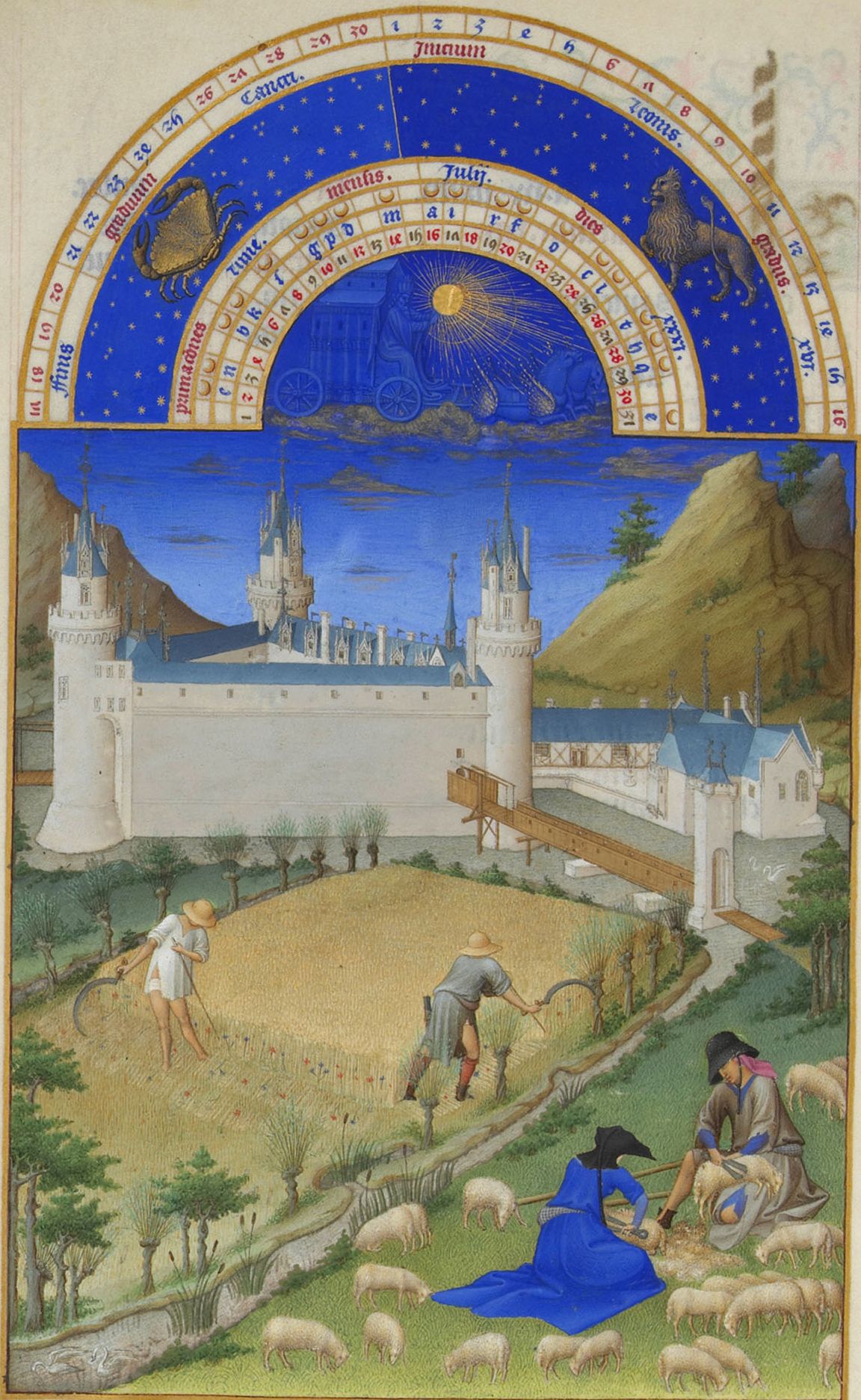
July


Image: Wikipedia

This illumination is attributed to Paul Limbourg  and depicts the Chateau or Palace of Poitiers, portions of which still survive. The chateau belonged to the Duke of Berry who had rebuilt portions of it in the decades preceding the painting.
Harvesting and sheep shearing are taking place in the foreground - all is beginning to be safely gathered in against the winter. One again the scene is idyllic - almost in the tradition of eighteenth century rustic scenes. Here is once again a scene of tranquility, rather different from the realities of life in northern nd central France in the years 1413-16.