Once I was a clever boy learning the arts of Oxford... is a quotation from the verses written by Bishop Richard Fleming (c.1385-1431) for his tomb in Lincoln Cathedral. Fleming, the founder of Lincoln College in Oxford, is the subject of my research for a D. Phil., and, like me, a son of the West Riding. I have remarked in the past that I have a deeply meaningful on-going relationship with a dead fifteenth century bishop... it was Fleming who, in effect, enabled me to come to Oxford and to learn its arts, and for that I am immensely grateful.


Thursday, 8 July 2010

Summorum Pontificum Three Years On

Yesterday was the third anniversary of Summorum Pontificum. The blogs seem to have quite a bit about the fact and the Catholic Herald has an online debate on whether the Papal initiative has been successful. The very fact that the Pope issued it is a thing to continue to be grateful for - I recall celebrating with modest glass of champagne back in 2007 - and I am thankful for all that has been achieved in consequence of the Holy Father's initiative.

Like many others I would like it to have had greater impact already, but a great deal has been achieved, and solid progress made. A great deal has been achieved and a great deal recovered for the liturgical life of the Church. In this country it is clear that some dioceses are more favourable than others, and that in some places the laity are more responsive or pro-active than in others. This may not entirely be the responsibility of individuals in the clerical hierarchy - it may be that there simply is not, at present, a constituency for traditional forms in certain areas. The reasons for that may be complex. Resolving then may require not only practical action but also research to understand developments over the last half century and maybe longer.

With both clergy and laity it is partly, though by no means entirely, a matter of different generations. The signs of a favourable attitude towards the Extraordinary Form amongst younger clergy and religious, as well as laypeople is very encouraging. The success of the various training conferences in this country is very hopeful, as has been the support given at an international level by leading members of the Curia. The New Liturgical Movement has some very positive stories today, including Cardinal Canizares at Wigratzbad for the ordinations there, a Usus Antiquior parish being established in Dayton, Ohio and a well attended EF Mass at St Charles Borromeo in Hull, of which the following is one of the photographs:


A few years ago such a restoration would have been barely imaginable. A great deal has been achieved.

This is despite some bishops seeking to claim a power to control the application of in their dioceses, and a sense that in not a few places the Papal motu proprio has never been heard of - that seems to include large parts of some avowedly Catholic countries.

To some extent supporters of the traditional liturgy have been over-optimistic as to the response of others, and now feel disappointed that more has not already happened. The zeal of some may indeed have intimidated members of the hierarchy, who themselves feel unsure about celebrating Mass in front of what can be so critical an audience. For some of them it must also be a shock to the system to see the return of that which they had, for whatever reasons, assumed belonged to the past. "We don't do that anymore" can now be answered with "Yes we can", and indeed "Yes we will."

On the whole I am optimistic, but I also feel impatient to see more achieved - but that may just be me. We should give thanks for what the Pope has given back to us, and work to make it more available. Traditionalist minded Catholics need to cultivate further the arts of positive evangelisation in these matters. I stress the positive aspect - simply denigating much that does indeed deserve denigration in contemporary liturgical life may relieve the feelings, but it may not achieve much more. The continuing positive promotion of the Extraordinary Form, as is being done by organisations and authors, but by all who support it, can, I am sure bring real benefits to both individual souls and the life iof the Church. That may be the way to cure impatience and the causes of impatience at the same time.

Wednesday, 7 July 2010

St Augustine and Anglicans


Whilst finding today's readings in the Divine Office I was struck by yesterday's second reading at Matins - I had read that proper for St Maria Goretti rather than the ferial one. That is from St Augustine's Discourses on the Psalms. In it he addressed as brothers those outside full communion, and sought ecclesial reconciliation with them. He was obviously thinking of the Donatists of his day, but the passage seemed highly relevant to contemporary concerns.

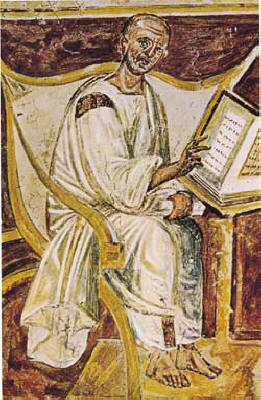
File:Augustine Lateran.jpg
The earliest surviving depiction of St Augustine - a sixth century painting from the Lateran

Next week the General Synod of the Church of England is due to debate further the plans to consecrate women bishops, and this may prove to be the crucial meeting in that process as far as traditional Anglo-Catholics are concerned - but then, it may not. Nevertheless St Augustine's concern to bring into the one true fold those outside who shared so much with him was palpable, and appears apposite to the situation of not a few Anglicans today. I hope and pray that contemporary Catholics share the same concern for ecclesial unity, and do all they can to bring those who think as they do into full peace and communion. I rather fear too many Catholics do not understand the experience of traditional Anglo-Catholics, and are inclined to see Anglicanism as possessing a coherence it has not possessed since at very least the time of the Tractarians

Wednesday next week is also the 177th anniversary of John Keble's sermon which was seen by Newman and others as inaugurating the Oxford Movement. As Newman approaches beatification this year let us do all we can to realise more fully that vision - by no means clear in 1833 - of the true unity of the Church. It was, of course, the similarities between the claims of Anglicans vis-a-vis Catholicism and those of dissident groups in the early Church which led Newman to begin to reconsider his position after 1839.


In(ter)dependence week in Oxford


This week is the Oxford Oratory's In(ter)dependence Appeal Week, concentrationg on Anglo-American links. It is, I think one may confidently say, going very well. The organisers are to be congratulated on their hard work in advance and the success of what has happened so far.

I was unable to attend the first event, last Saturday, a family day at The perch at Binsey, but I gather it was well supported and avery enjoyable event, with the Cajun band L'Angelus as the main performers. On Sunday the music at the Solemn Mass was by American composers, and the preacher Fr Joel Warden of the Brooklyn Oratory. Monday evening we had a splendid concert of music by the International Baroque Players and by Adam Brakel, the organist of West Palm Beach cathedral. In addition to fine music it was delightful on a summer evening to mix, Pimms in hand, with friends in the open space alongside the church.

Yesterday afternoon I led a group on a walk around medieval and Reformation Oxford. This was something I enjoyed, and so, I hope, did the members of the party. It was tantalising to have to hurry past so many places of interest with only a fleeting reference to what can be seen inside a college, or in the area behind a building, or without having the time to explain the intricacies of Oxford history. However I think I managed in two hours to cover five or so centuries with a degree of historical insight and some humour, as well as dodging the hazards of life in contemporary Oxford - pavements congested with tourists, scaffolding around historic monuments and the myriad of buses in the city centre.

Tonight we have a talk by Walter Hooper, a staunch member of the Ortaory congregation, about his memories of C.S.Lewis. Walter was Lewis' last secretary, and has been a leading figure on the interpretation of his work and legacy.

Tomorrow I am performing again - this time on Catholic and literary Oxford from Newman to the Inklings. So, if you are free tomorrow at 2pm, the Oratory is the place to be...

Tuesday, 6 July 2010

Oxford Martyrs memorial


Following on from my post yesterday I have now found a photograph of the memorial erected in 2008 to the four martyrs. It is at the eastern end of Holywell Street, near the junction with Lomgwall Street.


There is a piece about the plan to erect the plaque and an account of the four men in this report from the Catholic Herald

Monday, 5 July 2010

Oxford Martyrs of 1589


Today is the feast of the Oxford Martyrs of 1589 - Bl. George Nichols and Bl. Richard Yaxley, two mission priests, Bl. Thomas Belson and Bl.Humphrey Pritchard, laymen. They were apprehended just before midnight on May 18th that year at the Catherine Wheel, an inn which stood at the junction of Broad Street and Magdalen Street on a site which is now part of Balliol. It rather looks as if the Catherine Wheel and the Mitre in the High Street were 'safe houses' for Catholics, and presumably good 'cover' as places for recusants to meet up: there is something similar in John Gerard's Autobiography about his arrival in Norwich the previous autumn. The landlady of the Catherine Wheel was certainly seen as implicated, being subsequently sentenced to life imprisonment.

Frs Nichols and Yaxley were caught together with Thomas Belson, a young layman from a local gentrey family on the borders of Oxfordshire and Buckinghamshire, who had acted as their courier and agent. A young man of determination he had dissuaded his family from being "Church papists" - that is outward conformers to the established church. Humphrey Pritchard, born in Wales, was the barman at the inn, who when the others were arrested declared that he too was a Catholic.

The priests were hung, drawn and quartered, and the two laymen hanged at the gallows at the end of Holywell Street in Oxford. All four were beatified in 1987. A memorial tablet was unveiled and dedicated two years ago, and the place of their martyrdom an established place of pilgrimage for the LMS Oxford Pilgrimage.

There is a biography of Bl. Thomas Belson, published a few years ago, and the bar of the social centre at the Oxford Oratory is named in honour of Bl. Humphrey.

Here is a link to part of Tony Hadland's excellent Thames Valley Papists, which gives more details about the four martyrs, including their words from the scaffold.

Saturday, 3 July 2010

More thoughts on Canon Thomas Chamberlain

After I had posted my piece about my article on Canon Chamberlain yesterday it occurred to me that I really ought to say a little more about my sense of obligation to him and his ilk amongst the pioneers and sustainers of Anglo-Catholicism. When doing research on him I realised the extent of my admiration for this tough and determined man who set out to do what he believed to be right in his parish and achieved so much. In a sense I wanted to be battling alongside him in those far-off episodes of nineteenth century church history.

It was thanks to what he and others achieved up and down the country that I was able as an Anglican to grow into the Catholic faith. I owe a great deal not only to the likes of Chamberlain, and their successors, but also to faithful clergy who ministered in my own time and home area. The journey beginning at St Giles Pontefract and taking in en route St Thomas at Purston, St Mary at South Elmsall, St Cecilia Parson Cross and the Bilham group of parishes, and the shrine at Walsingham and the Glastonbury Pilgrimage, drew me on to Pusey House and St Thomas in Oxford. Without them I would not have so well placed to make the final transition to the fullness of that faith in full peace and communion with Rome. For all that I am immensely grateful.

Many other Anglo-Catholics have followed similar paths, and would, I am sure, agree as to the debts they too owe.

This is not just a personal matter, it has a wider significance. At the present time there is the real possibility and hope of other Anglo-Catholics making that final move. I appreciate their apprehension - above all perhaps over possibly losing their churches, as Valle Adurni highlighted last week - but as Ancient Richborough and others have indicated the risks of staying are ultimately worse. I am tempted to say that if I could do it, so can they.

Chamberlain may not have been a 'Romaniser', but then he was not faced with the threats to the integrity of orthodox belief and practice within Anglicanism which confront people today. The choices made by Chamberlain and others, led by Pusey were, in their own way, as difficult as those made by Newman and his companions. The former group chose to stay, in the hope of better things. For a while that hope seemed justified. It looks much less so now than a century or seventy odd years ago.

To cradle Catholics, who so often appear to know or understand little of the Anglo-Catholic expereince, I would say that beyond the charity of welcoming converts there is the deeper charity of making welcome people who think almost exactly as they do, and who have often been through journeys in faith that can augment the whole Church. There is a need to learn more about what Anglo-Catholics believe, and that it is not just 'dressing up' and 'playing at Church'. Those of us who have completed the crossing of the Tiber, and those paddling, wading or swimming across now, and those still tentatively putting a toe in the water have brought and can bring much to the life of the entire Body. It may be the 'Anglican Patrimony', it may just be ourselves, but it is something, and something that ultimately is called forth by God.

Friday, 2 July 2010

St Thomas Oxford and Thomas Chamberlain

This weekend is the patronal feast of St Thomas the Martyr Oxford, the Anglo-Catholic church near the railway station in Oxford, and where from 2002 -5 I had the privilege of being Churchwarden.

St Thomas' keeps the feast of the Translation of the relics of St Thomas on July 7 as its principal patronal, a tradition going back there to the late nineteenth century. Indeed St Thomas was one of the few post-apostolic saints to have two feast days - those of his death and translation - in 1170 and 1220 respectively. Another to have such a double commemoration is St Cuthbert.

I retain enormous affection and regard for St Thomas', for its faithful parishioners, and for its redoubtable p-i-c and blogger, Fr Hunwicke. Living just across the churchyard from it I see it everyday and keep it and all associated with it in my prayers.

In 2003 I published a history of the church and parish as a festschrift to the last Vicar, Robert Sweeney, and in so doing realised what a special place St Thomas has in the history of the Catholic revival in the Church of England.

I still have a place there as Archivist, and by a happy coincidence Forward Plus, the free newspaper produced by Forward in Faith, has in its latest edition an article about Thomas Chamberlain, the great and remarkable vicar who established St Thomas' as one of the very first Anglo-Catholic parishes in the country. Chamberlain's fifty year ministry there from 1842 to 1892 links the era of the Tractarians to that of the Lincoln Judgment. Modesty almost forbids me to name the author of the article, but I think being a blogger is not that modest, so I will own up to having written it. You can find the article online at the website of Forward Plus by scrolling down to the article, or you can, no doubt, pick up a copy in right thinking Anglican churches.

Thomas Chamberlain, by Lewis Carroll (Charles Lutwidge Dodgson), spring 1860 - NPG P7(3) - © National Portrait Gallery, London

© National Portrait Gallery, London


This photograph of Chamberlain which illustrates the article was taken in the early 1860s by one of his colleagues from Christ Church here in Oxford - the Rev. Charles Dodgson - Lewis Carroll.

Please pray for all at St Thomas' and for its future both as a community and as a place of worship.

Anyone interested in obtaining copies of my book on the church should contact me at jrwhitehead2000@yahoo.co.uk

Precious Blood at SS Gregory and Augustine

Yesterday evening I went to the EF Mass for the Feast of the Precious Blood at SS Gregory and Augustine here in Oxford. As a feast it was a casualty of the 1960s changes in the Novus Ordo so it was good to be able once again to observe it.

Whilst at the church I had an opportunity to admire their latest addition as part of their renovation project - the paintings of SS George, Frideswide, Bede and Anne Line, together with Bl.Humphrey Pritchard and the soon to be Bl. John Henry Newman. These have joined the other saints - Peter and Paul, John Fisher and Thomas More flanking the altar, and all participating, one sensed, in the everlasting thanksgiving for and adoration of the Precious Blood.