Once I was a clever boy learning the arts of Oxford... is a quotation from the verses written by Bishop Richard Fleming (c.1385-1431) for his tomb in Lincoln Cathedral. Fleming, the founder of Lincoln College in Oxford, is the subject of my research for a D. Phil., and, like me, a son of the West Riding. I have remarked in the past that I have a deeply meaningful on-going relationship with a dead fifteenth century bishop... it was Fleming who, in effect, enabled me to come to Oxford and to learn its arts, and for that I am immensely grateful.


Showing posts with label Stefan Lochner. Show all posts

Saturday, 10 October 2015

St Gereon and companions


I have lifted this from John Dillon's post on the Medieval Religion discussion group, with a few minor alterations and additions:


Today, October 10th, is the feast day of St. Gereon and companions, legendarily members of the Theban Legion who were not at Agaunus with St. Maurice but who voluntarily submitted to the Emperor Maximian in Köln (Cologne) and were executed there.

Some views of their church in Köln, the Basilika Sankt Gereon:

View from the west


View from the east

http://www.sacred-destinations.com/germany/cologne-st-gereon
https://de.wikipedia.org/wiki/St._Gereon
A virtual tour (use the links below the plan [at bottom of the page]):
http://www.stgereon.de/st-gereon-72.html

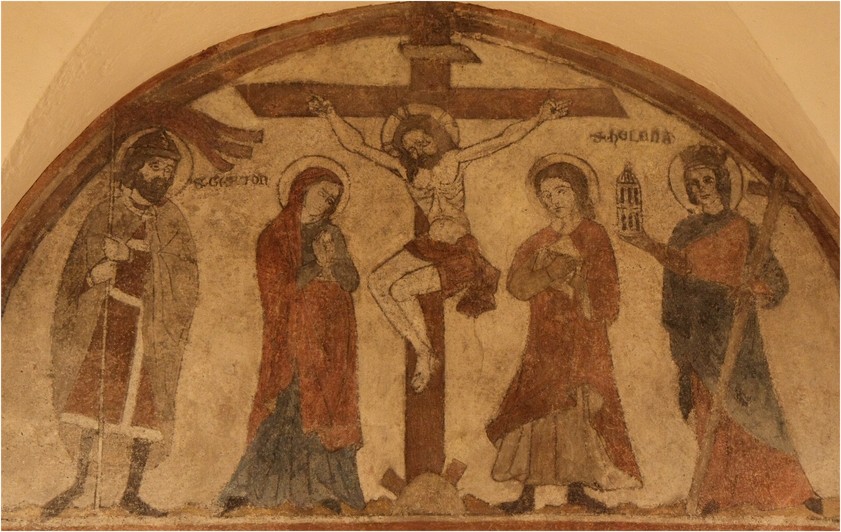
According to the late-eleventh or very early twelfth-century Vita sancti Annonis archiepiscopi Coloniensis, St. Helena had founded this church. Here is a view of an uncovered fresco from 1190/1191 over the entrance to the Confessio with Gereon at left and Helen at right (holding the earliest known representation of the church's polygonal nave, the Dekagon, completed in 1227):

http://www.heiligenlexikon.de/Fotos/Gereon_von_Koeln2.jpg


https://upload.wikimedia.org/wikipedia/commons/9/96/St.Gereon_Kreuzigungsdarstellung_Krypta.JPG


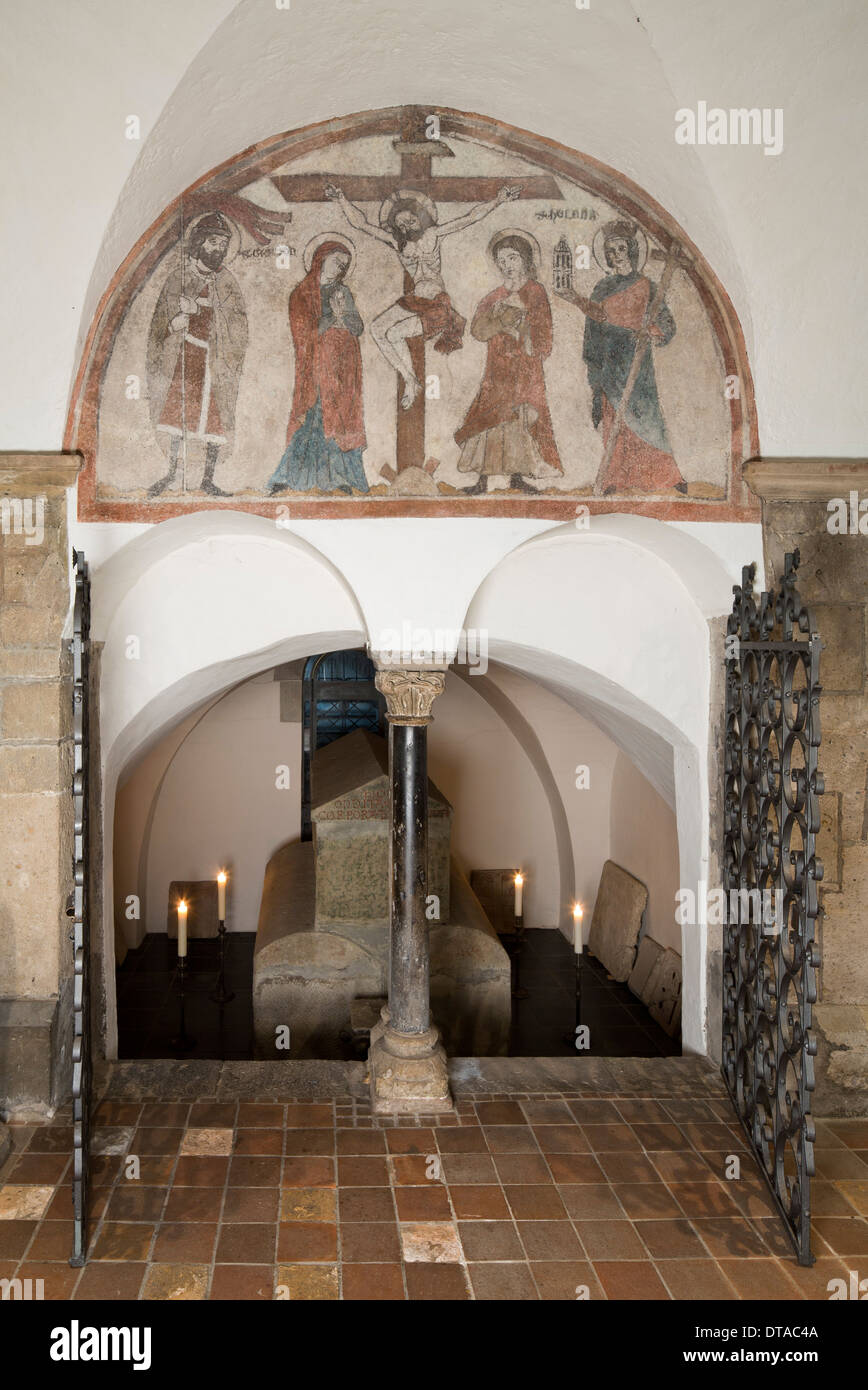
Context within the church (the sarcophagi contain skeletal remains unearthed in an Inventio in 1121 and proclaimed to be those of Gereon and some of his companions):
c8.alamy.com/comp/DTAC4A/kln-st-gereon-krypta-DTAC4A.jpg


Further period-pertinent images of Gereon and companions:

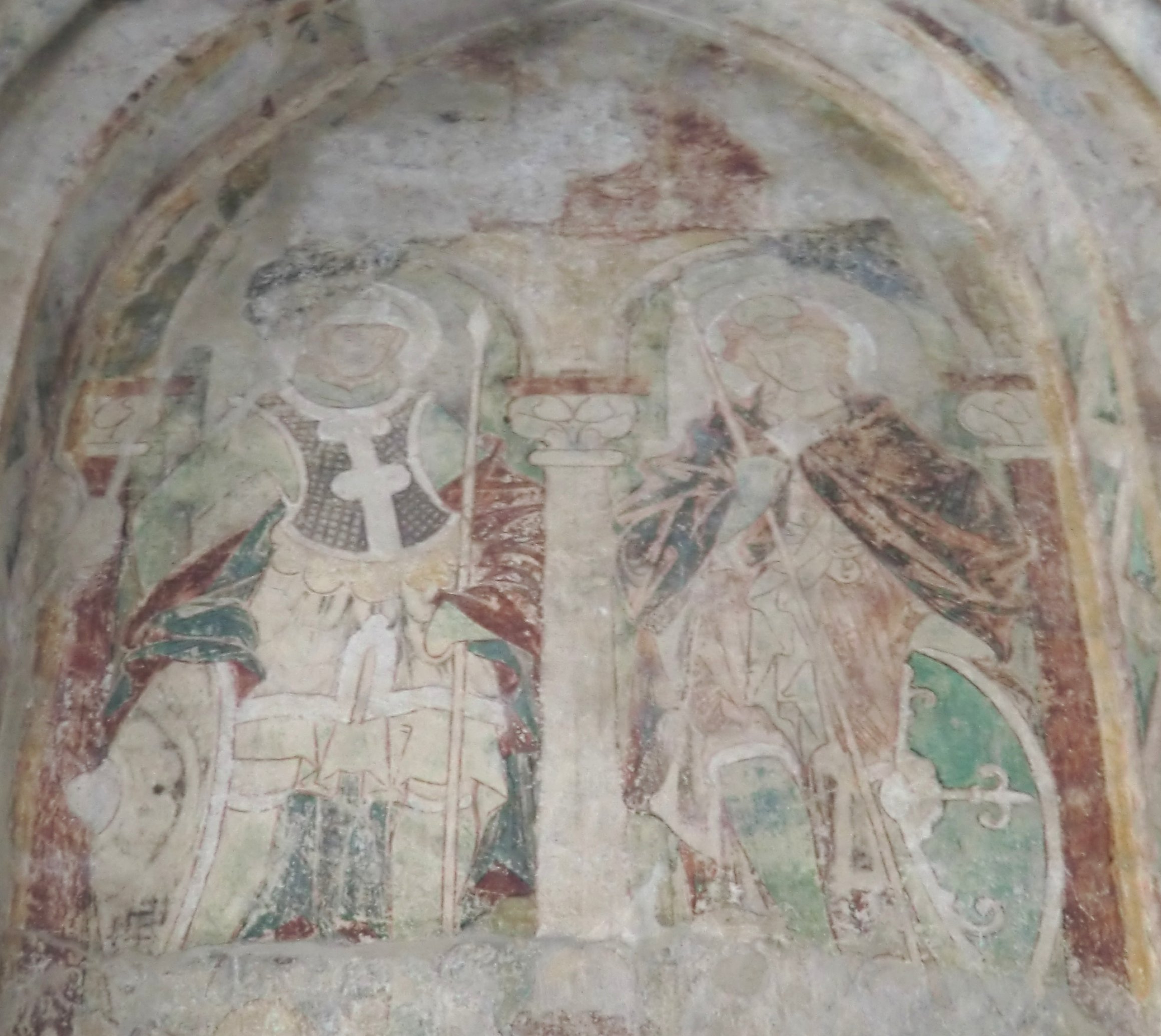
a) Gereon (at left?) and another martyr of the Theban Legion (Maurice? Gregory Maurus?) as depicted in a mid-thirteenth-century fresco in the baptismal chapel of Köln's Basilika Sankt Gereon:

https://www.heiligenlexikon.de/Fotos/Gereon_von_Koeln6.jpg


The fresco in an early twentieth-century grayscale drawing:

File:St. Gereon Koeln Wandgemaelde Taufkapelle.jpg

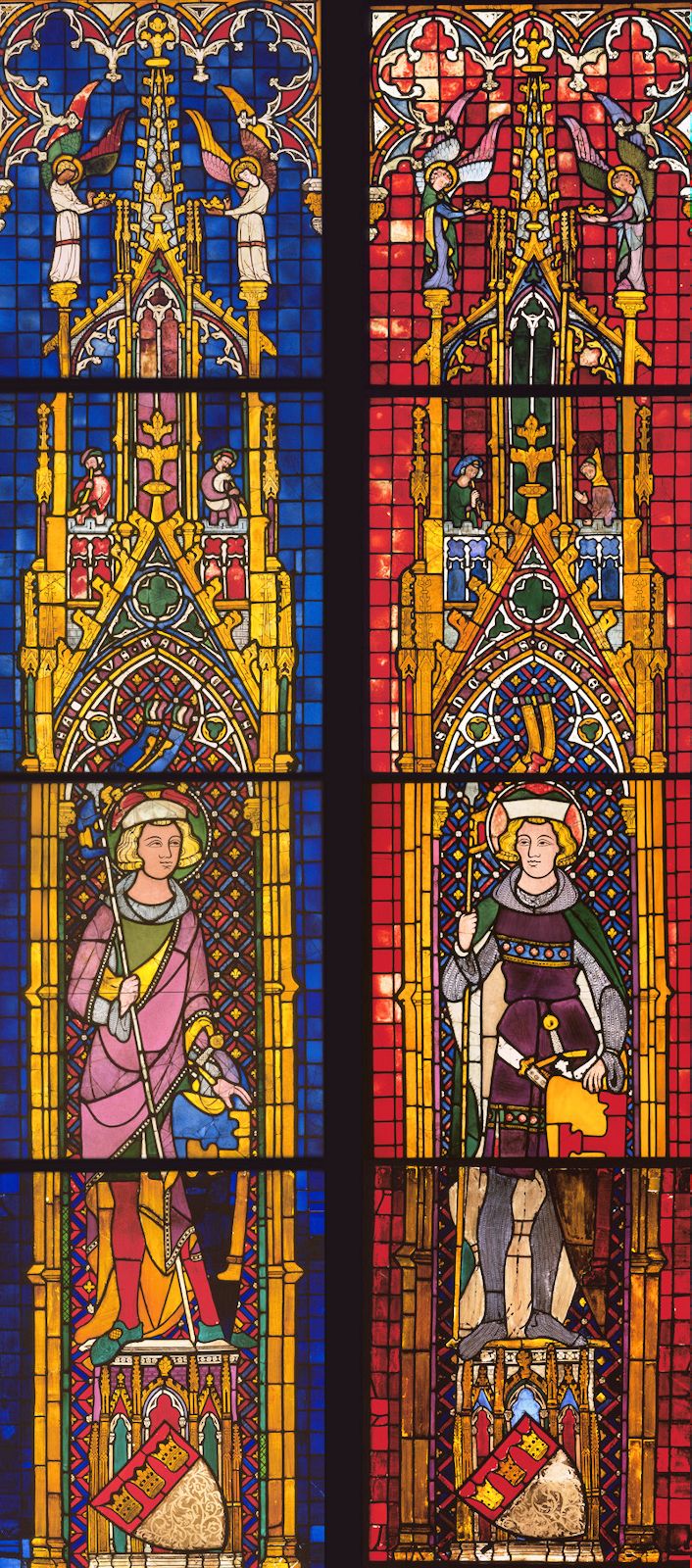
b) St Gereon and St Maurice as depicted in an earlier fourteenth-century glass window in Köln's Hohe Domkirche Sankt Peter und Maria:

Foto: © Dombauarchiv Köln


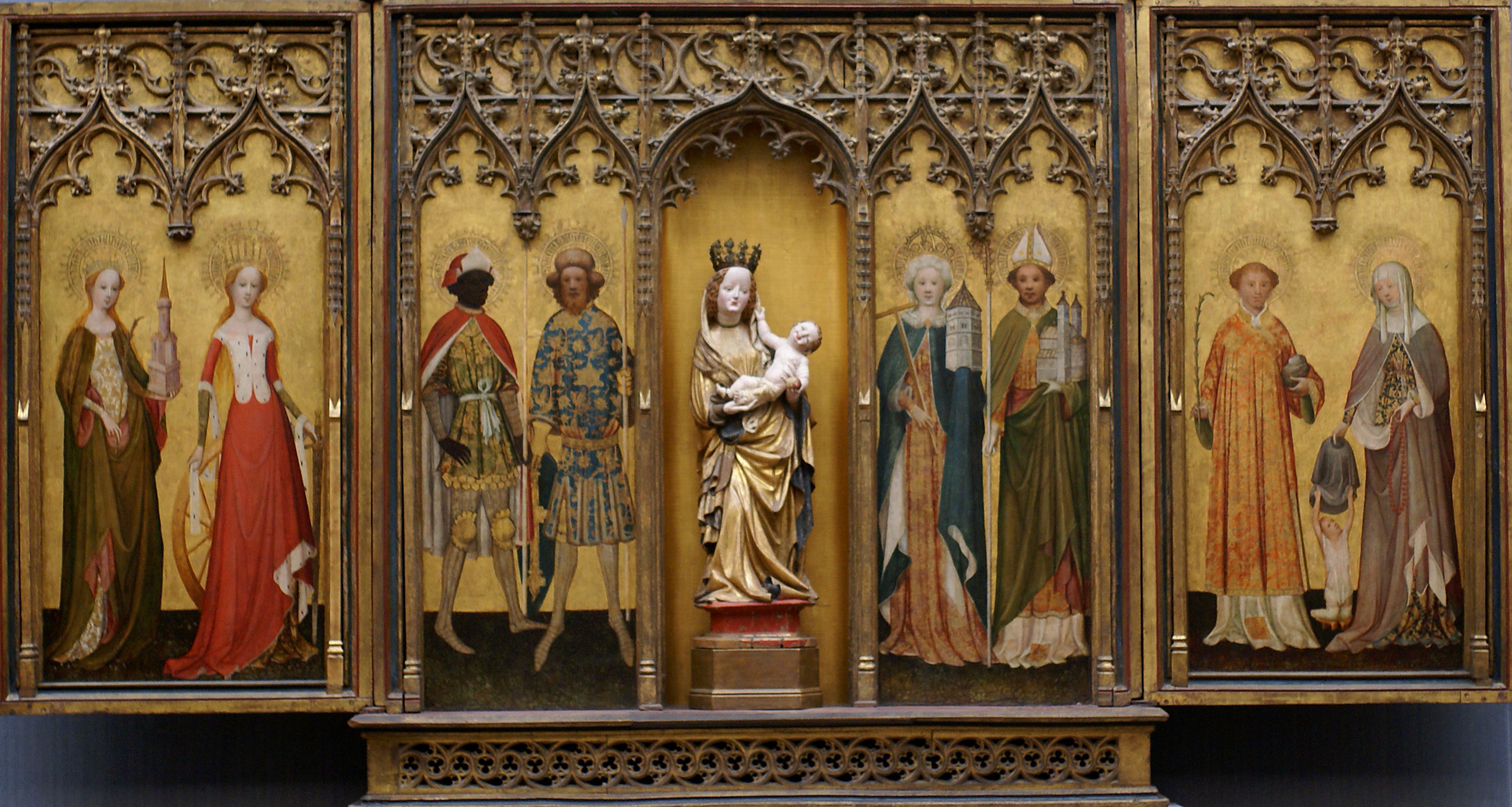
c) Gereon (second from left in central panel; at far left in the same panel, St. Gregory Maurus) as depicted in an earlier fifteenth-century altar of the BVM and saints of Köln (between 1410 and 1430) in the Gemäldegalerie, Berlin:

https://farm7.staticflickr.com/6210/6159854849_6336bcc975_o.jpg

Detail view (Gregory Maurus and Gereon):

http://40.media.tumblr.com/77a235798cb46ddb84380b3323354052/tumblr_njvigmpoz81ssmm02o1_500.jpg


This altar was formerly in the church (since 1920 a basilica minor) of St. Gereon in Köln. The two figures on the other side of the central panel are St. Helen, holding a model of the Dekagon, and Köln's bishop St. Anno, holding a model of the church's choir and east end.

The Clever Boy wonders if the figure of St Gereon is a tribute to king/Emperor Sigismund in that the face and beard are nor dissimilar to images of Sigismund and the hat like that shown in virtually all images of the Luxembourg king and later Emperor.

d) Gereon and companions as depicted by Stefan Lochner in an earlier fifteenth-century panel painting (c. 1440) on his Dreikönigsaltar in the cathedral of Köln:

https://upload.wikimedia.org/wikipedia/commons/c/c8/Stefan_Lochner_004.jpg

The altarpiece as a whole:

http://www.wga.hu/art/l/lochner/adorat.jpg


e) Gereon (second from left) and companions as depicted by the Master of the Assumption (Meister der Verherrlichung Mariae) in a later fifteenth-century panel painting (c. 1460) in the Germanisches Nationalmuseum, Nürnberg:
https://www.flickr.com/photos/roelipilami/14931956501/
https://www.flickr.com/photos/roelipilami/14935025195/

f) Gereon as depicted (second from left -- counting Christopher and his charge as one) by the Master of the Assumption (Meister der Verherrlichung Mariae) in a later fifteenth-century panel painting (c. 1480) in the Wallraf-Richartz Museum, Köln:

http://www.wga.hu/art/m/master/zunk_ge/zunk_ge2/14anne.jpg


The other figures are St Peter vested as Pope and the Virgin Mary with St Anne and the Christ Child - added by the Clever Boy.

g) Gereon as portrayed (at right; at left St. Ursula; at centre, the martyrdom of St. Barbara) in a wing of an early sixteenth-century pendant (1504) in the form of a silver gilt and enamel triptych in the Museum of Fine Arts, Boston:

http://tinyurl.com/ol97y83

h) Gereon as depicted in a panel of the early sixteenth-century Typological Window of the Nativity (Typologisches Geburt Christi-Fenster; c. 1508) in Köln's Hohe Domkirche Sankt Peter und Maria:
1) according to the cathedral's website (German-language) - St Maurice:

https://www.heiligenlexikon.de/Fotos/Mauritius9.jpg


2) according to heligenlexikon.de and to the cathedral's website (English-language) - St Gereon:

https://www.heiligenlexikon.de/Fotos/Gereon9.jpg

Neither site indicates the source for its identifications of the four saints in this register.

The window as a whole:
German-language text:
http://koelner-dom.de/index.php?id=17382
English-language text:
http://koelner-dom.de/index.php?id=17382&L=1

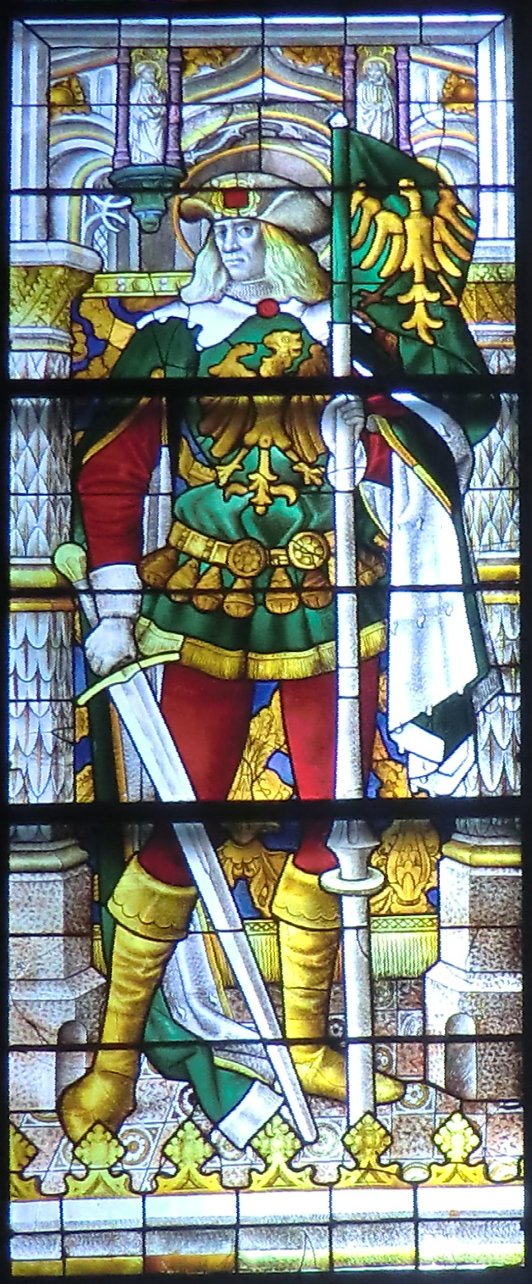
i) Gereon as depicted (at right; at left, St. Helena; at centre, St. Maternus of Köln) in an earlier sixteenth-century glass window panel (c. 1520-1530) in the church of St. Maria Lyskirchen in Köln:


Wednesday, 16 September 2015

SS Cornelius and Cyprian


John Dillon has posted on the Medieval  Religion discussion group about today's joint feast of SS Cornelius and Cyprian as follows ( slightly adapted):


Cornelius, Pope (d. 253) and Cyprian of Carthage (d. 258). Cornelius and Cyprian are named together in the Roman and the Ambrosian canons of the Mass. From at least the sixth century (and quite likely from some time in the earlier fourth century; see under CYPRIAN, below) until the beginning of the fifteenth century -- and perhaps later in some places that didn't get the memo -- their joint feast in the Roman Rite was celebrated on 14th September, also the feast day of the Exaltation of the Holy Cross. Since then it has fallen on 16th September, though editions of the Roman Martyrology, which began in the late sixteenth century, have continued to enter them under 14th September, their reported dies natalis in different years. Only with the revision of 1748 did the RM begin to carry a notice of the joint feast on 16th September.

I) CORNELIUS. Pope St. Fabian died in January 250 at the outset of the Decian persecution. For the next fourteen months the Roman church was governed by a collective of presbyters and deacons whose spokesman was the learned presbyter Novatian. In March 251 a new bishop of Rome was elected and the choice fell not to Novatian but rather to the presbyter Cornelius. Novatian's supporters refused to accept this and instead had their candidate consecrated by three south Italian bishops. Opinions differ as to whether there were at this time any difference between the two on the treatment of apostates who now wished to return to the Church. But the schism, if had not turned on this point from the outset, soon came to be defined in this light, with the Novatianists refusing re-admittance, and Cornelius and his supporters, who in time came to include bishops St. Cyprian of Carthage and Dionysius of Alexandria, opting for re-admittance after penance.

In 252, under Trebonianus Gallus and Volusianus (who otherwise are not known to have persecuted), Cornelius was arrested and relegated as a prisoner to Centumcellae (today's Civitavecchia [RM]). Cyprian of Carthage's letter to him after this arrest makes it plain that Cornelius alone had been singled out for repression and imagines him as leading the way to glory (_Ep._ 60: dum praecedis ad gloriam). The catalogue of Rome's bishops from Peter onward provided a century later by the Chronographer of 354 (the so-called Liberian Catalogue) says that after a pontificate of two years, three months, and ten days Cornelius passed away at Centumcellae with glory (ibi cum gloria dormitionem accepit); the phrasing does not suggest a death by execution. The Chronographer's less than exhaustive Depositio martyrum omits him. In about 380 St. Jerome in his version of Eusebius' Chronicle treats Cornelius a martyr.

Until its revision of 2001 the Roman Martyrology included in its elogium of Cornelius an assertion that he perished under Decius, having been beaten with leaded or leaden objects and then decapitated along with twenty-one others including Sts. Cerealis and Sallustia, husband and wife, whom Cornelius is said to have instructed in the faith. The ultimate source for this is their latter's legendary Passio (BHL 1964), whose gist was echoed in the Liber Pontificalis and in the early medieval historical martyrologies and which may have been inspired in part by phrasing in the aforementioned letter of St. Cyprian expressing the conviction that Cornelius will have many companions in glory (multos gloriae comites). As far as we know, that never happened. Even Novatian, who -- as Cyprian observes -- as the head of a Christian church should have suffered as well, remained free.

Cornelius was buried in the crypt of Lucina in the cemetery of Callistus. He is the earliest pope known to have had a Latin-language inscription on his grave slab:

 http://www.webalice.it/paolorodelli/Catacombe/foto18.jpg


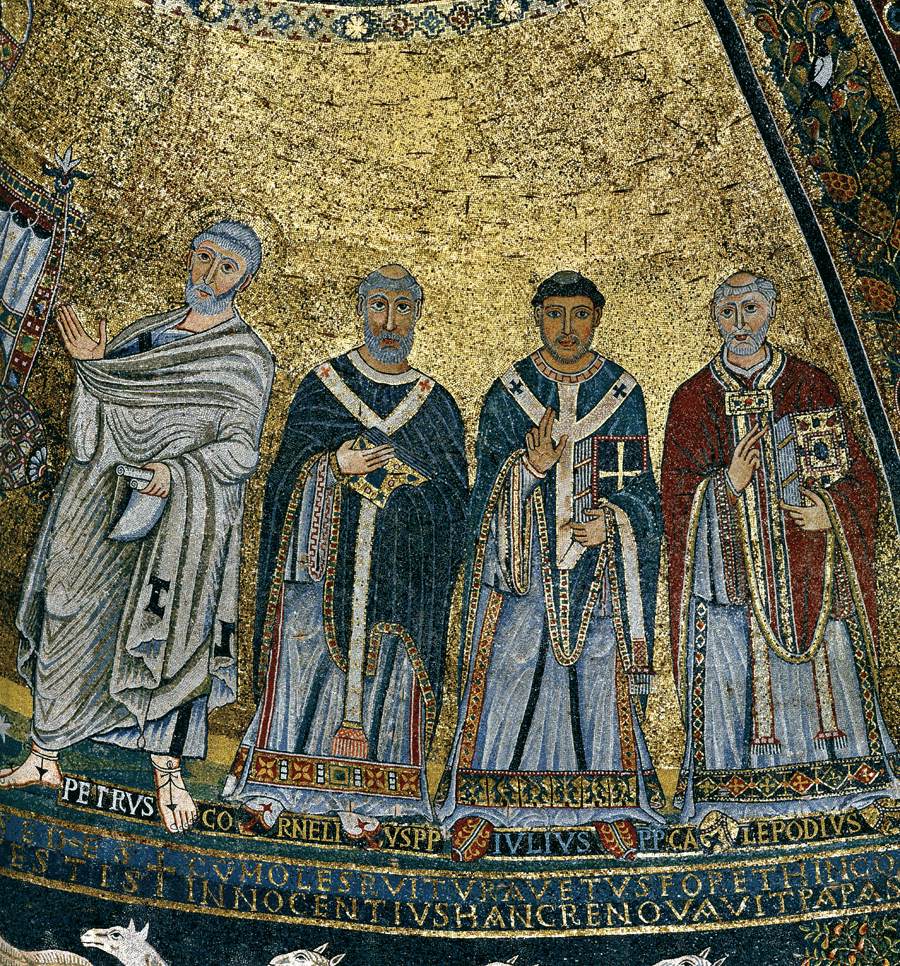
Cornelius' principal relics are now in Santa Maria in Trastevere, where in the twelfth-century apse mosaic he is depicted at St. Peter's immediate left (see in "period-pertinent images", below). In probably the earlier ninth century the abbey of the Holy Saviour on the Inde then near Aachen -- the site is now in Aachen -- received relics of Cornelius, perhaps already including cranium for which it was later famous. Gradually the abbey became known by the latter's name (hence the locale's modern German toponym  of Kornelimünster). In 875 Charles the Bald translated relics of Cornelius from Rome to Compiègne. In 1137 relics believed to be Cornelius' came to the Premonstratensian abbey at today's Ninove (Oost-Vlaanderen) where they too became the focus of pilgrimage. The similarity between the first part of his name and the standard Latin word for horn (cornu) helped make him a patron saint of matters involving cattle.


II) CYPRIAN. We know about Cyprian chiefly from his own writings, supplemented by a closely posthumous Vita by his deacon Pontius (BHL 2041) and by the so-called _Acta proconsularia_ of his trial in 258 (many versions: BHL 2037-2038q, 2038t-2040) The text is reproduced in the Divine Office for today. Well educated in rhetoric and wealthy, he was in 248, two years after his conversion to Christianity, elected bishop of Carthage, the paramount Christian diocese in Latin-speaking Africa. Cyprian distributed his wealth to the poor, continued his theological study, administered his church, and wrote treatises and letters outlining theological positions. During the Decian persecution he went underground and continued to write; in its aftermath his was a major voice for the readmission of apostates after penance and against recognition of sacraments performed by lapsi and others not in communion with the Church.

In August of 257, during the Valerianic persecution, Cyprian was exiled to the coastal city of Curubis (the name is a proparoxytone). A year later he was returned for trial in consequence of a new edict calling for the execution of bishops, presbyters, and deacons who would not sacrifice to the gods of the Roman state. He was convicted on 14th September and executed forthwith. The Depositio martyrum of the Chronographer of 354 gives that day as his feast day and the cemetery of Callistus as its place of celebration at Rome. As that cemetery is where Cornelius had been laid to rest after his translation from Centumcellae, the possibility exists that their joint feast already existed at the time of the Depositio martyrum's composition but that for some reason it was not so recorded in this list. St. Jerome (De viris illustribus, 66) notes that two died on the same day, though in different years.


Some period-pertinent images of Cornelius and Cyprian:

a) Cornelius and Cyprian as depicted (second and third from left) in the heavily restored later sixth-century mosaics (ca. 560) in the nave of Ravenna's basilica di Sant' Apollinare Nuovo (image greatly expandable):

 https://upload.wikimedia.org/wikipedia/commons/1/14/Ravenna%2C_sant%27apollinare_nuovo%2C_int.%2C_santi_martiri_offerenti%2C_epoca_del_vescovo_agnello%2C_02.JPG


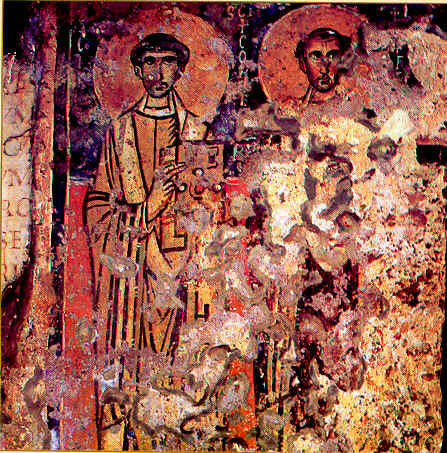
b) Cornelius and Cyprian as depicted in a damaged later sixth-century fresco (? between 561 and 574) next to Cornelius' tomb in Rome's cemetery of Callistus:

 http://www.parrocchie.it/roma/sancipriano/santi%20cipriano%20%20e%20cornelio.jpg


http://tinyurl.com/q66hq3t

Detail view (Cornelius) showing the fresco's location at the tomb:

 http://www.abtei-kornelimuenster.de/images/aktuell/kurznachrichten/Korneliusgrab_Callixtus-Katakombe_-_630x840.jpg


c) Cornelius (third from right) as depicted in the mid-twelfth-century apse mosaic (1140-1143) in Rome's basilica di Santa Maria in Trastevere:

 http://personal.stthomas.edu/plgavrilyuk/PLGAVRILYUK/Art/Lamb/Santa%20Maria%20in%20Trastevere%20apse1.JPG

Detail view:

 http://www.bogoslov.ru/data/2013/02/21/1235628103/15.jpg


d) Cornelius as depicted (martyrdom; two companions) in a late thirteenth-century copy of French origin of the Legenda aurea (San Marino, CA, Huntington Library, ms. HM 3027, fol. 127v):
http://digitalassets.lib.berkeley.edu/ds/huntington/images//000929A.jpg

e) Cornelius as depicted (martyrdom; two companions) in an earlier fourteenth-century copy of the Legenda aurea in its French-language version by Jean de Vignay (circa 1326-1350; Paris, BnF, ms. Français 185, fol. 255v):
http://tinyurl.com/nfq2swj

f) Cornelius as depicted (baptizing St. Blesilla) in an earlier fourteenth-century copy (circa 1335) of books 9-16 of Vincent of Beauvais' Speculum historiale in its French-language version by Jean de Vignay (Paris, BnF, ms. Arsenal 5080, fol. 160r):
http://tinyurl.com/pbelmc8

g) Cornelius as portrayed in his later fourteenth-century silver and gold head reliquary (circa 1360) in the Abtei St. Benedikt von Aniane und Papst Cornelius in Aachen's locality of Kornelimünster:

http://www.abtei-kornelimuenster.de/images/aktuell/kurznachrichten/2015-09-12_Korneliusbueste_-_14_Jh.jpg 

 http://static.panoramio.com/photos/large/108469712.jpg


h) Cornelius and Cyprian (panel at right) as depicted in a late fourteenth- or fifteenth-century triptych in the pieve dei Santi Cornelio e Cipriano (a.k.a. pieve di Codiponte) in Casola in Lunigiana (MS) in Tuscany:
 http://pievedicodiponte.altervista.org/wp-content/uploads/2014/09/TRITTICO.jpg


i) Cornelius and Cyprian as depicted in an earlier fifteenth-century missal of western German origin for the Use of Köln (circa 1401-1425; London, BL, Egerton MS 3018, fol. 92r):

Cornelius and Cyprian


http://molcat1.bl.uk/IllImages/Kslides%5Cbig/K064/K064089.jpg

j) Cornelius as depicted (image at left; martyrdom; image at right: St. Euphemia) in an earlier fifteenth-century copy of the Legenda aurea in its French-language version by Jean de Vignay followed by the Festes nouvelles attributed to Jean Golein (circa 1401-1425; Paris, BnF, ms. Français 242, fol. 211v):
http://gallica.bnf.fr/ark:/12148/btv1b8426005j/f438.image

k) Cornelius as portrayed on an earlier fifteenth-century pilgrim's badge in pewter almost certainly from Ninove (circa 1401-1450; for a later specimen see item q below) in the Cloisters Collection of the Metropolitan Museum of Art, New York:

 Pilgrim's Badge: Saint Cornelius


l) Cornelius and Cyprian as depicted in an early fifteenth-century breviary for the Use of Paris (circa 1414; Châteauroux, Bibliothèque municipale, ms. 2, fol. 330v):
http://tinyurl.com/33e9gzv

m) Cornelius and Cyprian as depicted in the earlier fifteenth-century Hours of Catherine of Cleves (circa 1440; New York, The Pierpont Morgan Library, ms. M.917, p. 247):
Static image:

 https://c1.staticflickr.com/9/8257/8602838371_8c12b19ee9_b.jpg

Greatly expandable image: http://tinyurl.com/oauxhwx

n) Cornelius as depicted (at center between Sts. Anthony of Egypt and Mary Magdalene) by Stefan Lochner in an earlier fifteenth-century panel painting (ca. 1445) in the Alte Pinakothek, Munich:

 http://www.wga.hu/art/l/lochner/catherin.jpg


o) Cornelius as depicted (panel at left; baptizing St. Blesilla) in a later fifteenth-century copy (1463) of Vincent of Beauvais' Speculum historiale in its French-language version by Jean de Vignay (Paris, BnF, ms. Français 51, fol. 3r):
http://tinyurl.com/olb8qbc

p) Cornelius as depicted by the Master of the Boston City of God in the Suffrages of a later fifteenth-century book of hours from Utrecht (circa 1470; Den Haag, KB, ms. 131 G 4, fol. 154r):
http://manuscripts.kb.nl/zoom/BYVANCKB%3Amimi_131g4%3A154r_init

q) Cornelius as portrayed on a later fifteenth-century pilgrim's badge in pewter from Ninove (circa. 1475; for an earlier specimen, see item k above) in the Museum Catharijneconvent, Utrecht:
http://www.catharijneverhalen.nl/3579/nl/cornelis
Greatly expandable view:
http://www.catharijneverhalen.nl/attachment/3579

r) Cornelius and Cyprian as depicted (martyrdoms) in a late fifteenth-century breviary for the Use of Langres (after 1481; Chaumont, Bibliothèque municipale, ms. 33, fol. 423v):
http://www.enluminures.culture.fr/Wave/savimage/enlumine/irht6/IRHT_097026-p.jpg

s) Cornelius and Cyprian as depicted in a late fifteenth-century Roman breviary of French origin (after 1482; Clermont-Ferrand, Bibliothèque du patrimoine, ms. 69, fol. 549v):
http://tinyurl.com/374lyyp

t) Cyprian as depicted (author portrait) in a later fifteenth-century copy of Roman origin of his Epistolae (ca. 1485; Paris, BnF, ms. Latin 1659, fol. 1r):
http://gallica.bnf.fr/ark:/12148/btv1b84467896/f9.image

u) Cyprian as depicted (at upper left) in a hand-colored woodcut in the Beloit College copy of Hartmann Schedel's late fifteenth-century Weltchronik (Nuremberg Chronicle; 1493) at fol. CXXIv:
http://www.beloit.edu/nuremberg/book/6th_age/left_page/25%20%28Folio%20CXXIv%29.pdf

v) Cornelius and Cyprian as portrayed on Cornelius' late fifteenth-century copper-gilt and silver-gilt reliquary shrine (before 1499; restored, 1861) in the Kirche St. Cornelius und Cyprian in Lippborg, a locality of Lippetal (Kr. Soest) in Nordrhein-Westfalen:
1) Cornelius:

 Mittelalterliche Kunst in Westfalen - Publikationsprojekt LWL 1998 ff

2) Cyprian:

 Mittelalterliche Kunst in Westfalen - Publikationsprojekt LWL 1998 ff


w) Cornelius as depicted by Jan Baegert in a late fifteenth- or early sixteenth-century panel painting, from the predella of a dismembered altarpiece, in the Museum für Kunst und Kulturgeschichte, Dortmund:
https://www.flickr.com/photos/ana_sudani/8738199011
Detail view:
https://www.flickr.com/photos/ana_sudani/8739318408/

x) Cornelius (upper register, presenting an abbot of Kornelimünster) as depicted in an early sixteenth-century glass window panel (circa 1505-1508) formerly at the abbey of Mariawald and now in the Metropolitan Museum of Art, New York:
https://www.flickr.com/photos/peterjr1961/4114544060

y) Cornelius as depicted in an earlier sixteenth-century glass window panel (circa 1520-1521) formerly at the abbey of Mariawald and now in the Victoria and Albert Museum, London:


z) Cornelius and Cyprian as depicted by the Master of Messkirch on panels from a dismembered earlier sixteenth-century altarpiece (circa 1535-1540) in the Staatsgalerie Stuttgart:
1) Cornelius: http://tinyurl.com/otd3vxd
2) Cyprian: http://tinyurl.com/qg9223n


Thursday, 25 December 2014

Unto us a Son is Given


A Holy, Blessed and Joyful Christmas to you all


Madonna of the Rose Bower

c. 1440

Stefan Lochner c.1400-1451

Oil on panel, 51 x 40 cm
Wallraf-Richartz Museum, Cologne


This small panel which employs several iconographic models is an especially charming remnant of Cologne Gothic.

It depicts the "humble Madonna" (Madonna dell' Umiltà) as Mary is sitting on the ground or on a pillow placed on the ground, gently holding an infant in her lap. Their figures are surrounded by adoring angels who offer flowers and fruits to the baby Jesus. To create a backdrop for the scene, two diligent angels stretch out a golden brocade curtain which reminds the viewer of the reigning, victorious Madonna. At the same time, this curtain insures separation from the rest of the world and the intimacy of the holy family. Above, surrounded by light-rays, we can see God the Father and the dove of the Holy Spirit. This intimates the Immaculate Conception; thus the painting includes the depiction of the Holy Trinity. This is the picture of completeness with the Divine Mother as its centre.

The image of being enclosed is reinforced by another motif: the low stone wall around Mary, which recalls the "hortus conclusus" (enclosed garden), the symbol of Mary's purity and innocence.

The spectacular carpet of flowers covering the ground intimates the earthly Garden of Eden, as does the bower of roses. Roses were often connected with the Madonna; such a simile appears in several medieval Latin hymns to the Virgin.

The musical child angels in the foreground play an important part in the creation of an idyllic atmosphere. Their instruments - two different sized lutes, a harp and a portative organ - are realistically rendered, and their small hands reveal their musical expertise.

Image and Notes from the Web Galley of Art

This is, in effect a republication of the post I have produced for Christmas Day for several years, although last year I varied it with the equally fascinating votive panel of Archbishop John Ocko of Prague from circa 1370, which can be seen at O Come Let Us Adore Him.


Using it has become something of a tradition and Christmas is avery tradition-conscious time of the year. I particularly like this image of Our Lady and the Christ Child and I have also used it to decorate my Christmas letter to friends some years. As an image it combines great beauty and delicacy, the tenderness of the mother-child relatiomship, the joy and delight of the angel musicians, and the references in the rose bower to the rich biblical and liturgical horticultural images of new life and renewal. The notes accompanying the picture draw out the symbolism further. It is also a painting from a period of history which is of particular interest to me.

I hope it conveys some of the joy and hope as well as the delight of Christmas, and I wish that to all my readers.


Tuesday, 25 December 2012

O Come Let Us Adore Him


A Holy, Blessed and Joyful Christmas to you all


Madonna of the Rose Bower

c. 1440

Stefan Lochner c.1400-1451

Oil on panel, 51 x 40 cm
Wallraf-Richartz Museum, Cologne


This small panel which employs several iconographic models is an especially charming remnant of Cologne Gothic.

It depicts the "humble Madonna" (Madonna dell' Umiltà) as Mary is sitting on the ground or on a pillow placed on the ground, gently holding an infant in her lap. Their figures are surrounded by adoring angels who offer flowers and fruits to the baby Jesus. To create a backdrop for the scene, two diligent angels stretch out a golden brocade curtain which reminds the viewer of the reigning, victorious Madonna. At the same time, this curtain insures separation from the rest of the world and the intimacy of the holy family. Above, surrounded by light-rays, we can see God the Father and the dove of the Holy Spirit. This intimates the Immaculate Conception; thus the painting includes the depiction of the Holy Trinity. This is the picture of completeness with the Divine Mother as its centre.

The image of being enclosed is reinforced by another motif: the low stone wall around Mary, which recalls the "hortus conclusus" (enclosed garden), the symbol of Mary's purity and innocence.

The spectacular carpet of flowers covering the ground intimates the earthly Garden of Eden, as does the bower of roses. Roses were often connected with the Madonna; such a simile appears in several medieval Latin hymns to the Virgin.

The musical child angels in the foreground play an important part in the creation of an idyllic atmosphere. Their instruments - two different sized lutes, a harp and a portative organ - are realistically rendered, and their small hands reveal their musical expertise.

Notes from the Web Galley of Art
This is, in effect a republication of the post I produced for Christmas Day for the last two years, but I particularly like this image of Our Lady and the Christ Child and I have used it to decorate my Christmas letter to friends this year. As an image it combines great beauty and delicacy, the tenderness of the mother-child relatiomship, the joy and delight of the angel musicians, and the references in the rose bower to the rich biblical and liturgical horticultural images of new life and renewal. The notes accompanying the picture draw out the symbolism further. It is also a painting from a period of history which is of particular interest to me.

I hope it conveys some of the joy and delight of Christmas, and I wish that to all my readers.


Thursday, 2 February 2012

Candlemas


Today is Candlemas, the Feast of the Presentation of Our Lord in the Temple, and of the Purification of Our Lady.

It is a feast of which I am particularly fond, originally for its symbolism and ceremonial, and then because it is both the feast of my college, Oriel - The House of Blessed Virgin Mary in Oxford commonly called Oriel College to give it the proper nomenclature - and also the anniversary of the establishment of the English Oratory in 1848 by that former Fellow of Oriel, Bl.John Henry Newman.

http://farm6.staticflickr.com/5007/5350300363_2ea23f9ee2_z.jpg

Image: Hagia Sophis on Flickr

I found this image on the internet, but so far have not discovered the artist or location of this tryptich which links to the Epiphany and the Coronation of Our Lady with its side panels. I assume it is early to mid-fifteenth century German or Netherlandish. I think it may well be by Stefan Lochner or apupil of his as it shows great similarities to the painting by him I posted last year in my post Candlemas. In any case it has delightful details and great charm.

Last year I posted the reading from the Divine Office for today from St Sophronius (560-638) which eloquently explores the symbolism of the feast, and indicates the use of candles and the procession at that time. It can be read at St Sophronius on Candlemas.


Friday, 6 January 2012

Epiphany


To mark the Epiphany I am doing as I did on Christmas Day and reproducing, with a few emendations, a post from last year.

It is Stefan Lochner's depiction of the Adoration of the Magi, dated to c.1440-45. It forms the central panel of his triptych of the Virgin and Child with the saints of Cologne, which is in the Lady Chapel of Cologne Cathedral - a cathedral which houses the relics of the Magi. As I had used his Madonna of the Rose Bower on my Christmas Day post I thought I would reproduce his Epiphany picture, partly because I like his paintings and particularly as in it he re-uses the same image of Our Lady:


The following are notes on Stefan Lochner from the Web Gallery of Art site:
This German late Gothic painter, considered to be the greatest representative of the school of Cologne. He is known primarily for his highly mystical religious paintings.
Little is known of his early life, but he is thought to have studied in the Netherlands, possibly under Robert Campin (tentatively identified with the Master of Flémalle), whose influence is evident in the treatment of the drapery and the careful rendering of detail in what may be Lochner's earliest extant painting, St Jerome in His Cell (heirs of Edith von Schröder Collection).
Lochner settled in Cologne about 1430. The earliest work he did there was an altarpiece for the church of St Laurenz (centrepiece with the Last Judgment now in Wallraf-Richartz Museum, Cologne; the wings are dispersed). The abundance of minute observation reflects his continued interest in Netherlandish art. But in the central panel he bound the various themes into a unified composition through the use of a dominating rhythmic design.
In the later 1430s Lochner must have been in the Netherlands again, where he encountered the art of Van Eyck. The first work to reflect this influence is the Madonna with the Violet (c. 1443; Erzbischöfliches Diözesan-Museum, Cologne). Van Eyck's influence is most noticeable in Lochner's chief work, the great town hall altarpiece much admired by Dürer. In this Altar of the Patron Saints, now in Cologne cathedral, Lochner adds to the idealism of the older painters of the Cologne school with a wealth of naturalistic observation in the figures, while the sculpture-like draperies lend them a monumental dignity. In 1447 he became a member of the town council, and from the same year dates the splendid Presentation in the Temple (Hessisches Landesmuseum, Darmstadt), which was originally in St Katharinen. The exquisite Madonna of the Rose Bower (Wallraf-Richartz Museum, Cologne) was painted soon afterward.
Lochner became one of Cologne's greatest painters, combining naturalism with a masterful sense of colour and design into a festal solemnity of representation. His work forms perhaps the most successful visual interpretation of late medieval German mysticism before Grünewald. Book illumination was also done in his workshop.

Sunday, 25 December 2011

Unto us a Child is born


A Holy, Blessed and Joyful Christmas to you all


Madonna of the Rose Bower

c. 1440

Stefan Lochner c.1400-1451

Oil on panel, 51 x 40 cm
Wallraf-Richartz Museum, Cologne


This small panel which employs several iconographic models is an especially charming remnant of Cologne Gothic.

It depicts the "humble Madonna" (Madonna dell' Umiltà) as Mary is sitting on the ground or on a pillow placed on the ground, gently holding an infant in her lap. Their figures are surrounded by adoring angels who offer flowers and fruits to the baby Jesus. To create a backdrop for the scene, two diligent angels stretch out a golden brocade curtain which reminds the viewer of the reigning, victorious Madonna. At the same time, this curtain insures separation from the rest of the world and the intimacy of the holy family. Above, surrounded by light-rays, we can see God the Father and the dove of the Holy Spirit. This intimates the Immaculate Conception; thus the painting includes the depiction of the Holy Trinity. This is the picture of completeness with the Divine Mother as its centre.

The image of being enclosed is reinforced by another motif: the low stone wall around Mary, which recalls the "hortus conclusus" (enclosed garden), the symbol of Mary's purity and innocence.

The spectacular carpet of flowers covering the ground intimates the earthly Garden of Eden, as does the bower of roses. Roses were often connected with the Madonna; such a simile appears in several medieval Latin hymns to the Virgin.

The musical child angels in the foreground play an important part in the creation of an idyllic atmosphere. Their instruments - two different sized lutes, a harp and a portative organ - are realistically rendered, and their small hands reveal their musical expertise.

Notes from the Web Galley of Art

This is the same post as I produced for Christmas Day last year, but I could not immediately think in the vast number of possible depictions of another image of Our Lady and the Christ Child that had quite so much appeal, so I decided to republish it.


Friday, 25 March 2011

The Annunciation


Today is the Feast of the Annunciation and an opportunity to share another wonderful early fifteenth century painting by Stefan Lochner.

Photo: © Dombauarchiv Köln, Matz und Schenk

Stefan Lochner
Altar of the Three Kings or the City Patrons, c. 1442.
Cologne Cathedral

Photo: © Dombauarchiv Köln, Matz und Schenk

The wings of the altar-piece can be closed to reveal a painting of the Annunciation to the Virgin. Although the scene is divided among two specially framed panels, it creates the impression of being one single image. The richly patterned gold curtain that stretches from one end of the scene to the other and the fact that the ceiling and the stone floor are both painted in perspective creates a very uniform, naturalistic space. Although the greeting of the angel entering the room through the door on the right-hand side seems entirely realistic and spontaneous, the understated colours used for the figures, the gentleness of the Virgin, and her golden nimbus create the impression of timelessness.

From the cathedral website.

Detailed views of this image:
Altar of the City Patrons, c. 1442, Closed Vase with Lilies from the Annunciation Head of the Angel of the  Annunciation Head of the Virgin of the  Annunciation Clasp of Archangel Gabriel's Coat
Dove of the Holy Spirit Altar

Wednesday, 2 February 2011

Candlemas


Click!

The Presentation in the Temple
Stefan Lochner
1447
Hessisches Landesmuseum Darmstadt

Today is Candlemas, the Feast of the Presentation of The Lord in the Temple and of the Purification of the Blessed Virgin Mary.

As it marks the fortieth and last day of Christmastide I have decided to mark the day here with another painting by Stefan Lochner, whose works I used at Christmas and Epiphany. It is another delightful example of his style.

Candlemas with its wonderful imagery is one of the feasts I enjoy most in the calendar, and here in Oxford I have found two particular reasons to add to the joyful nature of the day.

It is the feast of my college, Oriel, which will celebrate it with a gaudy tonight. The full name of the college is The House of Blessed Mary the Virgin in Oxford commonly called Oriel College, and although the other feasts of Our Lady used to be observed with celebrations I suspect Candlemas became the main one because it is the only feast of the Blessed Virgin Mary to fall in Full Term. The eighteenth century glass from the old east window of the chapel (now on the south side of the organ gallery) depicts the Presentation, which suggests that by the mid-eighteenth century at least it was seen as the college's patronal feast.

The second reason is linked. It was on Candlemas 1848 that Bl. John Henry Newman established the English Oratory. I am not sure if in this he was influenced by the Oriel connection, but he certainly chose the Oratorian model because it resembled in structure the lofe of an Oxford Common Room.

So it is a day to remember with thanksgiving both Oriel and the Oratories, and to pray for their continuing welfare.


Friday, 7 January 2011

The Adoration of the Magi


Whilst looking for images of the Epiphany yesterday I came across Stefan Lochner's depiction of the Adoration of the Magi, dated to c.1440-45. It is the central panel of his triptych of the Virgin and Child with the saints of Cologne, which is in the Lady Chapel of Cologne Cathedral - which houses the relics of the Magi. As I had used his Madonna of the Rose Bower on my Christmas Day post I thought I would reproduce his Epiphany picture, partly becuase I like his paintings and particularly as in it he re-uses the same image of Our Lady:


The following are notes on Stefan Lochner from the Web Gallery of Art site:

This German late Gothic painter, considered to be the greatest representative of the school of Cologne. He is known primarily for his highly mystical religious paintings.

Little is known of his early life, but he is thought to have studied in the Netherlands, possibly under Robert Campin (tentatively identified with the Master of Flémalle), whose influence is evident in the treatment of the drapery and the careful rendering of detail in what may be Lochner's earliest extant painting, St Jerome in His Cell (heirs of Edith von Schröder Collection).

Lochner settled in Cologne about 1430. The earliest work he did there was an altarpiece for the church of St Laurenz (centrepiece with the Last Judgment now in Wallraf-Richartz Museum, Cologne; the wings are dispersed). The abundance of minute observation reflects his continued interest in Netherlandish art. But in the central panel he bound the various themes into a unified composition through the use of a dominating rhythmic design.

In the later 1430s Lochner must have been in the Netherlands again, where he encountered the art of Van Eyck. The first work to reflect this influence is the Madonna with the Violet (c. 1443; Erzbischöfliches Diözesan-Museum, Cologne). Van Eyck's influence is most noticeable in Lochner's chief work, the great town hall altarpiece much admired by Dürer. In this Altar of the Patron Saints, now in Cologne cathedral, Lochner adds to the idealism of the older painters of the Cologne school with a wealth of naturalistic observation in the figures, while the sculpture-like draperies lend them a monumental dignity. In 1447 he became a member of the town council, and from the same year dates the splendid Presentation in the Temple (Hessisches Landesmuseum, Darmstadt), which was originally in St Katharinen. The exquisite Madonna of the Rose Bower (Wallraf-Richartz Museum, Cologne) was painted soon afterward.

Lochner became one of Cologne's greatest painters, combining naturalism with a masterful sense of colour and design into a festal solemnity of representation. His work forms perhaps the most successful visual interpretation of late medieval German mysticism before Grünewald. Book illumination was also done in his workshop.

Saturday, 25 December 2010

Unto us a Child is born


A Blessed and Happy Christmas to you all


Madonna of the Rose Bower

c. 1440

Stefan Lochner c.1400-1451

Oil on panel, 51 x 40 cm
Wallraf-Richartz Museum, Cologne


This small panel which employs several iconographic models is an especially charming remnant of Cologne Gothic.

It depicts the "humble Madonna" (Madonna dell' Umiltà) as Mary is sitting on the ground or on a pillow placed on the ground, gently holding an infant in her lap. Their figures are surrounded by adoring angels who offer flowers and fruits to the baby Jesus. To create a backdrop for the scene, two diligent angels stretch out a golden brocade curtain which reminds the viewer of the reigning, victorious Madonna. At the same time, this curtain insures separation from the rest of the world and the intimacy of the holy family. Above, surrounded by light-rays, we can see God the Father and the dove of the Holy Spirit. This intimates the Immaculate Conception; thus the painting includes the depiction of the Holy Trinity. This is the picture of completeness with the Divine Mother as its centre.

The image of being enclosed is reinforced by another motif: the low stone wall around Mary, which recalls the "hortus conclusus" (enclosed garden), the symbol of Mary's purity and innocence.

The spectacular carpet of flowers covering the ground intimates the earthly Garden of Eden, as does the bower of roses. Roses were often connected with the Madonna; such a simile appears in several medieval Latin hymns to the Virgin.

The musical child angels in the foreground play an important part in the creation of an idyllic atmosphere. Their instruments - two different sized lutes, a harp and a portative organ - are realistically rendered, and their small hands reveal their musical expertise.

Notes from the Web Galley of Art