Once I was a clever boy learning the arts of Oxford... is a quotation from the verses written by Bishop Richard Fleming (c.1385-1431) for his tomb in Lincoln Cathedral. Fleming, the founder of Lincoln College in Oxford, is the subject of my research for a D. Phil., and, like me, a son of the West Riding. I have remarked in the past that I have a deeply meaningful on-going relationship with a dead fifteenth century bishop... it was Fleming who, in effect, enabled me to come to Oxford and to learn its arts, and for that I am immensely grateful.


Showing posts with label Cologne Cathedral. Show all posts

Friday, 6 January 2012

Shrine of the Three Kings


St Matthew tells us that the Magi returned to their country by another way, and so they leave the pages of the Gospel, but tradition, legend and piety has not stopped there.

They acquired names and kingdoms - Caspar, King of Tarsus -the land of Myrrh, Melchior, King of Arabia-the land of Gold, and Balthasar, King of Saba (pron SAY-ba) or Sheba- where Frankincense flows from trees. [Ancient Ind, Persia,Kasdim-Chaldea] - and were provided with a history.

"When the Children of Israel were gone out of Egypt and had won and made subject to them Jerusalem there was in the Kingdom of Ind a tall hill called the Hill of Vaws or the Hill of Victory. Twelve clerks of astronomy kept watch for the Star that was prophesied by Balaam to be the birth of Christ." The Star ascended above the hill and was seen by the three wise men. The Three Kings presented their gifts of gold, frankincense, and myrrh to the Christ child. Gold symbolized kingship, frankincense showed godliness, and myrrh death. In return, He offered charity and spiritual riches for gold, faith for incense, and truth and meekness for myrrh.

The Kings returned home by a different route and St. Thomas found them in India and baptized them. They became martyrs and were buried outside the walls of Jerusalem. They were moved to Constantinople by Emperor Constantine’s mother St Helen to the Church of Hagia Sophia, and then to Milan. Finally in 1164 Archbishop Rainald of Dassel translated what were believed to be their relics to his cathedral in Cologne, where they continue to be venerated.

The Archbishop died in 1167 and the great reliquary which holds the bones was constructed between 1180-81 and about 1225, and is arguably the greatest surviving of all medieval relic chasses.

File:Rainald von dassel.jpg

Archbishop Rainhold as depicted on the shrine

Around the relics there developed an extensive devotional and hagiographic literature. The
text of an Early English translation of The Three Kings of Cologne by John of Hildesheim in its 1886 edition can be read here

I have heard the charming story that the church bells along the Rhine spontaneously rang as the relics passed by on their journey to their new home - it may be poetic licence, but it is a rather splendid notion.


There is an illustrated article about the Three Kings Shrine here
and another with more detailed illustrations here.

As to the relics themselves and their provenence I have seen a documentary about them which pointed out that some of the wrappings were made from early and expensive Byzantine silk - these were well attested relics long before they came to Cologne.
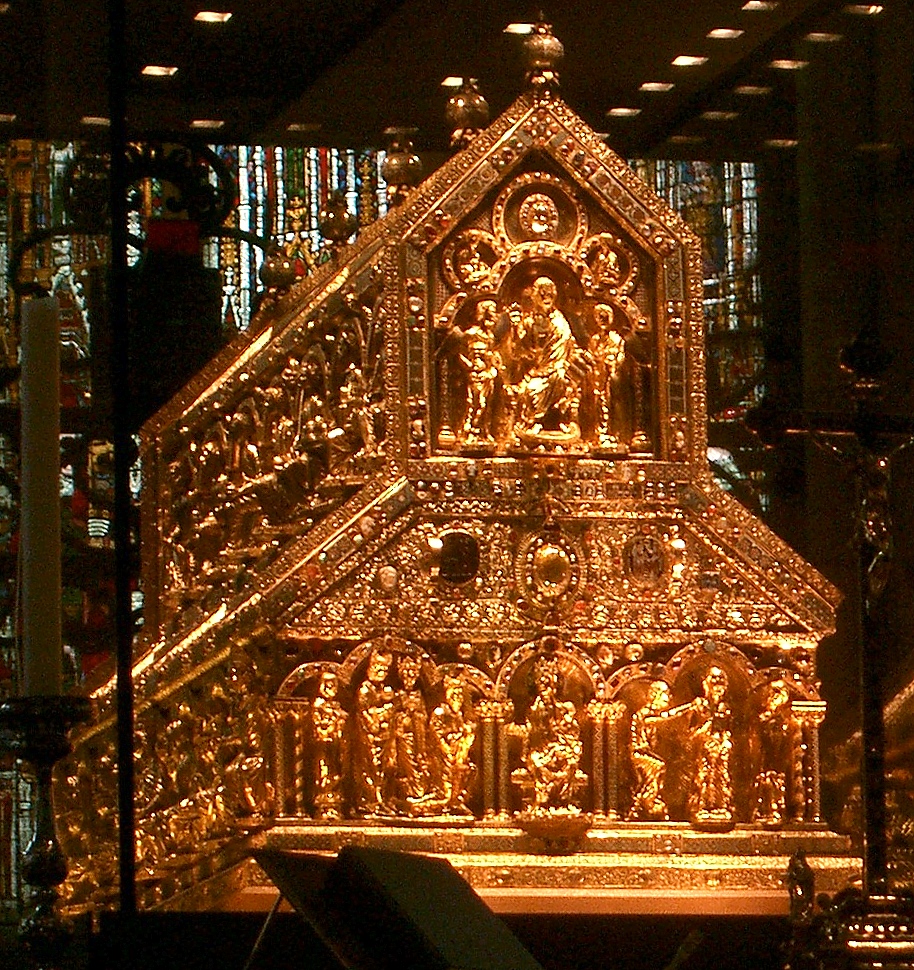
File:Köln Dreikönigsschrein.JPG

The Shrine of the Three Kings in Cologne Cathedral

Images: Wikimedia

Epiphany


To mark the Epiphany I am doing as I did on Christmas Day and reproducing, with a few emendations, a post from last year.

It is Stefan Lochner's depiction of the Adoration of the Magi, dated to c.1440-45. It forms the central panel of his triptych of the Virgin and Child with the saints of Cologne, which is in the Lady Chapel of Cologne Cathedral - a cathedral which houses the relics of the Magi. As I had used his Madonna of the Rose Bower on my Christmas Day post I thought I would reproduce his Epiphany picture, partly because I like his paintings and particularly as in it he re-uses the same image of Our Lady:


The following are notes on Stefan Lochner from the Web Gallery of Art site:
This German late Gothic painter, considered to be the greatest representative of the school of Cologne. He is known primarily for his highly mystical religious paintings.
Little is known of his early life, but he is thought to have studied in the Netherlands, possibly under Robert Campin (tentatively identified with the Master of Flémalle), whose influence is evident in the treatment of the drapery and the careful rendering of detail in what may be Lochner's earliest extant painting, St Jerome in His Cell (heirs of Edith von Schröder Collection).
Lochner settled in Cologne about 1430. The earliest work he did there was an altarpiece for the church of St Laurenz (centrepiece with the Last Judgment now in Wallraf-Richartz Museum, Cologne; the wings are dispersed). The abundance of minute observation reflects his continued interest in Netherlandish art. But in the central panel he bound the various themes into a unified composition through the use of a dominating rhythmic design.
In the later 1430s Lochner must have been in the Netherlands again, where he encountered the art of Van Eyck. The first work to reflect this influence is the Madonna with the Violet (c. 1443; Erzbischöfliches Diözesan-Museum, Cologne). Van Eyck's influence is most noticeable in Lochner's chief work, the great town hall altarpiece much admired by Dürer. In this Altar of the Patron Saints, now in Cologne cathedral, Lochner adds to the idealism of the older painters of the Cologne school with a wealth of naturalistic observation in the figures, while the sculpture-like draperies lend them a monumental dignity. In 1447 he became a member of the town council, and from the same year dates the splendid Presentation in the Temple (Hessisches Landesmuseum, Darmstadt), which was originally in St Katharinen. The exquisite Madonna of the Rose Bower (Wallraf-Richartz Museum, Cologne) was painted soon afterward.
Lochner became one of Cologne's greatest painters, combining naturalism with a masterful sense of colour and design into a festal solemnity of representation. His work forms perhaps the most successful visual interpretation of late medieval German mysticism before Grünewald. Book illumination was also done in his workshop.