Once I was a clever boy learning the arts of Oxford... is a quotation from the verses written by Bishop Richard Fleming (c.1385-1431) for his tomb in Lincoln Cathedral. Fleming, the founder of Lincoln College in Oxford, is the subject of my research for a D. Phil., and, like me, a son of the West Riding. I have remarked in the past that I have a deeply meaningful on-going relationship with a dead fifteenth century bishop... it was Fleming who, in effect, enabled me to come to Oxford and to learn its arts, and for that I am immensely grateful.


Showing posts with label Quinquagesima. Show all posts

Monday, 11 February 2013

Carshalton Revisited


Yesterday there was another of the Extraordinary Form Masses at Holy Cross Carshalton about which I have written before. David Forster and I drove up to south-west London along the A40, M40 and so via Heathrow to Carshalton through driving rain and motorway spray - well, David did the driving and I did a bit of map-reading.

We set off, and arrived earlier than previously so that we could have a traing session with other servers, and this time we had a full set of servers. This bodes well for the provision of this form of the Mass in the area, and despite the dreadful weather we had a decent number in the congregation.

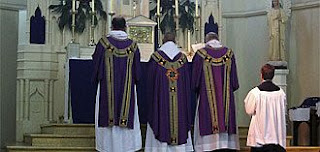
As it was Quinquagesima Sunday we had to change the hangings and vestments for violet rather than the novus ordo green, and, of course, change them back afterwards. The parish are very welcoming and the sacristan very obliging on these occasions, and those of us who go as helpers from outside feel both appreciated and also that  we are getting familiar with the church and its furnishings.

The celebrant, as in November, was Fr Alexander Lucie-Smith, the Parish Priest of Knaphill in Surrey, and who is a columnist for The Catholic Herald. 
Excellent music was again provided by Cantus Magnus, who sang music by the Franco-Flemish Renaissance composer Heinrich Isaac (c. 1450 – 1517).They are led by the organiser of the Mass Matthew Schellhorn, who is the LMS Diocesan Representative for Southwark North.
Over refreshments afterwards we were able to plan for future occasions and have a sense that there is here indeed a stable group and that these Masses are becoming an established part of the Catholic life of the area.

The rain, which was only drizzle in Carshalton, seemed to return in full force with driving sleet when we reached the motorway system - it must have been waiting for us - and it accompanied us all the way back to the outskirts of Oxford. Nevertheless we got back safe and sound and had supper before going off to our own homes. A satisfying day.

The next EF Mass at Holy Cross is scheduled for Laetare Sunday, March 10th at 5pm.


Thursday, 7 February 2013

The Season of Septuagesima


Last year I posted Septuagesima, Sexagesima, Quinquagesima about the traditional forms of the current pre-Lent season, citing posts from the New Liturgical Movement and elsewhere. In Burying the Alleluia I wrote about about the long-standing practice of suppressing the Alleluia from Septuagesima in the pre-1970 Calendar and from the beginning of Lent in the Novus Ordo.

There is an introduction to the history of the season here.

The essential commonality of practice between the Eastern and Western Churches in the matter of fasting until recent decades when the Western liturgical seasons were simplified can be seen in the articles which the New Liturgical Movement has again written about in Some Notes on the Origins and Character of Septuagesimatide (NLM Reprint) . They have also linked to their post The Question of the Septuagesima Season and the Modern Roman Liturgy: Possible Enrichment? from three years ago which has drawn some interesting comments. 

Given the discrepancy which now exists between the OF and EF Calendars as to the Pre-Lent period this is a topic which could be resolved by reversion to ancient usage or by making observance of the pre-Lenten days at least an option in the Novus Ordo. 

Having written the other day about the way Candlemas is a link, a hinge if you like, between Christmastide and Lent-Easter I am inclined to the view that the traditional Septuagesima season makes for a more pastoral and psychologically satisfying. 

There is a fine set of photographs from the blog Ars Orandi of the traditional liturgy of Septuagesima Sunday in the Extraordinary Form as celebrated at Kinkora in Ontario in 2010 here.


Tuesday, 14 February 2012

Septuagesima, Sexagesima, Quinquagesima


The New Liturgical Movement has republished one of their articles from past years about the Pre-Lent season and its origins which can be read at NLM Reprint: Some Notes on the Origins and Character of Pre-Lent (Septuagesima, Sexagesima, Quinquagesima).

Not only is this an ancient part of the Church's liturgy and something that liturgy shares with the Byzantine tradition - I have Orthodox friends who progress into Lent giving up various foodstuffs along the way Sunday by Sunday - so it can be seen to have an ecumenical as well as a diachronic function.

There are other online articles about the season here and,from the Catholic Encyclopedia, here.
https://blogger.googleusercontent.com/img/b/R29vZ2xl/AVvXsEhbOQAOlviL5iuStUvIcS4ee42AHYk1RyM10ntNGWfoBEsypmr7spV8KVBPkCPdmWv5eM6duBNegZgR6jIOhWnx8zhFetyxdxcoUGt5DQB-Mw3sjQJr23UJ80ea06ufdjJRj8uoQx0Y/s320/Septuagesima.jpg

Mass for Septuagesima in Switzerland 2007

Image:roamincatholicphiladelphia.blogspot

In this photograph the deacon and sub-deacon are wearing dalmatic and tunicle rather than the folded chasubles usual in when violet vestments were worn until the 1950s and still by some churches today. There is a well illustrated article from the St Lawrence Press blogsite which explores their origins and development and gives several modern examples of their continuing use and which can be read here.

Whilst the abruptness of the change on Ash Wednesday has a real impact on our lives the traditional idea appears to be that in the gesimas we acknowledge that we have sinned and need to do something about it. In Lent we get on and actually do do something about that fact - fasting, acts of charity, spiritual preparation, confession, penance and the like to be ready for Easter.