Once I was a clever boy learning the arts of Oxford... is a quotation from the verses written by Bishop Richard Fleming (c.1385-1431) for his tomb in Lincoln Cathedral. Fleming, the founder of Lincoln College in Oxford, is the subject of my research for a D. Phil., and, like me, a son of the West Riding. I have remarked in the past that I have a deeply meaningful on-going relationship with a dead fifteenth century bishop... it was Fleming who, in effect, enabled me to come to Oxford and to learn its arts, and for that I am immensely grateful.


Showing posts with label Malmesbury Abbey. Show all posts

Sunday, 2 July 2017

Tombstones - quaint and curious


The BBC News online website today has a post about various unusual or noteworthy gravestones.

Some are famous, such as those at Malmesbury and Winchester, but others are less well known - or indeed were unknown to me - and all have interesting, and at times, macabre, stories.

The article, entitled The headstones with unusual stories to tell, and which is illustrated, can be seen here and there are also links at the end to related articles.


Friday, 31 March 2017

Malmesbury


Today I had amost enjoyable day out with a college friend from Oriel and it was an opportunity to talk about plans and hopes for the future.

We drove westwards to Malmesbury in northern Wiltshire. I had been there once before but for him it was a first visit. Attractive and slightly intriguing town on a hill almost surrounded by the river Avon, and having parked down by the river we climbed up the hill. The town is dominated by the remains of the medieval Benedictine abbey.

There is an online account of it at Malmesbury Abbey and more from a BBC site here.
The local museum website has more about it at Malmesbury Abbey by Athelstan Museum

Today only a fragment remains of the church, that is the majority of the nave, and most of the site is accessible, although the eastern chapels have disappeared under a path and gardens. The central tower appears to have fallen as a result of a lightening strike a few years before the dissolution, hence teh fragmentary stae of the church

 Image result for Malmesbury Abbey

A reconstruction of the lost features of the abbey superimposed on the existing remains

Image: Athelstan Museum

Image result for Malmesbury Abbey

Malmesbury Abbey from the air
In the lower part of the picture is the tower and spire, all that now remains of the church of St Paul, once the place of worship for the townspeople

 Image: malmesburybells.co.uk

http://www.rareoldprints.com/swlitf/catalogue.nsf/$profile/A331C8847EE457B08025790200360D0F/$FILE/MalmesburyAbbeyPlan_Brakspear.jpg

Plan of the abbey church

Image:rareoldprints.com

The plan has been recovered of the Norman rebuilding with its later extensions eastwards. Prior to its collapse the spire, is said to have been, at 431 feet, taller than that of Salisbury Cathedral at 404 feet.

Image result for Malmesbury Abbey

A reconstruction of the chrch and the lightning strike

 Image: Athelstan Museum

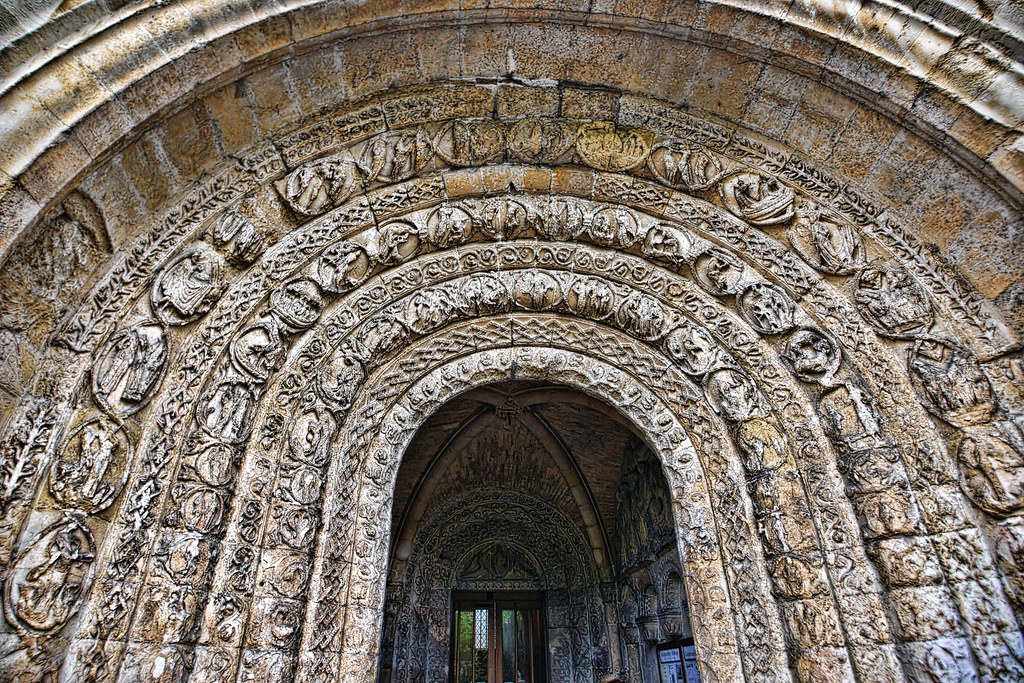
Today the especual glory of Malmesbury is the south door and porch. This is some of the most important Norman sculpture in England, encased in a late medieval outer casing. The sculpture is  sadly worn on the  outer portal but is still very impressive.

https://c1.staticflickr.com/5/4033/4619454423_77142380fb_b.jpg

 Image:staticflickr.com
Within the porch are carvings of the Apostles:


 Image:saintsandstones.net
The inner door has Christ in Majesty, flanked by angels:

Image result for Malmesbury Abbey

 Image: wikimedia commons

From what remains of the ruined west end the great west door was similar. Today this is still very striking; if it was originally painted to enhance as well as protect it the effect must have been much more intense, a powerful introduction to the House of God. This is all from a  period when Malmesbury Abbey was a leading intellectual centre, with the community including the chronicler William of Malmesbury and the house possessing a major library. This was also the era of the early eleventh century Flying Monk - Eilmer of Malmesbury

Image result for Malmesbury abbey

The church from the south-west

Image: Cotswold Info
 
Today about three-quarters of the nave survives. The exterior is a fourteenth to fifteenth century recasing, and inside Norman work with a gothic vault. It has arguable links to the design of the nave at Hereford both in respect of the arcades and the west end. Both churches added a western tower over the two western bays of the nave - and both collapsed wrecking catastrophic damage.

 http://www.malmesbury.com/media/k2/items/cache/e67ec824afbc9f855ad850f1b49c5b05_XL.jpg

The interior of the nave looking west to the Victorian west wall

Image: malmesbury.com


The church is now parochial and the layout of the interior reflected its modern Evangelical churchmanship. This was welcoming, but as my friend, who is a practising Muslim observed it felt like a Community centre. Yes - I know churches are communitues, but they are also more than that. I told him about the Februart half-term use of the nave as a skate park - andif you do not believe me look at  malmesbury abbey skate - Skate — Malmesbury Abbey

That said we did receive a friendly but not oppressive welcome to the abbey church, which was quite busy with other visitors.

We paid our respects to the fourteenth century tomb of King Athelstan (924-39) - arguably the first King of a unified England, and I saw there was an extensive number of books about him on sale.

Image result for King Athelstan tomb

The tomb of King Athelstan

Image: Athelstan Museum

The tomb was presumably rescued from the choir, and I assume his bones still lie is the destroyed part of the church. It is somewhat battered but the detail of, for examle, his shoes suggest this was once avery splendid tomb indeed.

Afterwards we looked at the very attractive late medieval Market Cross - a simpler version of the ones in Salisbury and Chichester, and about which there is more at Malmesbury Market Cross and at Malmesbury Market Cross by Athelstan Museum - and found the fine garden at Abbey House, but that was not open until tmorrow.

 Image result for Malmesbury market cross

Malmesbury Market Cross

Image: Pinterest 

After lunch - not at the pub called in honour of Eilmer The Flying Monk, which we did not find - and a further walk round this attractive and quite distinctive town we travelled back via Fairford - where we did not find space to park and enable me to show the wonderful stained glass in the church to my friend - to Lechlade, where we stopped for tea and so returned to Oxford.

A very enjoyable day out with a good friend and a good way to celebrate the anniversary of my reception in 2005 into the Catholic Church.


Monday, 5 March 2012

John Aubrey and the Printed Book


This evening I attended a lecture at the Oxford Bibliographical Society by Dr Kate Bennett on John Aubrey and the Printed Book. Dr Bennett has recently completed a new two volume edition of Aubrey's Brief Lives for Oxford University Press, and is now working on an edition of Aubrey's letters.

https://blogger.googleusercontent.com/img/b/R29vZ2xl/AVvXsEi_Zga7pPALZ4mXY3hYQMsxBg8-69dE88qjjOwA1cWQ0dgGuyThoVmY7QuGrv8msvsLsrpgHMfCPuZorguaj-Q9yPbDjhaT77UJN5QSoDanIHMjc8E_iosaq8bNlQJPTSYF-mHe-ZNwJek/s1600/John+Aubrey+%25281626-1697%2529.jpg

John Aubrey 1626-1697
A portrait from 1666.

Image: Avebury Matters blogspot

Many of Aubrey's books, with his annotations, and his manuscrpts survive in the Bodleian Library - her originally gave them to the Ashmolean - and at Worcester College here in Oxford. He spent a considerable amount of his life in and around Oxford, where indeed he is buried.

For much of his life he was peripatetic, and also impecunious, staying with friends, and leaving caches of his books and notes with them for safekeeping. In Oxford he worked with Anthony Wood, in the latter's work on the history of the University, and as an early member of the Royal Society corresponded with many of the scientifically minded pioneers of the time as well as with those with antiquarian interersts, for which he is better known.

His inspiration was partly from the ideas of Francis Bacon, but also from his childhood. He rercalled howas aboy he was a fiend of his local rector in Wiltshire who had manuscripts from Malmesbury abbey from which he used pages to stop up beer kegs, and all of which Aubrey, returning as a 21 year old in 1647, found had been irretrievably lost - the remainder had been used for scouring guns during the Civil War. Similarly he recalled paying 1/6 for abook not for the text but because he recognised the cover to be made out of a ninth-century manuscript which he wanted for its paleographic interest; the item is still there amongst his papers.

his nurse singing him ballads and thinking these ought to be preserved as potetially containing historical insights. Thus, although William Dugdale wrote to him that such sources were not worth keeping, Aubrey did so, becoming a pioneer of recording oral tradition and folk-lore. In many ways he saw the Civil War as a time not only of physical destruction but as the time when
" the Fairies were chased away." I recall that sense of nostalgia in him in the dramatisation of Brief Lives with Roy Dotrice when that was shown on television.

Aubrey's intersts, as the exhibition at the Bodleian in 2010 showed were wide - indeed as Dr Bennett said, he seesm to have deliberately avoided completion of his various and all embracing projects, because completion would lead to complacency. He was always adding to the sum of his knowledge.

He had an eye for detail both as an artist, drawing the remains of Rosamund's Bower at Woodstock and the "grot"or fantastical gardens of Thomas Bushell at Enstone nearby, or indeed commissioning the drawing of the tower of Osney abbey before it was destroyed in 1644, and for such things as the fact that his copy of John Denham's poem "Cooper's Hill" printed in Oxford during the Civil War was on brown paper, which was all that the printers could get rather than the better quality papers they were used to in London.

This was a thoroughly enjoyable talk about a really rather endearing character - I once had the idea of establishing a dining society in his honour for like-minded freinds, but it was one of those ideas that never got beyond being just that - so, I suppose, it was very Aubrey-like.

My previous posts on John Aubrey can be se en at John Aubrey and at An Italian garden in seventeenth century Surrey.


Thursday, 5 August 2010

The Flying Monk

Having put the article about Charles Waterton and his attempts to fly on the blog yesterday I looked at one of the links attached to it, that about Eilmer of Malmesbury, and thought I would also re-cycle that and add a few observations of my own. This is what The Lion And The Cardinal has:

EARLY CATHOLIC AVIATORS, part I: EILMER of MALMESBURY


Dr. Richard P. Hallion:
The first known serious flight attempt in world history occurred about a thousand years before the Wright brothers, in western England. Then, a young Benedictine monk leapt with a crude pair of cloth wings from a watchtower of a church abbey at the beginning of the 11th century. This monk, known to history as Eilmer of Malmesbury, covered a furlong - a distance of approximately 600 feet - before landing heavily and breaking both legs. Afterwards, he remarked that the cause of his crash was that he had forgotten to provide himself with a tail.

We know of Eilmer's attempt through the writings of a historian, William of Malmesbury, who mentions the flight in passing. Of more interest to William was that Eilmer, late in his life, was the first person to spot a comet which people then credited as being an omen of the Norman invasion of England by William the Conqueror.

Eilmer typified the inquisitive spirit of medieval enthusiasts who developed small drawstring toy helicopters, windmills, and sophisticated sails for boats. As well, church artists increasingly showed angels with ever-more-accurate depictions of bird-like wings, detailing the wing's camber that would prove crucial to generating the lifting forces enabling a bird - or an airplane - to fly. This climate of thought led to general acceptance that air was something that could be worked. Flying was thus not magical, but could be attained by physical effort and human reasoning.

Eilmer was an individual of remarkable daring and boldness. He leapt from the top of a tower, passed over a city wall, descended into a small valley by the River Avon, and then fell into a marshy field fully 150 feet lower than the point of his leap. Of his wings, we can surmise that they were constructed of ash or willow-wand, covered with a light cloth, and perhaps attached to pivots on either side of a back-brace, with hand-holds so he could hopefully flap them.

Given the geography of the Abbey, his landing site, and the account of his flight, he must have remained airborne about 15 seconds. At low altitude he apparently attempted to flap the wings, which threw him out of control. His post-flight assessment qualifies him as the first test pilot, for he sought to understand, in technological terms, what happened on the flight and why he crashed. Malmesbury exists today, much changed and quite quaint, near Swindon and Bristol. The Abbey features a stained-glass window of Brother Eilmer. Alas, a nice pub named The Flying Monk is no more, replaced by a shopping centre.


To this I would add the following thoughts. First, it is good to see a piece about the Flying Monk which treats him seriously, and not as just another lovable medieval monastic eccentric.

Secondly I think we must see Eilmer, who from his comet observation in 1066 clearly continued to be interested in scientific matters. He appears to belong to that English tradition in the eleventh and twelfth centuries that showed a remarkable interest in scientific observation, and which was concentrated in the western Midlands and the south west. Thus Adelard of Bath (c.1080- c.1152), a seeming polymath who traveled widely on the continent, about whom there are links here and here, or the monks of Worcester cathedral who were making drawings of sun spots in the early years of the twelfth century, or the observational interests of the canons of Hereford at the same time - and not least there the activities of Dinah, the lady astronomer who calculated by trigonometry the height of the cathedral tower - and that in the reign of King Henry I. This topic is introduced and developed, with classic elegance, in Sir Richard Southern's "Robert Grosseteste" (OUP).

So Eilmer the Flying Monk may have made history as the first recorded individual to have actually flown - but he should also be seen as part of a lively intellectual and practical tradition that witnesses to the vitality of his age and country.


Tuesday, 15 June 2010

Envisaging the past


The other day I reproduced a reconstruction of the monastic buildings at Dorchester by Dominic Andrews from his site www.archeoart.co.uk .

This is a very attractive source of historical reconstructions. I have always been drawn to such workd, and as a boy used to attempt drawings of the castle, priory, and other vanished buildings in my home town - as the title of the blog says, once I was a clever boy...but enough about me.

Here are one or two more examples of Dominic Andrews' work, chosen because they reflect my own high medieval enthusiasms - there are many more on his site from earlier and later periods.

Lewes castle in Sussex, in 1340, looking northwest


Clun Castle, Shropshire, seen around 1300. © English Heritage


In the sixteenth century, Malmesbury Abbey in Wiltshire was stuck by lightning, causing the spire and tower to fall and demolish half the church.


The 431 feet tall spire, taller than that of Salisbury cathedral (404 feet), and the tower it was built upon, collapsed in a storm around 1500 destroying much of the church, including part of the nave and the transept. The choir was a casualty of the dissolution of the abbey. The west tower fell around 1550, demolishing the three western bays of the nave. This was probably due in part, as with the west tower of Hereford cathedral which collapsed in 1786, to it having been up on pre-existing arcades and walls rather than from the ground on solid foundations. As a result of these two collapses less than a half of the original building stands today. The white part on this other reconstruction drawing shows how much, or perhaps one should say how little, survives of the abbey church today, and can be compared with the photograph of the building:


File:Malmesbury.abbey.drawing.arp.jpg


All of which makes one realise something of what we have lost since the medieval period, which is, of course, an aim of artists who do such work.