Once I was a clever boy learning the arts of Oxford... is a quotation from the verses written by Bishop Richard Fleming (c.1385-1431) for his tomb in Lincoln Cathedral. Fleming, the founder of Lincoln College in Oxford, is the subject of my research for a D. Phil., and, like me, a son of the West Riding. I have remarked in the past that I have a deeply meaningful on-going relationship with a dead fifteenth century bishop... it was Fleming who, in effect, enabled me to come to Oxford and to learn its arts, and for that I am immensely grateful.


Showing posts with label King Edward II. Show all posts

Tuesday, 24 June 2014

Bannockburn


Today is the 700th anniversary of the battle of Bannockburn in 1314. There can be little doubt that this was one of the most significant battle sin not only Scottish history, but in British history. Not only did it ensure Scottish independence in the early fourteenth century it created the conditions for that independence, or national identity, to become a continuing reality. 

The battle, and its memory, indeed its myth, became part of Scottish identity, and that has meant teh survival of a distinct Scots polity. Union with England both in the person on the monarch in 1603 and of the parliaments in 1707 did not involve the loss of national identity, of institutions and structures, of law and religion. I may regret that some aspects of Scottish history and life and not like those here in England - I distictly prefer Anglicanism to Calvinism for example - but they are facts of history. They are in part consequences of Bannockburn.

For England, especially for the northern counties, the defeat was a continuing disaster, with Scottish raids deep into Yorkshire. In 1319 the Scots reached the central part of the county, and may well have wintered in the Morley wapentake, and both sides of the border became areas of conflict and raiding with long term consequences both aggravating and aggravated by the European famine of 1315-17 - these were grim years indeed.
As someone of, so far as I know, entirely English ancestry I can respect the Scots identity and the achievement of King Robert I and his supporters. The Scottish fact adds to the rich history and diversity of the United Kingdom. Both of the ancient kingdoms that became Great Britain in 1707 have had and continue to have much to offer each other in their union. So I can reflect historically on the events of 1314, respect the Scots achievement in the decades following, and remain firmly of the opinion that moderrn "independence" for Scotland would be a disaster. It is understandable, but regrettable, that the SNP administration in Edinburgh has managed to hold the referenduim this year - I think at one point they actually sought to hold it today - and to obscure the proper historical understanding of Bannockburn. Historical sentiment and political sentiment can be dangerous bedfellows.

There is an online account of the battle at Battle of Bannockburn, and the BBC today has an illustrated piece about it which can be viewed at Battle of Bannockburn: What was it all about?.

Their website also has an interesting piece entitled Oldest surviving' Bannockburn manuscript restored which is about a copy of 1478 at St John's College Cambridge of John Barbour's The Brus, originally probably written circa 1375.

Given the extensive loss of life at the battle one way to commemorate it would be to pray for the dead of that day and for all who fought there.

Saturday, 7 June 2014

King Robert I

Today is the 685th anniversary of the death of King Robert I of Scots.

Robert the Bruce (Brus) or, as he became in 1306, King Robert I of Scots, was born on 11 July 1274, almost 740 years ago. As King of Scots from 25 March 1306 until his death, although not recognised as such by the English until 1328 and the Treaty of Northampton, he is arguably the greatest, and certainly one of the greatest of Scottish monarchs. His assertion of independence, his victory at Bannockburn in 1314, the writing by his nobility of the Declaration of Arbroath in 1320, and his successful campaigns against King Edward II in the north of England ensured the survival of Scotland as an seperate kingdom. The grant by Pope John XXII to him of the right for his succcessors to be anointed as monarchs was a further expression of sovereignty, and in advance of several other European kingdoms.

That said the events of the early fourteenth century should perhaps be looked upon with caution in making decisions about Scottish independence today in the twenty-first century. unity in diversity after so long aperiod of Union seems the right answer to me. Nonetheless without King Robert I the Scots (and, to the extent they are paying any attention at all, the English) would not be having the current debate about Scottish independence. It was King Robert, and not the semi-terrorist Wallace - the utterly appalling film Braveheart notwithstanding - who forged or reforged the national identity of his kingdom.

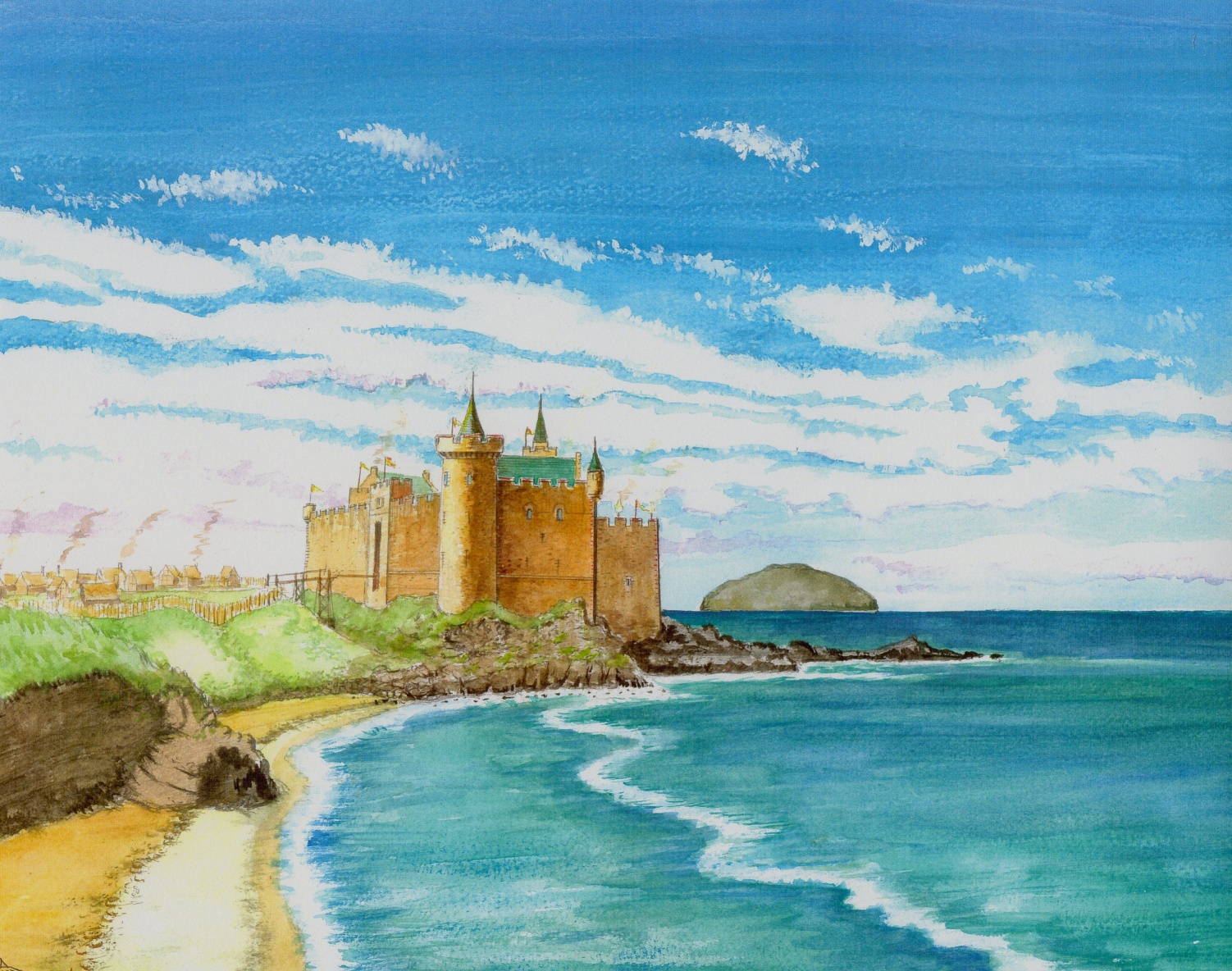
He was the son of Robert Bruce, 6th Lord of Annandale, and Marjorie, Countess of Carrick, and was born at Turnberry Castle. Although it is unknown whether Turnberry Castle is his actual birthplace, the fact that he spent his boyhood residing in the castle is not in doubt. Little now remains of the castle, its few stone smarked by the lighthouse which is a landmark near the golf course at Turnberry.


Reconstruction of Turnberry Castle. 
Click on the images to view full-size.  Copyright:Andrew Spratt.
Images:Maybole.org 

There is more about the castle and its history from the same website which can be viewed here.

The King's last years were marked by illness, and from a cast of his skull, found in 1818, at Dunfermline where he was buried a scientist, Richard Neave, has recreated the closest ever likeness of Robert the Bruce. This reveals the leprosy ravaged face of the warrior King Robert I at the age of 55, just before his death. It shows how the condition destroyed the cartilage in his nose causing it to collapse, and also shows a huge wound down his skull, fractured bones around the eye and a toothless mouth.


A facial reconstruction of King Robert I

Image:yannatry.blogspot.com

Cast of Robert's Skull, Dumfries Museum


Cast of the King's scull - Dumfries Museum


Image: undiscoveredscotland.co.uk


The King died at his manor house at Cardross near Dunbarton on the Firth of Clyde and his body was buried at Dunfermline Abbey, the shrine of St Margaret of Scotland, but his heart was removed and was to be taken on Crusade by Sir James Douglas, before eventually being buried at Melrose Abbey.

The link National Museums Scotland - Robert Bruce has expandable images of the King's Great Seal, of some of his coins and of artifacts associated with him and of fragments of his original tomb from Dunfermline.

Robert's Tomb, Dunfermline Abbey Church

The modern tomb of King Robert I at Dunfermline Abbey
Image: undiscoveredscotland.co.uk 


Friday, 21 September 2012

King Edward II


Today is the 685th anniversary of the date traditionally given as that of the murder of the deposed King Edward II at Berkeley castle.
 
EdwardEffigy 291x300 Effigy of Edward II
 
The eeffigy of King Edward II at Gloucester
 
Image:theplantagenets.com
 
I am reliably informed that the method used - a red hot poker - comes from only one chronicle, and that one which rather liked to record deaths which peculiarly matched the life of the deceased, so maybe there is poetic, if gruesome, imagination at work here. Nevertheless the red hot poker is now firmly entrenched in the popular view of his death.
 
My college of Oriel was founded (strictly speaking refounded in his name) by the King in January1326 and we commemorate him as "our memorable founder" in the College prayer. According to college gossip (so it must be true) a few years ago there was a serious discussion in the Governing Body as to whether it was appropriate for the college to have the plant kniphofia - commonly known as Red Hot Pokers - growing in Garden Quad. I am pleased to say that the plants survived, and still, I think, flower in Oriel. 
 
On a more serious note in recent years a number of medieval historians have questioned whether or not King Edward was murdered and have inclined to the idea, noted in the fourteenth century, that he was conveyed out of the country and died many years alter in Italy. Ian Mortimer in his books on Roger Mortimer and on King Edward III writes about the matter.
 
I am not sure what I think - I respect the arguments advanced, but there are so many stories of royal prisoners escaping death on the battlefield or in prison from King Harold II surviving Hastings and ending his days as a hermit at Chester through King Sebastian of Portugal to King Louis XVII, and from Emperor Alexander I of Russia retreating to a hermitage in 1825 and to the career of Anna Anderson in the twentieth century posing as the surviving Grand Duchess Anastasia, all of which appear  to be at best the triumph of hope over grim reality, or simply fradulant.
 
As a result I rather fear that King Edward did not survive his time in Berkeley, but there may be more to be understood of a period when a lot of people would have been hedging their bets.
 
The reign of King Edward II has attracted a vast amount of scholarly attention, and retains its fascination as a period, with its clashes of personalities, its political upheavals and the insights it affords into medieval government.
 
One topic which may not have attracted as much attention is the matter of the King's beard. His very fine, if somewhat damaged, tomb effigy at Gloucester, erected a few years after his death, shows him with a luxuriant and splendidly curling beard. It has to be said that the very fine, but much less well known label-stop portrait of the King in the nave of St Albans, along with probably the best surviving one of Queen Isabella, suggests a less elaborate decoration of the royal chin. Nonetheless it is the Gloucester image which predominates in later representaions.


King Edward II
 
Image:piersperrotgaveston.blogspot
 
This begs the question - it it just the skill of the carver we are seeing, or is it the skill of the royal barber? The King's red, curling hair falls in ringlets in his moustache and beard such as to suggest the use of curling tongs, or did he sleep with curling papers in his beard? Both suggest a side of the King's toilette which gives pause for thought. Royal hairdressing over the centuries has often been a demanding art.
 
edward.ii .3.full  300x225 Edward II

The King's effigy in profile

Image:theplantagenets.com
 
Whatever the exact date or nature of the King's death as a historian and as an Orielensis I remembered King Edward II in my intention at Mass this evening.

Tuesday, 19 June 2012

Piers Gaveston


Today is the seven hundredth anniversary of the death, by decapitation, of Piers Gaveston on Blacklow Hill outside Warwick in 1312.

The connections of his death to the Oxford area are strong. He was seized from the rectory at Deddington, where he had been left under guard by the Earl of Pembroke, on the night of the 9-10 June, and taken for trial at Warwick by the Earl of Warwick. After his death his body rested for two years at Blackfriars in Oxford prior to its reburial at King's Langley.

There is an introduction to his life and death, and the historical debates about them, here.

The recent Oxford Dictionary of National Biography life by J.S.Hamilton, whose book on Gaveston was published in 1988, can be read here.

File:Gaveston Cornwall charter.jpg

The 1307 grant to Gaveston of the Earldom of Cornwall.
The arms are those of the King and below those of Piers and his wife Margaret de Clare, the King's neice (Or, three chevrons, gules).
The surrounding birds are Gaveston's eagle and the Cornish chough - still a badge of the Duchy of Cornwall.

Image:Wikipedia


There is no surviving contemporary portrait or indication of his appearance. One of earliest depictions, and it is in no way contemporary, is this one from the late fifteenth century Rous Roll showing Guy, Earl of Warwick (1272-1315) standing on Gaveston's corpse:

http://www.historytoday.com/sites/default/files/gaveston.jpg

Image:historytoday.com

In preparing this post I came across the blog Edward II which has agreat deal of information about the reign, and which I am adding to the sidebar. Apart from a biography of Piers it also has posts such as this one Nineteen things you never knew about Piers Gaveston


There is also a blog devoted to Gaveston himself at Piers Gaveston, and I found an illustrated blog post about him which can be read here.


In contemporary Oxford there is, of course, the Piers Gaveston Society - about which you can read something here.

The Piers Gaveston Ball, usually held about this point of the end of Trinity Term is, well, fairly notorious. Watching those who are attending gathering in Oriel Square on a summer evening - now that is one of the sights of Oxford, and not one for the faint-hearted... A few years ago I used to invite friends around on the evening of the Piers Gaveston Ball to the splendid first-floor view offered by Oriel MCR of the goings-on in the square below. There were some pretty amazing costumes which were more (or less) being worn.