Once I was a clever boy learning the arts of Oxford... is a quotation from the verses written by Bishop Richard Fleming (c.1385-1431) for his tomb in Lincoln Cathedral. Fleming, the founder of Lincoln College in Oxford, is the subject of my research for a D. Phil., and, like me, a son of the West Riding. I have remarked in the past that I have a deeply meaningful on-going relationship with a dead fifteenth century bishop... it was Fleming who, in effect, enabled me to come to Oxford and to learn its arts, and for that I am immensely grateful.


Showing posts with label Irish royal arms. Show all posts

Sunday, 17 March 2013

An Irish version of the Royal Arms


The arms of the Kingdom of Ireland as used from its designation as such in 1541-2 have been, with a varient of gules three harps or used during part of the reign of Queen Elizabeth I, azure, a harp or stringed argent, which appears to derive from a thirteenth century precedent, as explained here.  From the time of King James I there was also a crest of a tower with a white hart issuing from it - possibly references to Dublin Castle itself and to King Richard II's visits to Ireland.
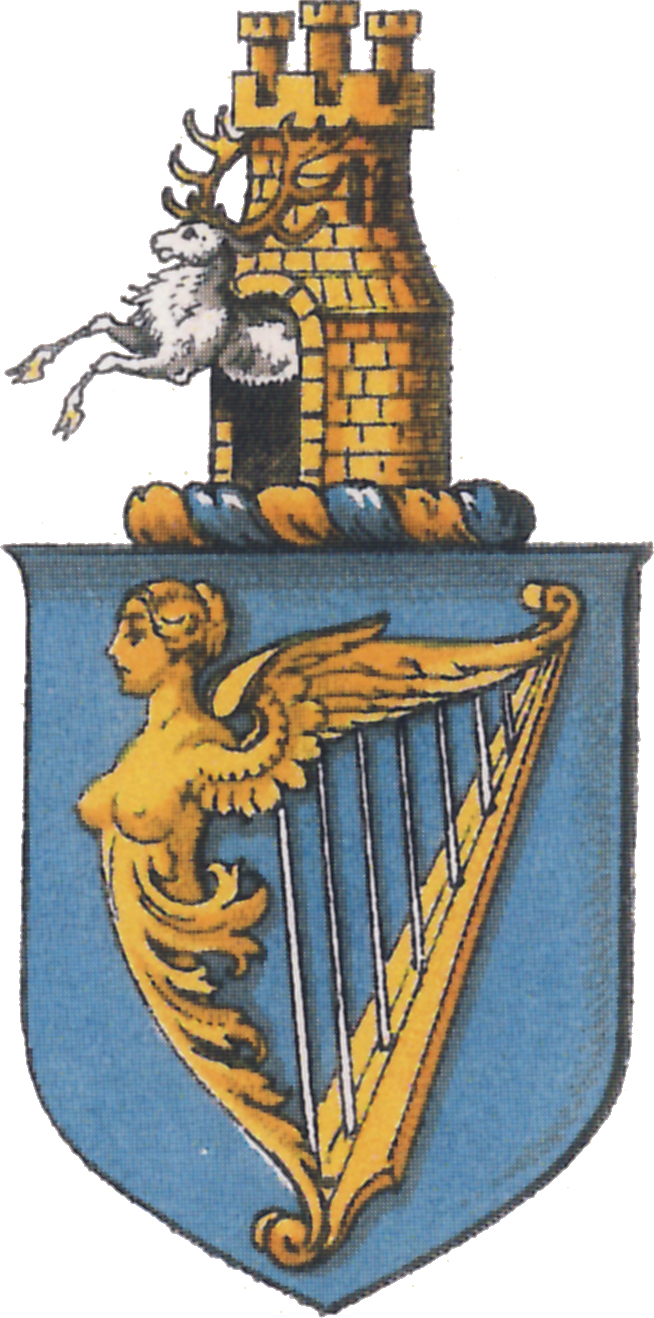
File:Ströhl-HA-LI-Fig. 04.png

The Arms of the Kingdom of Ireland as used from the accession of King James I

Image:Wikipedia

This coat of arms, often crowned rather than with the crest appeared on buildings in Dublin and elsewhere in the period before the Union of 1800-01. Since 1603 the Irish arms have been quartered in the Royal Arms as borne by the Sovereign, together with the arms of the English and Scottish Kingdoms  - there is an illustrated outline history of these arms here.

Unlike Scotland Ireland did not have an officially recognised version of the Royal Arms appropriate to itself which gave precedence to the kingdom. This tradition was recovered or reasserted in Scotland  for the visit of King George IV, and can still be seen both in shileds of arms and the tabards of the Lord Lyon and his Court. In Ireland, by contast, and presumably as a consequence of the long dependency of Ireland upon the English Crown the English version of the Royal Arms was used on shields and for the tabards of the Ulster King of Arms and his assistants.

However there were attempts to produce an Irish version. I have seen, many years ago, in a book on Dublin a photograph of a painted fanlight with the Royal Arms depicted with the Irish quarter first and fourth, England in the  second and Scotland in the third, and I am told by a friend that a similar shield is to be seen on one of the banks in Belfast. A third example is on the reverse of a pattern double florin for use in Ireland produced to mark Queen Victoria's visit in 1900 - this has four seperate shields for the three kingdoms, and two of them are Irish.

When the Irish Free State established its own seals in the 1930s, the "Fob Seal" used on letters of credence  varied the British arms by having the harp in two quarters - this is of course from the era of the External Relations Act prior to 1949.

If the constitutional settlement of Ireland had worked out differently during the twentieth century I can imagine that an Irish version of the Royal Arms might well have been adopted and used when appropriate. Recently I found this rather handsome version of the arms, although I would marshal England in the second quarter and Scotland third, and not as the artist has here with Scotland in the second and England in the third quarter. That notwithstanding it is a fine piece of work, and looks very handsome with the collar of the Order of St Patrick encircling it:


Small Royal Coat of arms with St Patrick Order collar photo SmallRoyalCoatofarmswithStPatrickOrdercollar.png

Image: oren_neu_dag on photobucket


There are other design possibilities from a heraldic enthusiast in Northern Ireland about such an achievement of arms here.

Wednesday, 21 September 2011

The Irish Presidency


The contest for the Presidency of the Irish Republic appears to be hotting up. The election itself is due on October 27th.

Now as an ardent Monarchist this might at first sight be of little concern to me, save for a sadness that such a post exists at all. I was, however, once assured by an Irish historian that a friend of his had conclusively demonstrated that the 1936 legislation to enact the abdication of King Edward VIII in Ireland had been incorrectly framed, so that he remained King of Ireland until his death in 1972, when the Crown of Ireland automatically descended to his neice, H. M. The Queen....

Meanwhile, and this is the point of this post, my friend Dr Ray Burke, an Orielensis whose doctorate was on Matthew Arnold and the Celt - and whose family from Mayo are from the republican tradition, wrote letter to the Irish Times in the wake of Her Majesty's visit to Dublin. The newspaper did not publish it, but in their default, and at his request, I will:


Queen Elizabeth for President of Ireland, anyone?
To: lettersed@irishtimes.com
Date: Thursday, May 26, 2011, 1:11 PM

Dear Sir,

I've just had the most brilliamt idea. Why should n't the Oireachtas get together and nominate The Queen as President. I'm sure the other candidates would defer to this idea, which would (if she accepted) at a stroke achieve a United Ireland and the goal of the original Sinn Fein, a Dual monarchy.

We wouldnt have to give up our sovereignty and she would n't have to come over to us that often. We could even have a Viceroy in ARAS an Unachtarain, there are enough sub Queens and drama Queens of all genders running around who would accept that office. She also speaks Irish with a better blas than most of our native politicians,.

I'm serious. It would be a symbolic gesture which would be appreciated by all Unionists , southern and Northern. It would n't undermine our Republic since she would be an elective Head of State. We would n't even have to rejoin the Commonwealth, which would be tedious and messy.It would allow us to move a step towards Unionism in achieving a United Ireland, instead of trying to bomb and ethnically cleanse our way, or simply allowing demographics to do our work for us. We talk about Unionism in the North recognising the symbols of Irish nationalism, but what about the reverse?

God Save the Queen, a hUachrtarain na hEireann.


Yours sincerely,

Raymond Burke

All interested email raymondburke@yahoo.com


A 19th century drawing of the arms of Ireland

The arms of the Kingdom of Ireland
as used from the early seventeenth century

Image: Wikipedia

Friday, 13 August 2010

Blenheim Palace

This morning I led a small group from a summer school here in Oxford on a tour of Blenheim Palace. As it turned out today is the anniversary of the battle in 1704, so it was a very suitable day on which to make a visit.

It is a while since I had visited Blenheim, and the whole business of welcoming visitors has expanded, but what was on offer was very well done, and the Palace is impressive, if very much a self conscious national monument - indeed that fact lay at the root of many of the disputes over its construction. It is grand, but impersonal. When the ninth Duke commented about the way the monument of the first Duke dominates the chapel "Here we worship Churchills" he was not far wrong. Of course such a complex building has to be understood in terms of the social norms which dictated its plan, and how these have changes - the rooms were designed for rather different functions than those they present today. I enjoyed this visit more than my previous one - but I would still say there are many more appealing grand houses of families of similar prominence. Nonetheless worth saying you have seen it.

One thing I regret is that there is nothing left of Woodstock manor. Apparently Vanburgh wanted to preserve the remains, but the formidable Duchess Sarah insisted upon their removal. From what I have gleaned from the Victoria County History volume for Woodstock it was a substantial complex, and presumably with features from the twelfth to the sixteenth century. A great loss. I am surprised the site has never, so far as I know, been excavated.

Looking round houses such as Blenheim it is often the not so obvious things which stay in the mind. Yesterday these included family photographs of Winston Churchill and other members of the family sitting and talking on the steps of the great entrance circa 1901 - a reminder that this was (and is, I suppose) a family home. There were also the three sheets of the Letters Patent of Queen Victoria appointing the seventh Duke as Lord Lieutenant of Ireland in 1876, all three bordered with the floral badges of the Monarch, and at the top the Royal Arms flanked by the English and Irish Royal Crests - the latter comprising the castle tower with the white hart emerging. Not as good heraldic art as you would get in the twentieth century, but a reminder of the ancient linkage of an undivided Ireland to the Crown.

Amongst the portraits two struck me - one of the first Duke's sister Arabella, mistress of the future King James II and VII and mother of, amongst others, the Jacobite Marshal Duke of Berwick, and the other, perhaps booty from the war which brought Marlborough to such prominence, a state portrait of King Louis XIV, seated in his robes of state and holding the royal sceptre and the Main de Justice. This is not the only portrait of the King at Blenheim - there seems to have been a pleasure in displaying images of the great adversary.