Once I was a clever boy learning the arts of Oxford... is a quotation from the verses written by Bishop Richard Fleming (c.1385-1431) for his tomb in Lincoln Cathedral. Fleming, the founder of Lincoln College in Oxford, is the subject of my research for a D. Phil., and, like me, a son of the West Riding. I have remarked in the past that I have a deeply meaningful on-going relationship with a dead fifteenth century bishop... it was Fleming who, in effect, enabled me to come to Oxford and to learn its arts, and for that I am immensely grateful.


Showing posts with label Hans Memling. Show all posts

Saturday, 27 December 2014

Feast of St John the Evangelist


As with my previous post I am republishing with some emendations a post from three years ago to mark this feast day.

I have always identified St John the Evangelist as my name-saint - being a bit squeamish it is probably because he was the one Apostle not to be martyred - and perhaps also because the medieval Cluniac priory in my home town was under his patronage. Anyway I do rather like the mystical theological approach to faith. That said and thinking about it as I get older I think I should maybe identify with St John the Baptist and indulge in my urge to tell the brood of vipers what I really think, and go round preaching repentence - but I do want people to like me, so maybe not...

St John the Evangelist has not, to my mind, provided the inspiration for artists that the Baptist has. Too often he is depicted as a long haired, rather effeminate young man, and not really the mystical theologian of the New Testament texts, still less one of the Sons of Thunder with a pushy mother...

This painting by Memling is rather better in conveying something of the meditative quality of St John, and anyway it is late medieval and therefore, ipso facto, good.

St. John The Evangelist

St John the Evangelist
Hans Memling c.1430 -1494

Image: artexpertswebsite.com

Here are both St John the Baptist and St John the Evangelist in the same artist's Mystic Marriage of St Catherine from the St John Altarpiece of 1474-79 which is in Bruges - the other female saint in the composition is St Barbara:

The Mystic Marriage Of St. Catherine Of Alexandria (central panel of the San Giovanni Polyptch) - Hans Memling - www.hansmemling.org


Here is Memling's panel from the same altarpiece showing St John on Patmos:

St John Altarpiece (right wing) 1474-79 - Hans Memling - www.hansmemling.org
 
 
There is great charm and delicacy in Hieronymous Bosch's 1485 painting of St John on Patmos:

http://stjohnleonia.org/parish/images/stories/church/stjohn.jpg

Image:stjohnleonia.org

Although there is something in this image of the nice young man from Sotheby's or Christie's holding up an object at an auction, and it is a really rather splendid chalice, there is more of both youthful impetuousness and conviction as well as the intensity of devotion and of mysticism in El Greco's paintings of him, as here:

http://www.southbear.com/stjohn3.jpg

Image: southbear.com


One of my regular readers commented on the post as follows about St John:

[He was p] erhaps just bar-mitzvah'd or whatever the expression is and thus qualified to make up the quorum in the synagogue.That would mean his walking alongside Christ from the ages of, say, 13-16: a deeply impressionable time in any young man's life. It would mean his having been born about A.D.20, and give him ample years in which to reflect, and would strengthen the claims of the early Fathers for his having lived into the second century.

That view of St John strikes me as very credible - teenage enthusiasm making him and his elder brother the brash Sons of Thunder, and, who knows, were they smug or acutely embarrassed by their mother's pursuit of places of honour for them under the seemingly impending new dispensation? There is also the youthful lack of fear that led him, alone of the Apostles, to stand (did he steal there against the advice of older voices, unable to stop himself ?)  at the foot of the Cross with Our Lady, and to rush off  with and out-run St Peter in going to the empty tomb, yet still with the youthful hesitancy to stand outside peering in. Add to that innate spiritual insight and a profound rapport with Our Lord and the Gospel account of him makes for a very believable portrait.

St John, pray for me


Monday, 1 September 2014

St Giles in art and devotion


Today is the feast of St Giles, and having been baptised in and spent years around a church dedicated to him, and about hich I wrote this time last year in St Giles in Pontefract. He is a saint for whom I have a particular interest and devotion.

 File:Saint Giles closeup.jpg

St Giles
Altarpiece by The Master of St Giles circa 1500
Detail from the painting in the National Gallery

Image: Wikipedia

There is an online summary of the legends about him here - the time scale and setting are not that well recorded - and also about the widespread devotion to him.

I have posted about him previously in St Giles, in St Giles by Thomas of Coloswar about a medieval Hungarian painting, in St Giles about his depiction in medieval glass in Wells Cathedral and in St Giles and his shrine.

I imagine that it was the placing of that shrine, one of the assembly points for the pilgrimage to Compostella, that led to the diffusion of the cult of St Giles, both along the route to Galicia and on the return to pilgrims' home countries; St Giles entered the bloodstream of the cult of Santiago. That was a cult which was supported by and supported in return the expansion of the Cluniac vision, and coincides at least with the spread of  devotion to St Giles to England after the Norman Conquest, as well as eastwards to Hungary and Poland.

Bty the later middle ages St Giles was accounted one of the Fourtenn Holy Helpers - and was indeed the only non-martyr amongst them - and frequently appears in devotional images in north-western Europe. Thus there is not only the great work - now sadly disassembled  - by the Master of St Giles, but also by artists such as Hans Memling (c1430-1494), about whom there is an online article here.


http://upload.wikimedia.org/wikipedia/commons/1/13/Hans_Memling_005.jpg

St Giles
Figure on the righthand wing of the Passion Altarpiece in Lübeck
Hans Memling 1491

Image; Wikipedia

His cult appears to have rather declined in the post-Tridentine world, yet he remains apopular patron saint of medieval churches in England. These often represent links to his story or patronage - hospital foundations, especially for the lame, or places linked to metal working or in forest areas.


St Giles on the right with St Maurus of Glanfeuil on the left flank St Christopher
The Tripych of William Moreel
Hans Memling 1484
Groeningemuseum Bruges

Image: Wikipedia

St Giles pray for us


Tuesday, 8 May 2012

The apparition of St Michael the Archangel


Although September 29th is the principal feast day of St Michael the Archangel today is the feast that commemorates his late fifth century apparition at Gargano on Adriatic coast of Italy - the spur of Italy - and the geginning of devotion to him there. It is said that the sanctuary dedicated to him there is the only church not dedicated by a bishop but by the Archangel himself - although a similar story was told in the middle ages of Westminster Abbey being consecrated by St Peter himself during a nightime visitation.

The feast of the Apparition entered the Roman Missal as aunversal feast with Pope St Pius V in 1570, but does not occur in the 1970 Missal.

There is an online article about the sanctuary here and there is another article about the Gargano peninsula here. The official website of the Sanctuary can be opened here.

Something of the theology and history of the cult of St Michael can be read in this online article.

Coincidentally Prof Georgi Vasilev of the State University of Library Studies and Information Technologies in Sofia Bulgaria recently posted on the Medieval religion discussion group some extracts from medieval apocrypha (basically coming from East) including the  "Apocryphal oratione of St. John Chrysostom how Michael, chieftan of the celestial army defeated Satan" which is rather popular. Here is a brief citation from the old Bulgarian version (the original source is Greek):
:
After Gabriel fails to sum up courage to fight with Satan, the Lord forgave Gabriel and again said unto Michael: ‘You were first in the kingdom of Adam, who proceedeth from me, and it is thine today to go down to that vile antichrist and take from him the heavenly mantle, the crown and the sceptre of  angelic orders, which he stole from Me. And divest him of his beauty and glory so that his servants see who the Father is.”(Bulgarskata literatura i knizhnina prez XIII vek, p.151)

and from the Apocryphal text "The Tiberiad Sea":
And God sent Michael to Satan. And Michael went but was scorched by Satan and returned to God and said ‘I did what You sent me to do but the fire of Satan
fell unto me.’… And Michael came and struck Satan with the sceptre and threw him down
with all his army. And they fell three days and three nights like drops of rain. (Stara bulgarska literatura.I. Apokrifi, p.32 )

As Prof Vasilev points out this image is used by John Milton in Paradise lost. In his interpretation Messiah (Christ) is send by God instead of Michael:

Raphael continues to relate how Michael and Gabriel were sent forth to battel against Satan and his Angels. The first Fight describ’d: Satan and his Powers retire under Night: He calls a Councel, invents devilish Engines, which in the second dayes Fight put Michael and his Angels to some disorder; But, they at length pulling up Mountains overwhelm’d both the force and Machins of Satan: Yet the Tumult not so ending, God on the third day sends Messiah his Son, for whom he had reserv’d the glory of that Victory: Hee in the Power of his Father coming to the place, and causing all his Legions to stand
still on either side, with his Chariot and Thunder driving into the midst of his Enemies, pursues them unable to resist towards the wall of Heaven; which opening, they leap down with horrour and confusion into the place of punishment prepar’d for them in the Deep: Messiah returns with triumph to his Father.
(Paradise Lost, Book VI. The Argument)


By another coincidence I am reminded of a conversation last week with someone who was asserting that there had beena feminization of religion in the nineteenth century, and cited in evidence religious art. Setting apart bad religious art - and of that there was a lot produced then - I disagreed strongly as to the dating of the changes in iconography he had in mind, as well indeed with his whole argument.

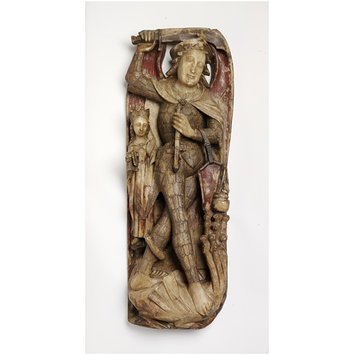
Had I thought I should have drawn attention to the image of St Michael. Long before the Baroque, let alone popular religious art such as many prayer cards, the Archangel was often depicted as a rather androgynus figure. Thus, in examples drawn from my own particular period of interest and enthusiasm, one can find many examples of this, although in this English alabaster of 1430-70 he appears very robust attacking the dragon of evil whilst weighing souls:

http://media.vam.ac.uk/media/thira/collection_images/2009BY/2009BY4615_jpg_ds.jpg


Image: Victoria and Albert Museum

However contemporary art from Catalonia and the Netherlands suggests a more complex angelic personality. Here is a small selection of such images chosen from a great wealth of such examples from both regions:

http://farm3.staticflickr.com/2680/4103333308_ed15ec18f3_z.jpg

Saint Michael the Archangel by Blasco de Grañén, 1422
Museu Nacional d'Art de Catalunya

Image:mbell1975 on Flickr


http://www.backtoclassics.com/images/pics/jaumehuguet/jaumehuguet_thearchangelstmichael.jpg

Jaume Huguet 1456

Image:backtoclassics.com

http://www.topofart.com/images/artists/Rogier_van_der_Weyden/paintings/weyden009.jpg 

St Michael weighing souls by Rogier van der Weyden

Image:topofart.com

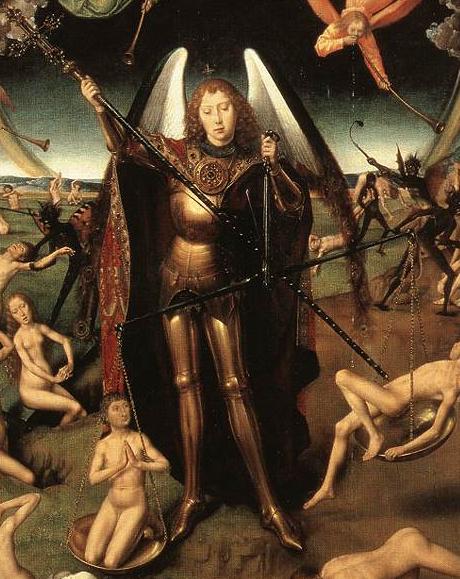
File:MemlingJudgmentCenter-crop.jpg


Detail of St Michael weighing souls at the Last Judgement
Hans Memling 1466-1473

Image: Wikipedia

File:Das Jüngste Gericht (Memling).jpg

 The Last Judgement
Hans Memling
National Museum, Gdansk

Image: Wikipedia


I assume the convention originates in an attempt to convey the beauty of holiness contrasted with the ugliness of evil, but the result has a definitely feminine quality to it, indicating the sexlessness of non-corporeal beings. Nevertheless by the late medieval period the image appears established. The muscular Christianity of Epstein's St Michael at Coventry appears a much more modern concept.

On the basis of some of the paintings i have reproduced here it is probably best to be able to recognise St Michael - we are all likely to meet him on Judgement Day.


Tuesday, 27 December 2011

St John the Evangelist


I have always identified St John the Evangelist as my name-saint - being a bit squeamish it is probably because he was the one Apostle not to be martyred - and perhaps also because the Cluniac priory in my home town was under his patronage. Anyway I do rather like the mystical and theological approach to faith. Thinking about it as I get older I think I should maybe identify with St John the Baptist and indulge in my urge to tell the brood of vipers what I really think, and go round preaching repentence - but I do want people to like me, so maybe not...

St John the Evangelist has not, to my mind, provided the inspiration for artists that the Baptist has. Too often he is depicted as a long haired rather effeminate young man, and not really the mystical theologian of the New Testament texts, still less one of the sons of thunder with a pushy mother...

This painting by Memling is rather better in conveying something of the meditative quality of St John, and anyway it is late medieval and therefore, ipso facto, good.

St. John The Evangelist

St John the Evangelist
Hans Memling c.1430 -1494

Image: artexpertswebsite.com

Here are both St John the Baptist and St John the Evangelist in the same artist' s Mystic Marriage of St Catherine from the St John Altarpiece of 1474-79 which is in Bruges - the other female saint in the composition is St Barbara:

The Mystic Marriage Of St. Catherine Of Alexandria (central panel of the San Giovanni Polyptch) - Hans Memling - www.hansmemling.org


Here is Memling's panel from the same altarpiece showing St John on Patmos:

St John Altarpiece (right wing) 1474-79 - Hans Memling - www.hansmemling.org

There is great charm and delicacy in Hieronymous Bosch's 1485 painting of St John on Patmos:

http://stjohnleonia.org/parish/images/stories/church/stjohn.jpg

Image:stjohnleonia.org

Although there is something of the nice young man from Sotheby's or Christie's holding up an object at an auction to the figure, and it is a really rather splendid chalice, there is more of both youthful impetuousness and conviction as well as the intensity of devotion and of mysticism in El Greco's paintings of him, as here:

http://www.southbear.com/stjohn3.jpg

Image: southbear.com