Once I was a clever boy learning the arts of Oxford... is a quotation from the verses written by Bishop Richard Fleming (c.1385-1431) for his tomb in Lincoln Cathedral. Fleming, the founder of Lincoln College in Oxford, is the subject of my research for a D. Phil., and, like me, a son of the West Riding. I have remarked in the past that I have a deeply meaningful on-going relationship with a dead fifteenth century bishop... it was Fleming who, in effect, enabled me to come to Oxford and to learn its arts, and for that I am immensely grateful.


Showing posts with label St John the Evangelist. Show all posts

Friday, 27 December 2024

St John the Evangelist


Today is the principal feast day of St John the Apostle and Evangelist.

Unlike his namesake St John the Baptist the life of the Evangelist has not provided artists with the dramatic inspiration of the life and death of the Great Foreunner. Mysticism is not as good material as Martyrdom. Even his deliverance from boiling oil at the Latern Gate is a rarity for patrons and artists, as is the tradition that he was accorded the privilege of being assumed into Heaven - an idea that was popular in later medieval Germany. Far too many depictions show him as a pale youth looking, frankly, a bit soppy, or as another venerable patriarch.

El Greco however did create an image which is both youthful and yet resolute - even if he does look slightly as someone performing a party trick - and of a young man you would want on your side.

File:El Greco - St. John - Google Art Project.jpg

St John the Apostle and Evangelist 
El Greco, 1610-1614
Image Wikipedia 

Another late work by El Greco, the uncompleted, and definitely dramatic The Vision of Saint John, dated to 1608-14, and now in the Metropolitan Museum in New York is discussed in an article from The Independent from 2013 at Great Works: The Vision of St John, 1608-14, By El Greco

Today it is the custom to bless wine, apparently by association with St John drinking deliberately poisoned wine and being unscathed.  I watched this ceremony online from SS Gregory and Augustine in Oxfordat the conclusion of the evening Mass.

The New Liturgical Movement had an article about this tradition last year which can be seen at The Blessing of Wine on the Feast of St John the Evangelist

Fr Zuhlsdorf has posted twice about this custom in recent years, and those pieces can be seen at 27 Dec – St. John the Evangelist – Today we bless WINE! and at Blessing wine on 27 December – St. John’s Day… or “another beverage”?


Sunday, 27 December 2015

St John the Evangelist in art


Here are a selection of some western high and late medieval images of St John the Evangelist linked to by John Dillon in a post for today's feast on the Medieval Religion discussion group.


R-250-13200-0001-25106 4069px x 2670px - 33.9 cm x 22.25 cm @ 300 ppp RGB


From  the late twelfth-century portal (between 1180 and 1190; restored between 1988 and 1995) of the église primatiale Saint-Trophime in Arles


The series of panels early thirteenth-century Life of St. John the Evangelist window (bay 22; c. 1215) in the cathédrale Saint-Étienne in Bourges can be viewed at http://www.medievalart.org.uk/bourges/22_pages/Bourges_Bay_22_key.htm


St John portrayed in a statuette (second from left, starting with the BVM around the corner) in the earlier thirteenth century Mary Shrine (consecrated, 1239) in the cathedral treasury in Aachen


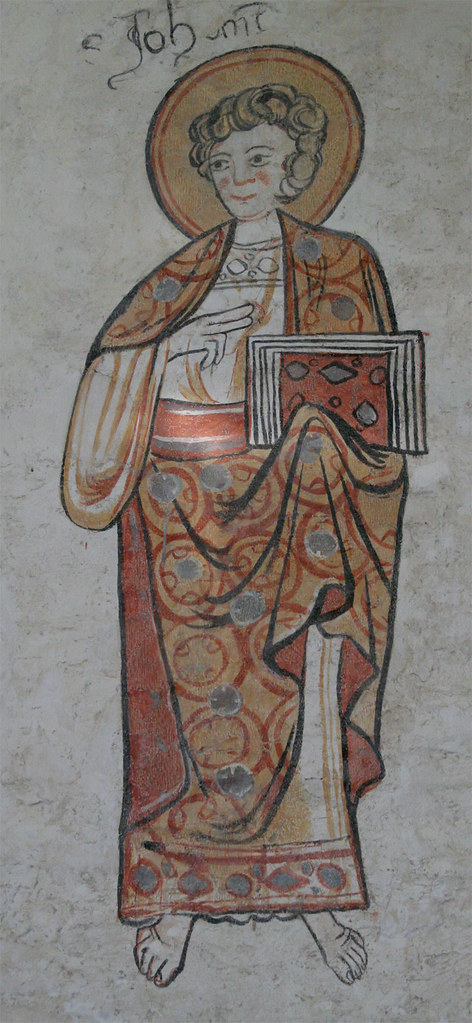
St John as depicted in a later thirteenth-century wall painting in the Reformed Church, Csaroda (Szabolcs-Szatmár-Bereg), Hungary


A detail of the painting:


St John portrayed in a silver gilt statuette on the later thirteenth-century copper gilt châsse of St. Remaclus (completed between 1263 and 1268) in the église Saint-Sébastien in Stavelot


St. John the Evangelist, Weston Longville [52KB]

A fourteenth-century wall painting in All Saints Church, Weston Longville (Norfolk)

Only the upper part of this painting of St. John the Evangelist is now left on the south side beside the chancel arch at Weston Longville. In the corresponding position at the north side is John the Baptist, who is very faint now. 
The painting has been restored, but St. John was probably always an impressive figure. He is shown here holding the most interesting of his attributes, a poisoned cup or chalice. According to his legend, John was ordered to drink from the cup as a test of his faith by the High Priest of Diana at Ephesus. Two condemned prisoners had already done so and died. John drank and survived unharmed, further demonstrating his power by restoring the two poisoned men to life. More often than not in painted versions of the story, a serpent or small dragon is shown emerging from the cup, to make the meaning intelligible. Here indeed is a small dragon, apparently uttering a cry of despair or frustration, although it has to be said that it looks more endearing than malevolent. Some of that may be due to restoration, but the creature does not look anything like so sinister as many others I have seen, particularly in paintings of St. John on East Anglian screens. A change in sensibilities since the Middle Ages is probably also operating - the whole painting has an slight but inescapable cartoonish air. [Extract from the website below]


A fourteenth-century panel from a glass window from the château of Rouen now in the Musée National du Moyen Age (Musée de Cluny) in Paris
:


St John as depicted by Cimabue in an early fourteenth-century Deesis mosaic from between 1301 and 1303) in the cattedrale metropolitana primaziale di Santa Maria Assunta in Pisa:


St John on Patmos by Giotto di Bondone in an earlier fourteenth-century fresco in the Peruzzi chapel of the basilica di Santa Croce in Florence


Giotto di Bondone in an earlier fourteenth-century panel painting (between 1320 and 1325) in the Musée Jacquemart-André in Paris


St John depicted by Simone Martini in a panel painting from between 1330 and 1339 in the Barber Institute of Fine Arts in Birmingham


Taddeo Gaddi produced these two panel paintings from between 1348 and 1353, and now in the Collezione Vittorio Cini in Venice.


St John drinking from the poisoned cup


:
St John being taken up to Heaven 


St John in a later fourteenth-century vault fresco in the baptistery of Parma:


Marble statue of St John by Donatello of 1410-1411 in the Museo dell'Opera del Duomo in Florence


 St John on Patmos in the earlier fifteenth-century Très Riches Heures du Duc de Berry between 1412 and 1416:  Chantilly, Musée Condé, ms. 65


St John depicted by Jan van Eyck in a panel of his Ghent Altarpiece of 1432 in the cathedral of Saint-Bavon / Sint Baaf in Gand / Ghent


St John by Andrea del Castagno in his vault fresco of 1442 in the cappella di San Tarasio in Venice's chiesa di San Zaccaria


St John on the right, and on the left his brother St. James the Great, by Miguel Ximénez and workshop in a panel of his and Martín Bernad's late fifteenth-century altarpiece of the Holy Cross completed in,1487 for the parish church of Blesa (Teruel) and now, after dismemberment, mostly in the Museo de Zaragoza


St John portrayed by Tilman Riemenschneider in a limewood statue of 1490-1492 from the predella of the high altar of the St. Magdalenenkirche in Münnerstadt) and now in the Bode-Museum in Berlin 
A close-up:


Wednesday, 6 May 2015

St John before the Latin Gate


Today is traditionally the feast of St John before the Latin Gate. Gordon Plumb has posted these stained glass depictions of the non-martyrdom of St John on the Medieval Religion discussion group:

Lincoln Cathedral, sII, 3a:

York Minster, East window, 11a:

Glasgow, Burrell Collection (ex Rouen, St Jean, c.1510-30)

Saturday, 27 December 2014

Feast of St John the Evangelist


As with my previous post I am republishing with some emendations a post from three years ago to mark this feast day.

I have always identified St John the Evangelist as my name-saint - being a bit squeamish it is probably because he was the one Apostle not to be martyred - and perhaps also because the medieval Cluniac priory in my home town was under his patronage. Anyway I do rather like the mystical theological approach to faith. That said and thinking about it as I get older I think I should maybe identify with St John the Baptist and indulge in my urge to tell the brood of vipers what I really think, and go round preaching repentence - but I do want people to like me, so maybe not...

St John the Evangelist has not, to my mind, provided the inspiration for artists that the Baptist has. Too often he is depicted as a long haired, rather effeminate young man, and not really the mystical theologian of the New Testament texts, still less one of the Sons of Thunder with a pushy mother...

This painting by Memling is rather better in conveying something of the meditative quality of St John, and anyway it is late medieval and therefore, ipso facto, good.

St. John The Evangelist

St John the Evangelist
Hans Memling c.1430 -1494

Image: artexpertswebsite.com

Here are both St John the Baptist and St John the Evangelist in the same artist's Mystic Marriage of St Catherine from the St John Altarpiece of 1474-79 which is in Bruges - the other female saint in the composition is St Barbara:

The Mystic Marriage Of St. Catherine Of Alexandria (central panel of the San Giovanni Polyptch) - Hans Memling - www.hansmemling.org


Here is Memling's panel from the same altarpiece showing St John on Patmos:

St John Altarpiece (right wing) 1474-79 - Hans Memling - www.hansmemling.org
 
 
There is great charm and delicacy in Hieronymous Bosch's 1485 painting of St John on Patmos:

http://stjohnleonia.org/parish/images/stories/church/stjohn.jpg

Image:stjohnleonia.org

Although there is something in this image of the nice young man from Sotheby's or Christie's holding up an object at an auction, and it is a really rather splendid chalice, there is more of both youthful impetuousness and conviction as well as the intensity of devotion and of mysticism in El Greco's paintings of him, as here:

http://www.southbear.com/stjohn3.jpg

Image: southbear.com


One of my regular readers commented on the post as follows about St John:

[He was p] erhaps just bar-mitzvah'd or whatever the expression is and thus qualified to make up the quorum in the synagogue.That would mean his walking alongside Christ from the ages of, say, 13-16: a deeply impressionable time in any young man's life. It would mean his having been born about A.D.20, and give him ample years in which to reflect, and would strengthen the claims of the early Fathers for his having lived into the second century.

That view of St John strikes me as very credible - teenage enthusiasm making him and his elder brother the brash Sons of Thunder, and, who knows, were they smug or acutely embarrassed by their mother's pursuit of places of honour for them under the seemingly impending new dispensation? There is also the youthful lack of fear that led him, alone of the Apostles, to stand (did he steal there against the advice of older voices, unable to stop himself ?)  at the foot of the Cross with Our Lady, and to rush off  with and out-run St Peter in going to the empty tomb, yet still with the youthful hesitancy to stand outside peering in. Add to that innate spiritual insight and a profound rapport with Our Lord and the Gospel account of him makes for a very believable portrait.

St John, pray for me


Thursday, 27 December 2012

St John the Evangelist in Christian Art


Last year on this day I posted in St John the Evangelist  about images of him, and this year, thanks to a post by John Dillon on the Medieval Religion discussion group which gives fifty ancient and medieval images of the saint, I am sharing some of those from the western tradition which struck me as being particularly interesting or noteworthy.


http://www.foxnews.com/static/managed/img/Scitech/Spotlight%20on%20John_slideshow_604x500.jpg 

This figure is thought to be St John
It is late fourth century and in the catacomb of St Tecla in Rome

Image: John Dillon 

Plaque carved in elephant ivory at Aarchen in the early ninth century, now in The Cloisters Collection in New York.

Until 1977, when it appeared at a London auction, this ivory from the Carolingian Renaissance was unknown. Carved in high relief, the frontally enthroned Evangelist displays his Gospel with the opening phrase IN PRINCI / PIO ERAT / VERBVM ("In the beginning was the Word" [John 1:1]). The arch, with its rich acanthus decoration, is supported by elaborate columns and encloses John's symbol, the eagle, which is directly above him. The entire composition is framed by a simple inscribed border. The text of this inscription is based on a line from the "Carmen Paschale," a poem by the fifth-century Christian writer Sedulius. Among the remarkable features of this ivory are John's loose, classical pallium and mantle, whose calligraphic treatment and plasticity verge on pure fantasy. This tendency toward a sumptuous ornamental effect, in which the abundant drapery patterns and textures take on a life of their own, becomes a characteristic of several ivories of the Court School of Charlemagne (r. 768–814). Artistically, these ivories are very close to the manuscripts produced in Aachen for the court of Charlemagne; this resemblance suggests that they probably were carved there. Some scholars have maintained that some of these ivories may date into the reign of his successor, Louis the Pious (814–840).


Image and notes : Metropolitan Museum New York


[Iluminura.+São+João+Evangelista,+do+Evangelho+do+Abade+Wedricus.+1147..jpg]

St John as depicted on the surviving leaf of the mid-twelfth-century (ca. 1147) Wedricus Gospels
Societé Archéologique et Historique, Avesnes-sur-Helpe (Nord) France

Image: John Dillon

At Chartres cathedral in the souith aisle of the nave there is an early thirteenth century window illustrating stories about him from the Golden LegendThe Sacred Destinations page about it, with expandable images, can be viewed here. St John is also featured in the sculptured figures of the Apostles at Chartres:

photo

Chartres Cathedral Earlier thirteenth century central portal of the south transept

From left to right: SS Paul, John, James the Great, James the Less and Bartholomew

Image: Gordon Plumb on Flickr

Slightly later in date, and showing significant stylistic development are the statues of Apostles and Prophets at Amiens cathedral on the Last Judgment portal of 1220 - 1236.  These include this figure of St John, carrying his emblem of a chalice with a serpent:

Amiens Cathedral: Last Judgment Portal: St. John the Evangelist

Image: © 2008 Holly Hayes/Art History Images. All rights reserved.


There are pictures of all these portal statues here and here.


http://upload.wikimedia.org/wikipedia/commons/5/5b/Saint_John_on_Patmos.jpg

St John on Patmos as depicted in the  Très Riches Heures of the Duc de Berry of 1412 and 1416
(Chantilly, Musée Condé, ms. 65)

I like the way the Evangelist's eagle obediently holds his pen case and ink well.

Image: Wikipedia

By this early fifteenth century date one of the conventions was well established whereby St John was depicted with long, often ringletted, hair, as by Jan van Eyck in this grisaille figure on the outer side of the St Bavon Altarpiece of 1432 in Ghent:


http://www.wga.hu/art/e/eyck_van/jan/09ghent/2closed2/l3johne.jpg

Image: World Gallery of Art

This type of depiction was very common during the Renaissance, both in Italy and in northern Europe. Here is one example from Bavaria:

http://upload.wikimedia.org/wikipedia/commons/5/50/Riemenschneider_Evangelisten_Johannes.jpg


Limewood statue of 1490-1492 by Tilman Riemenschneider
From the predella of the high altar of the St. Magdalenenkirche in Münnerstadt (Lkr. Unterfranken) in Bavaria, now in the Bode-Museum in Berlin

Image: Wikipedia


There is more about the wonderful work of the sculptor here.

In Italy there was also a continuing tradition of depicting him as an older man, and indeed as a very old man, as in this marble sculpture by Donatello from 1410-11:

http://www.wga.hu/art/d/donatell/1_early/duomo/3john_1.jpg


Statue in Museo dell'Opera del duomo, Florence

Image: World Gallery of Art
These are, of course, only a sample of depictions of a figure who has attracted a lot of attention and inspired varied images from artists in many mediums over the centuries


St John the Evangelist at Ephesus


Today is the feast of St John, Apostle and Evangelist who supposedly died circa 100. 

Traditionally in depictions of the events of the Gospels St John is usually depicted as a youth. I was struck by the point made by a commentator on my post from last year that he considered it possible that John was only in his early teens, very much still a boy in our terms. Thinking about it that seems psychologically reasonable in the accounts we have of him and his family. A youth like that might well manage to slip into the High Priest's palace, and have the lack of adult nerves to make his way to the foot of the Cross. His very youthfulness makes the Virgin's desolation all the more poignant - she is given, and given to, a mere teenager.

When James and John's mother pressed Our Lord for places of honour on their behalf or their reputations as Sons of Thunder do we again see the stresses and certainties of youthful zeal and a mother anxious for her still young sons to do well - especially if, as long standing tradition would have it, she is Our Lord's maternal aunt and they His cousins?

I am inclined to think of all the Apostles, or at least most of them as young men. Artists have often shown them as older than Our Lord, but both the evidence of their later lives, and the written accounts of their actions when given the choice of following Christ suggest men who were young, eager, but still constrained by the enthusiasms and uncertainties of youth or early manhood. Seeing them in such a
light makes their recorded reactions more readily understandable and the account in the Gospels more credible.

The rest of this post is based on a piece by John Dillon on the Medieval Religion discussion group, with a few adaptations of my own.

John, "the beloved disciple", was brother to the apostle James son of Zebedee (James the Great). In the (pseudo-)Hieronymian Martyrology and in the Latin Calendar of Sinai (ca. 800) both are celebrated on this date. In late antiquity and throughout the Middle Ages it was believed that John the Apostle, John the Evangelist, and John the Divine (John the Theologian), the author of the Apocalypse, were one and the same person. Despite some modern doubts, this is also the position of the Roman Martyrology. All the Johannine writings other than 2 and 3 John were usually ascribed to this one John.

Many legends of John go back to an origin in a probably later second-century aprocryphal Acts of John that circulated in Greek and in other languages and that was condemned by the Second Council of Nicaea in 787. A fifth- or sixth-century Acts of the Apostle and Evangelist John the Theologian supposedly written by his disciple St. Prochorus (BHG 916-917; Latin translation, BHL 4323) was likewise very influential. Somewhat similar in approach but substantively rather different is a legendary Account of John in Syriac (BHO 468). Legendary anecdotes of John occur in many other locations.

Apart from a period of exile on Patmos (preceded by arrest and transportation to Rome for interrogation, as in the story of St John before the Latin Gate, celebrated in the Calendar in May), John's legendary apostolate was conducted from Ephesus - where, of course, he lived with Our Lady. He is also said to have died there and a legend grew up that once he had been buried his body disappeared into the surrounding earth (John's metastasis). The sands over his grave were said to move; the tomb that was built above it gave forth on his feast day a healing, dust-like manna collected by numerous pilgrims. 

Here is a view of his tomb at Ephesus in the ruins of the remains of the Justinianic basilica that replaced an earlier chapel at the site and that lasted until late in the fourteenth century:


http://www.todayscatholicworld.com/st-john-tomb-ephesus-turkey.jpg

The tomb of St John in the ruins of the Basilica at Ephesus

Image:todayscatholicworld.com


The Sacred Destinations illustrated page on the history of this great church can be read here.


http://www.sacred-destinations.com/turkey/images/ephesus/basilica-john-model-nc-sterlingbear-com-200h.jpg 

Another view of the reconstruction model of the Basilica at Ephesus

Image: John Dillon


Tuesday, 27 December 2011

St John the Evangelist


I have always identified St John the Evangelist as my name-saint - being a bit squeamish it is probably because he was the one Apostle not to be martyred - and perhaps also because the Cluniac priory in my home town was under his patronage. Anyway I do rather like the mystical and theological approach to faith. Thinking about it as I get older I think I should maybe identify with St John the Baptist and indulge in my urge to tell the brood of vipers what I really think, and go round preaching repentence - but I do want people to like me, so maybe not...

St John the Evangelist has not, to my mind, provided the inspiration for artists that the Baptist has. Too often he is depicted as a long haired rather effeminate young man, and not really the mystical theologian of the New Testament texts, still less one of the sons of thunder with a pushy mother...

This painting by Memling is rather better in conveying something of the meditative quality of St John, and anyway it is late medieval and therefore, ipso facto, good.

St. John The Evangelist

St John the Evangelist
Hans Memling c.1430 -1494

Image: artexpertswebsite.com

Here are both St John the Baptist and St John the Evangelist in the same artist' s Mystic Marriage of St Catherine from the St John Altarpiece of 1474-79 which is in Bruges - the other female saint in the composition is St Barbara:

The Mystic Marriage Of St. Catherine Of Alexandria (central panel of the San Giovanni Polyptch) - Hans Memling - www.hansmemling.org


Here is Memling's panel from the same altarpiece showing St John on Patmos:

St John Altarpiece (right wing) 1474-79 - Hans Memling - www.hansmemling.org

There is great charm and delicacy in Hieronymous Bosch's 1485 painting of St John on Patmos:

http://stjohnleonia.org/parish/images/stories/church/stjohn.jpg

Image:stjohnleonia.org

Although there is something of the nice young man from Sotheby's or Christie's holding up an object at an auction to the figure, and it is a really rather splendid chalice, there is more of both youthful impetuousness and conviction as well as the intensity of devotion and of mysticism in El Greco's paintings of him, as here:

http://www.southbear.com/stjohn3.jpg

Image: southbear.com