Once I was a clever boy learning the arts of Oxford... is a quotation from the verses written by Bishop Richard Fleming (c.1385-1431) for his tomb in Lincoln Cathedral. Fleming, the founder of Lincoln College in Oxford, is the subject of my research for a D. Phil., and, like me, a son of the West Riding. I have remarked in the past that I have a deeply meaningful on-going relationship with a dead fifteenth century bishop... it was Fleming who, in effect, enabled me to come to Oxford and to learn its arts, and for that I am immensely grateful.


Showing posts with label Chartres Cathedral. Show all posts

Wednesday, 6 January 2016

Epiphany


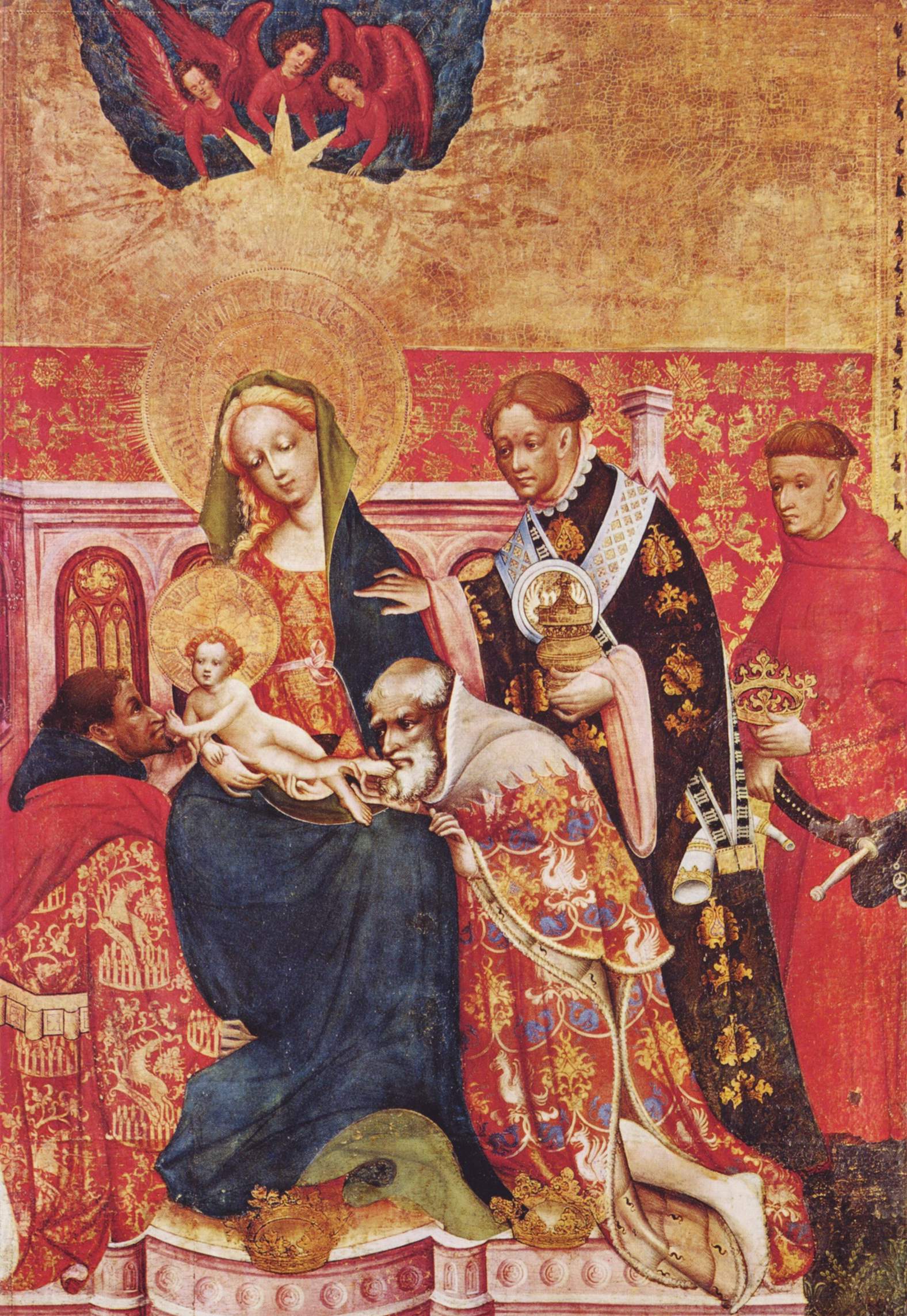
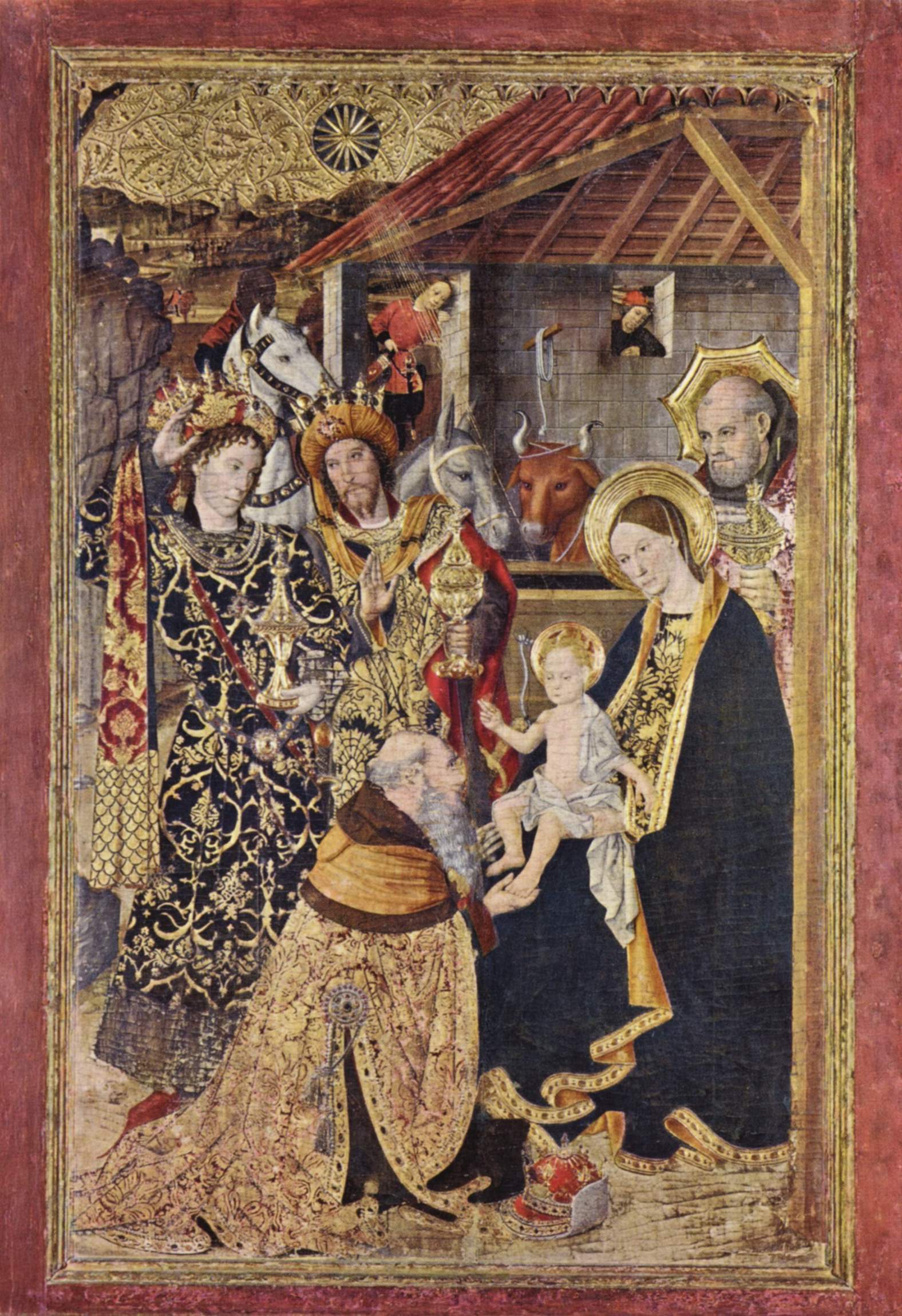
To celebrate today's feast of the Epiphany here are the late medieval western depictions of the story of the visit of the Magi from a post by John Dillon on the Medieval Religion discussion group. I have chosen these because the Epiphany has produced so many images over the centuries that John's post would be too long to reproduce in extenso, and also reflecting my own particular interest in the later middle ages. The images can be seen in a larger size by clicking on the links at the bottom right

Scenes attributed to Giovanni da Modena in his early fifteenth-century frescoes (c. 1410) in the cappella Bolognini of Bologna's basilica di San Petronio:


1) The Magi see the star and depart [click on the image to expand it]:
http://tinyurl.com/87zhx42
2)  Adoration of the Magi:
http://tinyurl.com/7g87f4v
3)  the Magi return by sea [click on the imag
e to expand it]:
http://tinyurl.com/7n3cmnu


The Adoration of the Magi by Conrad of Soest on a wing of the Marienaltar (c. 1420) in the Marienkirche, Dortmund


The Adoration of the Magi by Gentile da Fabriano in a panel painting (1423) in the Galleria degli Uffizi, Florence


Adoration of the Magi) by Beato Angelico in a mid-fifteenth-century fresco (c. 1440-1441) in cell 39 of the convento (now Museo nazionale) di San Marco, Florence


The Adoration of the Magi) by Beato Angelico and Filippo Lippi in a mid-fifteenth-century panel painting (1440s or 1450s) in the National Gallery of Art, Washington, DC
There is more about the painting at 


Adoration of the Magi by Andrea Mantegna in a panel painting on a retable of 1461. From the chapel of the Ducal palace at Mantua in the Galleria degli Uffizi, Florence


The Adoration of the Magi depicted by the Elmelunde workshop in a later fifteenth-century vault fresco (c. 1480) in Tingsted kirke, Tingsted, Guldborgsund Kommune (Region Sjælland), Denmark


Panel - Adoration of the Magi

The Adoration of the Magi on a later fifteenth-century alabaster panel, presumably from an altarpiece, in the Victoria and Albert Museum, London


The Adoration of the Magi by Jaume Huguet in a later fifteenth-century panel painting in the Museu d'Historia de la Ciutat, Barcelona


High relief  of the Adoration of the Magi by Pieter Dancart on his late fifteenth-century high altar (c. 1488) in Seville's catedral de Santa María de la Sede:


eeee) as portrayed in high relief (Adoration of the Magi) by Johann von Ach on the late fifteenth- or early sixteenth-century portail Saint-Laurent of Strasbourg's cathédrale Notre-Dame:
http://tinyurl.com/23mklv
For closer views, click on "statues" in the menu at right here:
http://tinyurl.com/2b2wpr


As depicted by the Elmelunde Master in a painting (c. 1500) in Elmelunde kirke, Elmelunde (Vordingborg Kommune), Sjælland, Denmark


High relief  of the Adoration of the Magi by Tilman Riemenschneider in a limewood relief panel (between c. 1505 and c. 1510) in the British Museum, London


High relief of the Adoration of the Magi by Jehan Soulas in the initial panels (1519-1521) of the earlier sixteenth-century choir screen in Chartres cathedral


High relief  of the Adoration of the Magi by Miguel Perrin on the tympanum of the earlier sixteenth-century Puerta del los Palos (c. 1520) of Seville's catedral de Santa María de la Sede


Wednesday, 11 November 2015

St Martin


Today is the feast of St Martin of Tours, the first non-martyr to have a recognised cult, and a very popular saint in the middle ages - as is indicated by the wide distribution of the images below.

On the Medieval Religion discussion group Gordon Plumb posted the following stained-glass depictions of St Martin:

Beverley Minster, east window, panels of c.1235:
1e, Martin dividing cloak with beggar:
https://www.flickr.com/photos/22274117@N08/3370751437
2a: St Martin among robbers:
https://www.flickr.com/photos/22274117@N08/3370748595
2h: Dream of St Martin:
3h: St Martin chosen as bishop:
https://www.flickr.com/photos/22274117@N08/3370766983
https://www.flickr.com/photos/22274117@N08/3371577724
3b: Miraculous mass of St Martin:
https://www.flickr.com/photos/22274117@N08/3371584594
4h: Death of St Martin:
https://www.flickr.com/photos/22274117@N08/3371590234

Tours Cathedral, bay4, St Martin window, c.1300:
https://www.flickr.com/photos/22274117@N08/14915306224
and detail:
register 4, Martin and the miracle of the pine; Martin baptizes:
https://www.flickr.com/photos/22274117@N08/15536918582

Exeter Cathedral, Choir Clerestory, east window, c.1301-1304:
https://www.flickr.com/photos/22274117@N08/2886163886

York St Martin cum Gregory, sII, 2b-3b, Martin dividing cloak with beggar, c.1340.:
https://www.flickr.com/photos/22274117@N08/4093266976
and detail:
https://www.flickr.com/photos/22274117@N08/4093261040

York St Martin--le-Grand, Coney Street, nII, Life of St Martin, a set on images of the window, c.1440:
https://www.flickr.com/photos/22274117@N08/albums/72157603903400734

Dewsbury Minster, north transept window, 2c, arms of St Martin:
https://www.flickr.com/photos/22274117@N08/4009638434

Shrewsbury, St Mary, south aisle, south-west window, glass from Musterbilzen in Belgium:
https://www.flickr.com/photos/22274117@N08/3180236634

St Nicholas-de-Port, bay 20, St Martin and the beggar, 1514-20 by the workshop of Valentin Bousch:
https://www.flickr.com/photos/22274117@N08/15603129316

John Dillon supplemted Gordon Plumb's posting by adding additional period-pertinent images of St. Martin of Tours:

a) as depicted (at far left) in the heavily restored later sixth-century mosaics (c. 560) in the nave of Ravenna's basilica di Sant' Apollinare Nuovo:

 https://blogger.googleusercontent.com/img/b/R29vZ2xl/AVvXsEiUlfvXORG2JtV4s-b02823lFTyBQre0XH2hc8E6oRAQlfxjxgfM0vRMLUxICpsxXhfQ8WDsCqvCjKXMSpVHhtFSRTIryKFf7Gku-vFIhVt18S5EAImM51sUaZ9VoA7E1ruPDGPRZwSGy5u/s1600/IMG_3936med.jpg

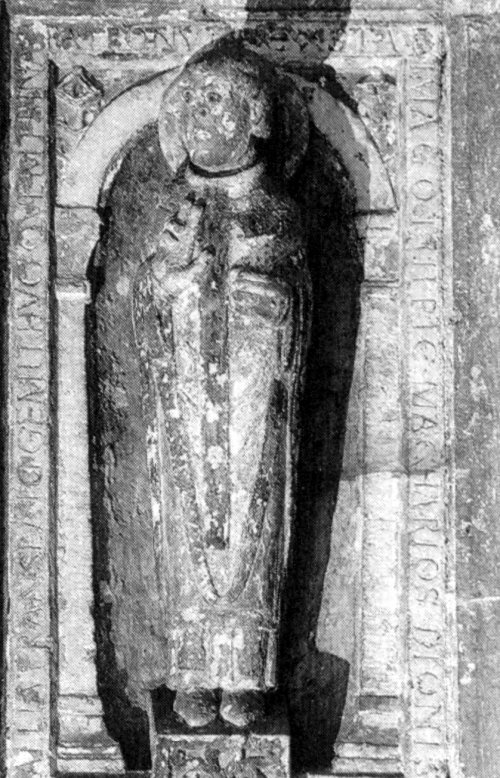
b) as portrayed on one of the very late eleventh-century capitals in the cloister (consecrated, 1100) of the abbaye de Saint-Pierre at Moissac:
http://p2.storage.canalblog.com/28/53/610887/78802475_o.jpg

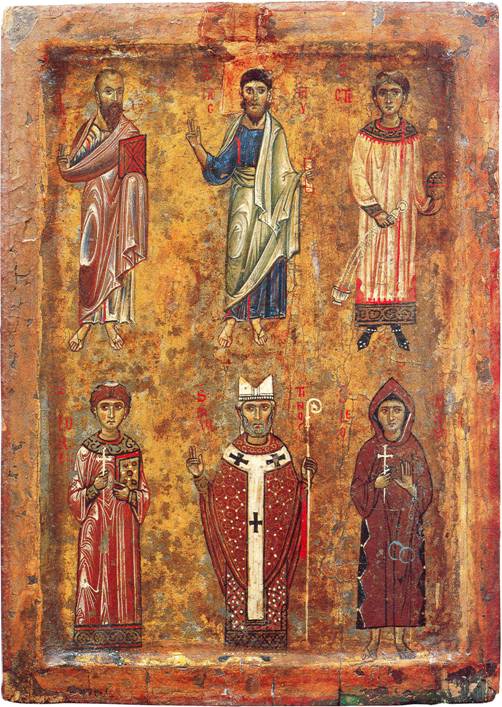
c) as depicted (at centre in lower register, between Sts. Lawrence of Rome and Leonard of Noblac) in a twelfth-century icon of Byzantine origin or inspiration in the Holy Monastery of the God-trodden Mount Sinai in St. Catherine (South Sinai governorate):

 http://www.forum-orthodoxe.com/images/stmartindetours.jpg


d) as depicted in a somewhat restored seemingly earlier twelfth-century mosaic in the diaconicon of the basilica (ex-cattedrale) di Santa Maria Assunta on Torcello:
http://tinyurl.com/26vvdrv
http://tinyurl.com/25a2z44

e) as depicted in an earlier twelfth-century legendary from the abbey of Cîteaux (between 1101 and 1133; Dijon, Bibliothèque municipale, ms. 641, fol. 113r):

http://www.culture.gouv.fr/Wave/savimage/enlumine/irht6/IRHT_094818-p.jpg


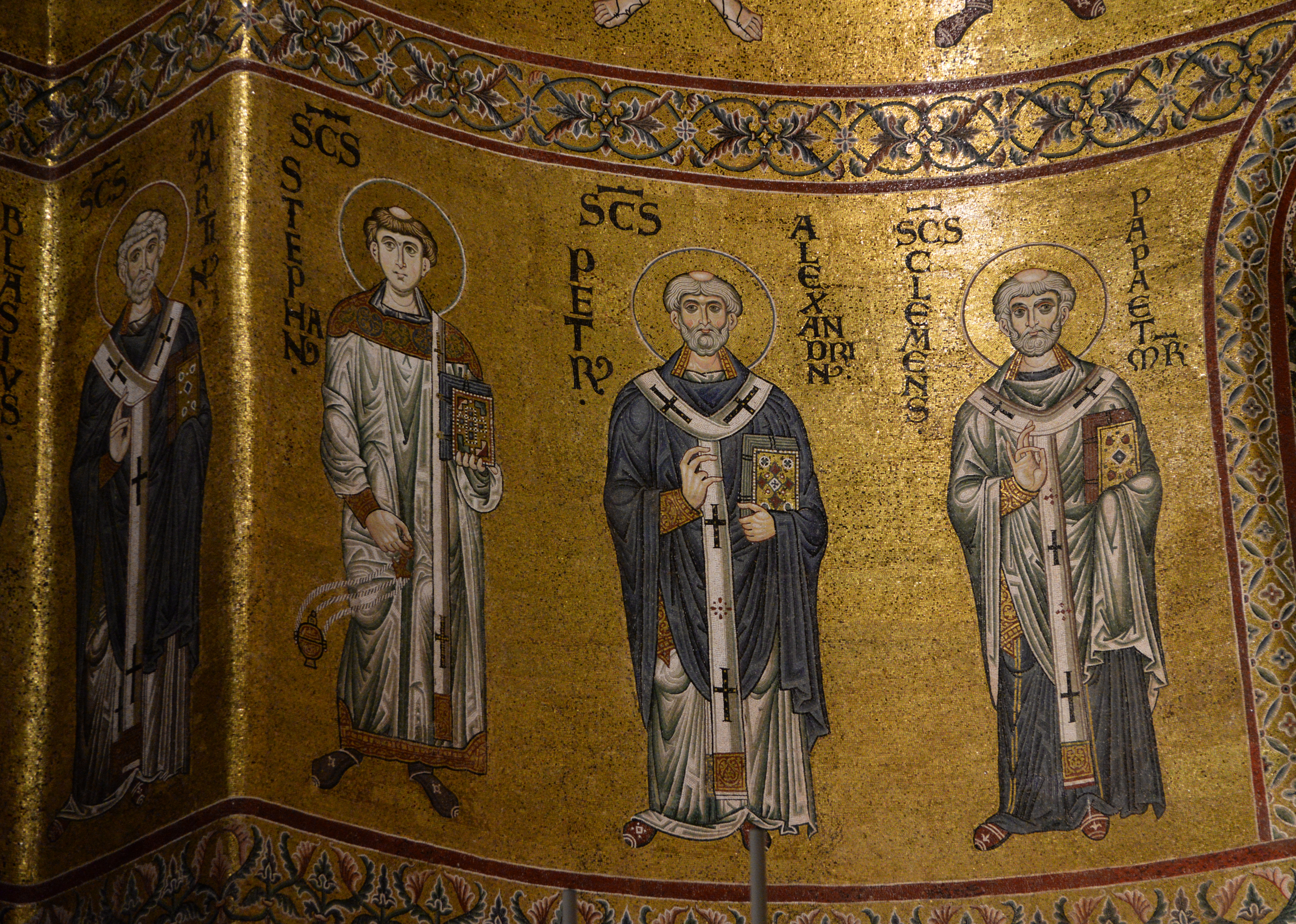
f) as depicted (at far left) in the late twelfth-century mosaics (c. 1182) in the sanctuary of the basilica cattedrale di Santa Maria Nuova in Monreale:


g) as portrayed in high relief in two locations on the right portal of the late twelfth or earlier thirteenth-century south porch of the basilique cathédrale Notre-Dame in Chartres:
1) On the right jambs (at left; at right, St. Jerome):
http://tinyurl.com/ostx422
Detail view:


2) On the tympanum (cutting his cloak):
http://tinyurl.com/ou6mnb5
Detail view:
http://tinyurl.com/nqfmnwc

h) as portrayed (scenes from his Vita) in four earlier thirteenth-century reliefs on the facade of the cattedrale di San Martino in Lucca:
http://tinyurl.com/27df48s
http://tinyurl.com/26rpoeb
http://tinyurl.com/2agms7o
http://tinyurl.com/29zfghw
There are detail views on this page:
http://tinyurl.com/32c6gkz

i) as depicted in the early thirteenth-century Life of St. Martin window (bay 7; c. 1215) in the cathédrale Saint-Étienne in Bourges:
http://www.medievalart.org.uk/bourges/07_pages/Bourges_Bay_07_key.htm
Detail view (cutting his cloak):
http://www.medievalart.org.uk/bourges/07_pages/Bourges_Bay_07_panel_01.htm

j) as depicted in the earlier thirteenth-century Life of St. Martin window (bay 102; c.1215-1225; restored, 1922 and 1995-1996) in the basilique cathédrale Notre-Dame in Chartres:
http://tinyurl.com/na6elhu
Detail view (cutting his cloak):

 https://s-media-cache-ak0.pinimg.com/736x/b2/4b/31/b24b312d70efcdb809034dc8c36a9aaf.jpg


k) as depicted (cutting his cloak) in an earlier thirteenth-century copy (c.1236-1250) of part of the Magnum legendarium Austriacum (Zwettl, Stiftsbibliothek, cod. 14, fol. 149r):
http://tarvos.imareal.oeaw.ac.at/server/images/7002565.JPG

l) as depicted in the earlier thirteenth-century Life of St. Martin window (bay 102b; c. 1240) in the cathédrale Saint-Maurice in Angers:
http://www.medievalart.org.uk/Angers/Bay_102b/Angers_Bay102b_Key.htm

m) as depicted (enthroned) in a mid-thirteenth-century pontifical from Mainz (between 1241 and 1251; Paris, BnF, Ms. Latin 946, fol. Av):


n) as depicted (cutting his cloak) in a late thirteenth-century copy of French origin of the Legenda aurea (San Marino, CA, Huntington Library, ms. HM 3027, fol. 156r):
http://digitalassets.lib.berkeley.edu/ds/huntington/images//000913A.jpg

o) as depicted (cutting his cloak) in the late thirteenth-century Livre d'images de Madame Marie (c. 1285-1290; Paris, BnF, ms. Nouvelle acquisition française 16251, fol. 89r):


p) as depicted (cutting his cloak) in an early fourteenth-century fresco in the cathédrale Saint-Gatien in Tours:
https://www.flickr.com/photos/biron-philippe/7585653434/

q) as depicted (scenes from his Vita) by Simone Martini in a series of early fourteenth-century frescoes (between 1312 and c. 1318) in the cappella di San Martino in the lower church of the basilica di San Francesco in Assisi:

 http://www.wga.hu/art/s/simone/3assisi/00view3.jpg


http://www.wga.hu/art/s/simone/3assisi/00view2.jpg
Detail views with captions:
http://www.wga.hu/frames-e.html?/html/s/simone/3assisi/index.html

r) as depicted (at top right in the major panels) by Giovanni di Bonino, perhaps working from a design by Simone Martini, in one of the three earlier fourteenth-century windows (after 1312) in the cappella di San Martino in the lower church of the basilica di San Francesco in Assisi:
http://www.wga.hu/art/s/simone/3assisi/scenes/99window.jpg
Detail view:

 http://www.akg-images.fr/Docs/AKG/Media/TR3_WATERMARKED/2/6/e/1/AKG286952.jpg


s) as portrayed in an earlier fourteenth-century elephant ivory statuette of German origin (c. 1320; Köln or Mainz) in the Victoria and Albert Museum, London:
http://tinyurl.com/nsnqkgh

 http://sargasso.nl/wp-content/uploads/2014/11/martinus_tours_1320_cologne_vam.jpg


t) as depicted (cutting his cloak) in an earlier fourteenth-century French-language legendary of Parisian origin with illuminations attributed to the Fauvel Master (c. 1327; Paris, BnF, ms. Français 183, fol. 165v):
http://tinyurl.com/nnuec2h

u) as depicted (at left; at right, St. Theodore the Stoudite) in the earlier fourteenth-century frescoes (between 1335 and 1350) in the narthex of the church of the Holy Ascension at the Visoki Dečani monastery near Peć in, depending on one's view of the matter, either the Republic of Kosovo or Serbia's province of Kosovo and Metohija:


v) as portrayed in high relief (consecration as bishop; cutting his cloak) on a mid-fourteenth-century polychromed ivory diptych (c. 1340-1350) of northern French or Flemish origin in the Cleveland Museum of Art:


w) as depicted (at lower right; cutting his cloak) in the mid-fourteenth-century San Martino altarpiece (seemingly later 1340s) from Oristano in the Antiquarium Arborense - Museo archeologico Giuseppe Pau, Oristano:

 http://www.antiquariumarborense.it/it/Museo/Sale/Immagini/retabloSanMartino1.jpg


x) as depicted (cutting his cloak) in a mid-fourteenth-century copy, from the workshop of Richard and Jeanne de Montbaston, of the Legenda aurea in its French-language version by Jean de Vignay (1348; Paris, BnF, ms. Français 241, fol. 300r):
http://tinyurl.com/pua5rvp

y) as depicted (cutting his cloak) in a mid-fourteenth-century vault painting (c. 1350) in Skibby Kirke at Skibby, Lejre Kommune, Sjælland:

 https://upload.wikimedia.org/wikipedia/commons/4/4c/Martin_af_Tours_(Skibby_Kirke).jpg


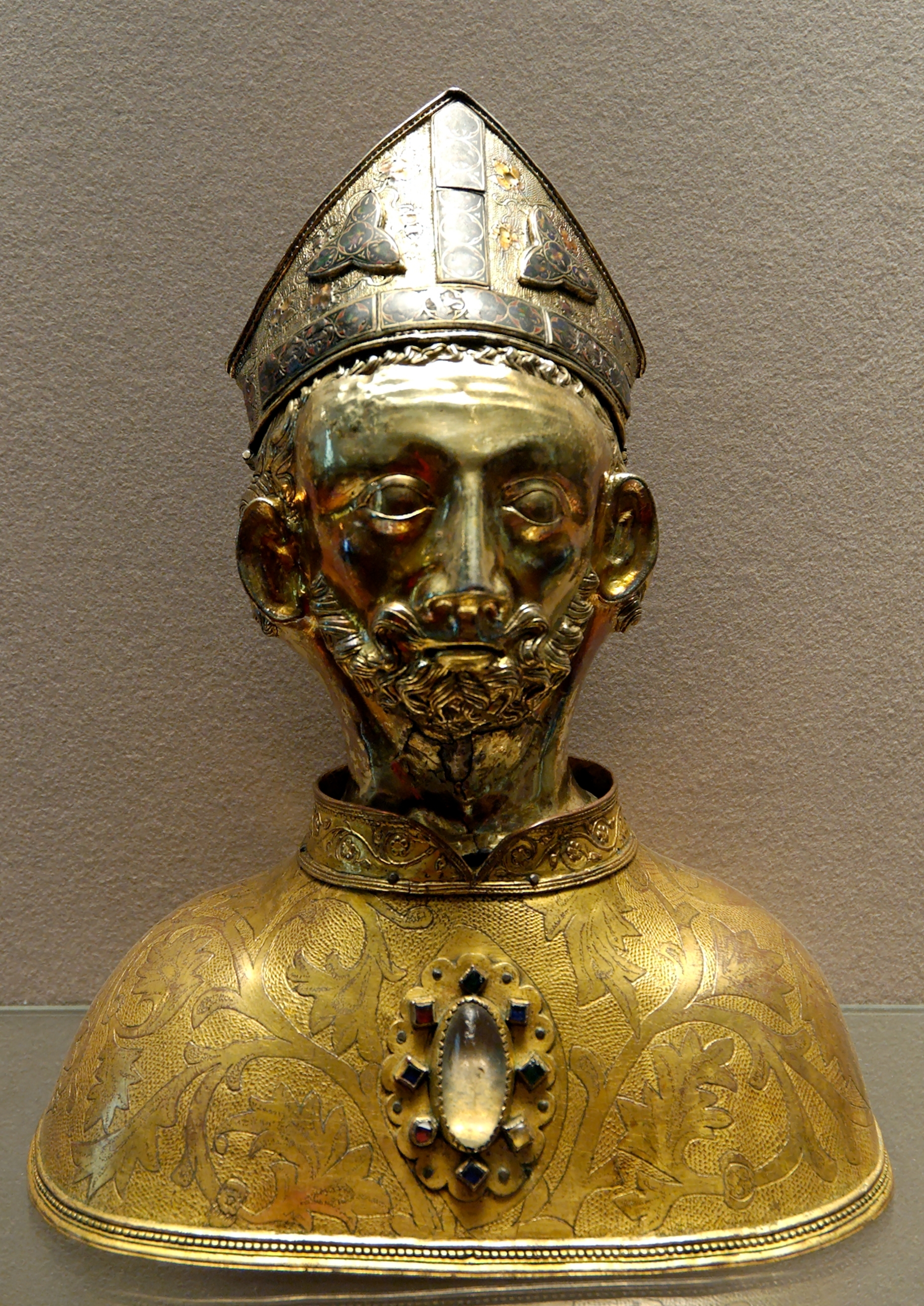
z) as portrayed in a late fourteenth-century reliquary bust (from Avignon?; restored in the twentieth century) in the Musée du Louvre in Paris:

 
 https://upload.wikimedia.org/wikipedia/commons/7/74/Head_reliquary_Martin_Louvre_OA6459.jpg


aa) as depicted (at top in the right margin; demanding a steep price of Clovis for the return of a horse) in the numerous pen-and-ink illustrations in the margins of an early fifteenth-century copy of the Chronicon a mundi creatione ad annum 1220, an abbreviation and continuation of the Pantheon of Godfrey of Viterbo (c. 1400-1415; Paris, BnF, ms. Latin 4935, fol. 8v):
http://gallica.bnf.fr/ark:/12148/btv1b8455934w/f26.image

bb) as depicted (at left; at right, brigands) in an earlier fifteenth-century embroidery of southern Netherlandic origin (c. 1430) in The Cloisters Collection of the Metropolitan Museum of Art, New York:

Saint Martin and the Brigands


cc) as depicted in grisaille (cutting his cloak) by Jean le Tavernier in the mid-fifteenth-century Hours of Philip of Burgundy (c. 1451-1460; Den Haag, KB, ms. 76 F 2, fol. 264v):
http://manuscripts.kb.nl/zoom/BYVANCKB%3Amimi_76f2%3A264v_min

dd) as depicted (upper right; cutting his cloak) by Girolamo di Giovanni of Camerino in a later fifteenth-century triptych (c. 1473) in the chiesa di San Martino Vescovo in Monte San Martino (MC) in the Marche:
http://tinyurl.com/q74m33o

Detail view:

 http://www.liricigreci.it/blog/wp-content/uploads/2013/06/polittico_girolamo_giovanni_monte_san_martino04.jpg


ee) as depicted (cutting his cloak) in a later fifteenth-century vault painting (c. 1474) in Jetsmark Kirke at Pandrup, Jammerbugt Kommune, Nordjylland:
http://tinyurl.com/pu5sh97

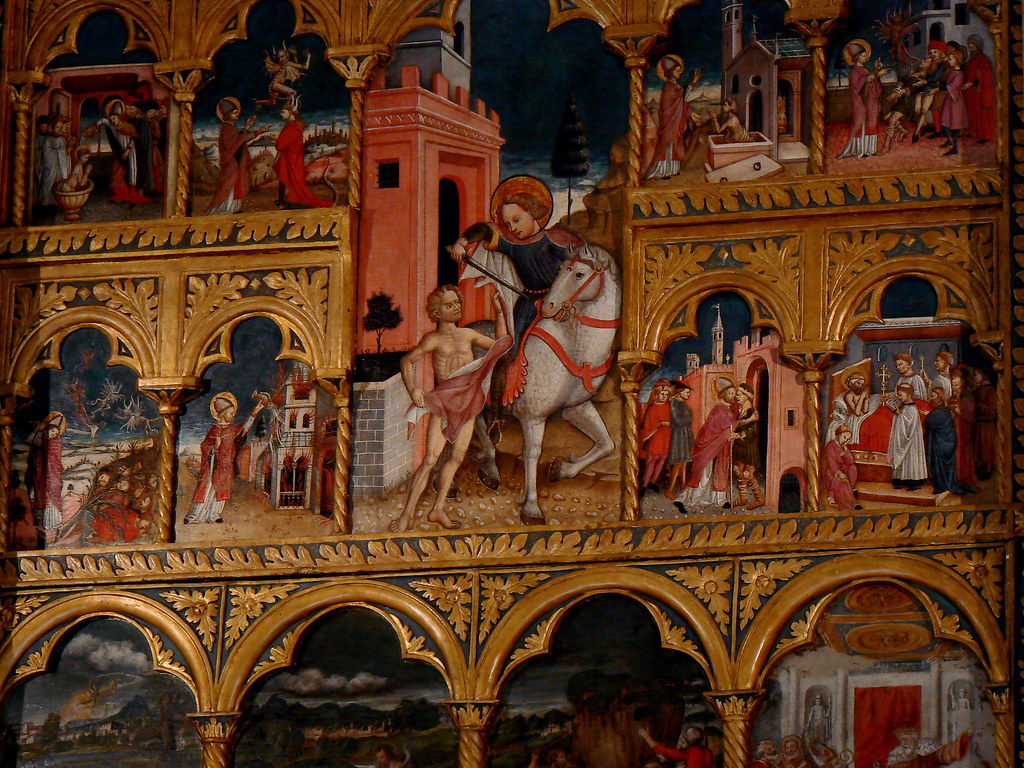
ff) as depicted (cutting his cloak and other scenes from his Vita) by the Master of the Galletti Chapel in a later fifteenth-century painted altarpiece (c. 1475-1480) in the crypt of the basilica cattedrale di San Martino in Belluno:
https://c1.staticflickr.com/3/2397/2177982293_8c1e640b3d_b.jpg

gg) as portrayed (with the beggar) in a later fifteenth-century statue (c. 1475-1480) of German origin in the Seattle Art Museum, Seattle (WA):

 http://www.wga.hu/art/m/master/zunk_ge/zunk_ge8/5martin.jpg


hh) as depicted in two late fifteenth-century panel paintings (c. 1490) on either side of a wing from a dismembered altarpiece in the Magyar Nemzeti Galéria, Budapest:
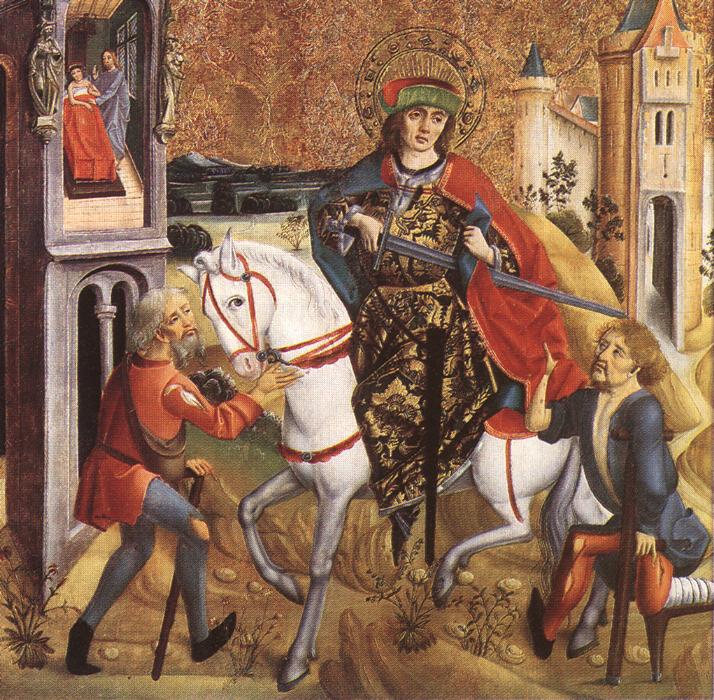
1) Cutting his cloak:

 http://www.wga.hu/art/m/master/zunk_hu/zunk_hu1/06martin.jpg


2) Celebrating Mass in shabby dress:


 http://www.wga.hu/art/m/master/zunk_hu/zunk_hu1/04martin.jpg


ii) as depicted (center panel; cutting his cloak) by Bartolomeo Vivarini in his late fifteenth-century Triptych of St. Martin (1491) in the Accademia Carrara, Bergamo:

 http://passaggioadovest.ilserio.it/immagini/Trittico.JPG


jj) as portrayed (cutting his cloak) in high relief in a late fifteenth- or early sixteenth-century sculpture (c. 1500), from Bjæverskov Kirke in Sjælland, in the Nationalmuseet, Copenhagen:


 https://wuhstry.files.wordpress.com/2015/10/imag0667_burst0021.jpg


kk) as depicted (cutting his cloak) in an embroidered early sixteenth-century cope shield (between 1500 and 1509) in the Museum Catharijneconvent in Utrecht:

 https://upload.wikimedia.org/wikipedia/commons/thumb/2/29/MCC-31218_Koorkapschild_met_St._Maarten_te_paard_en_bedelaar%2C_ingelijst_%281%29.tif/lossy-page1-1024px-MCC-31218_Koorkapschild_met_St._Maarten_te_paard_en_bedelaar%2C_ingelijst_%281%29.tif.jpg?1447199959777


Friday, 9 October 2015

St Denis and his companions


Today is by tradition the feast of the mid-third century Bishop of Paris St Denis and his companions in martyrdom SS. Rusticus of Paris and Eleutherius of Paris. For his life and cult, and for details which explain some of the images which follow see the online account at https://en.wikipedia.org/wiki/Denis

Nowadays here in the Birmingham Archdiocese this is, of course, the feast of Bl.John Henry Newman, so St Denis and his companions, together with St John Leonardi, are commemorated on October 8th.


The Medieval Religion discussion group yielded a fine crop of images. Gordon Plumb posted some stained glass depictions:

Chartres, Cathedrale Notre Dame, Bay 116, St Denis gives the Oriflamme to Jean-Clement de Metz:
https://www.flickr.com/photos/22274117@N08/8070019929

Lincoln Cathedral, sII, 1c, c.1225-35:
https://www.flickr.com/photos/22274117@N08/2259035172

York Minster, nXXXVI, 5b-6b, St Denis between two executioners:
https://www.flickr.com/photos/22274117@N08/4793957936

Winchester College, Fromond's Chapel, east window, A10:
https://www.flickr.com/photos/22274117@N08/3453937140
and detail:
https://www.flickr.com/photos/22274117@N08/3453937140


Bourges, Cathedrale Saint-Etienne, Bay 31, Story of St Denis, c.1517-18:
https://www.flickr.com/photos/22274117@N08/2218850130
and two details:
https://www.flickr.com/photos/22274117@N08/2218157075
https://www.flickr.com/photos/22274117@N08/2219153140

Genevra Kornbluth added these examples from her files in stone and wood:
http://www.KornbluthPhoto.com/StDenis.html

John Dillon provided a splendid array of images, many of which show St Denis as a cephalaphore
( now you really should know what that means...) and how artists dealt with that subject.

a) as depicted (at left; at centre and left, Sts. Rusticus and Eleutherius) in an early eleventh-century gradual according to the Use of the abbey of Saint-Denis near Paris (Paris, Bibliothèque Mazarine, ms. 384, fol. 117v):


http://www.enluminures.culture.fr/Wave/savimage/enlumine/irht16/IRHT_065156-p.jpg


b) as portrayed in a mid-eleventh-century relief in the entrance hall to the Kirche St. Emmeram in Regensburg, originally the church of a monastery claiming to possess his remains:


http://www.fantomzeit.de/wp-content/uploads/wibald03.jpg


c) as portrayed in high relief (at centre between Sts. Rusticus and Eleutherius, all achieving martyrdom) in the mid-twelfth-century sculptures on the tympanum of the Portail des Valois (rebuilt in the 1230s or 1240s; restored in the nineteenth century) of the basilique cathédrale Saint-Denis in Saint-Denis (Seine-Saint-Denis):


http://france-romane.com/photos/93-st-denis/Cathedrale_St-Denis-086.jpg


d) as portrayed in high relief (at centre between Sts. Rusticus and Eleutherius) in a mid-twelfth-century walrus ivory plaque from a portable altar in the Musée du Louvre, Paris:


http://www.photo.rmn.fr/archive/90-006373-2C6NU0HLVYSG.html

e) as portrayed in high relief (at centre) in the jambs of the left portal of the south porch (between 1194 and 1230) of the basilique cathédrale Notre-Dame in Chartres:


http://tinyurl.com/4o6rjl

Detail view:


http://tinyurl.com/4zncmm

f) as depicted (at left) in an earlier thirteenth-century window (1228-1231) of the south transept clerestory of the basilique cathédrale Notre-Dame in Chartres (not to miss the important bibliography cited this page's "description" tab):


http://tinyurl.com/3v5epn

g) as portrayed in an earlier thirteenth-century statue on a choir screen in Bamberg's Dom St. Peter und St. Georg (consecrated, 1237):
http://tinyurl.com/69dhonr

h) as depicted (at right at the foot of the page; at left, St. Lambert of Maastricht) in a later thirteenth-century psalter and book for hours according to the Use of Liège (ca. 1251-1300; Den Haag, KB, ms. 76 G 17, fol. 82v):
http://manuscripts.kb.nl/zoom/BYVANCKB%3Amimi_76g17%3A082v

i) as depicted in a later thirteenth-century window (c. 1280) in the Stadtkirche St. Dionys in Esslingen am Neckar:


Saint Dionysus
http://tinyurl.com/yfa8loy

j) as depicted (at centre betw. Sts. Rusticus and Eleutherius, all achieving martyrdom) as in a late thirteenth-century copy of French origin of the Legenda aurea (San Marino, CA, Huntington Library, ms. HM 3027, fol. 142v):
http://digitalassets.lib.berkeley.edu/ds/huntington/images//000923A.jpg

k) as depicted (at left; at right, St. Piatus of Seclin [ Feast day Oct.1st] ) in the late thirteenth-century (c. 1285-1290) Livre d'images de Madame Marie (Paris, BnF, ms. Nouvelle acquisition française 16251, fol. 84v):


http://tinyurl.com/y8v48ko

l) as depicted on a panel of the fourteenth-century rood screen of St Andrew, Hempstead (Norfolk):


http://www.norfolkchurches.co.uk/hempstead/images/hempstead%20(19).JPG
http://tinyurl.com/4q7jgt

m) as portrayed in a fourteenth-century pilgrim's badge in the Musée national du Moyen Âge (Musée de Cluny), Paris:


http://img.over-blog-kiwi.com/0/82/49/44/20140303/ob_8da42f_piece-de-fouille-saint-denis.jpg
http://tinyurl.com/obtg2cb

n) as portrayed (with the better preserved Sts. Rusticus and Eleutherius) in an earlier fourteenth-century marble sculpture (c. 1301-1326; formerly part of an altarpiece) in the Musée du Louvre, Paris:


http://www.photo.rmn.fr/archive/13-550042-2C6NU05JQU03.html

Detail view:


http://www.photo.rmn.fr/archive/13-550043-2C6NU05JQS9J.html

o) as portrayed in high relief (martyrdom; cephalophory) on an earlier fourteenth-century boss (c. 1301-1350) in the cloister of the cathedral church of the Holy and Undivided Trinity in Norwich:

http://www.paradoxplace.com/Photo%20Pages/UK/Britain_Centre/Norwich_Cathedral/Roof_Boss_Images/800/SDenis-Jul07-D0472sAR800.jpg

http://tinyurl.com/o4rgjxc

p) as depicted in the illuminated Vita et passio sancti Dionysii in Latin verse (with Boitbien's translation in French prose) presented to King Philip V in 1317 by an abbot of Saint-Denis (Paris, BnF, ms. Français 2090-2092):
1) seated; at left, Sts. Antoninus and Santoninus; at right, Sts. Rusticus and Eleutherius (BnF, ms. Français 2091, fol. 125r):


http://employees.oneonta.edu/farberas/arth/images/arth_214images/manuscripts/st_denis/commission.jpg

http://tinyurl.com/yk9773y

2) appearing with Sts. Rusticus and Eleutherius before the prefect Fescennius (BnF, ms. Français 2092, fol. 1r):


http://expositions.bnf.fr/fouquet/grand/f634.htm

q) as portrayed in a polychromed earlier fourteenth-century walnut-wood statue from Köln (ca. 1320) in that city's Schnütgen-Museum:


http://www.museum-schnuetgen.de/medien/abb/1434/2650__2720000.jpg

http://tinyurl.com/npqychy

r) as depicted (scenes of his life and and suffering; the last also depicting the martyrdom of Sts. Rusticus and Eleutherius) in an earlier fourteenth-century copy of the Legenda aurea in its French-language version by Jean de Vignay (c. 1326-1350; Paris, BnF, ms. Français 185, fols. 202r, 203v, 204r, 204v, 205v, 206v, 207v):
http://tinyurl.com/ylrytq7
http://tinyurl.com/yllhhq9
http://tinyurl.com/ykgrryk
http://tinyurl.com/yfrz7hr
http://tinyurl.com/yzbemgu
http://tinyurl.com/yfnbkse
http://tinyurl.com/ylppvlk


s) as depicted in an earlier fourteenth-century copy, from the workshop of Richard and Jeanne de Montbaston, of the Legenda aurea in its French-language version by Jean de Vignay (1348; Paris, BnF, ms. Français 241, fol. 275v):


http://tinyurl.com/ykxkqol

t) as depicted in a panel of a later fourteenth-century glass window in the north transept of the Basilica St. Valentinus und Dionysius in Kiedrich (Lkr. Rheingau-Taunus-Kreis) in Hessen:


http://www.kiedrich-geschichte.de/cms/upload/bilder/Abb_4_15_b_Nord_Dionysius.jpg

http://tinyurl.com/3pgesej

The panel's context in the window:
http://www.flickr.com/photos/hen-magonza/4849130575/


u) as depicted in a later fourteenth-century missal for the Use of Paris (after 1375?; Paris, Bibliothèque Mazarine, ms. 411, C fol. 67r):


http://www.enluminures.culture.fr/Wave/savimage/enlumine/irht17/IRHT_08472-p.jpg

http://www.enluminures.culture.fr/Wave/savimage/enlumine/irht17/IRHT_08472-p.jpg

v) as depicted (at left; at centre and right, Sts. Rusticus and Eleutherius; all achieving martyrdom) in a later fourteenth-century copy of the Legenda aurea in its French-language version by Jean de Vignay (ca. 1380; Paris, Bibliothèque Mazarine, ms. 1729, fol. 262v):

http://www.enluminures.culture.fr/Wave/savimage/enlumine/irht16/IRHT_068254-p.jpg

http://www.enluminures.culture.fr/Wave/savimage/enlumine/irht16/IRHT_068254-p.jpg

w) as portrayed in a fourteenth- or fifteenth-century pilgrim's badge in the Musée national du Moyen Âge (Musée de Cluny), Paris:


http://www.photo.rmn.fr/archive/97-011834-2C6NU0S38BSY.html

x) as depicted (betw. Sts. Rusticus and Eleutherius) in the early fifteenth-century Hours of René of Anjou (ca. 1410; London, BL, MS Egerton 1070, fol. 104r; image expandable):
http://www.bl.uk/catalogues/illuminatedmanuscripts/ILLUMIN.ASP?Size=mid&IllID=48351

y) as depicted in two illuminations in the early fifteenth-century Châteauroux Breviary (c. 1414; Châteauroux, Bibliothèque municipale, fols. 364r and 367v):
1) Preaching (third from left, after Sts. Rusticus and Eleutherius; fol. 367v):


http://www.enluminures.culture.fr/Wave/savimage/enlumine/irht2/IRHT_054227-p.jpg


2) Martyrdom (fourth from left, after Sts. Rusticus and Eleutherius; fol. 364r):


http://www.enluminures.culture.fr/Wave/savimage/enlumine/irht2/IRHT_054223-p.jpg


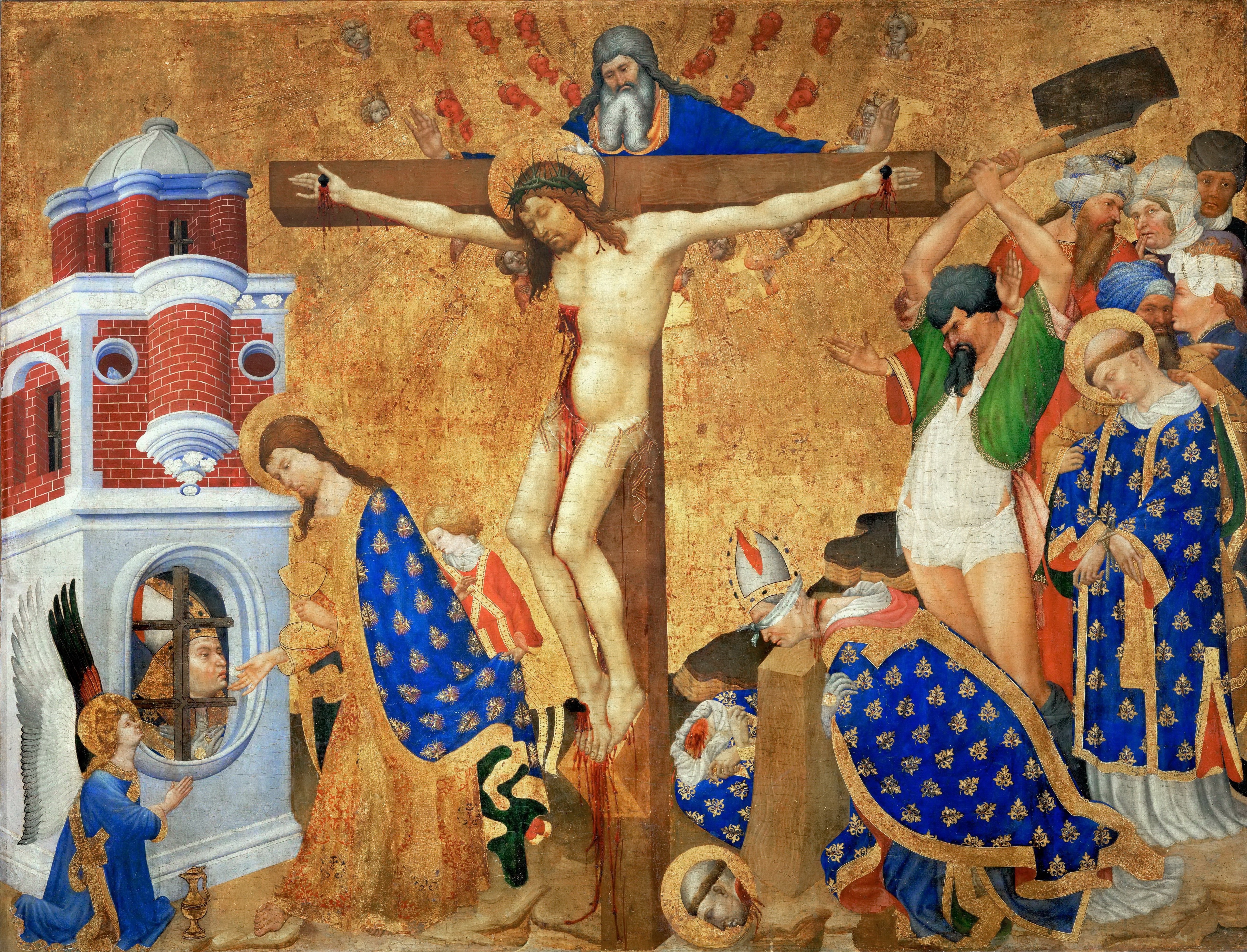
z) as depicted (at left, receiving communion from Jesus while imprisoned; at right, undergoing martyrdom along with Sts. Rusticus and Eleutherius) by Henri Bellechose on an early fifteenth-century altarpiece (paid for in 1416) in the Museé du Louvre in Paris:


https://upload.wikimedia.org/wikipedia/commons/6/64/Henri_Bellechose_001.jpg

http://tinyurl.com/3rey5zj

aa) as depicted in a full-page illumination of French or English workmanship, attributed to the Master of Sir John Fastolf's Hours, in an earlier fifteenth-century Book of Hours (ca. 1430-1440; Los Angeles, J. Paul Getty Museum, ms. 5, fol. 35v):


http://www.getty.edu/art/exhibitions/cult_saints/images/00300601_zm.jpg

http://tinyurl.com/yhcuuh5

Detail view (D.'s severed head):

St. Denis / M. Sir John Fastolf
http://tinyurl.com/ylooxrf

bb) as portrayed in a later fifteenth-century polychromed limestone statue (c. 1460-1470) in the Bode-Museum, Berlin:

https://upload.wikimedia.org/wikipedia/commons/6/60/Le_Moiturier_%28circle%29_Saint_Denis.jpg

http://tinyurl.com/4gvkeg

cc) as depicted (martyrdom and, in the upper register, cephalophory) in a later fifteenth-century copy of the Legenda aurea in its French-language translation by Jean de Vignay (c. 1480-1490; Paris, BnF, ms. Français 245, fol. 135r):


http://tinyurl.com/yg4vhdu

dd) as depicted (between Sts. Rusticus and Eleutherius) in a late fifteenth-century breviary according to the Use of Langres (after 1481; Chaumont, Mediathèque de Chaumont, ms. 33, fol. 456r):


http://www.enluminures.culture.fr/Wave/savimage/enlumine/irht6/IRHT_097055-p.jpg

http://www.enluminures.culture.fr/Wave/savimage/enlumine/irht6/IRHT_097055-p.jpg

ee) as depicted in a hand-colored woodcut in the Beloit College copy of Hartmann Schedel's late fifteenth-century Weltchronik (Nuremberg Chronicle; 1493) at fol. CIXv:


http://www.beloit.edu/nuremberg/book/images/Martyrs/big/Dionysius%20(the%20Areopagite)%20CIXv.jpg

http://tinyurl.com/9ghdm8w

ff) as portrayed in high relief on a polychromed and gilt panel of a late fifteenth- or early sixteenth-century altarpiece (ca. 1490-1510) in the Filialkirche Hl. Leonhard in Pesenbach (Oberösterreich):


http://tarvos.imareal.oeaw.ac.at/server/images/7017908.JPG

http://tarvos.imareal.oeaw.ac.at/server/images/7017908.JPG

gg) as depicted (at right; at left, St. Sebastian) on a panel of the late fifteenth- or early sixteenth-century winged altar (c. 1497-1507) in the Pfarrkirche Hl. Remigius in Gampern (Oberösterreich):


http://tarvos.imareal.oeaw.ac.at/server/images/7017792.JPG

http://tarvos.imareal.oeaw.ac.at/server/images/7017792.JPG

hh) as portrayed in high relief (at far left) on the central panel of the late fifteenth-century Vierzehn-Nothelfer-Altar (1498) in the Münster St. Marien und Jakobus in Heilsbronn (Lkr. Ansbach):


https://upload.wikimedia.org/wikipedia/commons/c/c6/Heilsbronn_M%C3%BCnster_Vierzehn-Nothelfer-Altar_Schrein.jpg

http://tinyurl.com/pcnarog

Detail view:


https://upload.wikimedia.org/wikipedia/commons/b/bc/Heilsbronn_M%C3%BCnster_Vierzehn-Nothelfer-Altar_Hl_Dionys.jpg

http://tinyurl.com/qbceeza

ii) as portrayed in high relief on an early sixteenth-century stall end (between 1501 and 1507) in the choir of the St. Martins-Kirche in Memmingen:


https://upload.wikimedia.org/wikipedia/commons/0/04/Chorgest%C3%BChl_St._Martin_Memmingen_-_St._Dionysos.JPG
http://tinyurl.com/nahwgj9

jj) as depicted (at left; at right, St. Margaret) by Vicente Macip in the central panel of his early sixteenth-century altarpiece (c. 1510) in the capilla de San Dionisio y Santa Margarita in Valencia's catedral de la Asunción de Nuestra Señora:


San Dionisio y Santa Margarita by Meldelen

http://tinyurl.com/3bbdu8b

kk) as depicted by the Master of Messkirch on a panel from a dismembered earlier sixteenth-century altarpiece (c. 1535-1540) in the Staatsgalerie Stuttgart:


https://upload.wikimedia.org/wikipedia/commons/4/47/Heiliger_Dionysius.jpg

http://tinyurl.com/pd6m447


John Dillon subsequently posted two additional images:
Dionysius as depicted in one of four panels of a full-page illumination in the late twelfth-century so-called Bible of Saint Bertin (ca. 1190-1200; Den Haag, KB, ms. 76 F 5, fol. 28v):
http://www.wga.hu/art/zgothic/miniatur/1151-200/3french/22french.jpg
http://manuscripts.kb.nl/zoom/BYVANCKB%3Amimi_76f5%3A028v_min_a2

Dionysius (martyrdom) as depicted in an earlier fifteenth-century prayer book from Brabant (ca. 1430-1440; Baltimore, The Walters Art Museum, ms. W.164, fol. 171r):


To all those I would add this image from the mid-fifteenth century east window of the church of St Denys in York


https://s-media-cache-ak0.pinimg.com/236x/e1/b0/d4/e1b0d44789eaee9c620bbe2cbed2b324.jpg

Image: pinterest/Roger Walton on Flickr

Meanwhile the New Liturgical Movement had an interesting post about the celebration of Mass in Greek by the monks of St Denis in honour of the Greek origin of their patron. The article is by The Greek Mass of St Denys of Paris