Once I was a clever boy learning the arts of Oxford... is a quotation from the verses written by Bishop Richard Fleming (c.1385-1431) for his tomb in Lincoln Cathedral. Fleming, the founder of Lincoln College in Oxford, is the subject of my research for a D. Phil., and, like me, a son of the West Riding. I have remarked in the past that I have a deeply meaningful on-going relationship with a dead fifteenth century bishop... it was Fleming who, in effect, enabled me to come to Oxford and to learn its arts, and for that I am immensely grateful.


Showing posts with label St Sebastian. Show all posts

Monday, 20 January 2025

St Sebastian - the emergence of an iconography


Today is the joint feast of the martyrs St Fabian and St Sebastian. 

Wikipedia has an account of his legend and his cult and patronage, as well as his iconography and its varied interpretations down to the present in Saint Sebastian

I have posted in past years in particular about the iconography of St Sebastian, which is one that in its established form in later medieval and Renaissance art is very distinctine and recognisable indeed.

My post from 2016, using examples posted by John Dillon on the Medieval Religion discussion group site, illustrates this process very well and it can be seen at St Sebastian

Last year I added to this fine collection a link to  an article on the New Liturgical Movement about a Florentine tryptophan from the late fourteenth century. That, with the link, can be seen at St Sebastian

This year I can add another St Sebastian triptych, or at least what remains of it, scattered across two continents and a number of galleries, which is always a thing to be deeply regretted, and which date from 1497-99. It is the work of Josse Lieferinxe

He was an artist from Hainault who then worked in Provence. The commission was for a confraternity based in a now destroyed church in Marseille. Formerly known only as the Master of St Sebastian he has now recovered something of his identity due to academic research.

The triptych is discussed in considerable detail in an informative article that can be accessed at Preventative Medicine: Josse Lieferinxe’s Retable Altar of St. Sebastian as a Defense Against Plague in 15th Century Provence - Persée

One of the panels, depicting St Sebastian interceding for the victims of plague, can be seen at Josse Lieferinxe - Saint Sebastian Interceding for the Plague Stricken - Walters


St Sebastian pray for us
St Fabian pray for us


Wednesday, 20 January 2016

St Sebastian


Being based in Oxford it seems only appropriate when offered by John Dillon via the Medieval Religion discussion group a series of images of St Sebastian to share them with readers on this the feast of the name saint of Lord Sebastian Flyte, the second son of the late Marquess of Marchmain.
Some of the later paintings reflect the choices made in the Italian renaissance by artists and patrons to depict the almost nude male form, as opposed to earlier traditions of representing St Sebastian, and do have, dare I suggest it, something in them of homoerotic sado-masochism - you can't say the Clever Boy fails to cater for all tastes amongst his readers.

Here is John's selection together with his introductory note:


The Roman martyr Sebastian (d. 3d cent.?) is first documented in the Depositio martyrum of the Chronographer of 354, where he is entered under today as a martyr of the Via Appia.  According to St. Ambrose of Milan, Sebastian was a native of that city who was martyred at Rome.  His legendary Passio (BHL 7543; ineptly ascribed to Ambrose) is our earliest source for this saint's frequently depicted attempted execution by arrows, of which so many pierced him that -- still according to the Passio -- he came to resemble a hedgehog.  The same account -- which is set in the the persecution of Diocletian and Maximian and which previously had detailed his support of the twins Mark and Marcellian and many others --  then gives a rapidly healed Sebastian a final colloquy with Diocletian after which the saint is clubbed to death in the Circus and his body is dumped into a nearby sewer.  Instructed by Sebastian in a vision, a Christian matron named Lucina retrieves his body and buries it at a location in the catacombs near the remains of the apostles (Peter and Paul, of course).  When the persecutions have ended Lucina converts her home into a church and gives it to the church of Rome.  Thus far the Passio.  Lucina's church is of course the titulus Lucinae, the predecessor of today's San Lorenzo in Lucina. The burial site specified in the Passio is that of Sebastian's martyrial church on the Via Appia Antica, after several rebuildings over the centuries today's basilica di San Sebastiano ad Catacumbas (or San Sebastiano f. l. M.).


Some period-pertinent images of St. Sebastian of Rome:

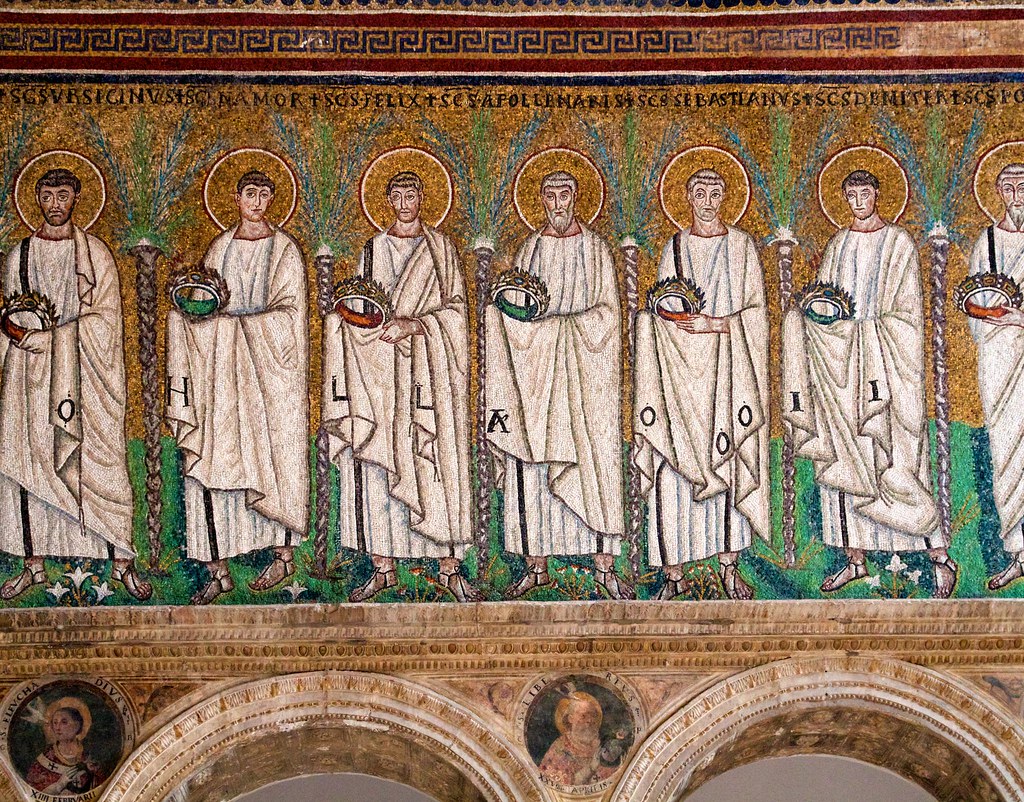
a) as depicted (third from right) in the heavily restored, later sixth-century procession of male martyrs (c. 561) in the nave of Ravenna's basilica di Sant'Apollinare Nuovo:

 
http://tinyurl.com/7lebx8n

b) as depicted in a probably late seventh-century mosaic portrait in Rome's basilica di San Pietro in Vincoli:


http://web.archive.org/web/20080227232948/http://bode.diee.unica.it/~giua/SEBASTIAN/PICS/vincoli.jpg


c) as depicted (upper register, martyrdom; lower register, St. Blasius / Blaise) in a later twelfth-century breviary for the canonesses of Seckau (Graz, UB, cod. 832, fol. 18r):
http://tarvos.imareal.oeaw.ac.at/server/images/7009800.JPG

d) as depicted (martyrdom) in one of four panels of a full-page illumination in the late twelfth-century so-called Bible of Saint Bertin (c. 1190-1200; Den Haag, KB, ms. 76 F 5, fol. 35v, sc. 1B):
http://manuscripts.kb.nl/zoom/BYVANCKB%3Amimi_76f5%3A035v_min_b1

e) as depicted (martyrdom) in an earlier thirteenth-century collection of saint's lives in their French-language translation by Wauchier de Denain (between 1226 and 1250; London, BL, Royal 20 D VI, fol. 48v):
http://www.bl.uk/catalogues/illuminatedmanuscripts/ILLUMIN.ASP?Size=mid&IllID=48231

f) as depicted (at left; St. Mary Magdalene at right) in a mid-thirteenth-century glass window (c. 1250-1260) in the west choir of Naumburg's Dom St. Peter und St. Paul:

 http://www.wga.hu/art/zgothic/stained/13c/12g_1250.jpg


g) as depicted (martyrdom) in a later thirteenth-century Cistercian psalter of upper Rhine origin (c. 1260; Besançon, Bibliothèques municipales, ms. 54, fol. 15r):
http://www.enluminures.culture.fr/Wave/savimage/enlumine/irht5/IRHT_083237-p.jpg

h) as depicted (martyrdom) in the later thirteenth-century frescoes (1278 or 1279) of Rome's chiesa di San Lorenzo in Palatio ad Sancta Sanctorum:
https://www.pemptousia.gr/wp-content/uploads/2014/12/ag.sebastianos22.jpg
A different interpretation (the BVM and St. John disporting themselves at archery?):
http://www.agefotostock.com/age/en/Stock-Images/Rights-Managed/DAE-11285236

i) as depicted (martyrdom) in a late thirteenth-century copy of French origin of the Legenda aurea (San Marino, CA, Huntington Library, ms. HM 3027, fol. 22v):
http://digitalassets.lib.berkeley.edu/ds/huntington/images//000969A.jpg

j) as depicted (at far right, martyrdom; at centre, Sts. Mark and Marcellian) in an earlier fourteenth-century copy of books 9-16 of Vincent of Beauvais' Speculum historiale in its French-language version by Jean de Vignay (c. 1335; Paris, BnF, ms. Arsenal 5080, fol. 218v):
http://gallica.bnf.fr/ark:/12148/btv1b7100627v/f442.item.zoom

k) as depicted (perhaps; the identifying inscription appears to have been re-painted) in the earlier fourteenth-century frescoes (between 1335 and 1350) in the church of the Holy Ascension in the Visoki Dečani monastery near Peć in, depending upon one's view of the matter, either the Republic of Kosovo or Serbia's province of Kosovo and Metohija:
http://tinyurl.com/6uubsp6

l) as depicted by Nicolò Semitecolo in several later fourteenth-century panel paintings (1367) in the Museo diocesano in Padua:
1) supporting Sts. Mark and Marcellian before the emperors:

 http://www.wga.hu/art/s/semiteco/2christi.jpg

2) martyrdom by arrows:

 https://upload.wikimedia.org/wikipedia/commons/6/63/Niccolo_Semitecolo._Sebastiano_trafitto_dalle_frecce._1367._53x60cm._Padova%2C_Museo_Diocesano.jpg

3) martyrdom by clubbing; his body dumped in a sewer:

https://upload.wikimedia.org/wikipedia/commons/f/f8/B_Nicol%C3%B2_Semitecolo._St_Sebastian_Beaten_with_Sticks._1367%2C_Padova%2C_Museo_Diocesano.jpg

4) entombment:
 https://upload.wikimedia.org/wikipedia/commons/4/4c/Nicol%C3%B2_Semitecolo%2C_Deposizione_del_corpo_di_San_Sebastiano_1367%2865%2C5x70cm%29Padova%2C_Museo_Diocesano.jpg


The Clever Boy would ad dthat these four paintings have some lovely fourteenth century details of interest in themselves - click on the link to see them in alarger format.

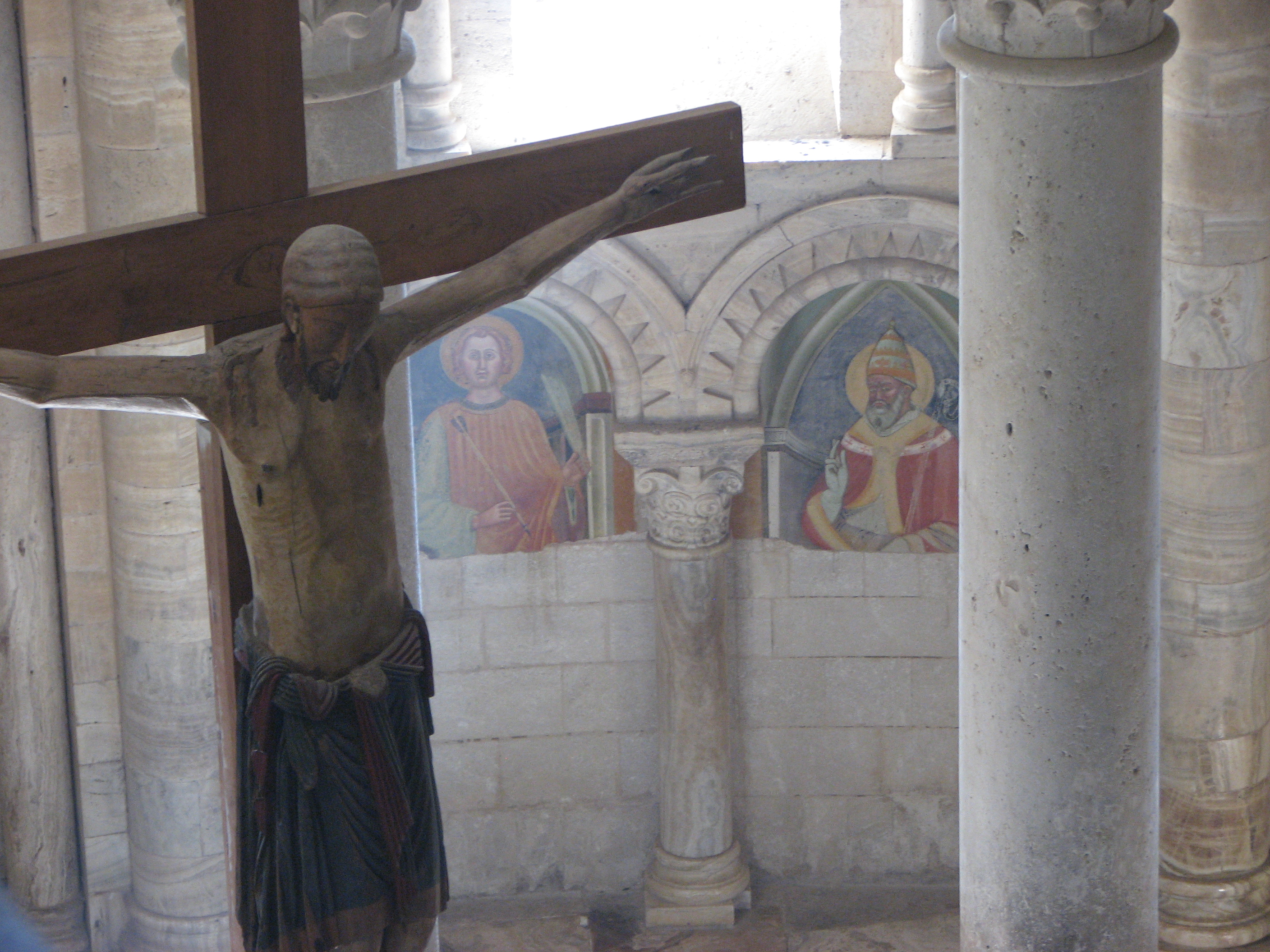
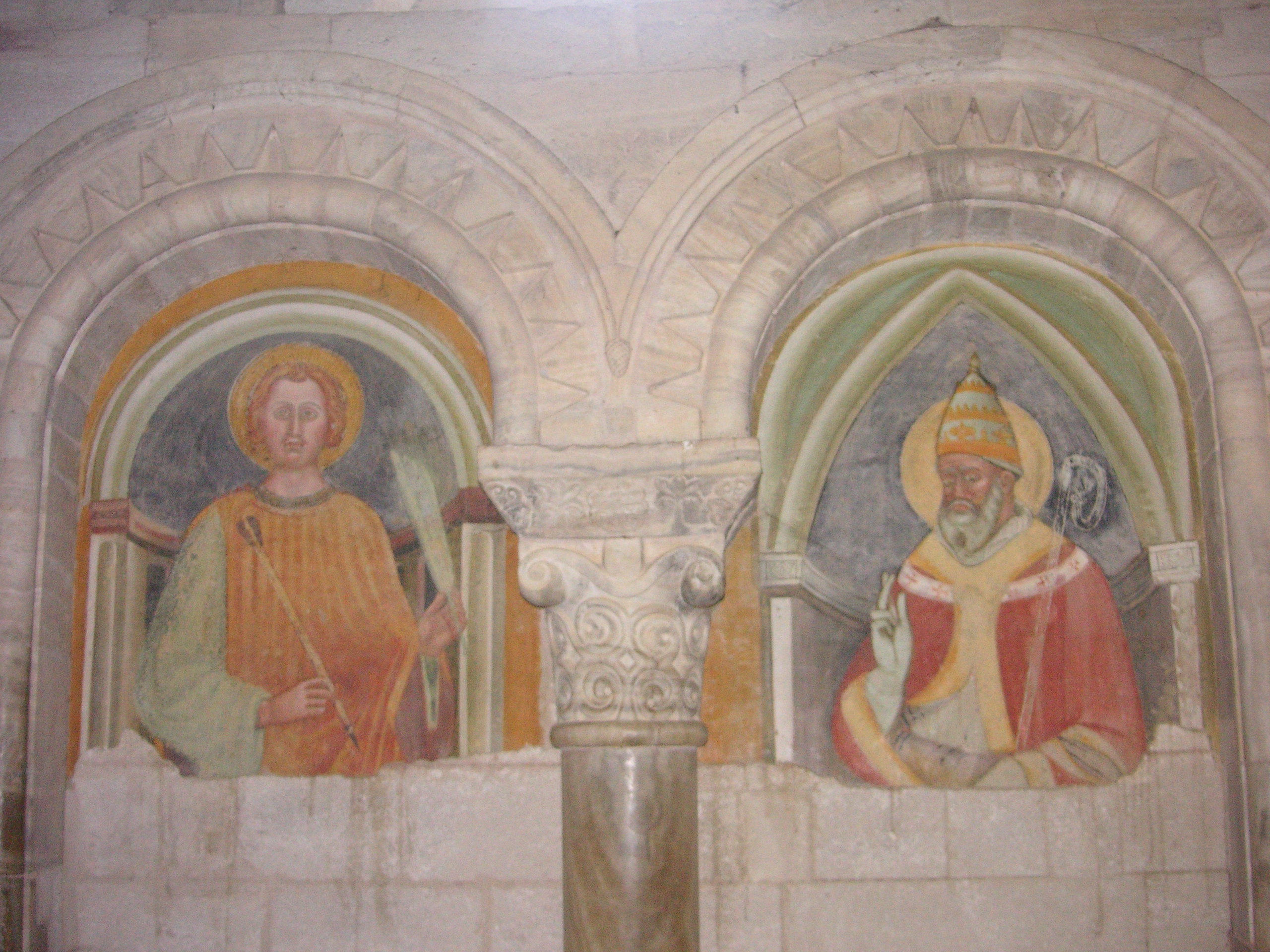
m) as depicted (at left; at right, a sainted pope) in a pair of late fourteenth- or fifteenth-century frescoes in the ambulatory of the abbey church of Sant'Antimo at Montalcino (SI) in Tuscany (the abbey claimed to possess relics of Sebastian given at its foundation in 781 by Pope Hadrian I, who supposedly had received them from Charlemagne):

 https://upload.wikimedia.org/wikipedia/commons/e/e2/Abbazia_di_Sant%27Antimo_-_53_-_Il_crocifisso_e_gli_affreschi_visti_dal_matroneo.jpg

https://upload.wikimedia.org/wikipedia/commons/4/46/Sant%27Antimo_affreschi.JPG


n) as depicted by Taddeo di Bartolo (martyrdom) in a remounted early fifteenth-century fresco (ca. 1400-1410) in Naples' Museo nazionale di Capodimonte:

 https://upload.wikimedia.org/wikipedia/commons/9/98/Taddeo_di_Bartolo_-_Saint_Sebastian.jpg

o) as depicted (martyrdom) in the Suffrages of the earlier to mid-fifteenth-century Hours of Françoise de Dinan (ca. 1435-1450; a.k.a. Hours of Catherine de Rohan and of Françoise de Dinan; Rennes, Bibliothèque de Rennes Métropole, ms. 34bis [pt. 2 of ms. 15942], fol. 87r):
http://www.tablettes-rennaises.fr/app/photopro.sk/rennes/detail?docid=6834#sessionhistory-ready
http://tinyurl.com/jyek5yp

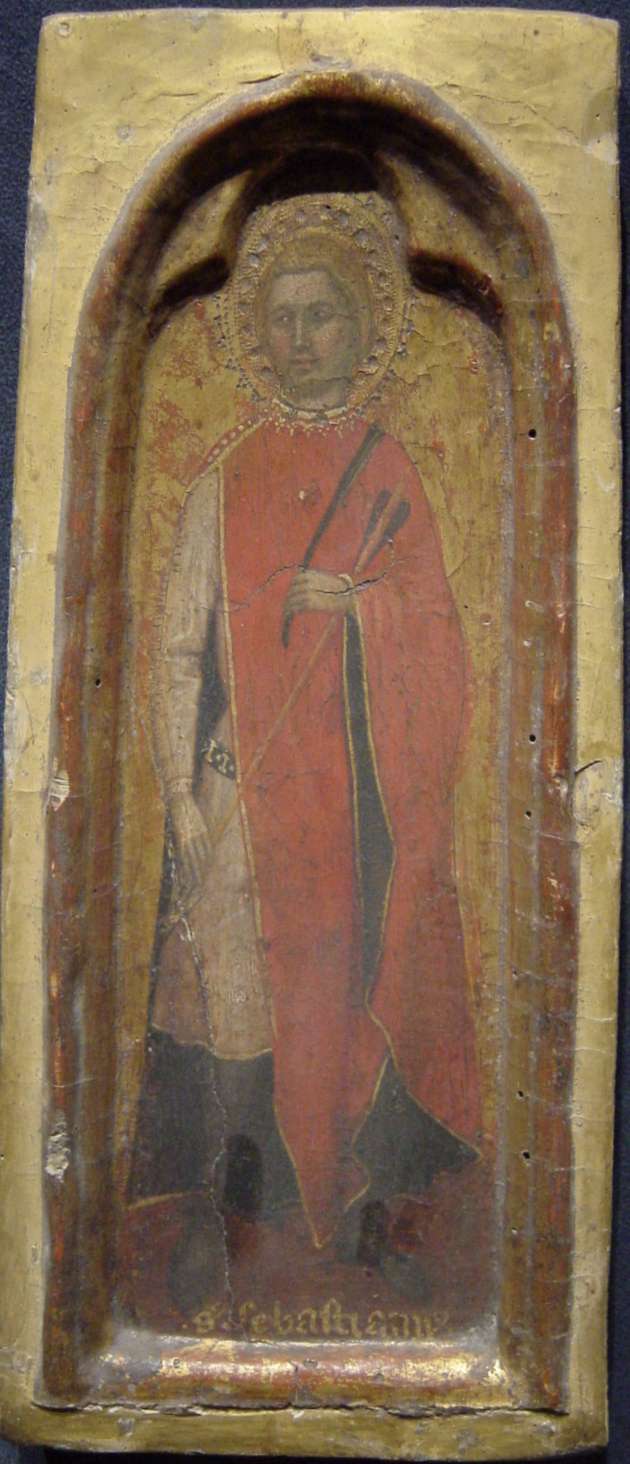
p) as depicted by the Master of the Bodensee (second from left, after St. Anthony of Egypt, and with St George and St Ursula) in an earlier fifteenth-century panel painting in the Staatliche Kunsthalle Karlsruhe:
http://www.ipernity.com/doc/1654608/38630734/

q) as portrayed in a mid-fifteenth-century head reliquary (1450) in the Pfarrkirche St. Sebastian in Ebersberg (Lkr. Ebersberg) in Bavaria:


File:Relic of St. Sebastian 01.JPG

There is anothe rpicture of the reliquary at 
 https://de.wikipedia.org/wiki/Datei:Relic_of_St._Sebastian_02.JPG

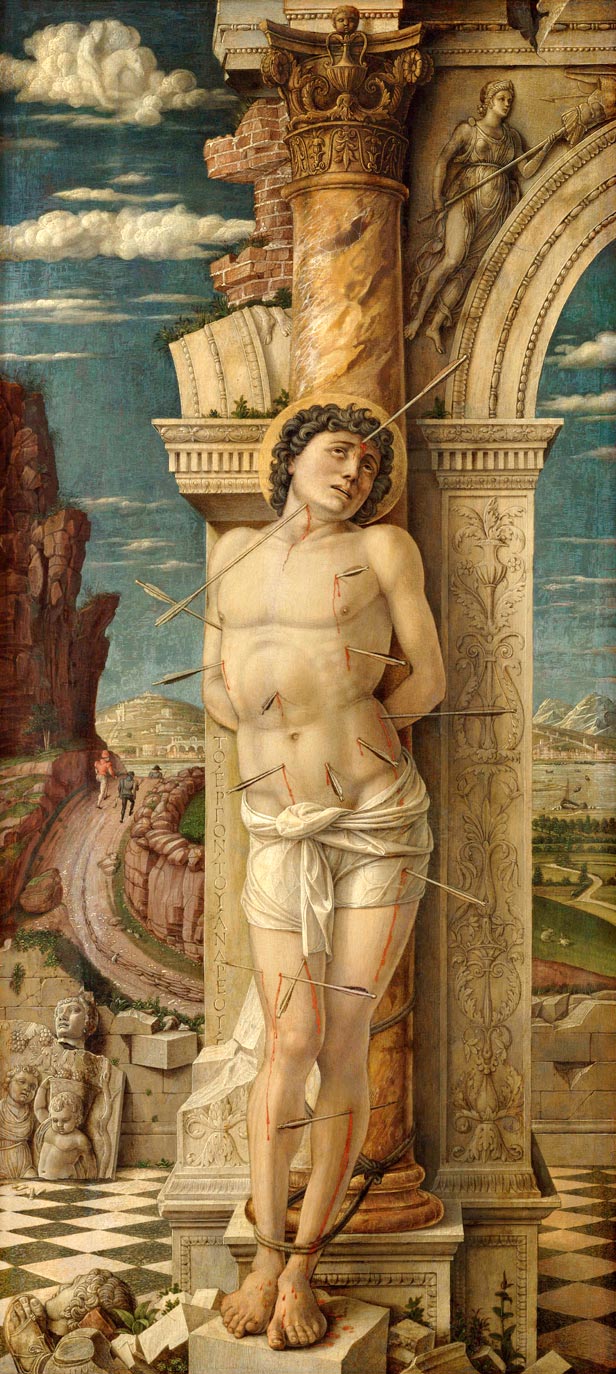
r) as depicted by Andrea Mantegna (martyrdom) in a mid-fifteenth-century panel painting (later 1450s) in the Kunsthistorische Museum, Vienna:


https://upload.wikimedia.org/wikipedia/commons/4/4d/Andrea_Mantegna_089.jpg


s) as depicted in a later fifteenth-century fresco in the left apsidal chapel of the crypt of the chiesa di San Ponziano in Spoleto:
https://www.flickr.com/photos/hen-magonza/9124891102/

t) as depicted by Sandro Botticelli (martyrdom) in a later fifteenth-century panel painting (1473) in the Gemäldegalerie, Berlin:

 https://upload.wikimedia.org/wikipedia/commons/4/4c/Sandro_Botticelli_054.jpg


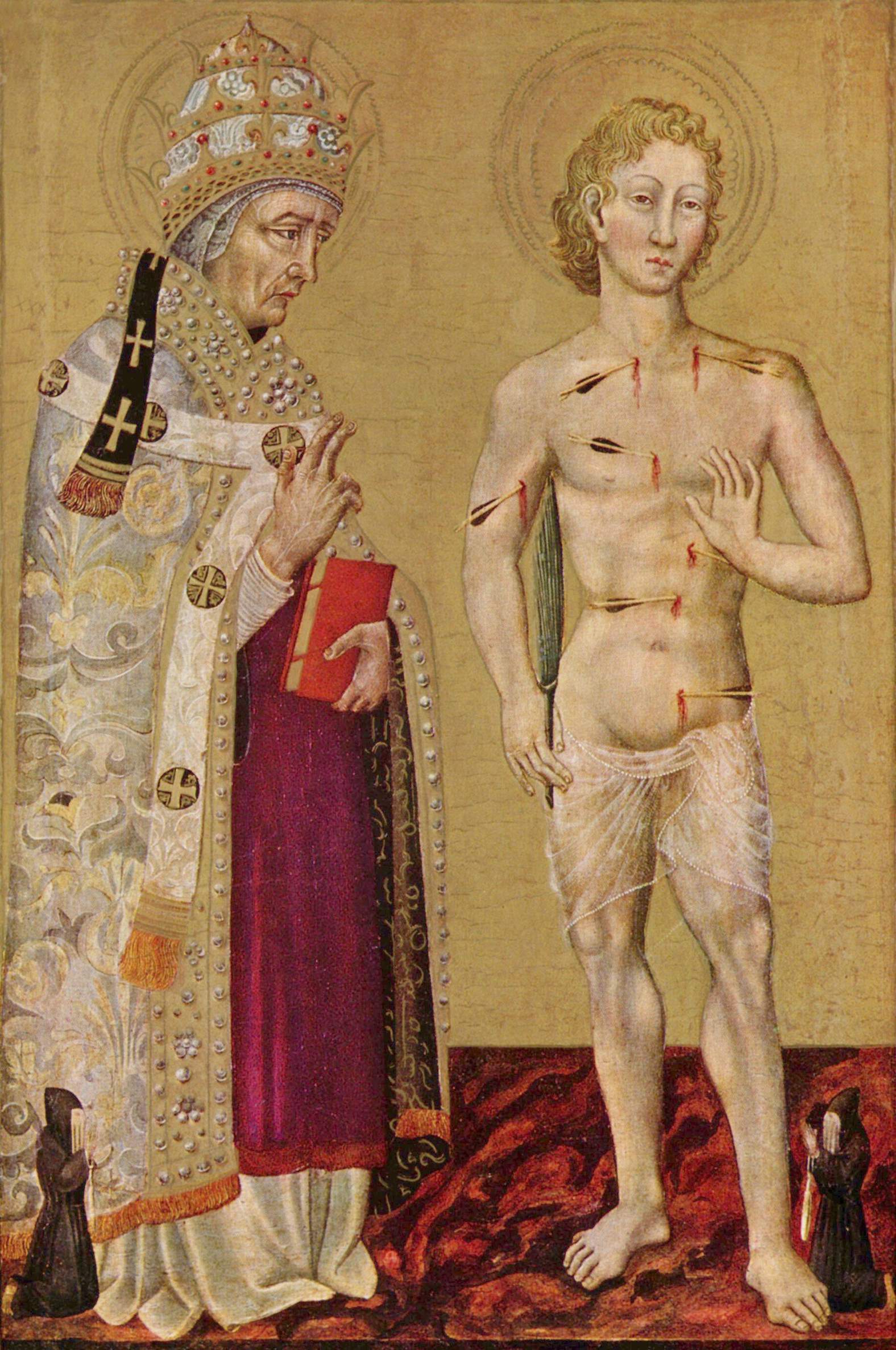
u) as depicted (at right, martyrdom; at left, pope St. Fabian, whose feast day also falls today) in a later fifteenth-century panel painting (c. 1475), attributed to Giovanni di Paolo, in the National Gallery, London:
1) Before cleaning in the 1970s (the National Gallery still calls this cleaning 'recent'):

 https://upload.wikimedia.org/wikipedia/commons/f/fa/Giovanni_di_Paolo_002.jpg


2) After cleaning (the second image is clearer but the colours are off) :
http://tinyurl.com/yczp53u
http://tinyurl.com/ycz7ccx

The Clever Boy will add that the National Gallery website states that: Recent cleaning revealed the original upraised position of Sebastian's hand and forearm and some twenty arrows piercing his body, most of which had been painted out.

At the bottom in each corner is a kneeling Brother of the Confraternity of the Misericordia, a lay brotherhood which was devoted to the Seven Works of Mercy. The brothers, dressed in black with white veils, are holding what may be spoons used for collecting alms.

This is a complete votive picture - one promised and offered in thanks for the favourable answer to a prayer - and is probably one of Giovanni di Paolo's late works.

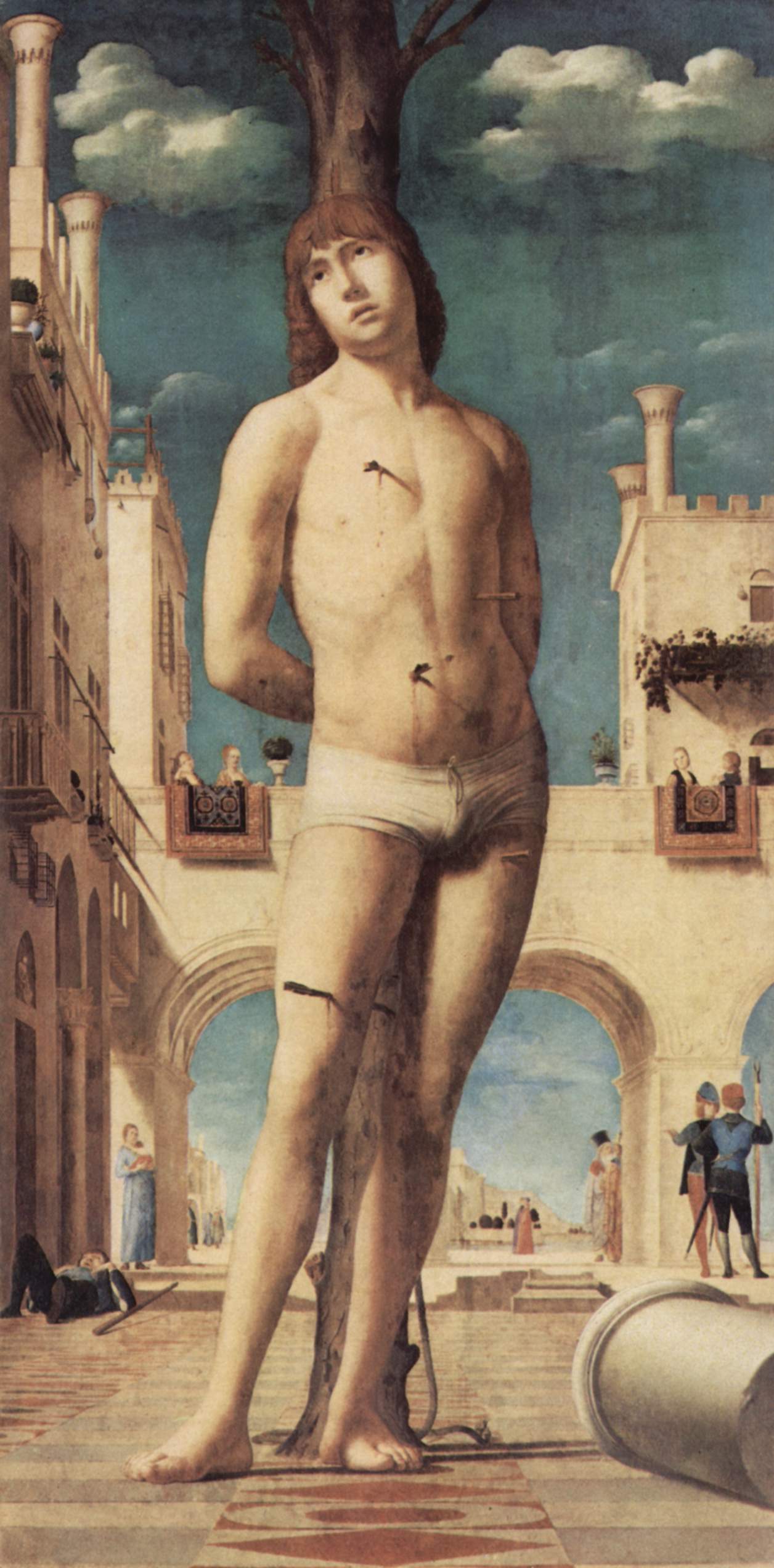
v) as depicted by Antonello da Messina (martyrdom) in a later fifteenth-century panel painting (c. 1476) in the Gemäldegalerie, Dresden:


https://upload.wikimedia.org/wikipedia/commons/4/47/Antonello_da_Messina_018.jpg


w) as depicted by Andrea Mantegna (martyrdom) in a later fifteenth-century panel painting (c. 1480) in the Musée du Louvre, Paris:


https://upload.wikimedia.org/wikipedia/commons/c/c1/Andrea_Mantegna_088.jpg


x) as depicted (martyrdom) in the later fifteenth-century Hours of Dionora of Urbino (c. 1480; London, BL, MS Yates Thompson 7, fol. 93v):
http://www.bl.uk/catalogues/illuminatedmanuscripts/ILLUMIN.ASP?Size=mid&IllID=6000

y) as depicted by Giovanni Baleison (martyrdom) in a late fifteenth-century fresco by Giovanni Baleison in the Chapelle Saint-Sebastien, Saint-Étienne-de-Tinée (Alpes-Maritimes):
http://www.culture.gouv.fr/culture/medieval/en/b036.htm

z) as depicted (at left; at right, St. Anthony of Egypt) in a late fifteenth-century stained glass roundel in the Museum Schnütgen, Köln:
http://tinyurl.com/hq9nvte

aa) as depicted (martyrdom) in a late fifteenth-century stained glass roundel in the Musée national du Moyen Âge (Musée de Cluny), Paris:
http://therosewindow.com/pilot/Paris-Musee-Cluny/w61.htm

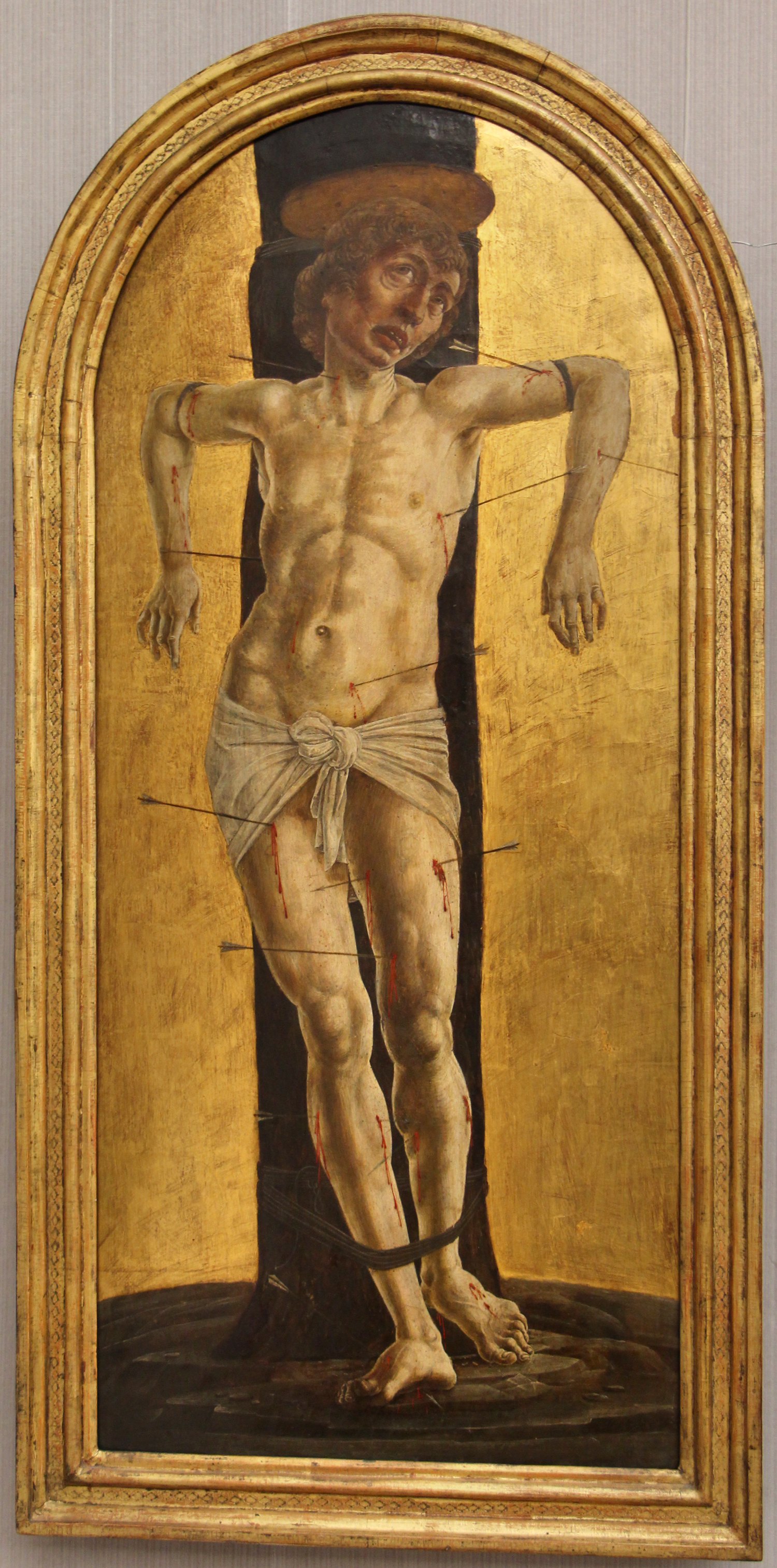
bb) as depicted by Cosmè Tura (martyrdom) in a late fifteenth-century panel painting (c. 1484) in the Gemäldegalerie, Berlin:

 https://upload.wikimedia.org/wikipedia/commons/8/8c/Cosm%C3%A8_tura%2C_san_sebastiano%2C_1484_ca.JPG


cc) as depicted by Andrea Mantegna (martyrdom) in a late fifteenth-century panel painting (c. 1490) in the Galleria Giorgio Franchetti alla Ca' d'Oro, Venice:


https://upload.wikimedia.org/wikipedia/commons/a/aa/St_Sebastian_3_Mantegna.jpg


dd) as portrayed (martyrdom) in a late fifteenth-century silver and silver gilt reliquary (c. 1497) from Augsburg in the Victoria and Albert Museum in London:


In addition here are some glass images added by Gordon Plumb:

St-Nicolas-de-Port, Bay 105, 5a-7a, 5b-7b, martyrdom of Sebastian,
early 16thC.:
https://www.flickr.com/photos/22274117@N08/4127966209
and detail:
https://www.flickr.com/photos/22274117@N08/4128739542

St-Nicolas-de-Port, Bay 113, 2c-4c:
https://www.flickr.com/photos/22274117@N08/4137043660

Bourges, Cathédrale Saint-Étienne, Bay 27, Virgin and Child with
Sebastian and another saint:
https://www.flickr.com/photos/22274117@N08/4266380565

Tuesday, 17 November 2015

St Elizabeth of Hungary


John Dillon posted about St Elizabeth of Hungary, whose feast falls today in the General calendar, on the Medieval Religion discussion group as follows:

A daughter of King Andrew II of Hungary, Elizabeth was married in 1221 to Ludwig IV, landgrave of Thüringen (whence she is also known as Elizabeth of Thüringen). They had three children of whom the third, a daughter, was born after her crusading father's death at Otranto in 1227 and died in infancy. Only twenty when she was widowed, Elizabeth left the Thuringian court soon afterward -- there was a nasty struggle over her dowry -- and took up residence in Marburg (in today's Hessen), where she lived ascetically, devoted herself to works of charity, and died in 1231 at the age of twenty-four. Miracles were reported at her tomb and a cult arose. Two canonization trials ensued, followed by a canonization in 1235. Having dedicated to St. Francis of Assisi a hospital she had built in Marburg, she was subsequently promoted by Franciscans as a model of lay spirituality and charity. But she was educated at a Dominican convent in Hungary and the Dominicans claim her as well.

Elizabeth has a very extensive hagiographic dossier, including rather different miracle collections emanating from the Order of Friars Minor and from the Order of Preachers. In one legend, the young Elizabeth was forbidden by her father to distribute food to the poor. She of course did so anyway and was stopped for inspection, whereupon the food was changed miraculously to flowers (or was miraculously covered by them).

Some period-pertinent images of St. Elizabeth of Hungary / of Thüringen:

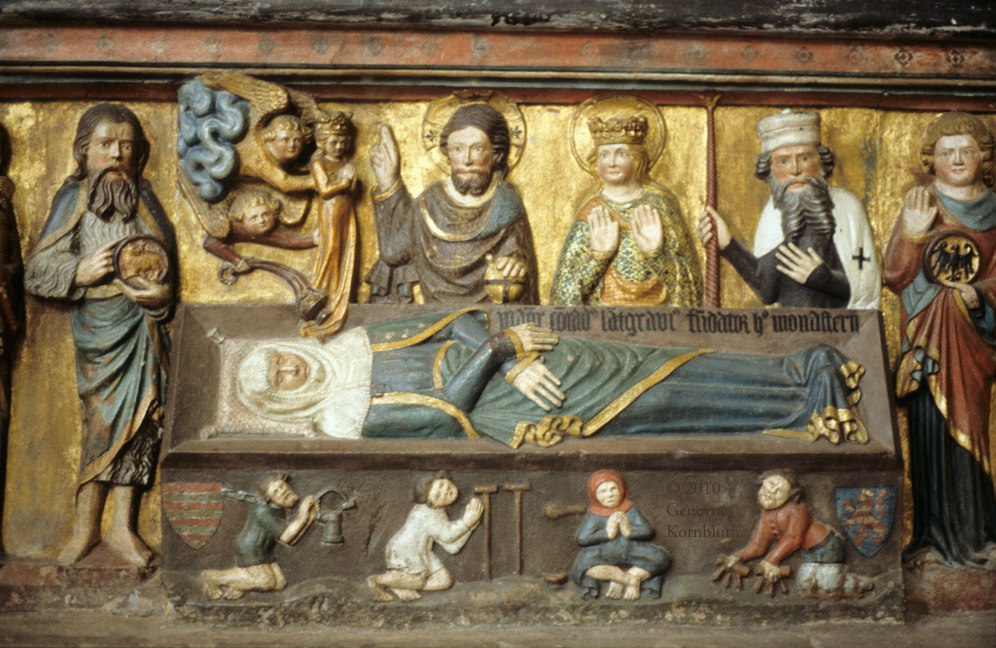
a) as portrayed at the base of her tomb (c. 1235-1250) in the originally thirteenth- and earlier fourteenth-century St. Elisabethkirche in Marburg an der Lahn, begun in the year of her canonization:

 http://www.kornbluthphoto.com/images/ElizShrine2.jpg

http://www.kornbluthphoto.com/images/ElizShrine2.jpg [photo courtesy of Genevra Kornbluth]
The tomb as a whole:

 http://www.elisabethkirche.de/fileadmin/_processed_/csm_04_EC_Mausoleum_01_e7d7fb54ad.jpg


http://www.kornbluthphoto.com/images/ElizShrine1.jpg [photo courtesy of Genevra Kornbluth]

b) as portrayed on her copper-gilt shrine (between 1235 and 1250) in the same church:
1) standing, on one of the shrine's short ends:

 http://www.elisabethkirche.org/typo3temp/pics/aeb08e1fc2.jpg


 http://www.elisabethkirche.org/typo3temp/pics/1ad12d9afb.jpg


2) Scenes of Elizabeth as portrayed on the roof of the shrine:

 http://www.rmv.de/linkableblob/de/38882-26173/original/MR_Elisabethkirche_Schrein.jpg

 http://www.kirchenzeitung.de/sites/bz5.bistumspresse-zentralredaktion.de/files/imagecache/node-gallery-display-full/images/fotostrecken/Elisabeth_5.jpg


 https://www.uni-marburg.de/aktuelles/news/2007/0515w/image_preview


 http://www.heilige-elisabeth-damp.de/bilder/00561_01.jpg


c) Elizabeth as portrayed in an earlier thirteenth-century statue, thought to be from very shortly after her canonization in 1235, in the Kirche (ex-cathedral) St. Peter und Paul in Naumburg:
http://tinyurl.com/2c92wjh

 https://rezitante.files.wordpress.com/2009/08/alten-naumburg-181.jpg?w=450&h=600

d) as depicted (scenes) in several panels of the earlier thirteenth-century glass window (before 1250) devoted to her in the choir of the St. Elisabethkirche in Marburg an der Lahn:
1) http://tinyurl.com/pn23wco
larger view:

 https://s-media-cache-ak0.pinimg.com/736x/6d/e8/32/6de83286d593fb41391968a23b499669.jpg

2) http://tinyurl.com/p4a2k7l

3) http://tinyurl.com/okvgktd
The window as a whole (click on the panels for smallish individual views):
http://alt.elisabethkirche.de/rundgang/ixu_fur_l6.htm

e) as depicted (at right; at left, St. Francis of Assisi) in a late thirteenth-century copy of French origin of the Legenda aurea (San Marino, CA, Huntington Library, ms. HM 3027, fol. 157r):
http://digitalassets.lib.berkeley.edu/ds/huntington/images//000914A.jpg

f) as depicted (tending the sick) in the late thirteenth-century Livre d'images de Madame Marie (c. 1285-1290; Paris, BnF, ms. Nouvelle acquisition française 16251, fol. 82v):
http://tinyurl.com/268a74o

g) as depicted (at left; with Sts. Margaret of Hungary and Henry of Hungary) by Simone Martini in his early fourteenth-century frescoes of Franciscan saints (c. 1318) in the south transept of the lower church of the basilica di San Francesco at Assisi:

 http://www.wga.hu/art/s/simone/3assisi/transept/5saints2.jpg


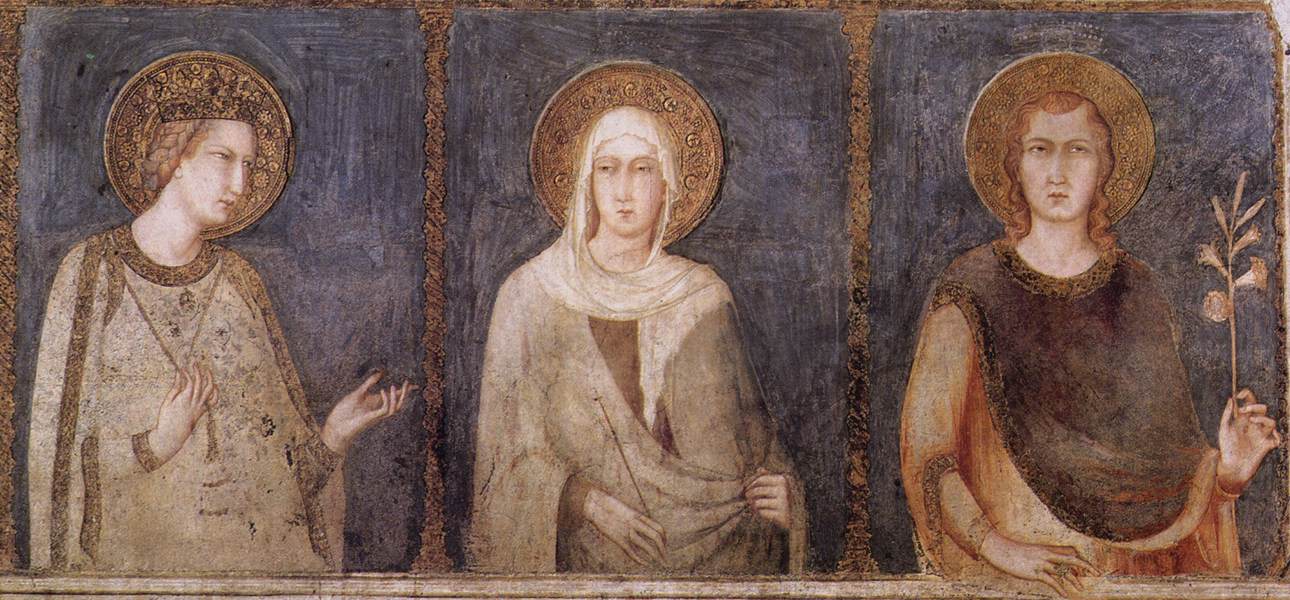
h) as depicted (at right; at left, St. Clare of Assisi) by Simone Martini in an earlier fourteenth-century fresco (c. 1318-1320) at the entrance to the cappella di San Martino in the lower church of the basilica di San Francesco at Assisi:

 http://www.wga.hu/art/s/simone/3assisi/1saints/saints40.jpg

Detail view (Elizabeth):

 http://www.wga.hu/art/s/simone/3assisi/1saints/saints41.jpg


i) as depicted (giving a cloak to a beggar) in a panel of the earlier fourteenth-century Altenberg Altarpiece (c. 1330) in the Städelsches Kunstinstitut, Frankfurt m Main:
https://www.flickr.com/photos/hen-magonza/5888827150/

j) as depicted (at right; miracle of the flowers) in an earlier fourteenth-century fresco (c. 1337) formerly in the chiesa di Sant'Elisabetta d'Ungheria in Perugia and now in the Galleria Nazionale dell'Umbria in that city:

 http://www.heiligenlexikon.de/Fotos/Nikolaus_von_Tolentino3.jpg


k) as depicted (experiencing a vision) in an earlier fourteenth-century copy of the Legenda aurea in its French-language version by Jean de Vignay (c. 1326-1350; Paris, BnF, ms. Français 185, fol. 223r):
http://tinyurl.com/27kq28s

l) as depicted (experiencing a vision) as depicted in an earlier fourteenth-century copy, from the workshop of Richard and Jeanne de Montbaston, of the Legenda aurea in its French-language version by Jean de Vignay (1348; Paris, BnF, ms. Français 241, fol. 305r):


m) as depicted on the upper portion of a wing of a later fourteenth-century altarpiece (c. 1370-1373) from Schloss Tirol in the Tiroler Landesmuseum Ferdinandeum, Innsbruck:

http://tarvos.imareal.oeaw.ac.at/server/images/7003466.JPG

The altarpiece as a whole:

 http://sammellust.ferdinandeum.at/wo_files/images/objekte/1826b.jpg


n) as depicted (holding flowers) in a late fourteenth- or very early fifteenth-century panel painting attributed to Gherardo Starnina (formerly known as the Maestro del Bambino Vispo) sold at auction at Sotheby's in 1962:

 https://upload.wikimedia.org/wikipedia/it/6/6b/Gherardo_Starnina_-_Sant%27Elisabetta_d%27Ungheria.jpg

Expandable grayscale views of the painting as photographed prior to that sale are here:
http://tinyurl.com/3x2fuzp
Where is the painting now?

o) as depicted (experiencing a vision) in the earlier fifteenth-century Châteauroux breviary (ca. 1414; Châteauroux, Bibliothèque municipale, ms. 2, fol. 415v):

 http://www.enluminures.culture.fr/Wave/savimage/enlumine/irht2/IRHT_054274-p.jpg


p) as depicted (washing a leper) in an early fifteenth-century copy of the Elsässische Legenda aurea (1419; Heidelberg, Universitätsbibliothek, Cod. Pal. germ. 144, fol. 242v):
http://digi.ub.uni-heidelberg.de/diglit/cpg144/0500
http://heidicon.ub.uni-heidelberg.de/heidicon/58/59/8795.html

q) as depicted (experiencing a vision) in an earlier-to-mid-fifteenth century Franciscan breviary of Milanese origin (Paris, BnF, ms. Latin 760, fol. 573r):
http://tinyurl.com/2a7psrq

r) as depicted (scenes) on the earlier fifteenth-century choir screen (c. 1420-1430) of the Heiligen-Geist-Hospital in Lübeck:


The panels in situ:

 https://upload.wikimedia.org/wikipedia/commons/d/d6/L%C3%BCbeck_Heiligen-Geist-Hospital_070311.jpg


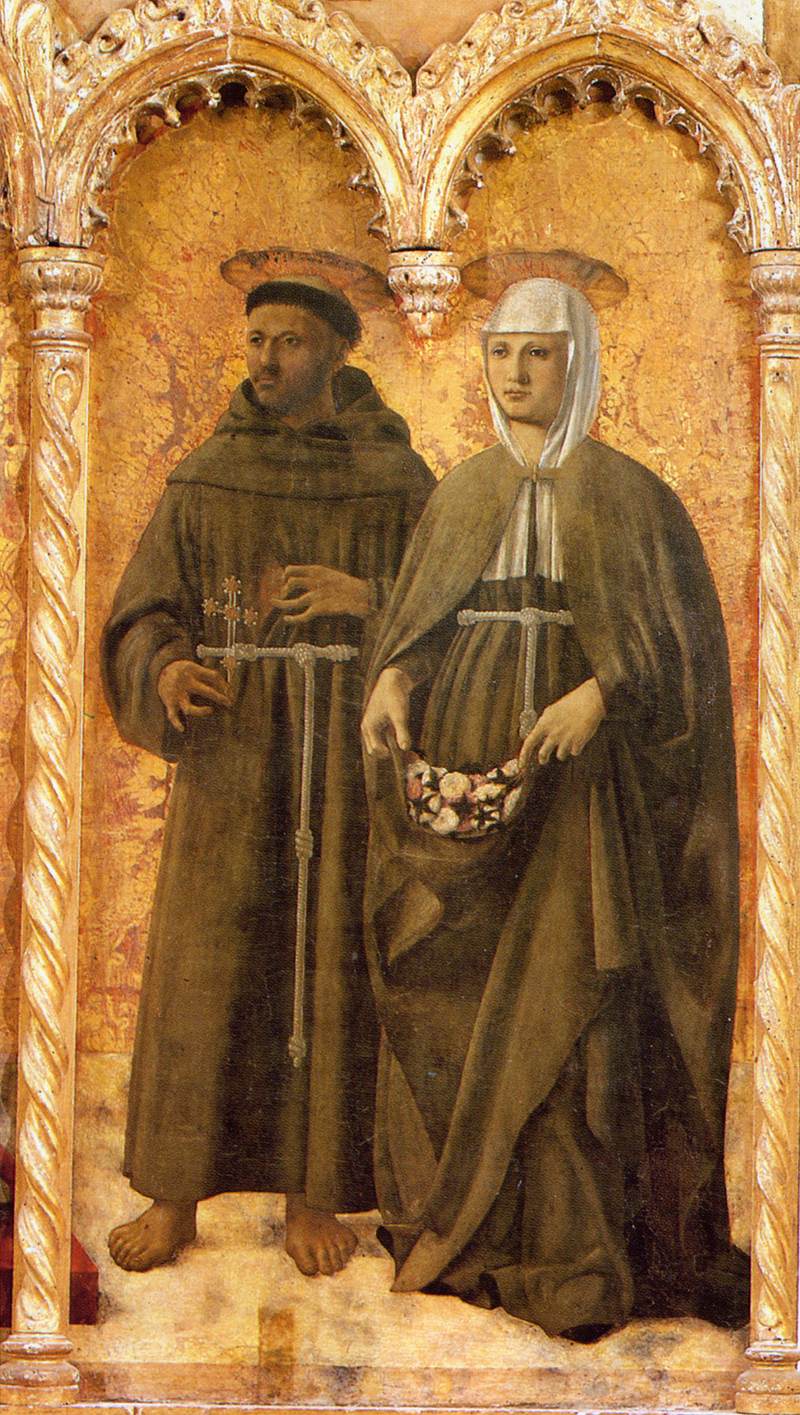
s) as depicted (at right, holding flowers; at left, St. Francis of Assisi) by Piero della Francesca in his later fifteenth-century Polyptych of Sant'Antonio (c. 1460-1470) in the Galleria Nazionale dell'Umbria in Perugia:

 http://www.wga.hu/art/p/piero/1/3anton04.jpg


t) as portrayed in a later fifteenth-century polychromed wooden statue (c. 1470; the crown is later) in the nave (near the choir screen) in the St. Elisabethkirche in Marburg an der Lahn:

https://blogger.googleusercontent.com/img/b/R29vZ2xl/AVvXsEj58nXMpcKwgjMYeh_-aDvuxVdwqr2TodBRR_xynni5CuFdgtS7nalG_Cn5TCmAsEZKYuNHBAQ6D3g-JpcN_VPU5afhH8k5Zmfr1TNJgYO9ygJmPZ3_IkSJY16AJB7PR74wzvd8mGFilHyA/s1600/196.JPG


 https://upload.wikimedia.org/wikipedia/commons/c/ca/Elisabeth_von_Th%C3%BCringen.JPG


In the statue she is holding the Elisabethkirche.

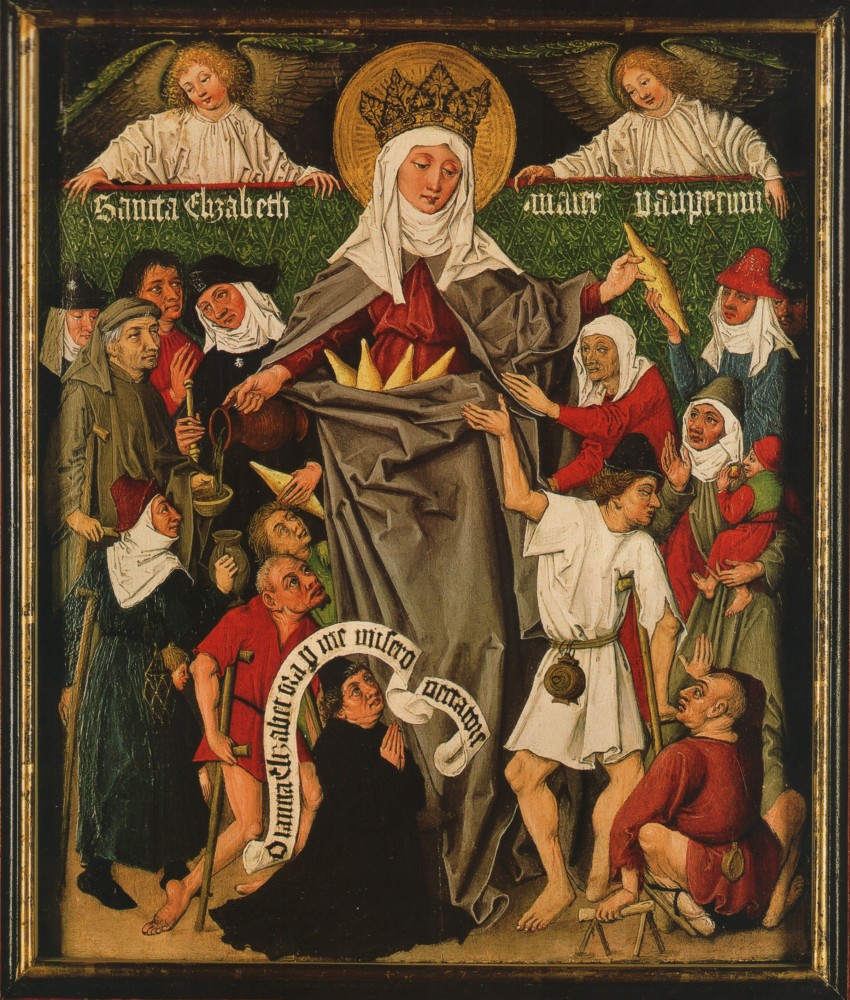
u) as depicted (witha jug and a loaf, succoring the poor) by the Master of the Drapery Studies in the central panel of the later fifteenth-century St. Elizabeth Triptych (c. 1480) in the Staatliche Kunsthalle, Karlsruhe:

 https://www.heiligenlexikon.de/Fotos/Elisabeth_von_Thueringen8.jpg


The altarpiece as a whole:


v) as depicted (succoring the poor) in a later fifteenth-century copy of Vincent of Beauvais' Speculum historiale in its French-language version by Jean de Vignay (c. 1480-1490; Paris, BnF, ms. Français 245, fol. 175r):


w) as depicted (at top in left margin; holding a jug and a loaf) in a hand-coloured woodcut in the Beloit College copy of Hartmann Schedel's late fifteenth-century Weltchronik (Nuremberg Chronicle; 1493) at fol. CCXIr:
http://www.beloit.edu/nuremberg/book/6th_age/right_page/114%20%28Folio%20CCXIr%29.pdf

x) as portrayed (holding a loaf and a spouted jug) by the Master of the Imberger Altar in a late fifteenth-century polychromed statuette in the altarpiece of the BVM and Saints (1495) in the Kapelle St. Jakobus at Reichenbach, a locality of Oberstdorf (Lkr. Oberallgäu) in Bavaria:
1) at right here:

 http://tarvos.imareal.oeaw.ac.at/server/images/7017228.JPG

2) at left here (at right, St. Sebastian):

 http://tarvos.imareal.oeaw.ac.at/server/images/7017229.JPG


y) as portrayed (second from left, holding flowers and looking remarkably aged for someone who died at age twenty-four; at left, St. Francis of Assisi) by Andrea della Robbia in about 1500 in his great terracotta relief of the Madonna and Child with Saints in the chiesa di Sant'Agata in Radicofani (SI) in Tuscany:
http://tinyurl.com/26h953j

z) as portrayed (also elderly; holding loaves and a jug) in a late fifteenth- or earlier sixteenth-century statue in the Stiftskirche in Stuttgart:

 http://www.veranstaltungen.elk-wue.de/fileadmin/mediapool/elkwue/bilder/gedenktage/Elisabeth_von_Thueringen_EvKiStu_Schmeck.jpg


aa) as portrayed (holding a loaf and a jug) in a late fifteenth- or early sixteenth-century panel painting on an altarpiece wing in the Stiftsgalerie in Herzogenburg (Land Niederösterreich):

 http://tarvos.imareal.oeaw.ac.at/server/images/7001310.JPG


bb) as portrayed on an early sixteenth-century Guldengroschen (1502) struck in Kassel by Wilhelm II, Landgraf of Hessen:
http://www.coingallery.de/Heilige/E/Elisabeth_3.jpg

cc) as portrayed in an earlier sixteenth-century polychromed wooden statue (1511) by Ludwig Juppe on the celebrants' sedile in the east choir of the St. Elisabethkirche in Marburg an der Lahn:

 http://www.elisabethkirche.de/fileadmin/_processed_/csm_2011-04-14_EKTa_0080_e70fcbaf66.jpg

Detail view:

 http://www.rmv.de/linkableblob/de/38872-25816/original/MR_Elisabethkirche_Juppe_Elisabeth.jpg

In the statue she is again depicted holding the Elisabethkirche

dd) as portrayed in an earlier sixteenth-century statue (c. 1520) of Bavarian origin, ascribed to the workshop of Hans Leinberger, in the Musée de l'Oeuvre Notre-Dame, Strasbourg:

 https://upload.wikimedia.org/wikipedia/commons/8/80/Sainte_Elisabeth_de_Hongrie-Mus%C3%A9e_de_l%27Oeuvre_Notre-Dame.jpg


ee) as portrayed in relief in a copy of an earlier sixteenth-century sculpture by Ludwig Juppe on Marburg's City Hall (1527; the original is in the Museum für Kulturgeschichte in the Marburger Schloss):

 http://www.kirchenzeitung.de/sites/bz5.bistumspresse-zentralredaktion.de/files/imagecache/node-gallery-display-full/images/fotostrecken/Elisabeth_6.jpg