Once I was a clever boy learning the arts of Oxford... is a quotation from the verses written by Bishop Richard Fleming (c.1385-1431) for his tomb in Lincoln Cathedral. Fleming, the founder of Lincoln College in Oxford, is the subject of my research for a D. Phil., and, like me, a son of the West Riding. I have remarked in the past that I have a deeply meaningful on-going relationship with a dead fifteenth century bishop... it was Fleming who, in effect, enabled me to come to Oxford and to learn its arts, and for that I am immensely grateful.


Showing posts with label Master of St Giles. Show all posts

Thursday, 1 October 2015

St Remigius of Reims


John Dillon posted this piece on the Medieval Religion discussion group about another French saint whose feast falls today besides St Thérèse of Lisieux, St Remigius, whose baptism of King Clovis in 496 was the crucial event in the creation of a Christian Kingdom of France:

St Remigius of Reims (d. 532 or 533; in standard French, Rémi, Rémy; at Reims, usually but not always Remi or Remy), the "apostle of the Franks", is said in his Vita by "Fortunatus, bishop of Poiters" (BHL 7150; it is not by St. Venantius Fortunatus) to have been of noble birth and to have been elected bishop of Reims at the age of twenty-two. St. Gregory of Tours' Historia Francorum is our first narrative source for his having baptized the Frankish King Clovis. Gregory credits him with various miracles, one being the suppression of a fire threatening to consume his city. Remigius' originally ninth-century Vita by Hincmar of Reims (BHL 7152-7164) makes him a member of a prominent noble and ecclesiastical family and adds other miracles, including that of the ampule of chrism miraculously provided for Clovis' baptismal ceremony.

Florus of Lyon and Hincmar both give January 13th as Remigius' dies natalis; this is the date under which he is commemorated in the Roman Martyrology as revised in 2001. His traditional feast on October 1st, removed in 1969 from the general Roman Calendar but still observed in the diocese of Reims-Ardennes, commemorates his translation in 1099 from Reims' cathedral to the abbey church of Saint-Remi. Remigius' putative remains repose in the latter's largely eleventh to thirteenth-century successor, today's basilique Saint-Remi.

Some period-pertinent images of St. Remigius of Reims (the geographic suffix distinguishes him from a sainted archbishop of Rouen):

a) as portrayed (three miracles: restoring to life a girl from Toulouse; replenishing a wine barrel; the heavenly dove providing chrism for Clovis' baptism) on a later ninth-century ivory book cover in the Musée de Picardie, Amiens:


b) as depicted (at left, with St. Anselm of Canterbury and St. Audemarus / Omer) in one of four panels of a full-page illumination in the late twelfth-century so-called Bible of Saint Bertin (ca. 1190-1200; Den Haag, KB, ms. 76 F 5, fol. 29r):
http://manuscripts.kb.nl/zoom/BYVANCKB%3Amimi_76f5%3A029r_min_b2
The page as a whole:
http://manuscripts.kb.nl/zoom/BYVANCKB%3Amimi_76f5%3A029r

c) as portrayed on an early thirteenth-century great seal (in use in 1219) of the abbey of Saint-Remi in Reims (cast from the Archives Nationales, Paris):


d) as depicted in the earlier thirteenth-century St. Rémi window (c. 1220-25) in Chartres' basilique cathédrale de Notre-Dame:
http://tinyurl.com/qedofzr - key and links to the scenes
http://tinyurl.com/yd5ens

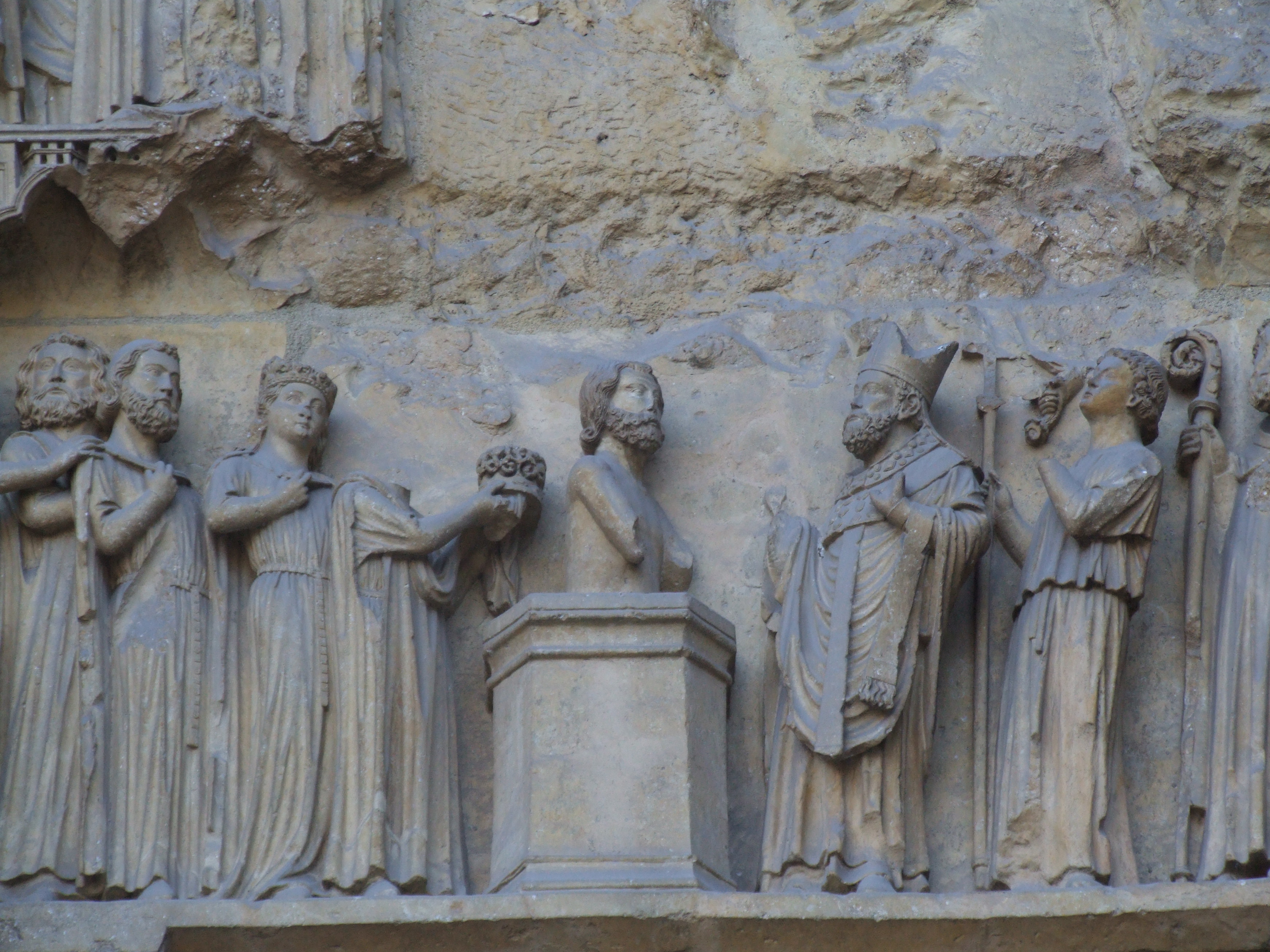
e) as portrayed several times on the originally earlier thirteenth-century "Portail des Saints" (c. 1220-1230) of the north transept of Reims' cathédrale de Notre-Dame (NB: Many of the carvings on this building were reworked in the nineteenth and twentieth centuries):
1) Second register from top (operating miracles):

 http://peregrinations.kenyon.edu/photobank/30.jpg

2) Just right of centre (at the baptism of Clovis):

 https://upload.wikimedia.org/wikipedia/commons/a/a5/Reims_Cathedrale_Notre_Dame_010_clovis_baptism.JPG


f) as depicted in a panel of a later thirteenth-century glass window (c. 1270; w. 207) in Strasbourg's cathédrale Notre-Dame:


g) as depicted (upper register, fourth from left; baptizing Clovis) in a late thirteenth-century copy of a French-language version of a Vita of St. Dionysius / Denis of Paris and companions (c. 1280-1285; Paris, BnF, ms. Nouvelle acquisition française 1098, fol. 50r):
http://tinyurl.com/nuzcd9x
A closer view:

 https://frmarkdwhite.files.wordpress.com/2012/12/clovis-baptism-st-remi.jpg


h) as portrayed (second from right in another scene of Clovis' baptism) in the "Galerie des Rois" on the originally fourteenth-century west front of Reims' cathédrale de Notre-Dame (NB: Many of the carvings on this building were reworked in the nineteenth and twentieth centuries):


i) as portrayed in high relief (exorcising the girl from Toulouse) in a fourteenth-century sculpture in the Musée Saint-Remi in Reims:

 https://upload.wikimedia.org/wikipedia/commons/1/10/St-R%C3%A9mi_exorcisant.jpg


j) as depicted (at foot of page: second from right, baptizing Clovis) in an earlier fourteenth-century copy of the Grandes Chroniques de France (between 1332 and 1350; London, BL, Royal MS 16 G VI, fol. 16r):
http://www.bl.uk/manuscripts/Viewer.aspx?ref=royal_ms_16_g_vi_fs001r

k) as depicted in a mid-fourteenth-century copy of a French-language version of Richer of Saint-Remi's tenth-century Vita of Remigius (Brussels, KB / BrB, ms. 5365, fol. 1r):

http://www.europeanaregia.eu/sites/www.europeanaregia.eu/files/manuscripts/thumbnail_kbr_5365.jpg

[Note the French Royal Arms and an early version of the arms of the Dauphin - Clever Boy]
For the locations in this now digitized ms. of other illuminations depicting Remigius see:
http://belgica.kbr.be/fr/coll/ms/ms5365_fr.html

l) as depicted (rear register, second from left) by Giottino in his later fourteenth-century Pietà of San Remigio (between 1360 and 1365) in the Galleria degli Uffizi, Florence:


m) as depicted (second from left, baptizing Clovis) in the later fourteenth-century Grandes Chroniques de France de Charles V (c. 1370-1380; Paris, BnF, ms. Français 2813, fol. 12v):


n) as depicted (third from right, baptizing Clovis) in another later fourteenth-century copy of the Grandes Chroniques de France (c. 1375-1400; Paris, BnF, ms. Français 10135, fol. 13r):
http://gallica.bnf.fr/ark:/12148/btv1b84525476/f33.item.zoom

o) as depicted (at right, baptizing Clovis) in the second volume of a late fourteenth- or early fifteenth-century copy of Don Gonzalo de la Hinojosa's chronicle of Burgos in its French-language translation by Jean Golein (c. 1400; Besançon, Bibliothèques municipales, ms. 1150, fol. 85v):

 http://www.enluminures.culture.fr/Wave/savimage/enlumine/irht5/IRHT_085692-p.jpg


p) as depicted in a lightly colored pen-and-ink illumination (at left, baptizing Clovis) in an early fifteenth-century copy of the Grandes Chroniques de France (c. 1401-1410; Valenciennes, Bibliothèque de Valenciennes, ms. 637, fol. 14v):

 http://www.enluminures.culture.fr/Wave/savimage/enlumine/irht5/IRHT_091849-p.jpg


q) as depicted (left-hand column) in the early fifteenth-century Hours of René of Anjou (c. 1405-1410; London, BL, Egerton MS 1070, fol. 103v; image zoomable):
http://www.bl.uk/catalogues/illuminatedmanuscripts/ILLUMIN.ASP?Size=mid&IllID=48375

r) as depicted in the early fifteenth-century Châteauroux Breviary (ca. 1414; Châteauroux, Bibliothèque municipale, fol. 359r):

http://www.enluminures.culture.fr/Wave/savimage/enlumine/irht2/IRHT_054213-p.jpg


s) as depicted (in two scenes: at centre in the first, at right in the second) in a mid-fifteenth-century copy of Giovanni Colonna's Mare historiarum (between 1447 and 1455; Paris, BnF, ms. Latin 4915, fol. 290v):
http://gallica.bnf.fr/ark:/12148/btv1b6000905v/f650.item.zoom

t) as depicted (at left, baptizing Clovis) by Jacques de Besançon in a late fifteenth-century copy of the Legenda aurea in its French-language version by Jean de Vignay (c. 1480-1490; Paris, BnF, ms. Français 245, fol. 122v):


u) as depicted in a late fifteenth-century breviary according to the Use of Langres (after 1481; Chaumont, Mediathèque de Chaumont, ms. 33, fol. 447v):

 http://www.enluminures.culture.fr/Wave/savimage/enlumine/irht6/IRHT_097043-p.jpg


v) as depicted (second from left in main panel) in a late fifteenth-century copy of the Chroniques abrégées des Anciens Rois et Ducs de Bourgogne attributed to Olivier de la Marche (c. 1485-1486; London, BL, Yates Thompson MS 32, fol. 4v):
http://www.bl.uk/manuscripts/Viewer.aspx?ref=yates_thompson_ms_32_fs004v

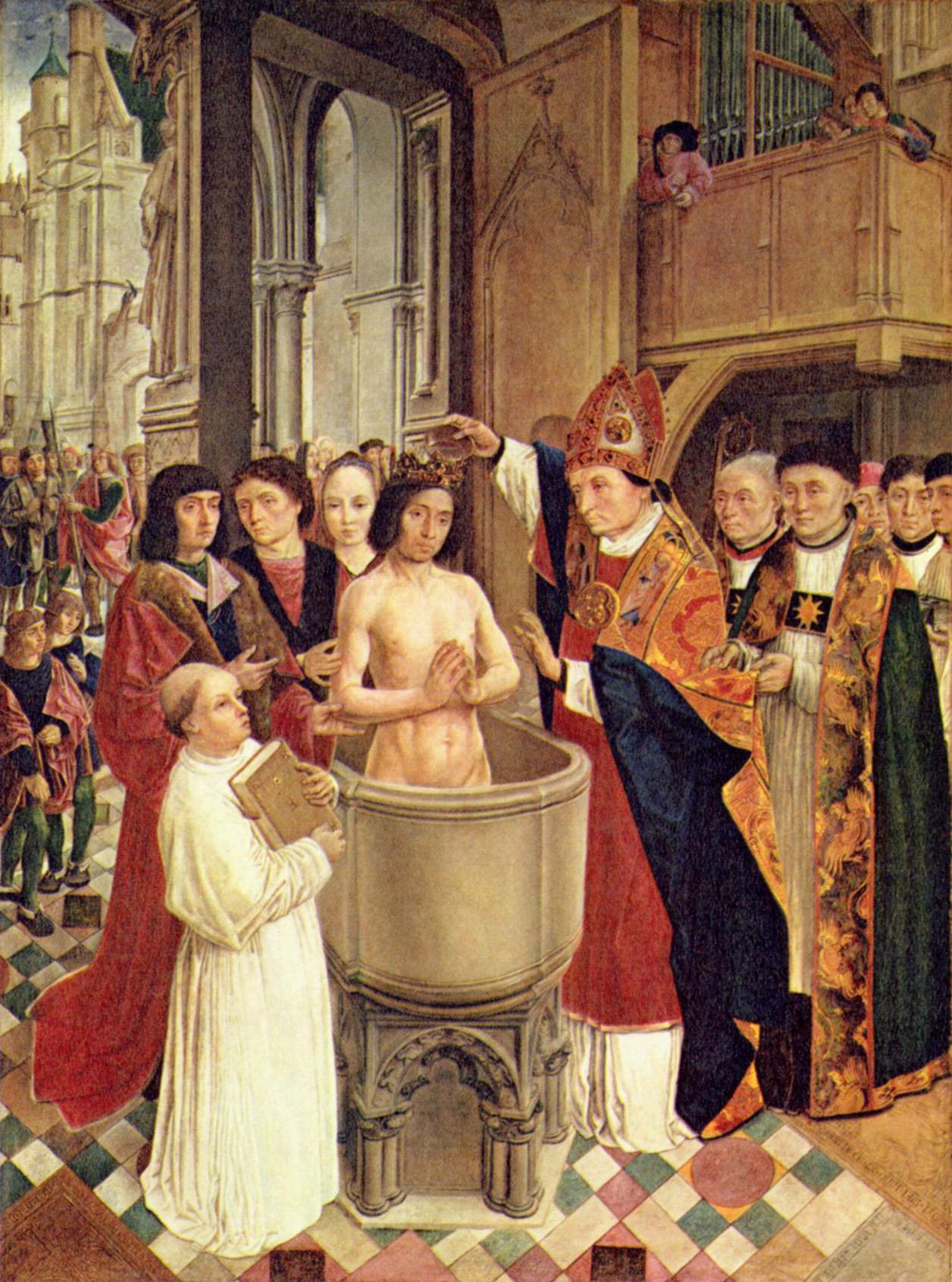
w) as depicted (sixth from right, baptizing Clovis) by the Master of St. Giles in a late fifteenth or early sixteenth-century panel painting (ca. 1500) in the National Gallery of Art, Washington, DC:
https://upload.wikimedia.org/wikipedia/commons/f/f1/Meister_des_Heiligen_%C3%84gidius_001.jpg


http://www.nga.gov/content/ngaweb/Collection/art-object-page.41597.html

x) as depicted (at centre, having miraculously replenished a wine barrel) in an early sixteenth-century panel painting of Swiss origin (c. 1500-1505) in the Metropolitan Museum of Art, New York:

 Saint Remigius Replenishing the Barrel of Wine; (interior) Saint Remigius and the Burning Wheat


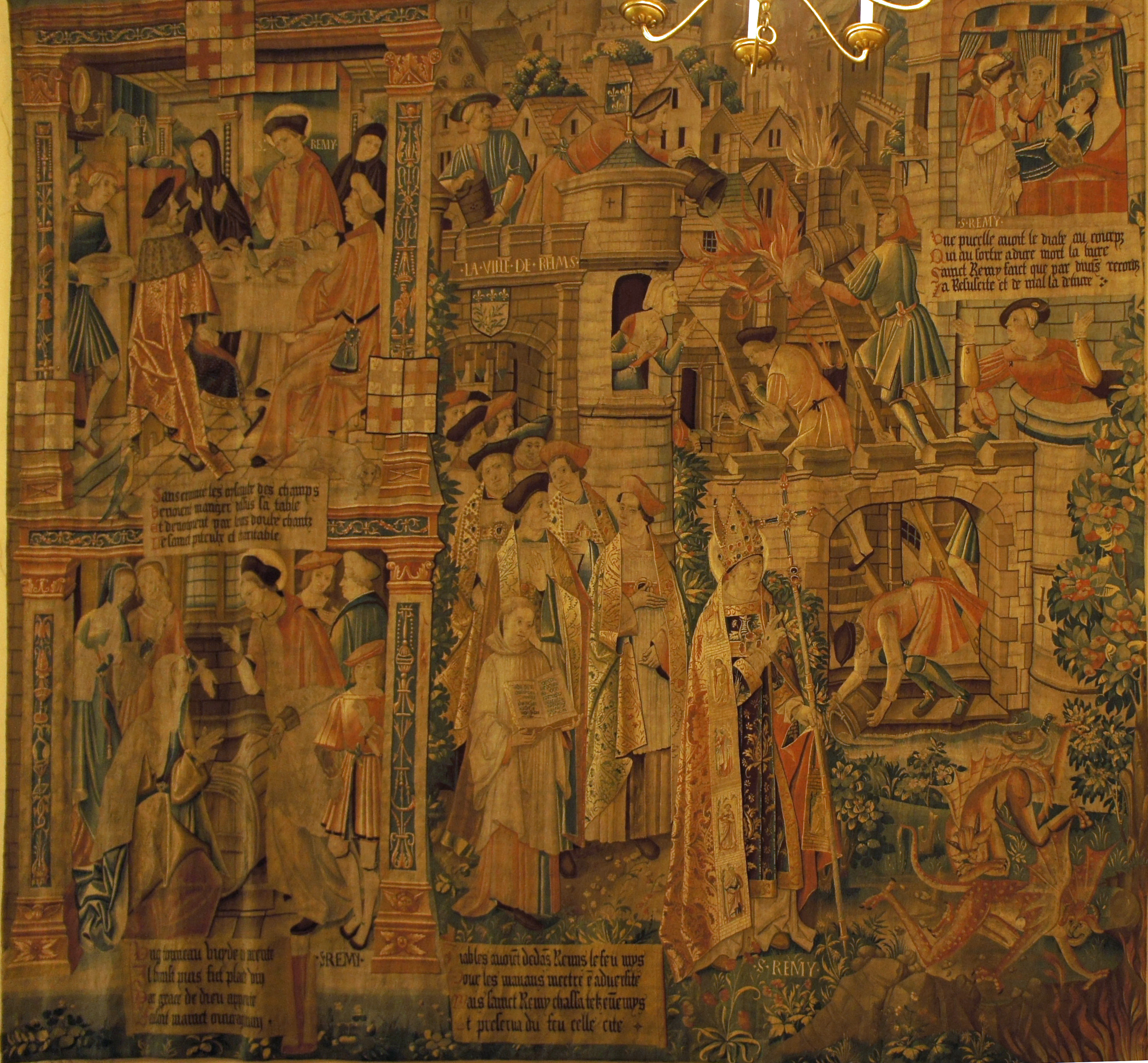
y) as depicted in two early sixteenth-century tapestries (completed by or in 1509) in the Musée Saint-Remi in Reims:
1) at bottom centrre and bottom right (infancy scenes):

 https://upload.wikimedia.org/wikipedia/commons/c/cf/1_naissance_de_Remy_Celine_Emiles_rend_la_vue_%C3%A0_M%C3%B4tain.JPG

2) at bottom right (miracle of the fire of Reims):

 https://upload.wikimedia.org/wikipedia/commons/6/62/3_incendie_de_Reims_%282%29.jpg

z) as depicted (second from right, baptizing Clovis) in King François I's copy of Guillaume Crétin's early sixteenth-century Recueil sommaire des cronicques françoyses (1515-1516; Paris, BnF, ms. Français 2817, fol. 40r):


Tuesday, 1 September 2015

St Giles


Today is the feast of St Giles, one of the Fourteen Holy Helpers, patron of cripples and many others, and of many churches built in Britain in the years following the Norman Conquest, when his cult arrived from France. In England 162 ancient churches were dedicated to him and at least 24 hospitals. Amongst those is the church of St Giles in Pontefract where I was baptised and where I worshipped for many years. He is therefore a saint whose aid I invoke in my prayers and for whom I have a special regard.

http://www.st-giles-church.org/Archive_site/saint_Giles_with_hind.gif

St Giles 

Image: saint-giles-church.org

The story of the Greek-born hermit who was discovered when he was wounded by a royal huntsman who had shot at the hind who provided Giles with milk, and of how the King Wamba (?) founded a monastery for the holy man is well known. There are online accounts of his life at  The Life of St Giles at Saint Giles  and at A Catholic Life: St. Giles.

Devotion to him spread across most of Catholic Europe in the middle ages.

Here are some depictions of the most famous incident in the life of the saint. I do rather like the aggrieved look on the faces of both the saint and his hind in the first example.


 Image;pinterest.com 


 photo 91giles6.gif 

Image: 365rosaries.blogspot.com


This is one of the panels of the Garamszentbenedek Altarpiece, which in now in the Christain Museum in Esztergom
.
Nicholas, a canon of Győr, who was also cantor of the royal chapel in Buda Castle, in 1427 commissioned Master Thomas, painter of Coloswar (Kolozsvár) to make a polyptych for the high altar of the Abbey Church at Garamszentbenedek (today Hronsky Benadik, Slovakia). 

Ending in a pointed arch, the central picture of the polyptych (which consists of nine panels) represents the Crucifixion, the internal wings are decorated with four episodes of the Passion and the external ones with scenes taken from the lives of several saints. (One of the latter has been lost, and so has the predella with the inscription about the donation.) The panel representing St Giles is the top quarter of the external wing on the right, its rounded corner following the line of the arch of the central picture.

The hermit, who lived in a forest, was nurtured by the milk of a tame hind. The king's huntsmen pursued the animal, and instead of wounding the deer it pierced St Giles's breast. This moment is recorded in the painting. The saint bears the pain with a meditative, pious countenance. The arrow is depicted in the picture twice, perhaps because a single arrow rushing in the air may have introduced too great a tension and lack of balance into this lyrical scene. The hind taking refuge with the hermit is also characterized by calm stillness. The artist may have used a drawing from a model-book of the period for this work, which is indicated not only by the calmness of the animal as if it were part of a still life, but also by its movement: the model of the animal looks as if it had been drawn with all four legs underneath it, but the painter, adjusting the model to the painting, represented its right foreleg streched out. Though the hunter s figure is much smaller than that of St Giles, the lines of the rock in the foreground and the light colours of the foliage of the forest seem to lead one's eyes to him. In accordance with the style, which had a predilection for elegant, curving lines, the painter stressed the impressive and buoyant line of the bow, which is beautifully set off by the darkness of the forest. A drawing of an archer from an artist's copybook, and of uncertain date and provenance, but of about 1400 and which is closely related to the figure in this painting is now in the collection at Christ Church in Oxford, and currently on display in their 250th anniversary exhibition.
 
In the international life of King Sigismund of Luxembourg's court at Buda, Thomas de Coloswar had an opportunity to become familiar with the leading movements in painting of the period. The panel representing St Giles has similarities to Bohemian art. The rocky, wooded landscape - to quote Antal Hekler - "the colour of a fairytale in spite of its awakening realism" reveals features akin to the art of the Master of Trebon and the illuminators working under his influence. 
 
Adapted from the Web Gallery of Art
 

http://i84.photobucket.com/albums/k27/jakyl32/365%20Rosaries-%20SEPTEMBER/91giles8.jpg 

Image:365rosaries.blogspot.com

http://www.nationalgallery.org.uk/upload/img/master-saint-giles-saint-giles-hind-NG1419-fm.jpg

St Giles and the Hind

The Master of St Giles, circa 1500
The National Gallery London
Image: nationalgallery.org 


 MASTER of Saint Gilles The Mass of Saint Giles oil painting picture

The Mass of St Giles
The Master of St Giles, circa 1500
The National Gallery London

Image:oilpainting-frame.com

 The miracle depicted has been set before the high altar of the Abbey of Saint-Denis near Paris. Many of the objects shown can be proved to have existed in the church. This is the only surviving representation of the church as it was in about 1500.

Charles Martel (?) (kneeling left) could not bring himself to confess a sin. He asked Saint Giles to pray for him. While Giles was celebrating Mass, an angel placed on the altar a paper on which was written the King's sin and his pardon, dependent on his repentance. The incident is said to have taken place in Orléans in 719. In some forms of the legend Charlemagne replaces Martel.

This and 'Saint Giles and the Hind' are part of an altarpiece which included 'Episodes from the Life of a Bishop Saint' and the 'Baptism of Clovis' (both now in Washington). 

Adapted from the National Gallery website 


Monday, 1 September 2014

St Giles in art and devotion


Today is the feast of St Giles, and having been baptised in and spent years around a church dedicated to him, and about hich I wrote this time last year in St Giles in Pontefract. He is a saint for whom I have a particular interest and devotion.

 File:Saint Giles closeup.jpg

St Giles
Altarpiece by The Master of St Giles circa 1500
Detail from the painting in the National Gallery

Image: Wikipedia

There is an online summary of the legends about him here - the time scale and setting are not that well recorded - and also about the widespread devotion to him.

I have posted about him previously in St Giles, in St Giles by Thomas of Coloswar about a medieval Hungarian painting, in St Giles about his depiction in medieval glass in Wells Cathedral and in St Giles and his shrine.

I imagine that it was the placing of that shrine, one of the assembly points for the pilgrimage to Compostella, that led to the diffusion of the cult of St Giles, both along the route to Galicia and on the return to pilgrims' home countries; St Giles entered the bloodstream of the cult of Santiago. That was a cult which was supported by and supported in return the expansion of the Cluniac vision, and coincides at least with the spread of  devotion to St Giles to England after the Norman Conquest, as well as eastwards to Hungary and Poland.

Bty the later middle ages St Giles was accounted one of the Fourtenn Holy Helpers - and was indeed the only non-martyr amongst them - and frequently appears in devotional images in north-western Europe. Thus there is not only the great work - now sadly disassembled  - by the Master of St Giles, but also by artists such as Hans Memling (c1430-1494), about whom there is an online article here.


http://upload.wikimedia.org/wikipedia/commons/1/13/Hans_Memling_005.jpg

St Giles
Figure on the righthand wing of the Passion Altarpiece in Lübeck
Hans Memling 1491

Image; Wikipedia

His cult appears to have rather declined in the post-Tridentine world, yet he remains apopular patron saint of medieval churches in England. These often represent links to his story or patronage - hospital foundations, especially for the lame, or places linked to metal working or in forest areas.


St Giles on the right with St Maurus of Glanfeuil on the left flank St Christopher
The Tripych of William Moreel
Hans Memling 1484
Groeningemuseum Bruges

Image: Wikipedia

St Giles pray for us