Once I was a clever boy learning the arts of Oxford... is a quotation from the verses written by Bishop Richard Fleming (c.1385-1431) for his tomb in Lincoln Cathedral. Fleming, the founder of Lincoln College in Oxford, is the subject of my research for a D. Phil., and, like me, a son of the West Riding. I have remarked in the past that I have a deeply meaningful on-going relationship with a dead fifteenth century bishop... it was Fleming who, in effect, enabled me to come to Oxford and to learn its arts, and for that I am immensely grateful.


Showing posts with label Rogier van der Weyden. Show all posts

Friday, 14 April 2017

Good Friday


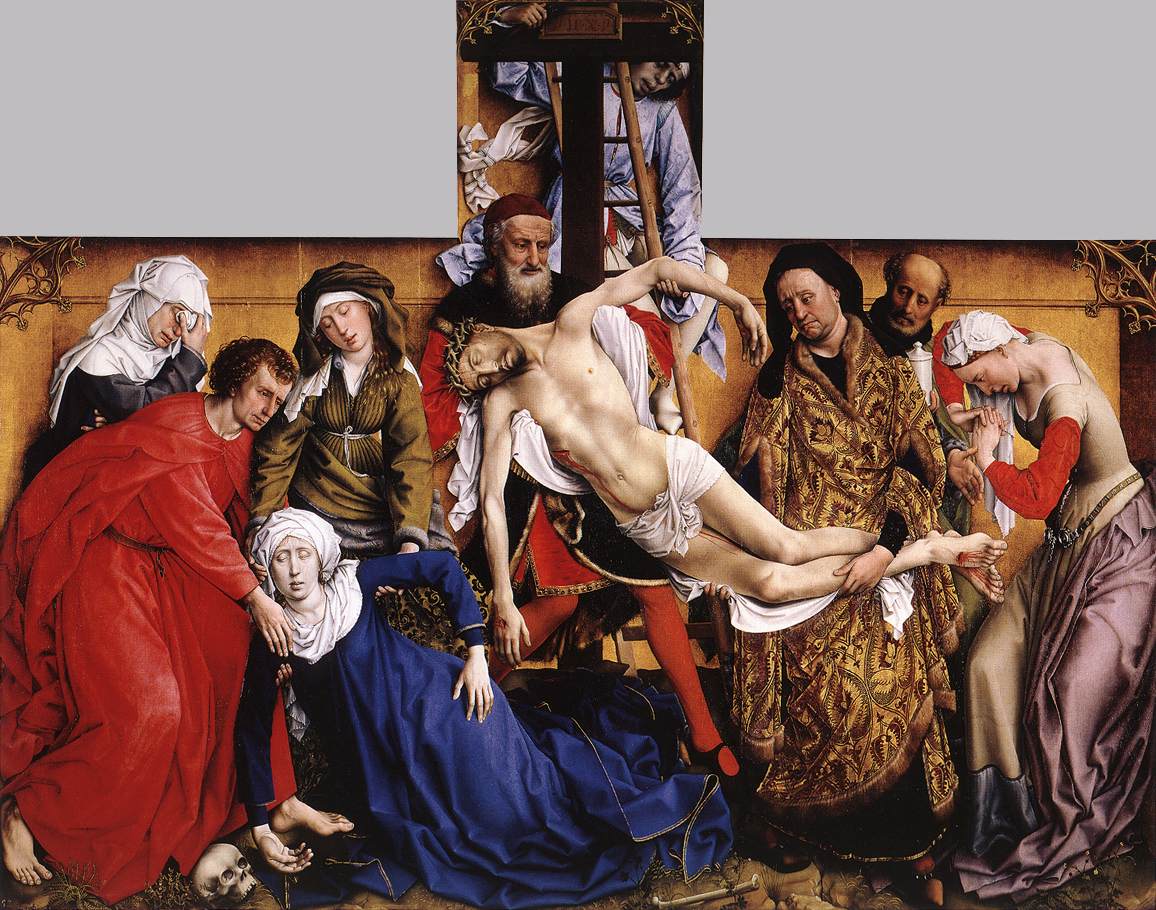
The second and third of these images I also posted last year to mark Good Friday and I am doing so again as I think them amongst the most profound amomgst so many depictions over the centuries.


 http://www.medievalhistories.com/wp-content/uploads/Descent-from-the-Cross-Roger-van-der-Weyden-Prado.jpg

The Descent from the Cross
Rogier van der Weyden  circa 1435

Prado Madrid

Image.medievalhistories.com


http://www.casa-in-italia.com/artpx/flem/images/Goes_Vienna_Lamentation.JPG


 The Lamentation 
  Hugo van der Goes circa 1470

Joseph of Arimathea (behind Jesus) and Nicodemus (at Jesus' left) 
 Kunsthistorisches Museum Vienna

Image: http://tinyurl.com/65mlog


Image: Breviary.net

Monday, 31 August 2015

Joseph of Arimathea and Nicodemus


John Dillon posted as follows [slightly adapted by the Clever Boy] on the Medieval Religion discussion group

In the Roman Martyrology August 31st is now the day of commemoration of Joseph of Arimathea and Nicodemus (d. 1st cent.).

These two Gospel figures were remembered in medieval Christianity primarily for their roles in the recovery of Jesus' body after the Crucifixion and its subsequent entombment. Starting at least with the Gospel of Nicodemus their acta were enlarged and embroidered upon. By the tenth century there was an Eastern tradition, preserved in a text in Georgian said to have been translated from Syriac, that Joseph of Arimathea was the founder of the church of Lydda. In the later Middle Ages he was reputed to have arrived in Provence with Lazarus, Martha, and Mary and to have gone on to evangelize in, depending on what text one is reading, parts of today's France, Spain, Portugal, or England [ Well we all know in England taht he came to Glastonbury - Clever Boy].

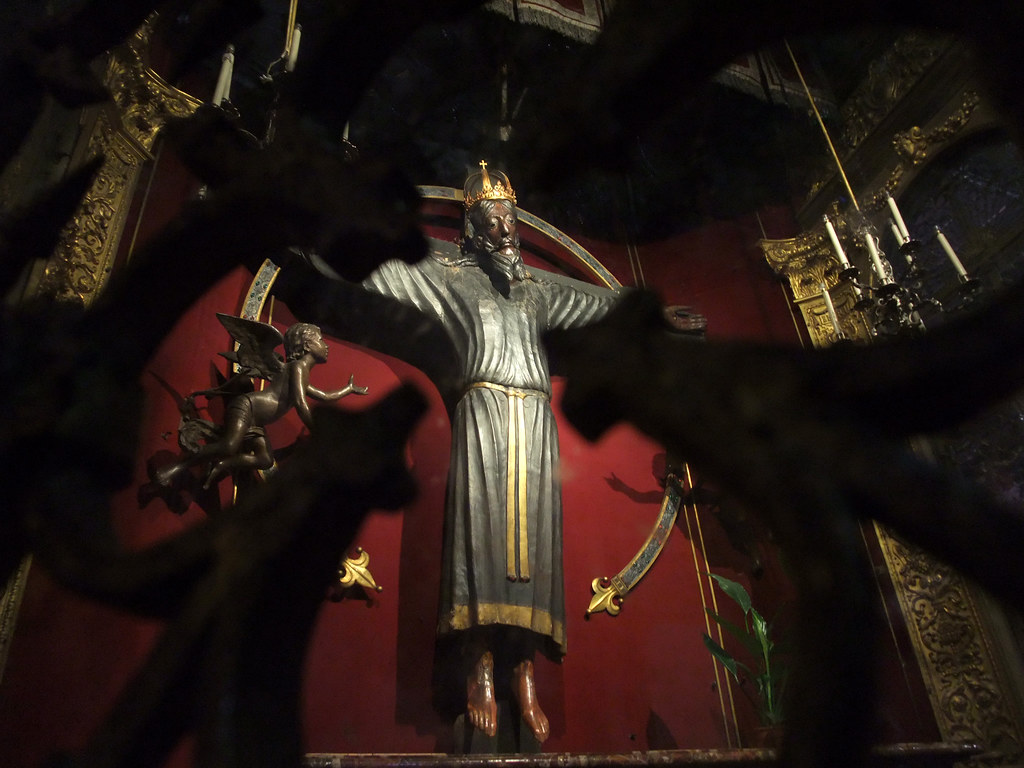
Nicodemus, who was said to to have removed the crucifixion nails from Jesus' body, was credited legendarily with the creation of that famous crucifix, the Holy Face (Volto Santo) of Lucca. In the legends of the Finding of St. Stephen Protomartyr, Nicodemus is said to have been buried by Gamaliel in Stephen's secret grave, into which were also placed Gamaliel's son Abibus and, when his time came, Gamaliel himself. Liturgical commemoration on August 2nd or 3rd of this supposed discovery insured Nicodemus' ongoing if not entirely robust construction as a saint in both the Eastern and Western Middle Ages.

Some visuals:

a) In the Church of the Holy Sepulchre in Jerusalem, the Stone of Anointing on which Joseph of Arimathea is said to have prepared Jesus' body for burial:
http://tinyurl.com/6mdmp6
http://tinyurl.com/68p8a5

b) The so-called Tomb of Joseph of Arimathea (rock-cut grave shafts) in the Church of the Holy Sepulchre in Jerusalem:
http://tinyurl.com/3yyofvb
http://198.62.75.1/www1/jhs/JHS-arimath-a.jpg
http://tinyurl.com/5oukb4

c) The Holy Face / Volto Santo of Lucca (late eleventh-century, with subsequent adornments):
https://c1.staticflickr.com/3/2621/4192466265_f8599d903e_b.jpg

 https://upload.wikimedia.org/wikipedia/commons/4/4d/Volto_Santo_de_Lucca.JPG


Some medieval images of Joseph of Arimathea and Nicodemus:

d) Joseph of Arimathea (holding Jesus) and Nicodemus (lower right, with forceps and vessel) at the Entombment as depicted in the late eleventh- or early twelfth-century so-called Gospels of Matilda of Canossa in the Museo diocesano d'arte sacra e benedettino at Nonantola (MO) in Emilia-Romagna:
http://tinyurl.com/5fmht6

e) Joseph of Arimathea and Nicodemus as depicted in two panels of the mid-twelfth-century Passion of Christ window (1145-1155) in the cathedral of Notre-Dame at Chartres:
1) Joseph of Arimathea (centre, holding Jesus) and Nicodemus (lower right, with forceps) at the Deposition:
http://tinyurl.com/nhkfxas
2) Joseph of Arimathea (middle register, far left) and Nicodemus (middle register, far right) at the Entombment:
http://tinyurl.com/qxhay7k

f) Joseph of Arimathea (on ladder, holding Jesus) and Nicodemus (at lower right, with forceps and vessel) as depicted in a later twelfth-century fresco of the Deposition from the Cross (ca. 1164) in the north chapel of the church of St. Panteleimon (Pantaleon) at Gorno Nerezi (Skopje municipality) in the Former Yugoslav Republic of Macedonia:
https://plus.google.com/photos/110067756467697073060/albums/5249084478545217697/5249088925958265666?pid=5249088925958265666&oid=110067756467697073060

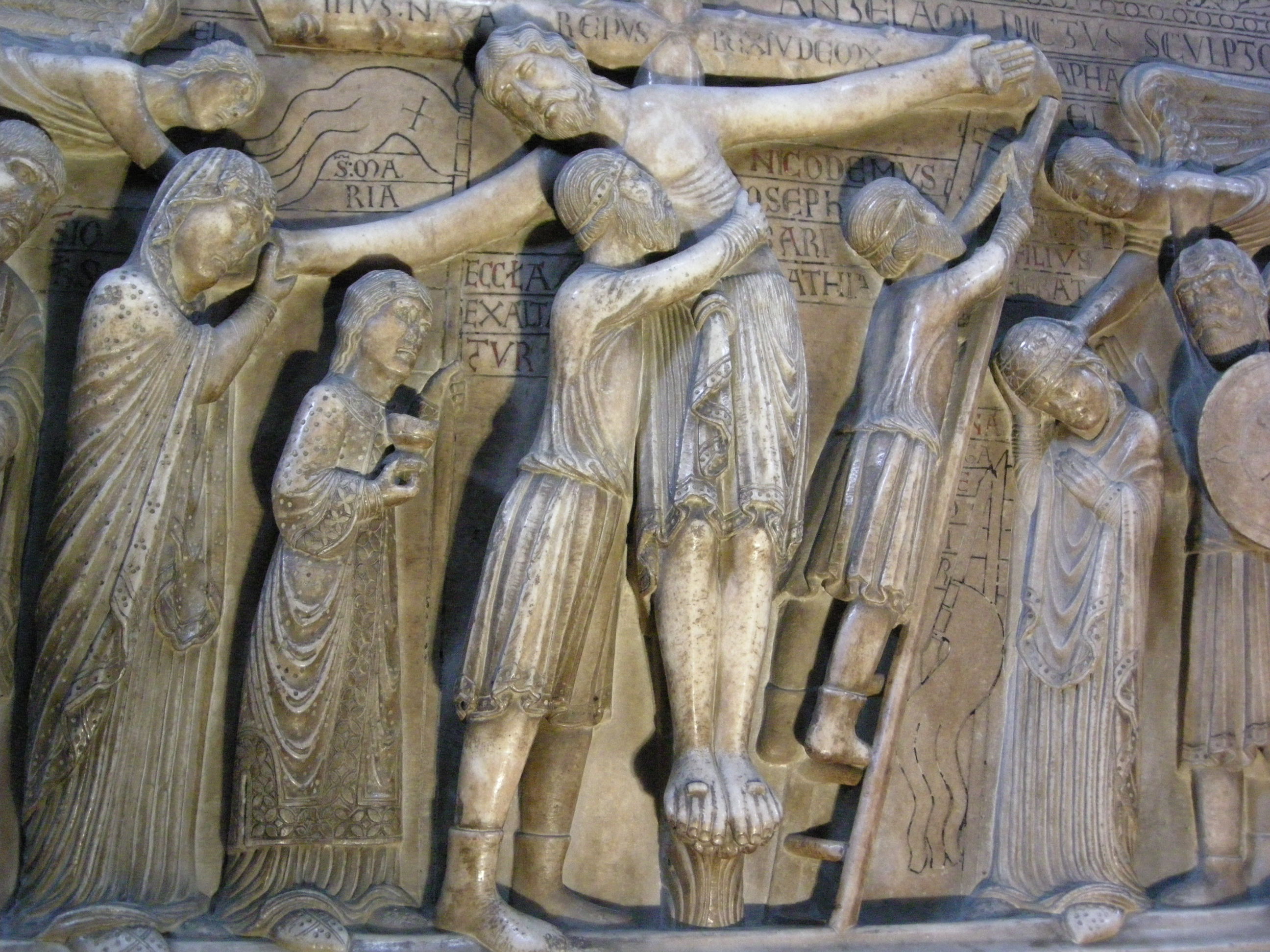
g) Joseph of Arimathea (holding Jesus) and Nicodemus (on the ladder) as portrayed in Benedetto Antelami's later twelfth-century relief of the Deposition from the Cross (ca. 1178) in the cathedral of Parma:

 http://www.shakespeareinitaly.it/deposizione.JPG

Detail view:


https://upload.wikimedia.org/wikipedia/commons/e/ee/Deposizione_dalla_croce_di_benedetto_antelami_09.JPG


h) Joseph of Arimathea (lower right, asking Pilate for Jesus' body) as depicted in the late twelfth-century Navarre Picture Bible (1197; Amiens, Bibliothèque Louis Aragon, ms. 108, fol. 189v):
http://www.enluminures.culture.fr/Wave/savimage/enlumine/irht3/IRHT_060259-p.jpg

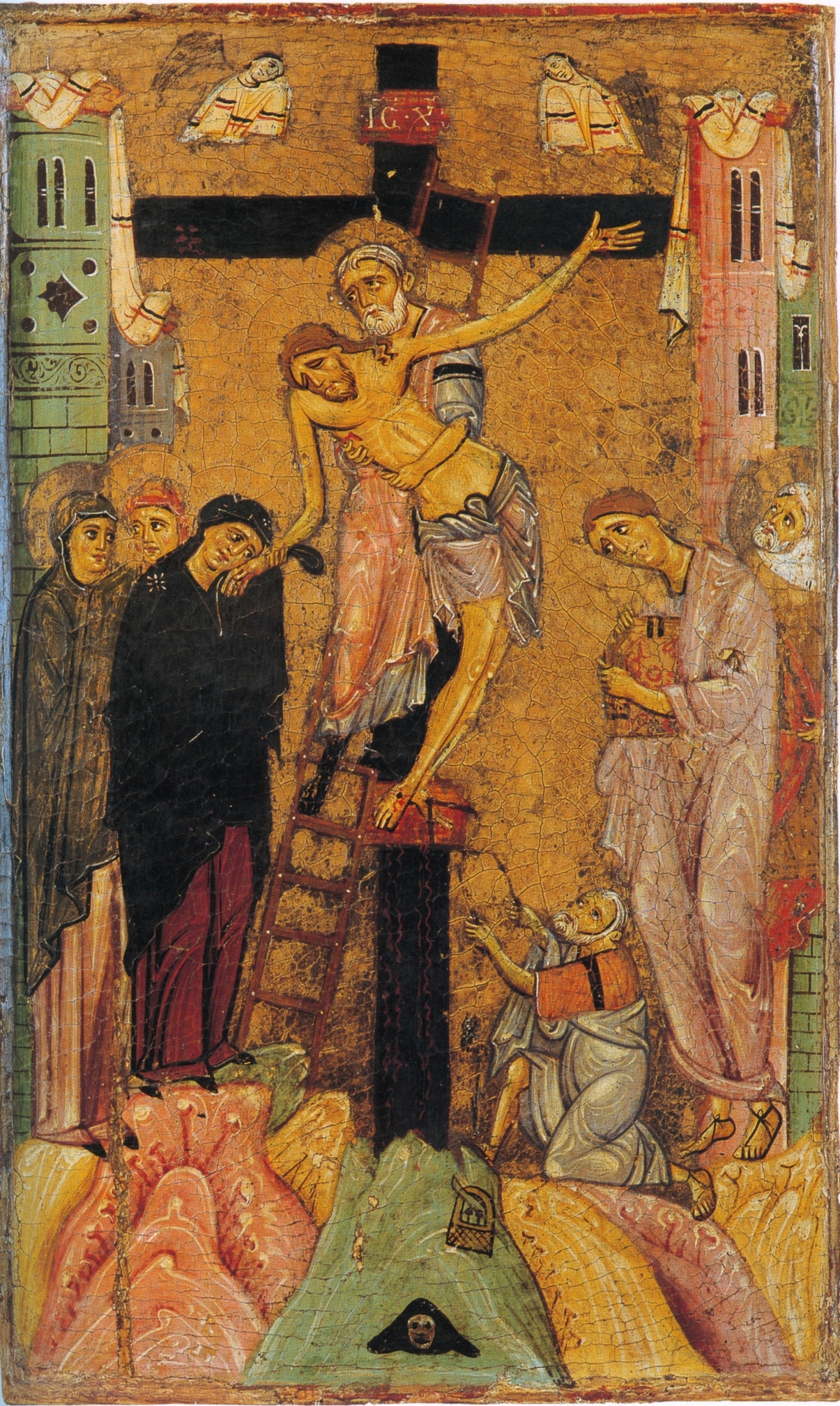
i) Joseph of Arimathea (holding Jesus) and Nicodemus (at the foot of the Cross) as depicted by Enrico di Tedice in a later thirteenth-century panel painting (1260s) in the Museo nazionale di San Martino, Pisa:
 https://upload.wikimedia.org/wikipedia/commons/c/c5/Enrico_di_Tedice._Deposizione._1260s%2C_57%2C5x35cm%2C_Muzeo_nazionale_di_San_Matteo%2C_Pisa.jpg


j) Nicodemus (in the illumination in the right-hand column; at the invention of Stephen, Gamaliel, Nicodemus, and Abibo) as depicted in a late thirteenth-century copy of French origin of the Legenda aurea (San Marino, CA, Huntington Library, ms. HM 3027, fol. 90r; image expandable):
http://tinyurl.com/24lqdjl

k) Joseph of Arimathea and Nicodemus as depicted by Pietro Lorenzetti in two earlier fourteenth-century frescoes (ca. 1320) in the lower church of the basilica di San Francesco, Assisi:
1) Joseph of Arimathea (centre left) and Nicodemus (right, with forceps) at the Deposition:
http://www.wga.hu/art/l/lorenzet/pietro/1/3arch/3deposit.jpg
2) Joseph of Arimathea (at left) and Nicodemus (centre right) at the Entombment:
http://www.wga.hu/art/l/lorenzet/pietro/1/3arch/4entomb.jpg

l) Four scenes, in three different different locations, in the earlier fourteenth-century frescoes (betw. 1335 and 1350) of the church of the Holy Ascension at the Visoki Dečani monastery near Peć in, depending on one's view of the matter, either the Republic of Kosovo or Serbia's province of Kosovo and Metohija
1) Joseph of Arimathea (at right) asking Pilate for Jesus' body:
http://tinyurl.com/26gxvo7
2) Joseph of Arimathea (at left) and Nicodemus at upper right (the smaller figure at lower right is presumably an assistant) at the Deposition:
http://tinyurl.com/3958drl
3) Nicodemus (rear left) and Joseph of Arimathea (rear right) in the Lamentation:
http://tinyurl.com/22sr5f7
Detail view:
http://tinyurl.com/2e9jnjx
4) Nicodemus (centre left) and Joseph of Arimathea (centre right) carrying Jesus at the Entombment:
http://tinyurl.com/277poab
Detail view:
http://tinyurl.com/275xzac

m) Nicodemus (nimbed) along with the also nimbed Gamaliel, Stephen, and Abibus in their uncovered grave at the Finding of Stephen as depicted by Bernardo Daddi (attrib.) in one of his mid-fourteenth-century predella paintings devoted to St. Stephen (ca. 1345) in the Pinacoteca Vaticana (from the point of view of the clerical discoverers Nicodemus is probably the first or the third corpse from left, as the one between these is clearly identifiable by vestment as the presumed deacon Stephen and the relatively youthful corpse at far right will be Abibus):
http://www.atlantedellarteitaliana.it/immagine/00023/15329OP368AU24434.jpg
For a different identification of the four nimbed corpses, see this from the Musei Vaticani, where the painting is titled the Ritrovamento dei corpi dei Santi Luciano (the person to whom the long-dead Gamaliel had appeared in a revelatory dream and thus one of those involved in the Finding), Abibo, Nicodemo, and Stefano:
http://mv.vatican.va/2_IT/pages/PIN/PIN_Sala01_04.html

n) Joseph of Arimathea (at left) and Nicodemus holding Jesus' body as depicted in Rogier van der Weyden's earlier fifteenth-century Deposition Altar (circa 1435) in the Museo del Prado, Madrid:

 http://www.wga.hu/art/w/weyden/rogier/01deposi/1deposit.jpg

Detail views:

 http://www.wga.hu/art/w/weyden/rogier/01deposi/1deposix.jpg


and
http://www.abcgallery.com/W/weyden/weyden5.html

o) Joseph of Arimathea (behind Jesus) and Nicodemus (at Jesus' left) as depicted by Hugo van der Goes in a later fifteenth-century panel painting of the Lamentation (ca. 1470) in the Kunsthistorisches Museum in Vienna:

http://www.casa-in-italia.com/artpx/flem/images/Goes_Vienna_Lamentation.JPG


p) Joseph of Arimathea and Nicodemus as depicted by Simon Marmion in a later fifteenth-century panel painting of the Lamentation (early 1470s) in the Metropolitan Museum of Art, New York:
http://tinyurl.com/6n5zax - which has notes on its commissioning by Duke Charles the Bold of Burgundy and his wife Margaret of York.

 http://www.casa-in-italia.com/artpx/flem/images/Marmion_Metropolitan_Lamentation.JPG 

http://tinyurl.com/6jktlv

q) Joseph of Arimathea (top centre) and Nicodemus (centre right, with vessel) as depicted in a late fifteenth-century icon in the State Tretyakov Gallery, Moscow:
http://www.icon-art.info/masterpiece.php?lng=en&mst_id=368

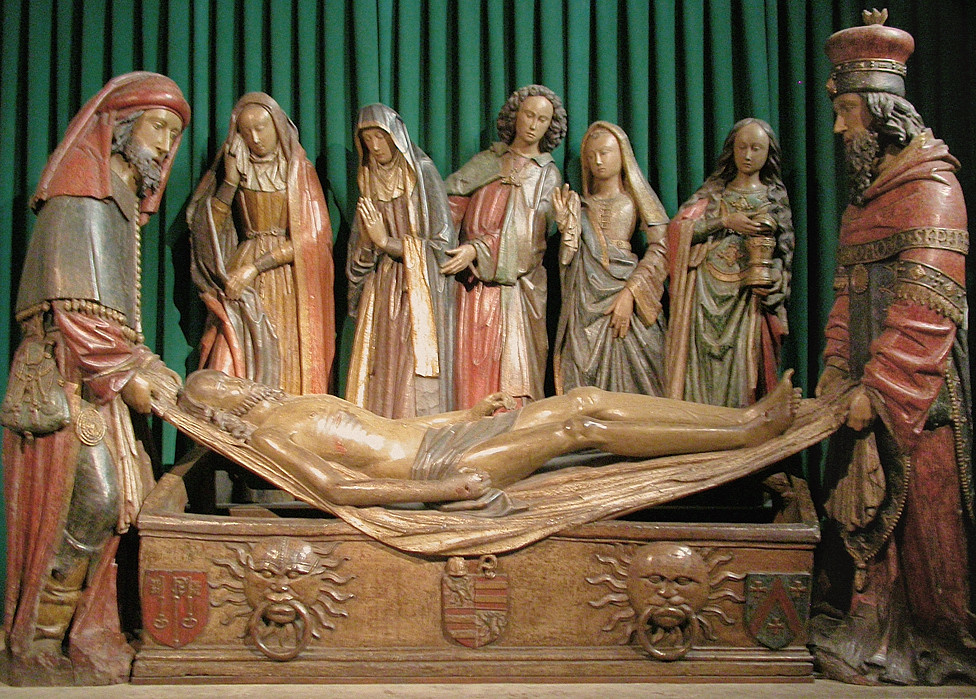
r) Nicodemus (at left) and Joseph of Arimathea (at right) as portrayed in a late fifteenth-century polychromed wooden sculpture of the Entombment (ca. 1485) in the abbaye Saint-Pierre at Moissac:

 https://c2.staticflickr.com/4/3892/14752312190_3bccd0d494_b.jpg


Gordon Plumb posted some further medieval images of St Joseph of Arimathea in stained glass and wall paintings:


Twycross, St James, Leicestershire, east window, panel originally in the Passion window in Bay H of the Sainte Chapelle, Paris, c.1245:
https://www.flickr.com/photos/22274117@N08/2198755430
and detail:
https://www.flickr.com/photos/22274117@N08/2365561815

Croughton, All Saints, Northamptonshire, nave north wall, Descent from the Cross wall painting, early 14thC.:
https://www.flickr.com/photos/22274117@N08/2937011873
and detail of heads:
https://www.flickr.com/photos/22274117@N08/2936980975

Lichfield Cathedral, Staffordshire, sIV, 2b, Descent from the Cross, originally from Herkenrode Abbey in Belgium. 1532-39:
https://www.flickr.com/photos/22274117@N08/15294316410

Langport, All Saints, Somerset, east window, 2e-3e, 15thC.:
https://www.flickr.com/photos/22274117@N08/2552016934
and detail:
https://www.flickr.com/photos/22274117@N08/2551195359

Shrewsbury, St Mary, Trinity Chapel, window from St Jacques Liège c.1535:
Though this originally was part of a Trinity and the incumbent, feeling it was improper to represent God, hadt a turban put in place of the top of God's head and the Dove of the Holy Spirit was moved to a tracery light in the window! So a made-up representation of Joseph, but interesting historically nevertheless!
https://www.flickr.com/photos/22274117@N08/3180707818
and detail of centre panel:
https://www.flickr.com/photos/22274117@N08/3180711922


Tuesday, 8 May 2012

The apparition of St Michael the Archangel


Although September 29th is the principal feast day of St Michael the Archangel today is the feast that commemorates his late fifth century apparition at Gargano on Adriatic coast of Italy - the spur of Italy - and the geginning of devotion to him there. It is said that the sanctuary dedicated to him there is the only church not dedicated by a bishop but by the Archangel himself - although a similar story was told in the middle ages of Westminster Abbey being consecrated by St Peter himself during a nightime visitation.

The feast of the Apparition entered the Roman Missal as aunversal feast with Pope St Pius V in 1570, but does not occur in the 1970 Missal.

There is an online article about the sanctuary here and there is another article about the Gargano peninsula here. The official website of the Sanctuary can be opened here.

Something of the theology and history of the cult of St Michael can be read in this online article.

Coincidentally Prof Georgi Vasilev of the State University of Library Studies and Information Technologies in Sofia Bulgaria recently posted on the Medieval religion discussion group some extracts from medieval apocrypha (basically coming from East) including the  "Apocryphal oratione of St. John Chrysostom how Michael, chieftan of the celestial army defeated Satan" which is rather popular. Here is a brief citation from the old Bulgarian version (the original source is Greek):
:
After Gabriel fails to sum up courage to fight with Satan, the Lord forgave Gabriel and again said unto Michael: ‘You were first in the kingdom of Adam, who proceedeth from me, and it is thine today to go down to that vile antichrist and take from him the heavenly mantle, the crown and the sceptre of  angelic orders, which he stole from Me. And divest him of his beauty and glory so that his servants see who the Father is.”(Bulgarskata literatura i knizhnina prez XIII vek, p.151)

and from the Apocryphal text "The Tiberiad Sea":
And God sent Michael to Satan. And Michael went but was scorched by Satan and returned to God and said ‘I did what You sent me to do but the fire of Satan
fell unto me.’… And Michael came and struck Satan with the sceptre and threw him down
with all his army. And they fell three days and three nights like drops of rain. (Stara bulgarska literatura.I. Apokrifi, p.32 )

As Prof Vasilev points out this image is used by John Milton in Paradise lost. In his interpretation Messiah (Christ) is send by God instead of Michael:

Raphael continues to relate how Michael and Gabriel were sent forth to battel against Satan and his Angels. The first Fight describ’d: Satan and his Powers retire under Night: He calls a Councel, invents devilish Engines, which in the second dayes Fight put Michael and his Angels to some disorder; But, they at length pulling up Mountains overwhelm’d both the force and Machins of Satan: Yet the Tumult not so ending, God on the third day sends Messiah his Son, for whom he had reserv’d the glory of that Victory: Hee in the Power of his Father coming to the place, and causing all his Legions to stand
still on either side, with his Chariot and Thunder driving into the midst of his Enemies, pursues them unable to resist towards the wall of Heaven; which opening, they leap down with horrour and confusion into the place of punishment prepar’d for them in the Deep: Messiah returns with triumph to his Father.
(Paradise Lost, Book VI. The Argument)


By another coincidence I am reminded of a conversation last week with someone who was asserting that there had beena feminization of religion in the nineteenth century, and cited in evidence religious art. Setting apart bad religious art - and of that there was a lot produced then - I disagreed strongly as to the dating of the changes in iconography he had in mind, as well indeed with his whole argument.

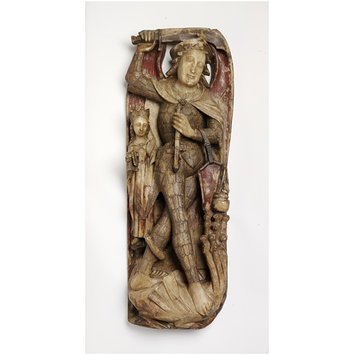
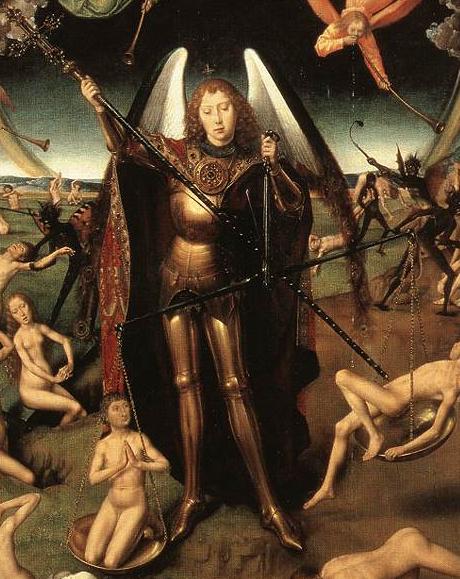
Had I thought I should have drawn attention to the image of St Michael. Long before the Baroque, let alone popular religious art such as many prayer cards, the Archangel was often depicted as a rather androgynus figure. Thus, in examples drawn from my own particular period of interest and enthusiasm, one can find many examples of this, although in this English alabaster of 1430-70 he appears very robust attacking the dragon of evil whilst weighing souls:

http://media.vam.ac.uk/media/thira/collection_images/2009BY/2009BY4615_jpg_ds.jpg


Image: Victoria and Albert Museum

However contemporary art from Catalonia and the Netherlands suggests a more complex angelic personality. Here is a small selection of such images chosen from a great wealth of such examples from both regions:

http://farm3.staticflickr.com/2680/4103333308_ed15ec18f3_z.jpg

Saint Michael the Archangel by Blasco de Grañén, 1422
Museu Nacional d'Art de Catalunya

Image:mbell1975 on Flickr


http://www.backtoclassics.com/images/pics/jaumehuguet/jaumehuguet_thearchangelstmichael.jpg

Jaume Huguet 1456

Image:backtoclassics.com

http://www.topofart.com/images/artists/Rogier_van_der_Weyden/paintings/weyden009.jpg 

St Michael weighing souls by Rogier van der Weyden

Image:topofart.com

File:MemlingJudgmentCenter-crop.jpg


Detail of St Michael weighing souls at the Last Judgement
Hans Memling 1466-1473

Image: Wikipedia

File:Das Jüngste Gericht (Memling).jpg

 The Last Judgement
Hans Memling
National Museum, Gdansk

Image: Wikipedia


I assume the convention originates in an attempt to convey the beauty of holiness contrasted with the ugliness of evil, but the result has a definitely feminine quality to it, indicating the sexlessness of non-corporeal beings. Nevertheless by the late medieval period the image appears established. The muscular Christianity of Epstein's St Michael at Coventry appears a much more modern concept.

On the basis of some of the paintings i have reproduced here it is probably best to be able to recognise St Michael - we are all likely to meet him on Judgement Day.


Monday, 26 March 2012

The Annunciation by Robert Campin


Today is the transferred Feast of the Annunciation to Our Lady, and not only a cause of great joy to her and all mankind, but also, apart from the Crucifixion, and then the Nativity of Our Lord and depictions of the Virgin and Child, probably the most widely depicted scene in Christian art.

Many are in the tradition of Fra Angelico's delcate and lyrical meetings of Virgin and Archangel. Others from northern artists of the later middle ages include fascinating glimpses of contemporary life as in the works of Robert Campin (active by 1406, died 1444). There is for example his Merode triptych of 1427-32, now in the Metropolitan Museum in New York, and about which there is more information here:

http://www.metmuseum.org/toah/images/hb/hb_56.70.jpg

Image; Metropolitan Museum of Art

In the Prado in Madrid is another Campin depiction of the Annunciation. The first picture I found of it was this:

Annunciation by
Image: friendsofart.net

- which appears well enough until I found another, taken in December last year, which suggests arecent cleaning to reveal the full splendour of the original composition, dated to 1419-20:

photo

Image: petrus agricola on Flickr

What strikes me about this is partly the detailed rendition of the architecture - an interesting contemporary view of the church buildings around the artist. I assume it is meant to represent the temple and the idea of ther Bleesed Virgin vowed to God and resident in the Temple, as in the feast of the Presentation of Our Lady. The Archangel is suitably coped and vested for his important mission and looks with excited anticipation towards the studious Virgin.

A related subject by Campin, amd also in the Prado is this painting of the betrothal of the Virgin:

photo

Robert Campin
The Betrothal of the Virgin, 1420
Madrid Museo del Prado

Image: Petrus Agricola on Flickr

Two scenes are represented in this work. On the left, in a circular, Romanesque interior covered with a dome, we see The Miracle of the Flowered Staff, which designated Joseph as the husband of Mary. In the building's stained-glass windows, capitals and tympana are scenes from the Old Testament that foreshadow or announce others from the New Testament, such as the sacrifice of Isaac, which prefigures the Redemption of Christ.

On the right is a depiction of the betrothal of Mary and Joseph under a gothic portico, announcing the imminent arrival of the New Law.

Amongst Campin's pupils was Rogier van der Weyden, who also depicted the Annunciation in contemporary domestic settings as here:

http://www.art-wallpaper.com/24916/Van+der+Weyden+Rogier/Annunciation-1600x1200-24916.jpg

The Annunciation, Roger van der Weyden

Image:art-wallpaper.com


Monday, 29 August 2011

The Decollation of St John the Baptist


As someone with a particular interest in the later middle ages I appreciate very much the northern gothic style of the paintings of the period. Here is a fine example in Rogier van der Weyden's depiction of the Decollation of St John. It is part of his St John Altarpiece of c.1455-1460 which is now in the Staatliche Museum in Berlin. I am always drawn to the attention to contemporary detail and the refined disdain of the figures in the paintings of the era.

http://www.wga.hu/art/w/weyden/rogier/12stjohn/3john1.jpg


There is a larger version available here, which reveals more of the details in the scene. The whole panel can be viewed here and the whole altarpiece with its three panels can be seen here (the views are greatly expandable).

As a priest-friend once commented to me it is noteworthy that devotion to a saint who was so widely venerated as was St John in the later middle ages - think of the number of surviving depictions and church dedications - but which as a cult has virtually entirely disappeared today, other than as a patronal feast in particular churches.