Once I was a clever boy learning the arts of Oxford... is a quotation from the verses written by Bishop Richard Fleming (c.1385-1431) for his tomb in Lincoln Cathedral. Fleming, the founder of Lincoln College in Oxford, is the subject of my research for a D. Phil., and, like me, a son of the West Riding. I have remarked in the past that I have a deeply meaningful on-going relationship with a dead fifteenth century bishop... it was Fleming who, in effect, enabled me to come to Oxford and to learn its arts, and for that I am immensely grateful.


Showing posts with label Robert Campin. Show all posts

Sunday, 26 May 2013

Holy Trinity


Today is Trinity Sundaya day to celebrate and to attempt to reflect upon the ineffable nature of the Godhead.


http://www.casa-in-italia.com/artpx/flem/images/Campin_Louvain_Holy_Trinity.JPG

The Holy Trinity
Robert Campin (circa 1375-1444)
Louvain

Image: casa-in -italia.com

This type of depiction of the Holy Trinity was very popular in the late middle ages, and popular in alabaster carvings for churches, tombs and domestic use. However it became the object of particular hatred to Lollards and other such heretics, who saw it as breaching the Second Commandment and as being idolatrous, and increasingly fell out of favour in the Catholic Church at Trent because it was open to such theological misunderstanding.

I have posted paintings by Robert Campin before, both because I like them as works of art and devotion and because they are works produced in a period in which I have a particular interest as a historian.
Three works by Campin - a Standing Virgin and Child, Saint Veronica, and Holy Trinity (all now in the Städelsches Kunstinstitut, Frankfurt) - were wrongly thought to have come from a non-existent abbey at Flémalle, near Liège giving rise to the creation of an anonymous Master of Flémalle. It is now generally agreed that this painter is identical with Robert Campin.

Campin's origins and exact date of birth remain obscure. In 1410 he acquired his citizenship in Tournai, where he was already working as a painter by 1405-6. He was dean of the Guild of Saint Luke between 1425 and 1427 and was elected to the town council. Probably the head of a large workshop, Campin accepted commissions from city officials, churches, and the bourgeoisie, made designs for banners, coats of arms, and costumes, and sometimes produced manuscript illuminations. He had two famous pupils, Rogelet de la Pasture (Rogier van der Weyden) and Jacques Daret, both of whom worked for him until 1432. The early works of Rogier and those of his master are sometimes confused.

A triptych with the Lamentation (Courtauld Institute Galleries, London) is considered the earliest of his works. Among the latest is the Von Werl Altarpiece, dated 1438 (Prado, Madrid), sometimes ascribed to Rogier. While the Annunciation Triptych has traditionally been viewed as a key painting by the master, its attribution within the Campin group, is a matter of controversy. Campin's influence was widespread, and some of his compositions were frequently copied well into the sixteenth century.

Adapted from the Casa-in-Italia website

Here is an example of a textile of the Holy Trinity by Campin. Worked in  gold. silver silk embroidery, pearls, glass beads and velvet on linen it is dated to 1433 and is now in the Kunsthistorisches Museum Vienna:


http://uploads1.wikipaintings.org/images/robert-campin/holy-trinity-gold-silver-and-silk-embroidery-pearls-glass-beads-and-velvet-applique-on-linen-1433.jpg!Large.jpg

Image: Wikipaintings


Here is a list of other paintings by Campin together with links to them:

Monday, 3 September 2012

St Gregory the Great


Today, in the novus ordo calendar, is the feast of St Gregory the Great, Pope from 590 until 604, and the Apostle of the English.

To mark his feast day here is another depiction of the Mass of St Gregory, the oft-used later medieval story of how he convinced a doubter of the reality of Transubstantiation. As became usual the scene is shown with the Saint having a vision of the Man of Sorrows.

Mass of Saint Gregory

The Mass of Saint Gregory

Student or follower of Robert Campin about 1440
Oil on panel, 85 x 73 cm
Brussels, Musees Royaux des Beaux-Arts
.
.
.
Some scholars have thought that the Mass of Saint Gregory was a copy after a lost original by Robert Campin dating from around 1410-1415.

Image: aiwaz.net

As with other depictions of this story the painting is an insight into late medieval liturgical practice and also late medieval expectations of what churches and liturgies looked like.

Monday, 26 March 2012

The Annunciation by Robert Campin


Today is the transferred Feast of the Annunciation to Our Lady, and not only a cause of great joy to her and all mankind, but also, apart from the Crucifixion, and then the Nativity of Our Lord and depictions of the Virgin and Child, probably the most widely depicted scene in Christian art.

Many are in the tradition of Fra Angelico's delcate and lyrical meetings of Virgin and Archangel. Others from northern artists of the later middle ages include fascinating glimpses of contemporary life as in the works of Robert Campin (active by 1406, died 1444). There is for example his Merode triptych of 1427-32, now in the Metropolitan Museum in New York, and about which there is more information here:

http://www.metmuseum.org/toah/images/hb/hb_56.70.jpg

Image; Metropolitan Museum of Art

In the Prado in Madrid is another Campin depiction of the Annunciation. The first picture I found of it was this:

Annunciation by
Image: friendsofart.net

- which appears well enough until I found another, taken in December last year, which suggests arecent cleaning to reveal the full splendour of the original composition, dated to 1419-20:

photo

Image: petrus agricola on Flickr

What strikes me about this is partly the detailed rendition of the architecture - an interesting contemporary view of the church buildings around the artist. I assume it is meant to represent the temple and the idea of ther Bleesed Virgin vowed to God and resident in the Temple, as in the feast of the Presentation of Our Lady. The Archangel is suitably coped and vested for his important mission and looks with excited anticipation towards the studious Virgin.

A related subject by Campin, amd also in the Prado is this painting of the betrothal of the Virgin:

photo

Robert Campin
The Betrothal of the Virgin, 1420
Madrid Museo del Prado

Image: Petrus Agricola on Flickr

Two scenes are represented in this work. On the left, in a circular, Romanesque interior covered with a dome, we see The Miracle of the Flowered Staff, which designated Joseph as the husband of Mary. In the building's stained-glass windows, capitals and tympana are scenes from the Old Testament that foreshadow or announce others from the New Testament, such as the sacrifice of Isaac, which prefigures the Redemption of Christ.

On the right is a depiction of the betrothal of Mary and Joseph under a gothic portico, announcing the imminent arrival of the New Law.

Amongst Campin's pupils was Rogier van der Weyden, who also depicted the Annunciation in contemporary domestic settings as here:

http://www.art-wallpaper.com/24916/Van+der+Weyden+Rogier/Annunciation-1600x1200-24916.jpg

The Annunciation, Roger van der Weyden

Image:art-wallpaper.com


Sunday, 4 December 2011

St Barbara


In addition to St Osmund today is also the traditional feast day of St Barbara - whose cultic recognition was one of the victims of Pope Paul VI's cull in 1969-70. The reason was, I understand, the lack of historical evidence for her actual existence - as with St Catherine of Alexandria. Her very name Barbara suggested a Barbarian origin, and she was expunged as a pious fiction. However reading her story as oulined in the link below I am tempted to say that her story looks very much like that of an 'honour killing', and should not have been so easily dismissed.

In the meantime the long standing devotion to her has not ceased as is mentioned in this online article about her. Maybe, like St Catherine, she will make a liturgical comeback.

She is one of the demoted saints who turns up, complete in her case with artillery piece, in one of Robertson Davies' comic ghost stories in High Spirits - a book which I recommend as I do the rest of his works.

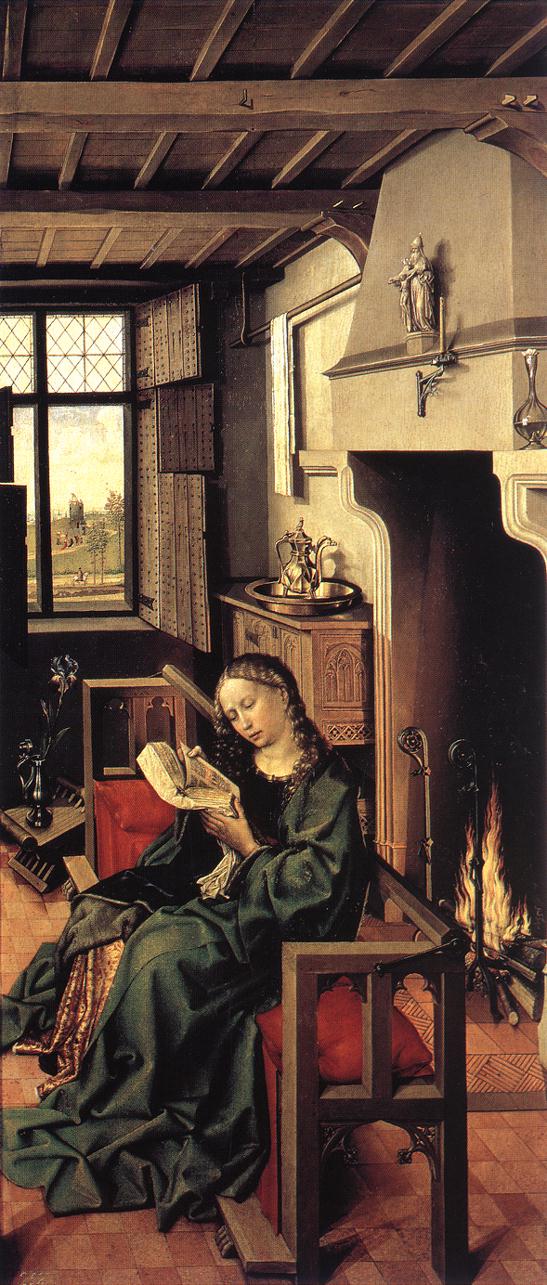
File:The Werl Altarpiece Saint Barbara.jpg

St Barbara in her tower by Robert Campin 1438

The Werl Altarpiece in The Prado Madrid

This painting is interesting in its own right as a depiction of an early fifteenth century interior

Image: Wikipedia