Once I was a clever boy learning the arts of Oxford... is a quotation from the verses written by Bishop Richard Fleming (c.1385-1431) for his tomb in Lincoln Cathedral. Fleming, the founder of Lincoln College in Oxford, is the subject of my research for a D. Phil., and, like me, a son of the West Riding. I have remarked in the past that I have a deeply meaningful on-going relationship with a dead fifteenth century bishop... it was Fleming who, in effect, enabled me to come to Oxford and to learn its arts, and for that I am immensely grateful.


Showing posts with label Frankfurt Kaiserdom. Show all posts

Monday, 24 August 2015

St Bartholomew in medieval art


Today is the feast of St Bartholomew. I have slightly adapted the posts by John Dillon and Gordon Plumb on the Medieval Religion discussion group. I have opened some examples and copied and pasted them, but all repay viewing.

Bartholomew was an apostle, thus named by the Synoptic gospels (the name means 'son of Tolmai'), though he is generally identified by most biblical scholars today with the Nathanael of John 1:45-50 and 21:2.

There are no certain traditions about his ministry and death. He is said to have preached in places vaguely called "India", in Lycaonia and other parts of Asia Minor, and, finally, in Armenia. Accounts of his martyrdom vary. In the East he was said either to have been crucified or to have been drowned; medieval Western versions have him flayed alive or decapitated (sometimes both).

The Roman Martyrology gives him an apostolate in India and Armenia, where he is said to have been flayed alive before being beheaded. Tanners and leather workers took him for their patron.

 His relics are claimed to have been translated first to the island of Lipara, then to Beneventum and finally to Rome where they are claimed by the church of St Bartholomew on the Tiber. In the 11th century what was claimed to be an arm of Bartholomew was given to Canterbury by Emma, wife of Cnut, which probably contributed to the diffusion of the cult in England (though he also appears in the Life of Guthlac). 165 ancient English dedications to him, including Crowland Abbey. He is often shown holding a flaying knife and sometimes, as at Grappenhall in Cheshire (see below) with his flayed skin neatly folded across his arm!

Gordon Plumb's selection of English stained glass images:

Acaster Malbis, Holy Trinity, Yorkshire, east window, 3e-4e:
Glass of the c.1340 by the West window workshop of York Minster.
https://www.flickr.com/photos/22274117@N08/2831009917
and detail of head:
https://www.flickr.com/photos/22274117@N08/2833567496

Oxford, Merton College Chapel, nVI, 3b:
glass of c.1305-12.
https://www.flickr.com/photos/22274117@N08/6404936845

Withcote, Withcote Chapel, Leicestershire, nIII, 2a-3a, c.1537:
https://www.flickr.com/photos/22274117@N08/6404936845

Cartmel Priory, Cumbria, east window, A9 15thC.:
https://www.flickr.com/photos/22274117@N08/2892467209

Langport, All Saints, Somerset, east window, C3 15thC.:
https://www.flickr.com/photos/22274117@N08/2829153788

Orchardleigh, St Mary, Somerset nII, 3a 15thC.:
https://www.flickr.com/photos/22274117@N08/2490113513
and detail:
https://www.flickr.com/photos/22274117@N08/2490110905

Metz, Cathédrale Saint-Étienne, Bay 20, martyrdom of St B3, ?1260'S:
https://www.flickr.com/photos/22274117@N08/4313915092

Grappenhall, St Wilfrid, Cheshire, sIII, 1c, c .1334 :
https://www.flickr.com/photos/22274117@N08/2831205960

Folkingham, St Andrew, Lincolnshire, nIII, 3b, head of St B, c.1330-50:
https://www.flickr.com/photos/22274117@N08/2269052939

Melbury Bubb, St Mary, Dorset, wI, 3b (with St Philip), Late 15thc. :
https://www.flickr.com/photos/22274117@N08/3480765682


John Dillon's selection of images illustrates the range of depiction of a saint who was indeed one of the Apostles, but of whom little is known:


a) as depicted (at top, just right of centre) in the later fifth-century mosaic ceiling (between 451 and 475) of the Neonian Baptistery / Orthodox Baptistery in Ravenna (for best results, click to expand the image):
http://tinyurl.com/otuyj8z

b) as depicted in the very late fifth- or early sixth-century mosaics of the Cappella Arcivescovile (a.k.a. Cappella di Sant'Andrea) in Ravenna:
https://www.flickr.com/photos/pelegrino/5779777038/

c) as depicted (at far right, after SS. Simon and Thomas, apostles) in the earlier to mid-sixth-century mosaics of the presbytery arch (carefully restored, 1890-1900) in the Basilica Eufrasiana in Poreč:
http://tinyurl.com/pak3fch 


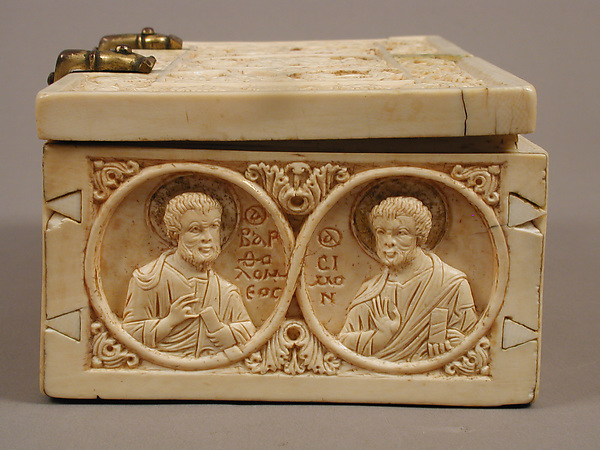
d) as depicted in relief (at left; at right, St. Simon the Apostle) on a later tenth-century ivory reliquary casket (betw. ca. 951 and 1000) of probable Constantinopolitan origin and now in the Metropolitan Museum of Art, New York:
http://images.metmuseum.org/CRDImages/md/web-large/sf17-190-238s4.jpg 


e) as depicted in the earlier eleventh-century decor (restored between 1953 and 1962) of the monastery of Hosios Loukas near Distomo in Phokis:
1) in mosaic in the narthex of the church of the Theotokos:
http://tinyurl.com/nw6ua39
2) in fresco in the crypt of the katholikon:
http://tinyurl.com/q8cqsgt

f) as depicted (upper margin; martyrdom: crucified and flayed) in a twelfth-century Gospels of probable Constantinopolitan origin (Paris, BnF, ms. Supplément grec 27, fol. 192r):
http://gallica.bnf.fr/ark:/12148/btv1b8593586z/f389.image
A slightly closer view:
http://tinyurl.com/nncdpd4 


g) as portrayed (flayed) in a twelfth-century polychromed columnar stone statue in the iglesia de San Bartolomé in Rebordans (Pontevedra) in Galicia:
http://www.arquivoltas.com/11-Galicia/Tuy-Rebordans%20G27.jpg

http://www.arquivoltas.com/11-Galicia/Tuy-Rebordans%20G26.jpg
http://www.arquivoltas.com/11-Galicia/Tuy-Rebordans%20G28.jpg
The statue's placement in the window niche of the church's apse is recent.

h) as depicted in an earlier twelfth-century legendary (ca. 1101-1133) from the abbey of Cîteaux (Dijon, Bibliothèque municipale, ms. 641, fol. 24v):
http://tinyurl.com/2usjp8m 


i) as depicted (at right in the intrados; at left, St. Simon the Apostle) in the mid-twelfth-century mosaics (ca. 1143) of the chiesa di Santa Maria dell'Ammiraglio (a.k.a. chiesa della Martorana) in Palermo:
http://tinyurl.com/njteyah
Detail view (Bartholomew):
http://tinyurl.com/2mduez


j) as depicted (lower register, at centre between the apostles Simon and Thomas) in the mid-twelfth-century apse mosaics (completed in 1148) of the basilica cattedrale della Trasfigurazione in Cefalù:


k) as depicted (martyrdom: being flayed) in a mid-twelfth-century gradual for the Use of of the abbey of Fontevraud (Limoges, Bibliothèque municipale, ms. 2, fol. 181v):
http://tinyurl.com/2ehh6ht

l) as portrayed in relief (second from left in the Last Supper panel) by Anselmo da Campione on the later twelfth-century parapet / _pontile_ (ca. 1170-1180) in the cattedrale di San Geminiano in Modena:
http://tinyurl.com/ngmwj5c 


m) as portrayed in relief (lower register at far left; next, St. James the Less; then, St. Trophimus of Arles) on the late twelfth-century portal (betw. 1190 and 1200) of the basilique primatiale Saint-Trophime in Arles:
http://tinyurl.com/opdmujc
Detail view (Bartholomew):
http://tinyurl.com/oklfmhq 


n) as depicted (at left, aiding St. Guthlac) in the early thirteenth-century Guthlac Roll (1210) in the British Library (Harley Roll, Y.6, roundel 8):
http://tinyurl.com/dzqy8n


image from http://s3.amazonaws.com/hires.aviary.com/k/mr6i2hifk4wxt1dp/14082213/3be7cce9-54ca-41ed-8f9c-22a91489995f.png


o) as depicted in one of the earlier thirteenth-century glass windows in the choir (baie 106; ca. 1225-1230) of the basilique cathédrale in Reims:
1) full-length image:


2) scenes from his Passio:
http://tinyurl.com/qx5zaz4


p) as depicted (martyrdom: being flayed) in an earlier thirteenth-century collection of saint's lives in their French-language translation by Wauchier de Denain (betw. 1226 and 1250; London, BL, Royal 20 D VI, fol. 42r; image greatly expandable):
http://tinyurl.com/q8vvqwn


q) as depicted (upper margin; martyrdom: being flayed) in an earlier thirteenth-century psalter from Hildesheim (ca. 1230-1240; Paris, BnF, Nouvelle acquisition latine 3102, fol. 5r):
http://tinyurl.com/osessz5

r) as depicted (enthroned) in the circle of the apostles in the later thirteenth-century frescoes (between 1251 and ca. 1273) on the ceiling of the baptistery of Parma:


s) as depicted (holding his flayed skin) in the later thirteenth-century Oscott Psalter (ca. 1265-1270; London, BL, MS Add 50000, fol. 9r):
http://www.bl.uk/manuscripts/Viewer.aspx?ref=add_ms_50000_f009r


t) as depicted (teaching under the inspiration of the Holy Spirit) in a late thirteenth-century book of hours (ca. 1280-1290) for the Use of Thérouanne (Marseille, Bibliothèque municipale, ms. 111, fol. 60r):
http://tinyurl.com/2dzrzrt

u) as depicted (martyrdom: decapitation) in a later thirteenth-century collection of saint's lives in French (1285; Paris, BnF, ms. Français 412, fol. 46v):
http://gallica.bnf.fr/ark:/12148/btv1b84259980/f102.item


v) as depicted (martyrdom: being flayed) in the late thirteenth-century Livre d'images de Madame Marie (ca. 1285-1290; Paris, BnF, ms. Nouvelle acquisition française 16251, fol. 67v):
http://tinyurl.com/2bkjjkb


w) as depicted (panel at far left, followed by those for St. Ansanus, St. Crescentius, and St. Savinus) as one of Siena's patron saints by Duccio di Buoninsegna in his relatively recently restored late thirteenth-century great window (1287-1288) for that city's cathedral (now in the Museo dell'Opera della Metropolitana):
http://tinyurl.com/nlbn8ut

x) as depicted (second from left) in an earlier fourteenth-century fresco (betw. 1301 and 1350) in the chiesa di San Tommaso di Canterbury at Corenno Plinio in Dervio (LC) in Lombardy:
http://tinyurl.com/34pfo7o

y) as depicted in an earlier fourteenth-century glass window (betw. 1301 and 1350) in Hörsne kyrka (Gotland):
http://tinyurl.com/n9dt9n7


z) as depicted (at right; at left, St. James the Less) by Duccio di Buoninsegna in his early fourteenth-century Maestà altarpiece (betw. 1308-1311) in the Museo del Opera del Duomo in Siena:


aa) as depicted in the earlier fourteenth-century apse frescoes (betw. ca. 1315 and 1324) of the basilica di Sant'Abbondio in Como:
https://www.flickr.com/photos/renzodionigi/3493571462/


bb) as depicted (martyrdom: being flayed) in an earlier fourteenth-century French-language legendary of Parisian origin (ca. 1327), with illuminations attributed to the Fauvel Master (Paris, BnF, ms. Français 183, fol. 31v):
http://tinyurl.com/2wk3v3b 


cc) as depicted in an earlier fourteenth-century copy (ca. 1326-1350) of the _Legenda aurea_ in its French-language version by Jean de Vignay (Paris, BnF, ms. Français 185, fol. 43v):
http://tinyurl.com/3697fvv

dd) as depicted (martyrdom; being flayed) in an earlier fourteenth-century fresco (ca. 1335) in the cappella di San Giovanni in the chiesa dei Domenicani in Bolzano / Bozen:
http://tinyurl.com/qbhhjqt


ee) as portrayed (seated) in a probably mid- to later fourteenth-century statue (ca. 1340-1380; once routinely attributed to Nicola da Monteforte) in Benevento's basilica cattedrale metropolitana di Santa Maria de Episcopio:
http://tinyurl.com/gul9v


ff) as depicted (martyrdom: being flayed) by Giovanni da Milano in a predella panel of his mid-fourteenth-century Prato polyptych (ca. 1343-1363) in that city's Pinacoteca comunale:
http://tinyurl.com/qa5688z

gg) as depicted (holding his flayed skin) in the Litanies section of a later fourteenth-century miscellany of mostly French-language devotional texts (between 1351 and 1400; Paris, BnF, Français 400 [Colbert 1432], fol. 26r):
http://tinyurl.com/nuych9l


hh) as depicted (at left; at right -- in a separate fragment from the same dismembered altarpiece--, St. Anthony of Egypt) by Lorenzo Veneziano in a later fourteenth-century panel painting (1368?) in the Pinacoteca nazionale in Bologna:
http://tinyurl.com/q2bv7me

ii) as depicted in a later fourteenth-century Roman missal of north Italian origin (ca. 1370; Avignon, Bibliothèque-Médiathèque Municipale Ceccano, ms. 136, fol. 264v):
http://www.enluminures.culture.fr/Wave/savimage/enlumine/irht2/IRHT_055362-p.jpg
Detail view:
http://www.enluminures.culture.fr/Wave/savimage/enlumine/irht2/IRHT_055363-p.jpg

jj) as portrayed (at left, with an abbot- or bishop-saint) in a late fourteenth-century vault boss from the Carmelite convent in Barcelona (demolished, 1875) now in the Museu d'Arte de Catalunya in the same city:


kk) as depicted by the Master of the Modena Book of Hours in a late fifteenth-century Dominican missal from Lombardy (ca. 1490-1500; The Hague, Museum Meermanno, Ms. 10 A 16, fol. 212r; zoomable image):
http://manuscripts.kb.nl/zoom/BYVANCKB%3Amimi_mmw_10a16%3A212r_init


ll) as portrayed in relief (fourth from right) on the late fourteenth- or early fifteenth-century tomb of St. Wendelin in his basilica in Sankt Wendel:
http://tinyurl.com/pepm5t9


mm) as portrayed in an earlier fifteenth-century polychromed stone statue from Burgundy (betw. 1401 and 1450) now in the Cloisters Collection of the Metropolitan Museum of Art, New York (image expandable):

Saint Bartholomew


nn) as depicted (at left; at right, St. Anthony of Egypt) by Mariotto di Nardo in a pair of early fifteenth-century panel paintings (1408) in the Minneapolis Institute of Arts (image expandable):
http://www.artsmia.org/viewer/detail.php?v=12&id=1628#


oo) as depicted in an early fifteenth-century glass window panel (ca. 1410) of Austrian origin in the Metropolitan Museum of Art, New York:
http://www.metmuseum.org/collection/the-collection-online/search/471054


pp) as depicted (at right; at left, St. Thomas the Apostle) in the early fifteenth-century Apostles Window (1419) in the Liebfrauenkirche in Ravensburg:
http://tinyurl.com/neuq4am 


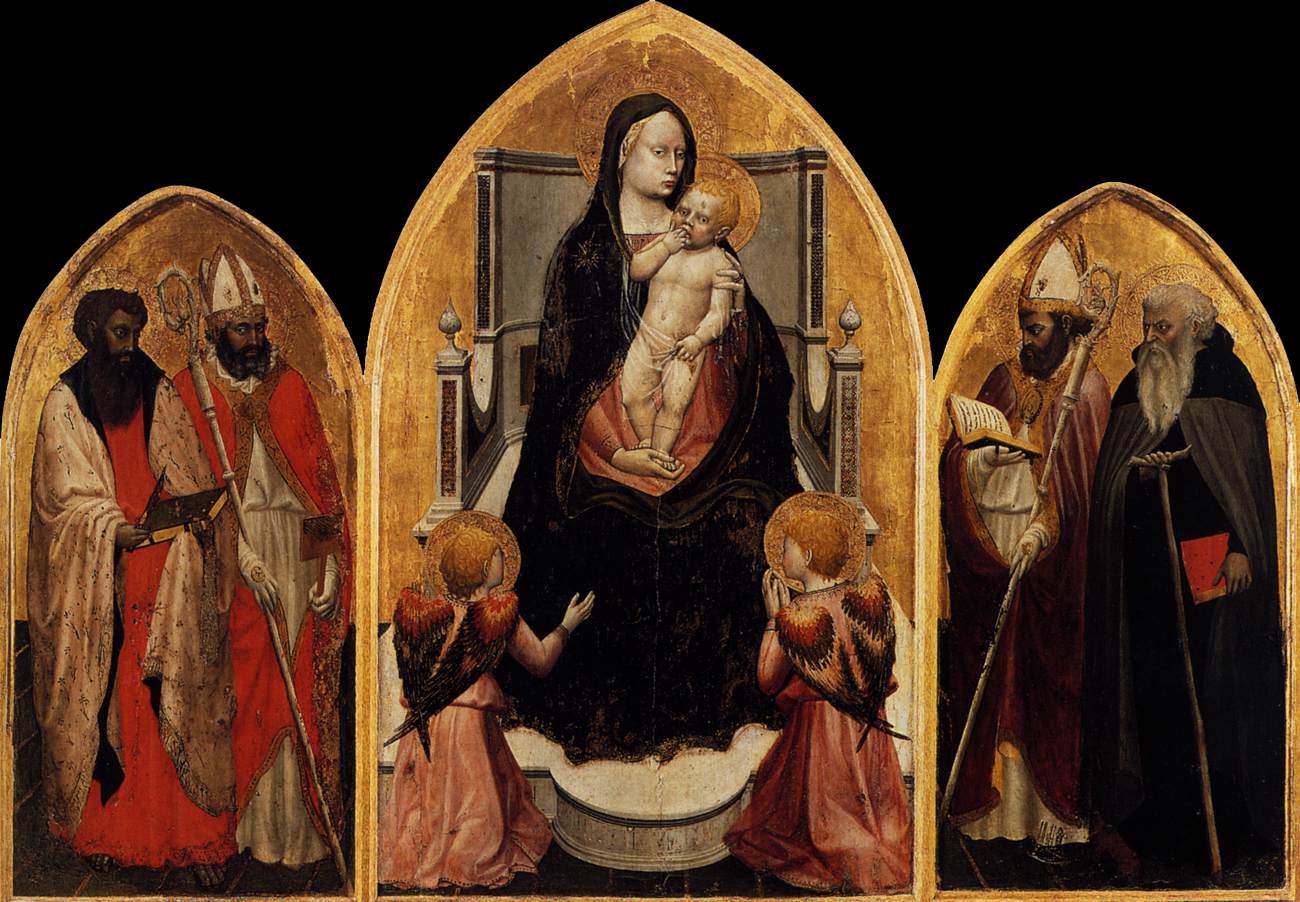
qq) as depicted (at left in the wing at left; at right in that wing, St. Blasius of Sebaste / Blaise / Biagio; the corresponding figures on the other wing are St. Juvenal of Narni and St. Anthony of Egypt) by Masaccio in his earlier fifteenth-century San Giovenale triptych (1422) in the Museo Masaccio at Cascia di Reggello (FI) in Tuscany:
http://www.wga.hu/art/m/masaccio/z_panels/giovena1.jpg


rr) as depicted in a full-page miniature by the Master of Zweder van Culemborg in an earlier fifteenth-century book of hours for the Use of Utrecht (ca. 1430-1435; Amsterdam, KB, ms. 79 K 2, fol. 114v):
http://tinyurl.com/odms9rm

ss) as depicted (second from left, exorcising a demon) by the Master of Saint Bartholomew in a mid-fifteenth-century panel painting (circa. 1440-1460) from a dismembered altarpiece in the Museu d'Arte de Catalunya, Barcelona:


tt) as depicted (fourth from left) in what remains of a mid-fifteenth-century fresco of the Last Supper (ca. 1450; restored, 1870-1873) in the oratorio di San Lorenzo all'alpe Seccio in Boccioleto (VC) in Piedmont:
http://tinyurl.com/pgfny2v


uu) as depicted (martyrdom: being flayed) in a later fifteenth-century copy (ca. 1451-1500) of Jean Mansel's Fleur des histoires (Paris, BnF, ms. Français 57, fol. 39r):
http://tinyurl.com/oopeeyb

vv) as depicted (evangelizing in Armenia; martyrdom) in a later fifteenth-century copy (1463) of books 9-16 of Vincent of Beauvais' Speculum historiale in its French-language version by Jean de Vignay (Paris, BnF, ms. Français 50, fol. 337v, 338v):
1) evangelizing in Armenia:
http://tinyurl.com/nek4mjb
2) martyrdom (decapitation after flaying):
http://tinyurl.com/pgk6t98


ww) as depicted (at right, after the apostles Matthew and Barnabas) by the Master of the Eggelsberger Altarpiece on a later fifteenth-century altar (ca. 1465-1475) in the Veste Oberhaus museum in Passau:
http://tarvos.imareal.oeaw.ac.at/server/images/7006269.JPG

xx) as depicted (holding his flayed skin) by Matteo di Giovanni in a later fifteenth-century panel painting (ca. 1480) in the Museum of Fine Arts, Budapest:

http://tinyurl.com/nf26kkr

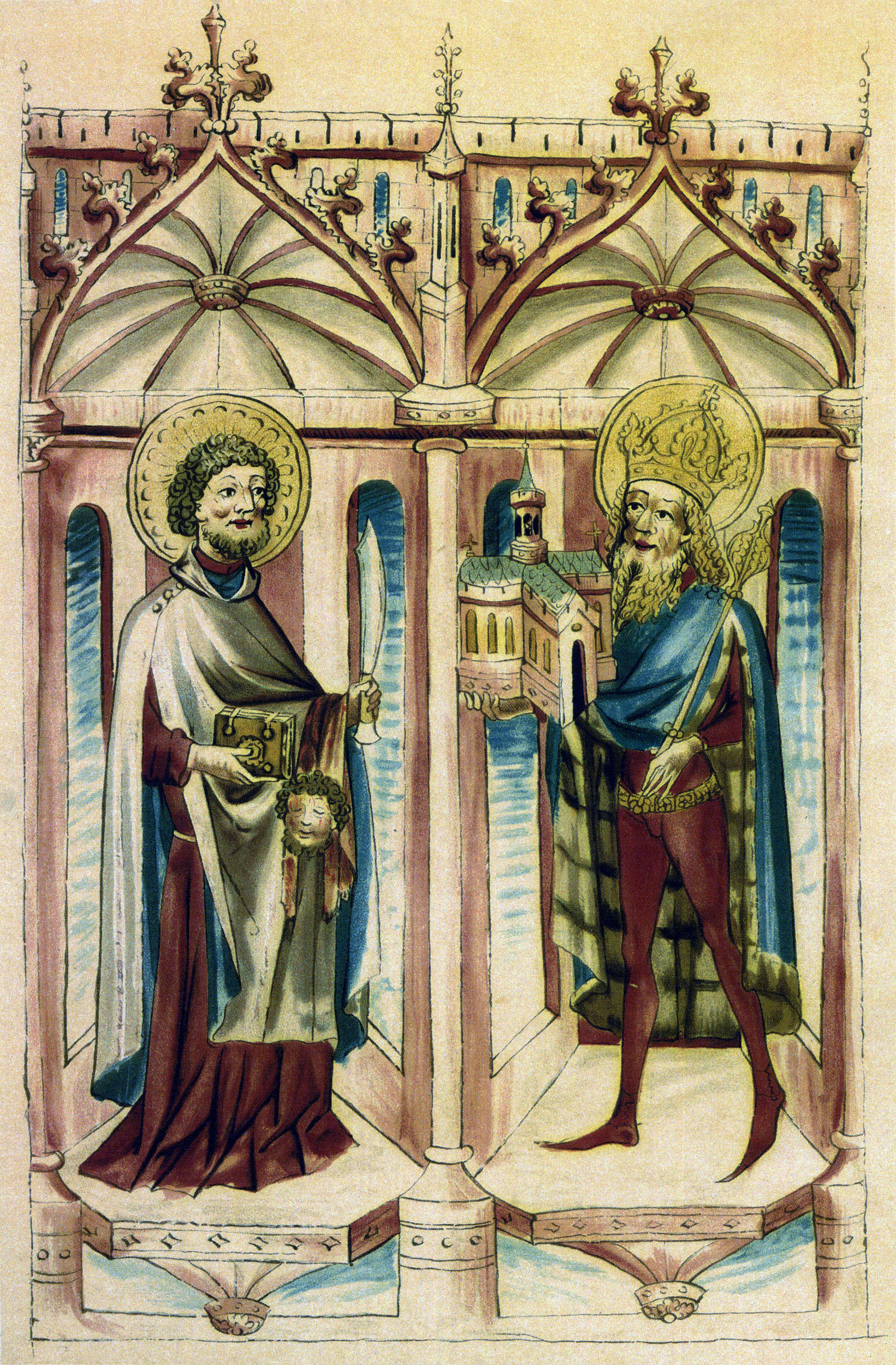
yy) as depicted (at left, holding his flayed skin; at right, Bl. Charlemagne) in an _Amtsbuch_ (register) from 1482 of the chapter of the Imperial "cathedral" dedicated to him in Frankfurt am Main, now in the Stadtarchiv Frankfurt am Main:


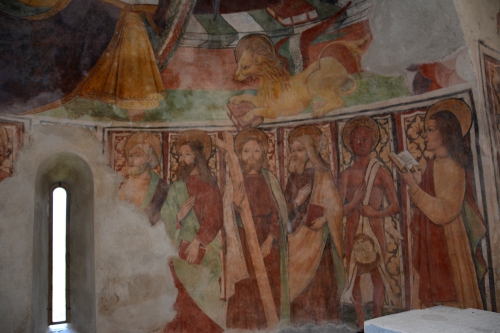
zz) as depicted (second from right, holding his flayed skin) in the recently restored late fifteenth-century portraits of the apostles (ca. 1490-1500) in the apse of the chapelle San Pantaleon in Gavignano (Haute-Corse):
http://elizabethpardon.hautetfort.com/media/01/02/2714715379.jpg
Detail views (Bartholomew):
http://elizabethpardon.hautetfort.com/media/01/02/1806742755.jpg

http://elizabethpardon.hautetfort.com/media/02/00/1104967850.jpg
http://elizabethpardon.hautetfort.com/media/02/01/4042760745.jpg 

aaa) as depicted (at center, with a donor) on the early sixteenth-century St. Bartholomew Altar (ca. 1503) in the Alte Pinakothek, München:


bbb) as depicted (third from left) by Giovanni Botoneri in his early sixteenth-century fresco of the Last Supper (1514) in the cappella del santuario di San Magno in Castelmagno (CN) in Piedmont:
http://www.accademiaaleramica.com/images/2011/cpc1_g.jpg


Saturday, 24 August 2013

The death of the Emperor Henry VII


Today is the seven hundredth anniversary of the death of the Holy Roman Emperor Henry VII in 1313. There is an online life of him here.

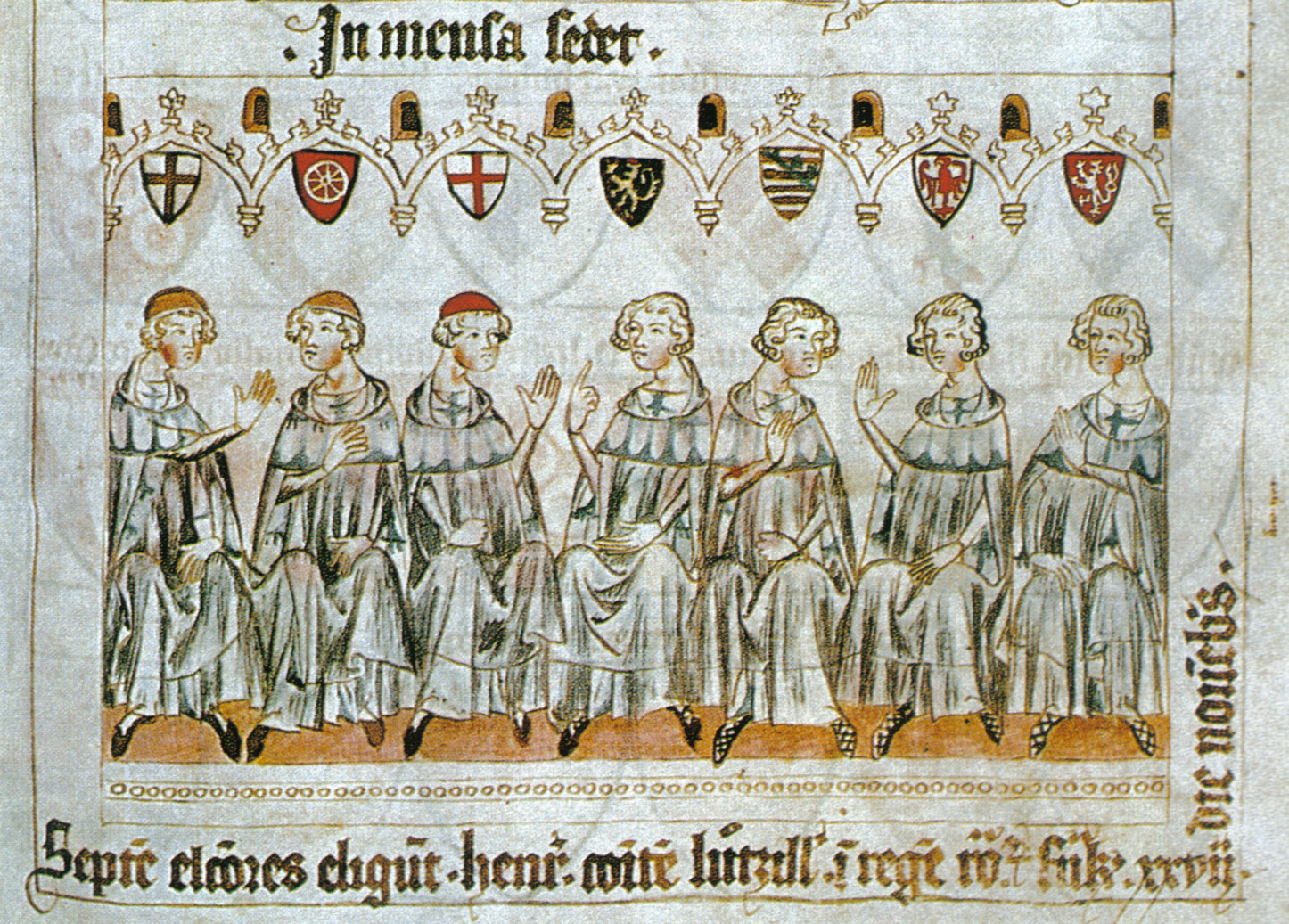
Apparently elected to prevent a French candidate becoming Emperor, largely at the instance of his brother Baldwin, the Archbishop of Trier, Henry was elevated from a fairly minor position as Count of Luxembourg to a position of enormous prestige but uncertain authority. His attempts to make that authority tangible dominate his short reign, and helped establish his family for the next century and a half amongst the great ruling dynasties of Europe.


The election, enthronement  and coronation of Henry as King of the Romans


Pen-and-ink miniature from the picture chronicle of Emperor Henry VII, the Balduineum. The drawing, on parchment, dates from 1341
 Federal State Record Office in Koblenz.

Images: Wikimedia


Having been elected with six votes at Frankfurt on 27 November 1308 Henry was subsequently crowned as King of the Romans at Aachen on 6 January 1309 - the Epiphany was an eminently suitable day to choose for a coronation - and it was on the same feast in 1311 that he received the crown of Lombardy in Milan.
His expedition to Italy both for that and his Imperial coronation on June 29 1312 (SS Peter and Paul) and to assert Imperial rights in the north of the peninsula was one of the last, perhaps indeed the last, real attempts to re-establish the Holy Roman Empire in Italy. It was in connectuion with this campaign that Dante wrote De Monarchia as an argument for the rule of a Universal Emperor who could bring peace and reconciliation. Whatever the likelihood of that in the early fourteenth century the death of the Emperor marked the end of the project. 


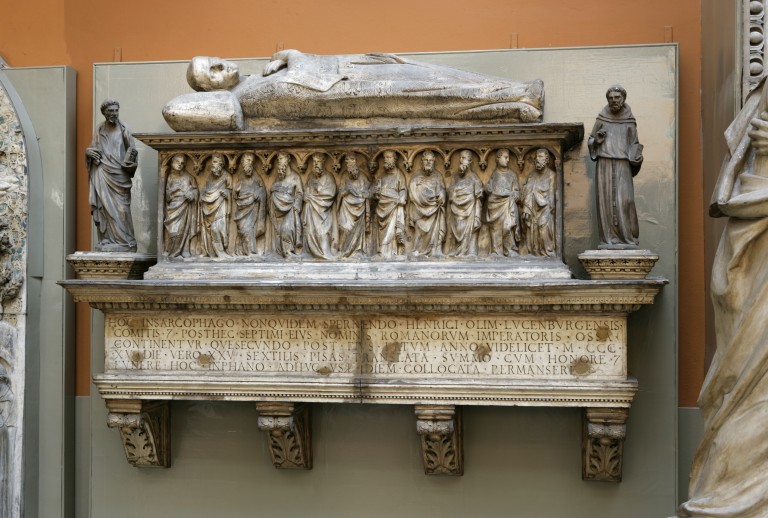
Purchased from Messrs Franchi and Son in 1865 for £66 13s 4d
The original tomb by Tino da Camaino (circa 1280-1337) dates from 1315
and is made of marble, pigmented and gilded. It is in the right transept of Pisa Cathedral

Image: Copyright Victoria and Albert Museum
 
The Emperor Henry VII died near Siena on St Bartholomew's Day, August 24th, 1313. His tomb was completed in February 1315 and was completed within the stipulated six months. It was installed in the tribune behind the high altar, but has suffered slow dismemberment through several removals. For the tomb of Emperor Henry VII, Tino signed the contract in February 1315, a little more than a year after the Emperor's sudden death during his expedition from Pisa to destroy the power of Robert of Anjou in Naples. The tomb was completed by the end of July. However, it was later dismembered, the sarcophagus itself, with the recumbent effigy is still in the cathedral, and the free-standing figures of the Emperor and four of his councillors, together with some minor figures likewise in the Camposanto. 
The original appearance of the monument was thus far more elaborate than either the cast in the Victoria and Albert Museum, or the present arrangement in the cathedral at Pisa. 
In both cases, only the effigy and the arcading containing eleven (originally twelve) apostles are preserved in their original relationship. Here, as in Pisa, the inscriptions and the consoles of the lower part date from 1494, when the tomb was removed to the chapel of San Ranieri. In the cast shown here, the lateral saints, Peter and Francis, probably date from the early 15th century and the originals of these figures are now in the Cathedral repository. At Pisa, their place is occupied by an Annunciation group from Tino di Camaino's workshop: the Virgin and Gabriel had been installed on either side of the effigy as early as 1829. The Annunciation may have formed part of the original monument, but would not initially have occupied this position, which most likely held angels drawing back curtains to reveal the effigy.

It has also been established that there was below the tomb a related altar dedicated to St Bartholomew. which might have supported a group by Tino da Camaino including a central Madonna and Child ( now in the Museo Civico, Pisa ) and a figure of St Bartholomew (now in storage in the Cathedral).

That the Emperor died on St Bartholomew's feast day had an additional poignancy in that it was in the church of St Bartholomew in Frankfurt - the so-called Kaiserdom - that Kings of the Romans were elected and enthroned, as in the second illustraion from the Balduineum by being seated on the altar. I assume this derived from the offertory at Mass - rather as it appears the Stone of Scone in Scotland was originally a portable altar.

Wednesday, 24 August 2011

Frankfurt Kaiserdom


Today being the feast of St Bartholomew my mind, being what it is, turns to thoughts about churches dedicated to him. One that comes into the mind's eye, although I have not visited it, is the Kaiserdom in Frankfurt - often referred to as a cathedral, although it has never been the seat of a bishop.


The Kaiserdom in Frankfurt

Image: www.capturedplan.com


As with several other apostles there have been many disputes as to which church holds their authentic relics, and the former papal enclave of Benevento has claimed to hold them for centuries. However Imperial veneration of St Bartholomew also manifested itself north of the Alps, where a chapel dedicated to him was erected in 1017 in the residence at Paderborn and adjacent to the cathedral.

Frankfurt has claimed to have his skin since 1238 - remember the predominant western tradition thatBatholomew was flayed. In 1239 construction began of the present church, dedicated to him and associated with the the imperial residence at Frankfurt am Main. Popularly known as the Kaiserdom ('Dom' in the sense of 'large, impressive church'), it was not completed until the early fifteenth century.

In its present form, including the pinnacles and spirelet on the tower, it is a result of a major restoration following a fire in 1867.


http://www.globosapiens.net/data/gallery/gm/pictures_468/--germany--hessen--id=

A detail of the upper stages of the tower

There is a multi-page site on the church here , and a brief history can be read here. There are floor plans of the church here and here.

The high altar has a fine Gothic retable from the second half of the fifteenthth century, which depicts the life of Christ, and was originally created for the Katharinenkirche in Salzwedel.
The splendid Maria Schlaf Altar, situated in the Lady Chapel, is the only altar which originally graced the Kaiserdom. It was created in 1434 and shows the dying Virgin Mary surrounded by the apostles. The choir stalls, from 1352, are also noteworthy.

Maria Schlaff Altar

The Maria Schlaff altar.

Image:aviewoncities.com

From the issue of the Golden Bull by the Emperor Charles IV in 1356 it was the site of the election of the Holy Roman Emperors, and in the Wahlkapelle (Election Chapel) the seven Electors (nine from the seventeenth century) gathered here to elect a new Emperor. 16 out of the total 23 German emperors were elected in this small vaulted room on the south side of the church.

Election Chapel

The Wahlkappelle.

Image:aviewoncities.com

The procedure was for the Archbishop of Mainz as senior Elector to be seated in the chapel, for the remaining electors to go in individually and state their choice to him before the Archbishop himself voted and announced the result. If he was present the successful candidate was then enthroned on the altar - that is, I assume, derived from the Offertory at Mass.

http://www.hotelpraguecity.com/pics/Golden_Bull.jpg

The Golden Bull of 1356.

Image: www.hotelpraguecity.com

From 1564 the Holy Roman Emperors were crowned in this church in Frankfurt, as were their heirs, the Kings of the Romans until the last coronation in 1792. In front of the choir a white modern altar, installed in 1994, marks the site where the newly elected Emperors were crowned. There is an article, with illustrations, about the Coronations in the same series as those on the Kaiserdom here.

http://germanhistorydocs.ghi-dc.org/images/30029994_Leopold%20I%20is%20Crowned%20Kaiser.jpg

The Coronation of Emperor Leopold I on August 1 1658.
Top left the proclamation, top right the coronation,
and below the procession to the banquest after the ceremony.

Image: germanhistorydocs.ghi-dc.org


http://www.1st-art-gallery.com/thumbnail/212176/2/The-Coronation-Of-Joseph-II-1741-90-As-Emperor-Of-Germany-In-Frankfurt-Cathedral-1764-2.jpg


The coronation of Joseph II as King of the Romans April 3 1764.
A painting by Martin II Mytens or Meytens in the Kunsthistorisches Museum in Vienna.

Image:www.1st-art-gallery.com


http://english.habsburger.net/stories-en/gibt2019s-was-zu-feiern-habsburgs-feste/leitbild/image_large

A detail from the painting of the coronation in 1764.

Image: english-habsburger.net


http://www.downies.com/aca/Auction303/aca/images/lots/303/2075.jpg


A medal commemorating the coronation of the Holy Roman Emperor Francis II in 1792 - the last such coronation.
Considering what had happened in France on July 14 just three years earlier this was perhaps not a very auspicious date.

Image:http://www.downies.com/

The Holy Roman Emperor Francis II died as EmperorFrancis I of Austria in 1835. In his last years he was much loved by his grandson, the young Archduke Francis, born in 1830 and who became the Emperor Francis Joseph in 1848. In his last years he was photographed with his great great nephew Archduke Otto, who died earlier this year - a remarkable link across the centuries.