


On this date in 1268, 645 years ago, the 16 year old boy- king Conradin was beheaded in Naples with his best friend Frederick of Baden and a number of his supporters, an event which schocked many contemporaries. I wrote about the events anterior to this in my post The Battle of Tagliacozzo in August.
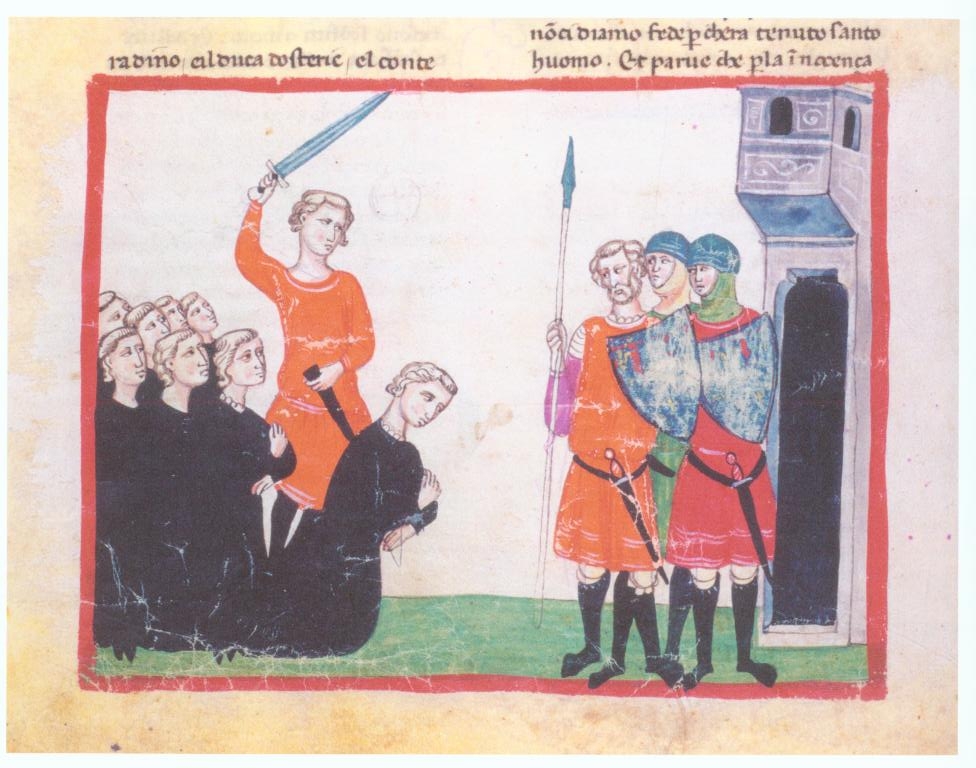
A fourteenth century depiction of the death of Conradin and his companions
from Giovanni Villani's Nuovo Cronica
Image;Wikipedia
There is an online life of Conradin here.

Conradin from the early fourteenth century Codex Manesse,
a collection of German lyrics, preserved at Heidelburg, and in which
there appear two songs written by Conradin
a collection of German lyrics, preserved at Heidelburg, and in which
there appear two songs written by Conradin
Image:Wikipedia
Conradin, the last direct Hohenstaufen, was the son of the German King Conrad IV, and grandson of the Emperor Frederick II, inherited his claim to the thrones of Germany, Sicily and Jerusalem at the age of 26 months when his father died in 1254.
Although regarded as King Conrad V by some Germans the monarchy of the King of the Romans was elective, and with papal pressure not to elect another Hohenstaufen, not to mention the fact that Conradin was only a child Germany entered upon the interregnum that included the double election of Richard of Cornwall in 1257 and of Alfonso X of Castile that did not end until the election of Rudolf of Habsburg in 1273.
Conradin’s uncle and “regent” Manfred usurped him in Sicily, possibly beleiving or claiming to have heard of the boy's death. King Manfred, an illegitimate son of the Emperor Frederick II was eventually killed at the battle of Benevento in 1266 fighting against Charles of Anjou, brother of St Louis IX and brother-in-law of King Henry III, upon whom the Papacy, as suzerain had bestowed the kingdom.
At this point Conradin decided to assert his Sicilian claim, at an age not dissimilar to his grandfather's seizure of poer in Germany half a century or so beforehand as a teenager. By the standards of medieval Europe, he was old enough to press his rights in battle. So Conradin, Corradino to the Italians, as I outlined in August led his troops into Italy, but his international army was defeated at Tagliacozzo on August 23 1268.

King Charles
of Anjou.
Reale d'oro, Barletta.
Half length portrait between lily and
cross, with on the reverse his. coat of arms.
Image;coinsweekly.com
Escaping from the field of battle, Conradin reached Rome, but acting on advice to leave the city he proceeded to Astura in an attempt to sail for Sicily: but here he was betrayed by the Frangipani family, arrested and handed over on September 8th to Charles, who imprisoned him in the Castel dell'Ovo in Naples, together with his inseparable friend Frederick of Baden. The actual nature of their friendship may historically be unclear, but these days it has attracted predictable interest from certain quarters.
His captor’s attitude was summed up in the sentiment Vita Corradini, mors Caroli - Mors Corradini, vita
Caroli. “Conrad’s life is Charles’s death, the death of Conrad is the life of Charles” somewhat doubtfully ascribed to the counsel of Pope Clement IV.The Pope, who was living at Viterbo, was to attract blame for not apparently interceding for Conradin's life, and indeed in the opinion of some was held to be responsib;e. This point was to be made by Luther during the German reformation with a propaganda print showing the Pope personally decapitating Conradin. However there is good evidence that the Pope did try to save Conradin - whom he had described as alamb led to the slaughter as his army advanced through Italy - and also sought the intervention of Charles' brother the King of France to save the young man. In any event the pope was to die a month later at the end of November.

Charles of Anjou
Image:allempires.com
Charles hesitated between life imprisonment or death as a punishment. Prisoners from Tagliocozzo, such as the Infante Enrique of Castile were to be imprisoned for upwards of twenty three years, whilst there was also the precedent of King Enzo of Sardinia, illegitimate son of the Emperor Frederick lived out the rest of his life in prison in Bologna from his capture in 1249 until 1272.
Charles decided on death for his rival and called together a tribunal composed of two representitives of each of the towns of the region. Conradin was arraigned before this court with having revolted aganst his legitimate sovereign, of having shown contempt for his excommunication by the Church, of having allied himself with the Saracens - i.e. his grandfather's settlement of themn at Lucera - and of pillaging the convents and churches of Rome. Only one of the judges, Guido de Lucaria, found in favour of Conradin, in a case whose verdict was certain from the beginning.
Conradin was not present at his condemnation, news of which was brought to him in prison by an elderly French knight according to some sources. At the time he was playing chess with Frederick, and, without rising having heard their fatepronounced, resumed their game.
Accounts vary as to whether the sentence was fixed for thenext day or that they were given three days to prepare. Early on the morning of October 29th Conradin,accompagnied by Frederick, the Ghibelline Counts Gualferano and Bartolomeo Lancia, Gerard and Gavano Donoratico of Pisa and seven others went to the scaffold erected in the new Market Place of Naples. The one grace Charles afforded his rival was that Conradin was executed first.
Charles did not help his subsequent public image by turning up to witness the executions, and the events as recorded, accurately or not, by later writers enhance the already dramatic nature of what happened. Villani in the next century ha s the story of Robert Count of Flanders, son in law of Charles of Anjou,outraged at the sentence striking and killing Robert of Bari who pronounced it at the execution, with the words "Tiens, voici pour t'apprendre à oser condamner à mort un aussi noble et si gentil seigneur." Confidently mounting the scaffold Conradin is said to have declared his innocence, announced his certainty that his German subjects would avenge him and threw one of his gloves to the watching crowd where it was retrieved by Henri d'Apifero , who found within it the young King;s signet and carried the glove to Constance, the daughter of King Manfred, and this Conradin's cousin, who was married to King Peter III of Aragon. This was no sentimental gesture but rather an action of bestowing the Hohenstaufen claim on the Aragonese. It seems similar to the symbolism of gloves as in the English coronation rite where one is given to the hand which holds the royal sceptre.

Conradin throws his glove to the crowd
Engraving by William Zimmermann in A Popular History of Germany c.1890
Image;lookanlearn.com

Conradin glove in hand on the scaffold - note the approaching eagle
Nineteenth century engraving by J.Plueddemann
Image:eonimages
His last words are said to have been "O Mother ! What griefs I cause you."
Immediately after Conradin's decapitation Frederick is said to have kissed the severed head before suffering a like fate, and that an eagle swooped down and dipped its right wing tip in the blood of Conradin.
There is more about the trial and execution in the extract from Giuseppe Quatriglio's A Thousand Years in Sicily: From the Arabs to the Bourbons (1991) here
The significance of the story of Conradin's death is in part that thereby Charles of Anjou set a dangerous precedent for many other executions over succeeding centuries of dynastic and political rivals across Europe - hitherto the fate of political rivals had not been determined by public show trials resulting in a journey to the scaffold.
Runciman in The Sicilian Vespers says that Conradin's erstwhile subjects never forgot him, and he remained for centuries a figure of legend and romantic speculation. By the fourteenth century the story of the eagle dipping its wing in his blood was known, and in the late 1320s the Emperor Louis IV when ion italy deliberately razed to the ground a fortress where, mistakenly, it was thought Conradin had suffered. In the sixteenth century in Germany he was presented by Luther as a victim of the abuse of Papal power, and I have been told that in 1870 Germans spoke of the Franco-Prussian war as revenge for Tagliacozzo.
His story inspired a whole series of dramatic works and poems in German, French and English in the eighteenth and nineteenth centuries. An example of its popular appeal to nineteenth century English poets with an interest in the Italian middle ages, can be seen in this extract from Conradin by William John Rous, published in 1884:
For artists the story of the teenage Conradin was rather like the English ones of the Princes in the Tower or Lady Jane Grey, as in Paul Delaroche's well-known painting of her execution. In the case of Conradin and Frederick the topic appealed to the Romantic imagination of the latre eighteenth century, as with this somewhat sentimental piece:He turns to clasp with longing arms his friend,And turning, sees the fatal blow descend,Then presses with his lips the severed head,Last greeting of the dying to the dead.One quivering flash, a shock that is not pain,And those he parted death unites again.So perished Conradin, but legends tellThat as the trenchant blade descending fell,An eagle, that, unseen by human eyes,Had poised aloft, down swooping from the skies,For one short instant hovered o’er the slain,And dyed his pinions with a crimson stain,Then wildly shrieked, and upward soaring spedTo witness for the blood unjustly shed.
Conradin of Swabia and Frederick of Baden Being Informed of Their Execution in Prison in Naples
Johann Heinrich Wilhelm Tischbein 1785

Image:Wikipedia
and some are frankly awful:

Painting by Pauline Soltau (1833-1902) of 1860Image:WikipediaOthers are fine examples of ineteenth century historical painting. This one shows Conradin wearing a cap like that he is depicted wearing in the Villani illustrations:
Image:artelista.com
and this one better still I think:
Robert of Bari reads the death sentence to Conradin and FrederickAnton WernerKunsthalle KarlsruheImage: Flickriver.com
The execution itself inspired a number of dramatic, if not overly accurate, indeed fanciful depictions over the centuries. Although these suggest the executioner used a sword or an axe one website I saw suggests Conradin and his companions died by the use of a mannaia (literally "the knife"), a very primitive forerunner of the guillotine, which was operated by driving the blade - essentially a meat cleaver, hence the name mountd in a block of wood - down through the victim's neck using a heavy mallet. Mannias eventually evolved into larger devices with weighted blades that more closely resemble the Halifax Gibbet, but the short drop required a very heavy blade to insure decapitation, and the axes would likely crush through the spinal column rather than slice through it.
Frederick of Baden receives the head of Conradin - detail from an early printImage:executedtoday
The execution of Conradin in Naples
A seventeenth century copper engraving
Image:chain.to

Frederick kisses the severed head of ConradinPrint by Bernhard Rode, 1781Image: Wikipedia

Image;corbisimages.comWith Conradin's death at 16, the legitimate Hohenstaufen line became extinct. He was buried at first as an excommunicate on the beach at Naples but hisis remains, with those of Frederick of Baden, were removed to the church of the monastery of Our Lady of Mount Carmel in Naples founded by his mother for the good of his soul, and situated near the site of his death.There in 1847 the Crown Prince of Bavaria, later King Maximilian II(1848-64) erected a marble statue by Bertel Thorvaldsen to his memory.

The statue of Conradin by Thorvaldson in the Carmelite church in Naples
Image: Wikipedia


Ccnradin' s posthumous career from thirteenth century teenage claimant and victim to fourteenth century figure of legend and then sixteenth century anti- Papal icon to the Romantic hero-victim which appealled to the a sensibilities of that era to nineteenth century proto-nationalist and twenty first century gay icon is a remarkable cultural journey - and no mean achievement for a teenager who died before he was seventeen.

