Once I was a clever boy learning the arts of Oxford... is a quotation from the verses written by Bishop Richard Fleming (c.1385-1431) for his tomb in Lincoln Cathedral. Fleming, the founder of Lincoln College in Oxford, is the subject of my research for a D. Phil., and, like me, a son of the West Riding. I have remarked in the past that I have a deeply meaningful on-going relationship with a dead fifteenth century bishop... it was Fleming who, in effect, enabled me to come to Oxford and to learn its arts, and for that I am immensely grateful.


Showing posts with label Anne Boleyn. Show all posts

Tuesday, 23 October 2012

Woodvilles and Boleyns


With one of the students I am teaching this term I am looking at the life and times of Anne Boleyn. In today's tutorial we considered her background and upbringing, and her time at the Burgundian-Habsburg court of Margaret of Austria and at the French court.

A point which occurred to me some time ago, and which I made in our meeting, was the similarity between Elizabeth Woodville and her family and Anne Boleyn and hers. The physical similarities between King Edward IV and his grandson King Henry VIII are clear, and also the fact that both became King at the age of eighteen - with possibly no few consequences attendant thereupon. Both had continental ambitions that remained fundamentally unrealised.

The similarities between Elizabeth and Anne are interesting and noteworthy. Elizabeth was half Burgundian through her mother Jaquetta, Anne had lived at the court in Brussels as a girl. In both cases previous marriages or pr-contacts by their husbands shaped their rise or fall. Both resisted becoming the King's mistress, both were highly controversial choices as Queen consort, both, inevitably, advanced the position of their family. Both their families were far from popular, if not cordially loathed, by others in the political establishment, and both paid a bloody price - Elizabreth Woodville lost her father, two brothers and a son by her previous marriage to the headsman as well, of course, as the disappearance of her sons by King Edward IV; Anne Boleyn lost her own head, as did her brother George his, and the family never recovered its influence.


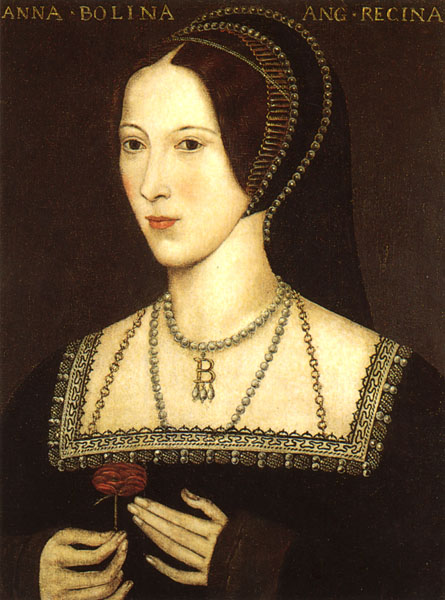
Anne Boleyn
Later copy of a portrait of circa 1534

Image: Wikipedia

Anthony Woodville, Earl Rivers and George Boleyn Viscount Rochford can be seen to have been more considerable figures than might have been supposed the Oxford Dictionary of National Biography lives of them bring this out. That of Rivers, by Michael Hicks, can be read here and that of Rochford by Joseph Block is here.

Both were accomplished in courtly and diplomatic arts, and men of learning with a recognised interest in learning and religious ideas. There is more about Rivers' literary patronage here  and George Boleyn was anxious to advance the evangelical reformist ideas that gained ground with his sister's elevation.


Caxton and Rivers presenting book to King Edward IV

Earl Rivers and William Caxton presenting a book to King Edward IV,
Queen Elizabeth and Edward Prince of Wales, later King Edward V.
The figures between the King and Earl Rivers may be the Duke of Buckingham and Cardinal Bourchier of Canterbury.

Image: Luminarium.org

What strikes me in this similarity is the point that the world of the 1460,70s and 80s was very similar to that of the 1520s and 30s, though clearly the religious controversies of the latter were new in themselves.  The late-medievalist in me tends to see the period as a unity - another reason for not seeing Bosworth as either an ending or a beginning.


Thursday, 3 February 2011

Anne Boleyn and Elizabeth Woodville


My course of teaching on women in the sixteenth century continued this morning with a tutorial on Anne Boleyn.

The Wikipedia articles on Anne Boleyn and her brother George, Viscount Rochford are a good and detailed digest of current historical opinion about them, and well worth looking at.


A late Elizabethan portrait of Anne Boleyn, possibly derived from a lost original of 1533–36.

Photo: Wikipedia


The themes I gave my student to consider were those of the extent to which Anne Boleyn can be seen as protagonist and to what extent victim. Apart from the obvious answers the results of such an examination of her extraordinary life yields interesting insights into which category her life fell at different points. Once married to the King her freedom of action paradoxically declined - as Queen Consort her power was circumscribed in action. Like the medieval vision of the wheel of fate she was likely to fall from the apogee. A not dissimilar fate befell the family of Jane Seymour after she had died, even though she left the King with the long sought male-heir.

One thing which struck me was the similarity between Anne Boleyn and Henry VIII's grandmother, Elizabeth Woodville, about whom there is a good introductory article here. Both women came from courtier families, yet were in many ways outsiders, unpopular as individuals and families for their spectacular rise to power and influence with a marriage to the King. Just as Anne Boleyn refused to be Henry VIII's mistress, so, it is claimed, Elizabeth, Lady Grey (as she then was) refused Edward IV's advances without the promise of marriage. Both marriages complicated (to put it mildly) foreign policy. Both families paid a terrible price for the ascent to the throne - Elizabeth lost her father, two brothers and three sons to violent deaths, whilst Anne and her brother lost their own lives. Both Elizabeth's mother and Anne were to be accused of witchcraft. Both their marriages to their regal husbands were to be declared invalid - Elizabeth's by Richard III, Anne's by Henry VIII - and their children consequently illegitimate.


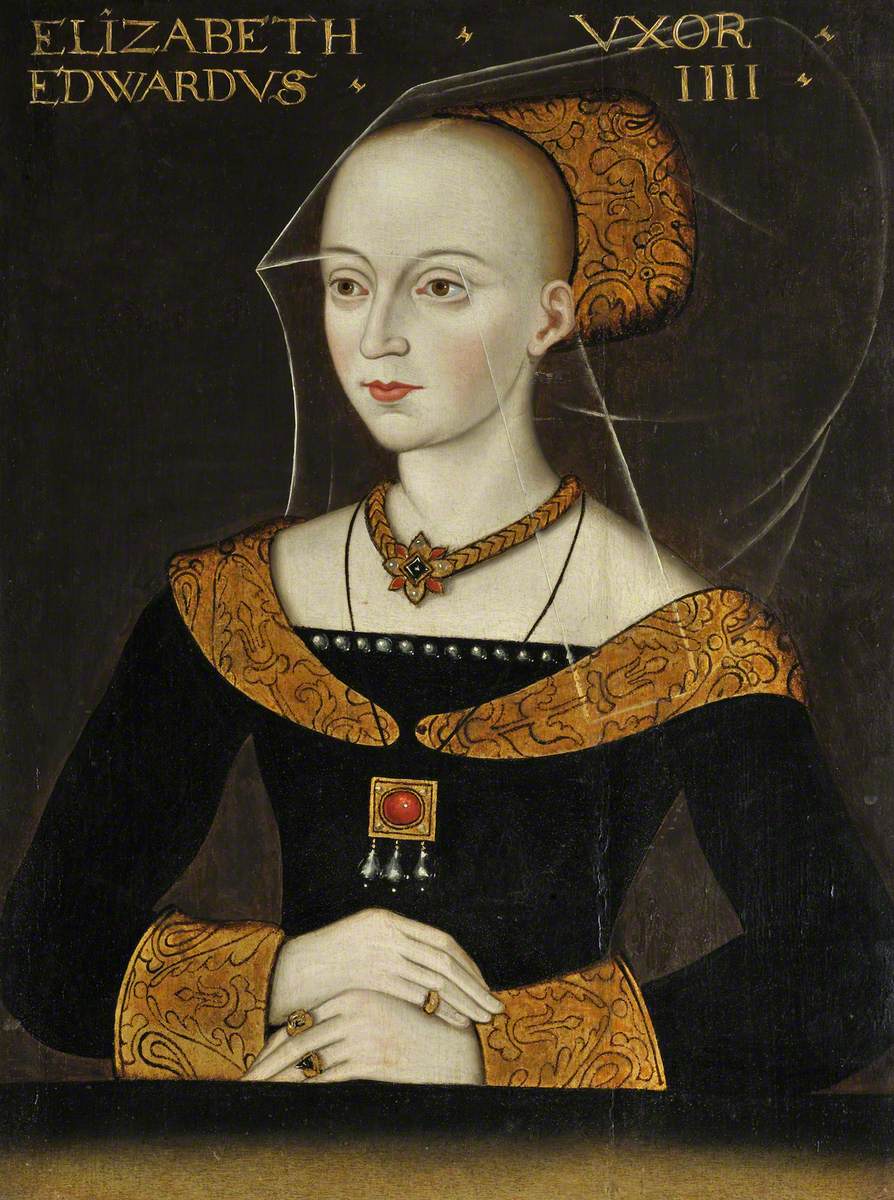
Elizabeth Woodville

Photo: Wikipedia

Perhaps all that these points prove is that the England of the 1530s was far less different from what it had been half a century earlier - but as a late medievalist I suppose I would say that. Nevertheless I think the similarities are instructive about both the life of these two consorts, and about the abilities of women in such a society to achieve social mobility, as well as of the risks involved for them and their families the higher one rose.