Once I was a clever boy learning the arts of Oxford... is a quotation from the verses written by Bishop Richard Fleming (c.1385-1431) for his tomb in Lincoln Cathedral. Fleming, the founder of Lincoln College in Oxford, is the subject of my research for a D. Phil., and, like me, a son of the West Riding. I have remarked in the past that I have a deeply meaningful on-going relationship with a dead fifteenth century bishop... it was Fleming who, in effect, enabled me to come to Oxford and to learn its arts, and for that I am immensely grateful.


Monday, 31 January 2022

Another relic of King Charles the Martyr


Having written yesterday about surviving relics of King Charles I the serendipity of the Internet yielded another in the form of an article in the Daily Express yesterday about a silver locket that contains what is described as part of a single strand of the King’s hair. It is interesting that the fragment is described by a label ( of what date?) on the locket as being hair of “S Charles”, so it was clearly seen very much as a relic to be treasured and venerated in the High Anglican tradition.


Sunday, 30 January 2022

Relics of the Royal Martyr


Today is the anniversary of the beheading of King Charles I in 1648/9. The cult of the Royal Martyr has been accompanied by various relics, anf two of these have been in the news in recent years.

The first is what is believed to be the second shirt or waistcoat/vest he wore so as not to shiver with the cold, and be mistaken for showing fear.

What was once believed to be that shirt was acquired for the Royal Collection in 1911 and is preserved at Windsor Castle. However a report from 1998 argues that the item has been misidentified and that it is in fact a woman’s night dress of the period. This is set out in an article from The Independent which can be read at Charles I's shirt is really lady's nightie

What appears to be the real second shirt is now in the collection of the Museum of London and was due to go on display as part of an exhibition about London executions which has, I assume, been delayed by the pandemic. From the various press reports about this shirt it was clearly going to be the main attraction.

There are pictures of it, together with others of the gloves the King is believed to have worn on that day and of a monogrammed pocket handkerchief, in articles from the Guardian at Shirt worn by Charles I for his execution to go on display in London, from the BBC News website at Vest worn by Charles I at execution to be shown, from The Tatler at The blood-stained shirt worn by King Charles I on day of his execution will go on display, from the Smithsonian Magazine at See Charles I's Stained Execution Shirt and from the MailOnline at Was this the waistcoat that Charles I was wearing when he was beheaded?

A second link to that grim day is a games compendium that was sold at auction in 2012. The exquisitely made piece with its amber inlays allows for playing chess, draughts, backgammon and Nine Men’s Morris. It is believed that this was taken by the King with him from St James’s Palace to Whitehall, presumably to use to wile away the time before he stepped out onto the scaffold. There is an illustrated article about it from the MailOnline at Cheque mate: Chess board taken by King Charles to his execution sells for £600,000 to private collector


Thursday, 27 January 2022

Vestments in fifteenth and sixteenth century paintings

 
Shawn Tribe has a beautifully illustrated article on the Liturgical Arts Journal website about the depiction of liturgical vestments by artists in the fifteenth and sixteenth centuries.

It appears clear that these are paintings of actual vestments or at very least ones that correspond to what would have then existed in sacristies across Latin Christendom.

The ones shown in the article are not dissimilar to surviving examples such as those of the Order of the Golden Fleece which are preserved in Vienna or other surviving pieces and fragments of medieval textiles in museum collections.

The article with its fine selection of illustrations can be seen at Sacred Vestments from the Fifteenth and Sixteenth Century As Seen In Historical Paintings


Wednesday, 26 January 2022

A wooden statuette from early Roman Britain


In the link to the report on the latest discoveries at Stoke Mandeville in my previous post there is a reference to the discovery on another site in Buckinghamshire of a small wooden Roman statue. This discovery st Twyford is covered in considerable detail in a report on Live Science. This stresses both the rarity of such an object surviving at all and also the insight it offers into another aspect, or indeed aspects, of life in early Britannia.


More discoveries from the site of Stoke Mandeville Church


The excavation of the site of the old parish church of St Mary at Stoke Mandeville in Buckinghamshire continues to yield intriguing and striking evidence as to the early occupation of the plot.

I have posted about previous discoveries there before in 2020 in Dealing with evil in the Buckinghamshire countryside and in Roman statues from Stoke Mandeville church last year.

The latest evidence appears to be from the end of the Roman period or at some point in the earlier phase of Anglo-Saxon occupation. It appears generally accepted that the Chilterns remained under British control after the rest of this southern lowland region fell under Anglo-Saxon domination, which might stretch the time limits for dating. The evidence revealed is of the disturbance of eight cremation urns and of their being shattered, possibly as another corpse, having apparently suffered a violent death, was being thrown or rolled in on top. 

The report about these latest excavations is from the Daily Express and can be seen at Archaeologists baffled by ‘extraordinary’ skeleton that had been ‘rolled into a ditch’

Much as I deplore the HS2 project the excavations along its route are revealing very important additions to our knowledge of Roman and early English life, as I linked to in Roman trading town revealed in Northamptonshire

It is just a pity that the funds could not be made available for such archaeological research without the environmental disaster that is HS2

I can certainly see the story of the site Stoke Mandeville church becoming standard in books on Romano-British and Anglo-Saxon for future generations.


Tuesday, 25 January 2022

The church that Bishop Fleming built


Today, January 25th, is the 591st anniversary of the death of Bishop Richard Fleming, the subject of my thesis research.

Fleming was born at the village of Crofton, which lies just south east of Wakefield, and looks westward up the Calder valley. Politically however in the lifetime of Fleming it looked eastward to Pontefract as it formed part of the Honour centred on the castle there, and which was an important component of the estates of the Duchy of Lancaster. It was through that set of connections that Fleming made the connections that helped carry him to the episcopate.

Rather as men successful in politics in the later sixteenth century built grand country houses in or near the villages or towns in which they were born so fifteenth century bishops tended to rebuild, extend or augment the parish churches of their home villages. Thus Bishop Walter Skirlaw of Durham rebuilt the church at Skirlaugh in the East Riding, Bishop Nicholas Bubwith of Bath and Wells built the tower of the church at Bubwith in the same Riding, Bishop William Waynfleet of Winchester established a school in his home village of Wainfleet in Lincolnshire, Archbishop Henry Chichele of Canterbury established a collegiate foundation at his home parish of Higham Ferrers in Northamptonshire, Archbishop John Kempe of York did the same in his home parish of Wye in Kent, and Archbishop Thomas Rotherham did the same in his eponymous hometown. Bishop John Alcock of Ely founded a grammar school in his home city of Kingston-upon-Hull. Skirlaw, Waynfleet, Chichele, Rotherham and Alcock were all founders or benefactors of colleges in Oxford or Cambridge. Richard Fleming was similar - not only did he found Lincoln College in Oxford and attempt to turn his previous parish church at Boston into a collegiate foundation but he also rebuilt the church in his home parish of Crofton.
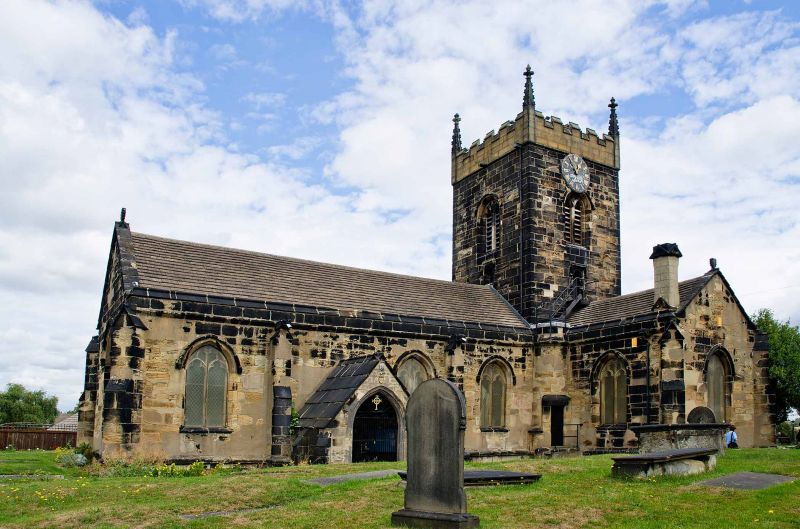


Crofton Church from the south west

Image: britishlistedbuildings.co.uk

A local tale claims that he moved the church site from a low lying position to the present one, but this I think unlikely. This is because the church has the remains of two Anglo-Saxon crosses - presumably found in the walls of the church during the nineteenth century restoration - and current opinion would suggest the tower arches date from about 1300. This would suggest Fleming’s rebuilding was carried out around a pre-existing structure.

His coat of arms is over the porch entrance and in the early seventeenth century the indefatigable Yorkshire antiquary Roger Dodsworth recorded a panel of glass - now alas list - which showed Fleming preaching ( he was a distinguished preacher ) and recorded him as the rebuilder and consecrator of the church. 

The unaisled cruciform church is simple in plan and any original fittings, other than probably the font, have long gone. Nonetheless this is a link to a famous son of the village. It is also a witness to Fleming’s commitment to his home. If we date the work at Crofton to his second period as Bishop of Lincoln, from 1426 until his death in 1431 this was when he was founding Lincoln College and trying to create the collegiate community at Boston, when his finances were certainly straightened. Crofton church may not be an elaborate structure, but the fact that it was rebuilt at all by Fleming is a sign of his filial devotion to his parish, his village and his family.


Sale of the King Henry III gold penny


I recently posted in Another gold penny of King Henry III about the forthcoming sale of a King Henry III gold penny, minted in 1257 and discovered by a metal detector in a Devon field last autumn. It is one of only eight known examples of this coin, the first gold coin to be struck in England after 1066.  Last weekend the coin was sold at auction for a record price, and happily the new owner intends to keep it in this country and to loan it to a museum for public viewing.

My previous post had a number of links to articles about the coin, its iconography and place in the monetary history of this country. Here are two more articles about it and the sale. The first is from the Mail Online and can be seen at Metal detectorist finds one of England's 'first ever gold coins' and the second is from the latest Medievalists.net posting on their website and is available at Medieval gold penny could fetch up to £400,000 at auction

This article draws out more about the design of the coin and what it sought to express to those who handled it. As a piece it is further testimony to the artistic sensibilities and patronage of the King and to his vision of his position as monarch.

I liked the finder saying that he had paid a visit to Westminster Abbey to thank King Henry III for having made the discovery and its resulting boost to his family finances. I rather think that the King would appreciate that.


St Dwynwen


Today, apart from being the Feast of the Conversion of St Paul, is also that of the fifth century Welsh nun St Dwynwen. 

Now for those of you have have never, or even scarcely, heard of her that excellent journal Country Life has an article about her life and cult as the Welsh equivalent of St Valentine. In recent years the revival of interest in her had come to my attention, but when I used to stay in North Wales on holiday as a schoolboy in the 1960s she was never mentioned at all.

The story of St Dwynwen shows the perils attached to getting in the way of such a saint’s vocation and has similarities to the later, eighth century, story of St Frideswide here in Oxford and her pursuit by Algar of Leicester.

The informative article, which also looks at the intercession role of St Raphael based upon the Book of Tobit, can be read at Curious Question: Was St Valentine beaten to it by 1,000 years by the Welsh patron saint of love?