Once I was a clever boy learning the arts of Oxford... is a quotation from the verses written by Bishop Richard Fleming (c.1385-1431) for his tomb in Lincoln Cathedral. Fleming, the founder of Lincoln College in Oxford, is the subject of my research for a D. Phil., and, like me, a son of the West Riding. I have remarked in the past that I have a deeply meaningful on-going relationship with a dead fifteenth century bishop... it was Fleming who, in effect, enabled me to come to Oxford and to learn its arts, and for that I am immensely grateful.


Thursday, 6 January 2022

Epiphany Water


As I was leaving Mass this evening in addition to seeing a basket full of blessed chalk I was reminded by a friend to take a phial of Epiphany Water from by the crib. This I did, carried it home and sprinkled it around and threw the last drops over myself.

There is an introduction to this particular type of Holy Water at Epiphany water is a powerful weapon against Satan and the full text of the blessing from the Roman Ritual as approved in 1890 can be found, with the rubrics, in translation at Liturgical Year : Prayers : Roman Ritual: Blessing of Water on Eve of Epiphany  Oh, for the days of such rigidity!

There is an article about its use in the Orthodox Church at THE SECRET OF THE Epiphany WATER: How and when is holy water used 

Which reminds me to wish a holy and joyful Christmas to my Orthodox friends for tomorrow and the ensuing season.


The birth of King Richard II


645 years ago today in Bordeaux the Princess of Wales was delivered of a son, who was to become King Richard II a decade and a half later. The second son of her marriage to the Prince of Wales he did not become the direct heir until the death of his elder brother, Edward of Angoulême, in 1371.

At the time of his birth his father, Prince Edward, was about to set off on what was to become the Nájera campaign in support of of King Pedro I ( The Cruel ) of Castile and some sources maintain that the Princess went into early labour because of her anxiety about her husband’s departure for a mid-winter crossing of the Pyrenees. There is an account from Wikipedia of the campaign and the Prince’s victory near Burgos the following April at Battle of Nájera

My post from five years ago about the future King’s birth can be seen at Birth of King Richard IIBorn as he was on the feast of the Epiphany in adulthood he, and his circle, appears to have drawn upon the symbolism of the day in such things as the Wilton Diptych and in literary works, as I point out in that post. In an age of sacral monarchy being born at Epiphany and reportedly having three kings at his baptism could clearly be presented as auspicious. Here was birth, baptism and naming, manifestation to the world in the Epiphany season of a child born, as it turned out, to be King. Furthermore he appears to have been initially baptised as John, from came his strong and self-acknowledged devotion to St John the Baptist, a saint who figures prominently in the narratives of Christ’s birth and baptism, and both commemorated in the traditional liturgy for today. Perhaps it is no wonder if it possibly all went to his head. That however might be too easy an explanation of the causes  and effects, of the political factors which shaped the life of a late medieval monarch, and which led finally to the death of Richard of Bordeaux in the castle of my home town at the age of 33 - or is there in that an ultimate violent fulfilment of his Christ-like quality? Shakespeare was not a contemporary but his poetic account conveys something of the sense of the deposition and murder as having a Passion-like quality. It may well not have been the view of the majority of the country in 1400, but it may have sustained the dethroned monarch.

That post I wrote in 2017 can now be supplemented by other online articles about the city of his birth, which was then the second city in the dominions of King Edward IIi and the capital of his father’s Principality of Aquitaine created by the peace treaty of 1361. This topic is covered in a very readable form by Michael Jones’ relatively recent biography The Black Prince.

The French website BORDEAUX-MEDIEVAL-DOSSIER-ENSEIGNANTS gives both an introduction to surviving medieval buildings in the city and also has a number of striking reconstructions of the appearance of late medieval Bordeaux, including the Ombrière and the area around the cathedral.

Wikipedia has a much improved and more detailed article about the cathedral at Bordeaux Cathedral and one about the neighbouring basilica of St Severinus at Basilica of Saint Severinus of Bordeaux

One of my intentions at the High Mass for Epiphany this evening was to pray for the repose of King Richard II. May he rest in peace.


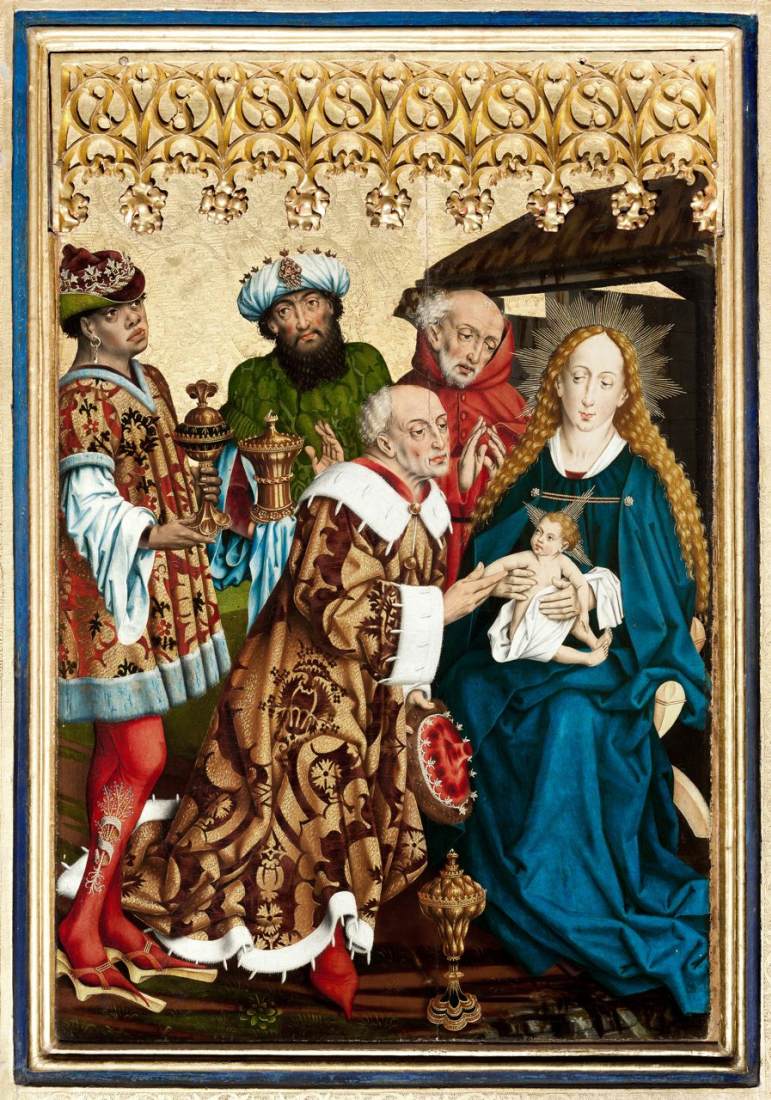
Epiphany


The Adorarion of the Magi
Friedrich Herlin ( c.1425/30 -1500 )
A panel from the High Altar reredos of the Stadtkirche St Jakob in Rothenburg ob der Tauber, completed in 1466.

Image: Web Gallery of Art

Exotic golden vessels, richly coloured and textured fabrics, pattens on the feet of one of the Magi, not to mention his elaborately decorated hose, are all an insight into the fifteenth century view of kingship and its appurtenances. For the history of his footwear, perhaps best known from the Arnolfini Marriage Portrait, see History of Patten Shoes
 
Three racial origins for the Magi is a common artistic trope, the homage of the nations and of different ethnicities and different cultures and learned traditios is more than a reminder but a demonstration of the Universality of Our Lord’s mission, made manifest today.


Wednesday, 5 January 2022

Maintaining Monastic Fidelity


The scholarly and informative website Canticum Salomonis has a striking post which reproduces a statement issued on December 21st from the traditional rite monastery of the Benedictines of the Immaculate at Taggia, in north-west Italy. The house was founded from Le Barroux and clearly enjoys the favour of its diocesan Bishop. The statement is a clear and cogent response to Traditionis Custodes and to the recent CDW clarifications. 

The tone is measured but clear, respectful yet unyielding. This is a community that will not abandon its foundation principles but will remain faithful to them. Here is a fine example of the type of response that needs to be made.

I understand from a friend that the Society of St Vincent Ferrer, the traditionalist French Fominicans have issued a similar statement.

The text of the Taggia statement and the comments from the Prior in an interview, can be read at Canticum Salomonis:Statement from the Benedictines of the Immaculate


Tuesday, 4 January 2022

Interview with the Clever Boy


My Oxford friend George from Ireland has a vlog on which he posts his thoughts on current events and also on perhaps lesser known historical sites in London or in his native Ireland. He also occasionally does interviews with people. Last week he was back in Oxford and filmed one such with me. Recorded on his mobile phone in the hotel coffee lounge I think it comes out quite well, especially as I had no real warning of what I was going to be asked, Mind you a normal conversation with George can be like that …

For those of my readers who want an idea of the Clever Boy in conversation, well almost in monologue mode, and to hear my thoughts on a number of historical themes, the video can be viewed at: 

Monday, 3 January 2022

King Philip V of France


Today is the seventh centenary of the death of King Philip V of France, who also reigned as King Philip II of Navarre, in 1322. He is often known from his height as Philip le longue, the Tall. Born in 1291-3 he had been created Count of Poitiers by his father and became King in 1316.

The son of King Philip IV, brother of King Louis X and King Charles IV, and of Queen Isabella, wife of King Edward II, and uncle of King John I, King Edward III and Queen Joan II of Navarre he was fully engaged in the network of dynastic politics and connections that made up his life and that of the later Capetians.

File:Philip iv and family.jpg

King Philip IV and his family
Flanking the King on the left are his sons, the future Kings Charles and Philip, whose height seems to be indicated, his daughter Queen Isabella, snd on the right his eldest son King Louis as King of Navarre from 1305, and his brother, Charles Count of Valois, father of King Philip VI.

Image: historic-uk.com

Probably the most important legacy of his short reign was the way in which his arguments for taking the throne in 1316 were later expounded and rationalised into the Salic Law, a process which took until late in the fourteenth century to fully accomplish. This excluded females from the succession to the French crown on the basis of customary law. Ironically, like his brother, he left only daughters and the succession passed on his death in 1322 to the youngest of King Philip IV’s sons, who became King Charles IV,  When, in turn, he died six years later, again only leaving daughters, the succession was secured by his Valois cousin, King Philip VI, in 1328. This was, of course, to eventually be disputed with King Edward III, who claimed the throne of France for a variety of reasons, both dynastic and pragmatic. His claim was through the female line represented by his mother Queen Isabella, but by-passing her. Some of the consequences for individuals and institutions of the accession of the King in 1316 under the Salic Law are set out in Philip V of France

His reign was in many ways a troubled one, set against the background of the widespread European famine, and the further disruption of popularist religio-political revolts. As a monarch he is often considered the most able of the three sons of King Philip IV, and perhaps closest to his father’s model of governance - the reaction against that under King Louis X having waned, or perhaps a new political balance having been achieved. He himself appears to have been a capable and determined young man, exemplified in the events of 1316, as well as his determination to stand by his wife, Jeanne ( Joan ) of Burgundy, after her implication in the affair of the Tour du Nesle in 1314. There is an online life of her, with relevant links, at Joan II, Countess of Burgundy

His life and reign are recounted in a better than usual Wikipedia biography at Philip V of France

There are similarly useful biographies of his father and of his elder brother at Philip IV,
and  Louis Xwhich provide background to his own life. The life of his brother and successor can be read at Charles IV of France


The seal of King Philip V.

Image: Hubert-herald.nl 

Seated on a throne with lion supporters, which is draped in a cloth semeé with fleur de lys, the King is shown robed and crowned, and holding the royal sceptre and the main de justice. 
The lion throne was a motif in the seals of the Kings of France from at least the reign of King Philip II ( 1180-1223 ), but the draped cloth of estate is an innovation by King Philip V, and used again by King Philip VI. For more illustrations of these see FranPortraits2

Unfortunately I cannot find on the internet a good close-up of his effigy at St Denis. There is an excellent one, as there are of other late Capetian effigies, in John Barton and Joy Law’s readable summaries of French monarchs    in Fleur de Lys.


Effigies of King Philip V, dated to 1327, on the left, his brother and successor King Charles IV, dated to 1329, on the right and between them that of Queen Jeanne of Evreux, third wife of King Charles IV.
The effigies, disassociated from their original locations, are still in the Basilica of St Denis.

Image: Gazeteer of Church Monuments: St Denis


A surviving link with the King and his Queen, Jeanne of Burgundy, is this small but precious portable statue of the Virgin and Child made, it is thought, in or around Paris between 1317 and 1322, and which was given to the treasury of Seville Cathedral in 1701 by the then Archbishop:

File:Portapaz de Felipe V de Francia y Juana de Borgoña (Tesoro de la catedral de Sevilla).jpg

Image: Wikimedia Commons


Sunday, 2 January 2022

Ten Historic Weapons discovered in 2021


New Year is a time for looking back over the past year and forward to the coming months. It is a time to take stock and to note what has been achieved in the past twelve months. 

One such summary was on Live Science which collected together reports they have published on historic weapons that were found in 2021. Most of these reports were ones I had already seen. Together they form an interesting and diverse group and open our eyes to what happened in the past and to what has survived.

The illustrated articles can be read at

Saturday, 1 January 2022

Commemorating the Circumcision of Christ


Today is observed in the modern liturgical calendar as the Solemnity of Mary Mother of God. For many centuries this Octave Day of Christmas was known as the Feast of the Circumcision, as that specific event is recorded as taking place on the eighth day after Our Lord’s birth. 

Yesterday the ever-informative New Liturgical Movement had a well researched study of the Propers of the traditional Mass for today. It has been written by Michael P. Foley and points to the special Marian emphases in the liturgy. It can be seen at The Mostly Marian Orations of the Christmas Octave

The way the feast evolved over time was also outlined in an extremely knowledgeable post last year by Fr Hunwicke, which repays reading, and to which there is a link in my own post based upon it from then, and which can be read at The Day of the Circumcision


The Circumcision of Christ
Friedrich Herlin (1425/30 -1500)
A panel from the High Altar reredos in the Stadtkirche St Jakob in Rothenburg ob der Tauber, painting completed in 1466.

Image: Web Gallery of Art

Herlin is another of those late medieval artists whose work consistently appeals to me. In this painting there is once again that delight and precision in depicting the details and folds of textiles and of surfaces as well as of human faces which make the work of these Internationsl Gothic or Northern Renaissance - both far from ideal terms I will venture to suggest - so appealing. In this painting it is the fabric of the mantle of the Jewish priest or rabbi that catches the eye, but so also do his spectacles, balanced on the bridge of his nose - a reminder of the scientific and technical accomplishments of the time.
What little is known about Herlin is set out by Wikipedia at Friedrich Herlin


A Happy New Year and Solemnity of Mary Mother lol of God to all my readers