Once I was a clever boy learning the arts of Oxford... is a quotation from the verses written by Bishop Richard Fleming (c.1385-1431) for his tomb in Lincoln Cathedral. Fleming, the founder of Lincoln College in Oxford, is the subject of my research for a D. Phil., and, like me, a son of the West Riding. I have remarked in the past that I have a deeply meaningful on-going relationship with a dead fifteenth century bishop... it was Fleming who, in effect, enabled me to come to Oxford and to learn its arts, and for that I am immensely grateful.


Thursday, 5 January 2012

Ordination in Oslo


I commend to your prayers my good friend Martin Stamnestro who will be ordained as a deacon by the Bishop of Oslo in his cathedral tomorrow evening.

Martin is Norwegian by birth and upbringing, but with a degree from Durham, followed by a D.Phil. in liturgical history from Oxford. I met him as Pusey House, and he is one of my group of friends from there who, like me, have been received into the full peace and communion of the Catholic Church. He has been training in Norway and Germany for ministry.


St Olav's Cathedral, Oslo

Image: Wikimedia

There is more about the cathedral here.


Tuesday, 3 January 2012

Most Holy Hame of Jesus


Today is the feast of the Most Holy Name of Jesus, a feast which originates in the middle ages, was extended to the universal Church by Pope Innocent XIII in 1721, changed to a movable date by Pope Pius X, discarded in 1969 and, happily, reinstated on this date in 2000.

The Pope, King Philip II and the Doge of Venice join in the adoration of the Holy Name
El Greco

Image: fisheaters.com

There is a history of devotion to the Holy Name here, which amongst other things points out the extent to which it developed in medieval England from St Anselm (d.1109) onwards, and an older article from the 1913 Catholic Encyclopaedia here. To this one might add the use of the Name as a foundation title for Archbishop Rotherham's Jesus College at Rotherham and Bishop John Alcock of Ely's college of the same name at Cambridge from the last quarter of the fifteenth century. This was of course at the end of the century which had seen the extensive promotion of the devotion by St Bernardino and St John Capistrano on the continent.

There is a history of the feast itself and the various days on which it has been celebrated here.


Here is St. Bernard of Clairvaux (1090-1152) on the Most Holy Name of Jesus:
The sweet Name of Jesus produces in us holy thoughts, fills the soul with noble sentiments, strengthens virtue, begets good works, and nourishes pure affections. All spiritual food leaves the soul dry, if it contain not that penetrating oil, the Name Jesus. When you take your pen, write the Name Jesus: if you write books, let the Name of Jesus be contained in them, else they will possess no charm or attraction for me; you may speak, or you may reply, but if the Name of Jesus sounds not from your lips, you are without unction and without charm. Jesus is honey in our mouth, light in our eyes, a flame in our heart. This name is the cure for all diseases of the soul. Are you troubled? think but of Jesus, speak but the Name of Jesus, the clouds disperse, and peace descends anew from heaven. Have you fallen into sin? so that you fear death? invoke the Name of Jesus, and you will soon feel life returning. No obduracy of the soul, no weakness, no coldness of heart can resist this holy Name; there is no heart which will not soften and open in tears at this holy name. Are you surrounded by sorrow and danger? invoke the Name of Jesus, and your fears will vanish.

Never yet was human being in urgent need, and on the point of perishing, who invoked this help-giving Name, and was not powerfully sustained. It was given us for the cure of all our ills; to soften the impetuosity of anger, to quench the fire of concupiscence, to conquer pride, to mitigate the pain of our wounds, to overcome the thirst of avarice, to quiet sensual passions, and the desires of low pleasures. If we call to our minds the Name of Jesus, it brings before us His most meek and humble heart, and gives us a new knowledge of His most loving and tender compassion. The Name of Jesus is the purest, and holiest, the noblest and most indulgent of names, the Name of all blessings and of all virtues; it is the Name of the God-Man, of sanctity itself. To think of Jesus is to think of the great, infinite God Who, having given us His life as an example, has also bestowed the necessary understanding, energy and assistance to enable us to follow and imitate Him, in our thoughts, inclinations, words and actions. If the Name of Jesus reaches the depths of our heart, it leaves heavenly virtue there. We say, therefore, with our great master, St. Paul the Apostle: If any man love not our Lord Jesus Christ, let him be anathema.
To St Bernard also is attributed this hymn, which was adopted as the Office hymn for today when Bernardine dei Busti composed the propers of the feast:

Jesu, dúlcis memória,
Dans véra córdis gáudia:
Sed super mel et ómnia
Ejus dúlcis præséntia.

Nil cánitur suávius,
Nil audítur jucúndius,
Nil cogitátur dúlcius,
Quam Jésus Déi Fílius.

Jésu, spes pæniténtibus,
Quan píus es peténtibus!
Quan bónus te quæréntibus!
Sed quid inveniéntibus?

Nec língua válet dícere,
Nec líttera exprímere:
Expértus pótest crédere,
Quid sit Jésum dilígere.

Sis, Jésu, nóstrum gáudium,
Qui est futúrus praémium
Sit nóstra in te glória,
Per cúncta semper saécula.

Jesus, the very thought of Thee
With sweetness fills the breast!
Yet sweeter far Thy face to see
And in Thy Presence rest.

No voice can sing, no heart can frame,
Nor can the memory find,
A sweeter sound than Jesus' Name,
The Savior of mankind.

O hope of every contrite heart!
O joy of all the meek!
To those who fall, how kind Thou art!
How good to those who seek!

But what to those who find? Ah! this
Nor tongue nor pen can show
The love of Jesus, what it is,
None but His loved ones know.

Jesus! our only hope be Thou,
As Thou our prize shalt be;
In Thee be all our glory now,
And through eternity. Amen.

There is also this hymn dating from the fifteenth, or possibly the eighteenth, century translated by J.M.Neale in 1851, and published in Hymns Ancient and Modern in 1860. Of the various tunes to which it can be sung I think Oriel is the best known, and, of course, the most suitable:

To the Name of our salvation,
laud and honor let us pay,
which for many a generation
hid in God's foreknowledge lay;
but with holy exultation
we may sing aloud today.

Jesus is the Name we treasure;
Name beyond what words can tell;
Name of gladness, Name of pleasure,
ear and heart delighting well;
Name of sweetness, passing measure,
saving us from sin and hell.

'Tis the Name for adoration,
Name for songs of victory,
Name for holy meditation
in this vale of misery,
Name for joyful veneration
by the citizens on high.

'Tis the Name that whoso preacheth
speaks like music to the ear;
who in prayer this Name beseecheth
sweetest comfort findeth near;
who its perfect wisdom reacheth,
heavenly joy possesseth here.

Jesus is the Name exalted
over every other name;
in this Name, whene'er assaulted,
we can put our foes to shame;
strength to them who else had halted,
eyes to blind, and feet to lame.

Therefore we in love adoring,
this most blessèd Name revere;
holy Jesus, thee imploring
so to write it in us here,
that hereafter, heavenward soaring,
we may sing with angels there.


Queen Catherine of Valois


Today is the 575th anniversary of the death of Queen Catherine of Valois, the widow of King Henry V, mother of King Henry VI and, through her eldest son by her second husband, Owen Tudor, the grandmother of King Henry VII.

http://image2.findagrave.com/photos250/photos/2005/188/8344315_112085115495.jpg

Queen Catherine's funeral effigy at
Westminster abbey as it is today

Image: findagrave.com

The article on her life by Michael Jones in the Oxford DNB can be read here.

She was Queen consort and then Queen mother or dowager in the lifetime of Bishop Richard Fleming, who attended her coronation at Westminster on February 23 1421, and who took part in King Henry V's funeral in the autumn of 1422.

Continuing renovation in Brighton


Fr Blake has a post about the latest progess he has made in the restoration of his church in Brighton which can be read at Renovations at St Mary Magdalen. This continuing cleaning and remnovation in the church is really very good news for that church and parish, and for the wider Church - Fr Blake and his parishioners have shown what can be done with faith, determination and fundraising. It is a project I commend to your pockets as well as your prayers, and should, of course, be viewed in situ, and when in use liturgically.

Monday, 2 January 2012

Returning to Oxford


I returned to Oxford today after my Christmas and New Year holiday with a cousin in Totnes in Devon. Once again I had the pleasure of catching up with my three paternal cousins and some members of their families. It has been a great delight in recent years to be able to spend more time with this side of my family - for many years we were simply too many miles apart. In addition there is the interest of re-visiting this historic town and seeing another part of the country.

We spent a relatively quiet time over Christmas, but enlivened by family members calling in. In addition to some reading - not, of course, the books I took with me from Oxford and returned with, still unread, but ones that belong to my cousin, I took the opportunity to catch up on Sky TV link with a whole range of history viewing.

There were some interesting Time Team programmes - notably those on the evolution of the village of Nether Poppleton in my home county of Yorkshire around the site of St Everilda's seventh century monastery, on Bishop Waynflete's buildings of the 1460s at Esher and the first Earl of Bedford's house at Chenies in Buckinghamshire from the 1530s and 40s.

Two interesting programmes concentrated on the reign of King James I. The first reconstructed on a test site what would have happened had the Gunpowder Plot actually been carried through. The explosion of the thirty six barrels of gunpowder under the House of Lords would, on this evidence, have been catastrophic. The second programme dealt with the background to the 1611 translation of the Bible, and with an intelligent dramatic presentation of the King at the 1604 Hampton Court conference - the actor helped significantly to restore the image of the King as a shrewd and clever political operator, something which has not always been the case.

There were also new programmes on ancient Egypt and the links between Rameses II and the story of the Exodus, arguing sensibly (rather than otherwise) for links between Akenhaten's monotheism and the revelation to Moses, others on oriental art and archaeology, and the last of the trilogy on the history of Jerusalem (soon followed on the BBC News 24 by the latest, violent, dispute between different groups over cleaning the church of the Nativity in Bethelehem).

We enjoyed watching Great Expectations, though somehow I rather kept expecting someone to tell Gillian Anderson's Miss Haversham (a bit of a left-over from the summers of love of the 1960s?) that the truth was out there...well, there were all those fog-shrouded Essex marshes surrounding the place with all kinds of dark secrets. Had it been David Suchet's Mr Jaggers one might have suspected Hercule Poirot had taken up time-travel. No matter - a production that did make me want to read a novel I have not read.

My cousin being a sports fan there was also the opportunity some good ski-jumping to watch and enjoy - except, of course, for when the recording ran out four jumps before the end...

I came back today in time to attend the annual Oxford Oratory 'At Home' held by the Oratorians for helpers in the life of the church. Once again this was a very enjoyable occasion, and an opportunity to catch up with friends from the community, on their news and on plans for the future.

The return home and the New Year has, however, been rather overshadowed by news of the serious illness of friends and of their relatives, and also of bereavements - one from last February which I only heard about just before Christmas, others quite recent.

Sunday, 1 January 2012

January


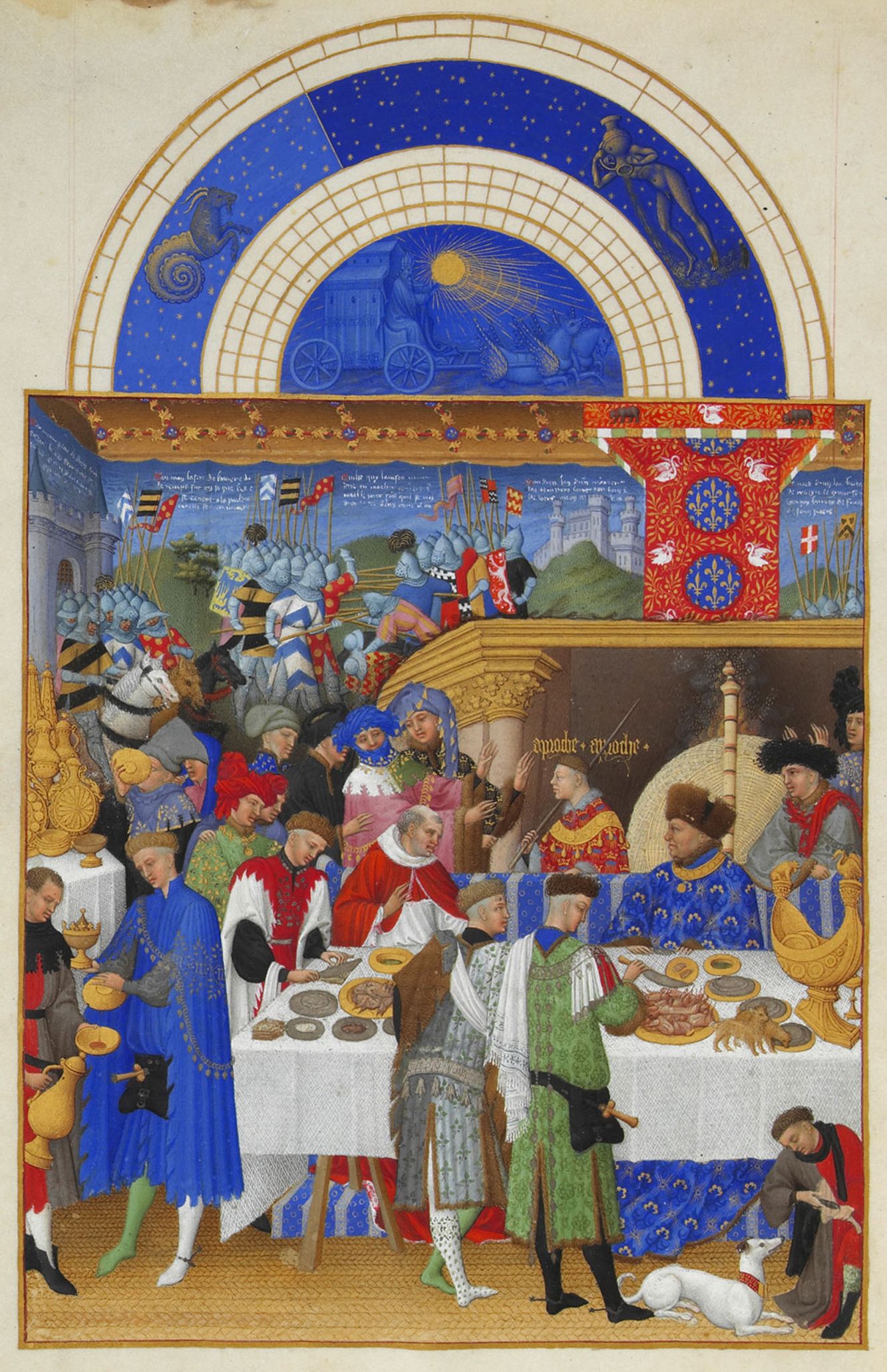
File:Les Très Riches Heures du duc de Berry Janvier.jpg

Image:Wikipedia

The Duke of Berry, dressed in blue and seated to the right, and wearing a handsome fur hat to indicate his status, celebrates the Christmas and Epipany seasons. There appears to be the exchange of gifts - New Year or Epiphany ones - and a cultivated and splendid lifestyle. This is a pattern which would have been replicated or emulated across Europe in royal and aristocratic households.

Note the canopy and cloth of estate with his arms above the Duke's head and the tapestries or hangings with their battle scenes decorating the room. The firescreen is also an interesting feature, as is the woven rush matting - rushes on the floor clearly did not mean a strewn hay stack as one might be led to believe, but a fitted covering in such a household.

On the left is a sideboard or buffet with a display of gold plate as was expected on such occasion to display princely magnificence, and other splendid plate is in use at the feast, as well as an aquamanile for washing the hands of those dining at the table. The pieces shown are very similar to the relatively few surviving examples from the period in museums and collections such as those of the Oxford and Cambridge colleges.

The painting is attributed to the artist identified as the 'the courtly painter'.


Calendar pages


One minor New Year's resolution for 2012 is to post the appropriate calendar page from the Très Riches Heures of Jean, Duc de Berry each month. There is an article about this famous Book of Hours here, which has links to articles on the artists involved. The manuscript was begun by the Limbourg brothers Herman (b. 1385), Paul (b.1386 or 7) and Jean (b. 1388) in 1412, but left unfinished when they all died, probably of plague, in February 1416. The Duke died that same year and the Hours were completed by later artists, in a recognisably different style.

The majority of the calendar pages are by the Limbourgs themselves, and include marvellous views of the ducal and other royal residences in France. What they do not indicate in their idyllic representations - and, given the nature of the book, why should they I might add - is that they were produced against the background of civil conflit between the Armagnacs and the Burgundians, as detailed in the journal of the Bourgeois of Paris, and, in 1415, King Henry V's invasion and the French defeat at Agincourt.

I will post each one seperately month by month with some notes about the scene.

New Year - the Gate of the Year


So we are now in 2012, and we can all wish one another a happy and prosperous New Year. What it will actually bring is, of course, largely hidden from us. Some things are clearly going to happen - we can look forward to the Queen's Diamond Jubilee and to the Olympics - though the latter will keep me well away from London in July and August if I can help it - and we shall have to endure coverage of both a French and a US presidential election. Apart from that, and a predictable continuing economic crisis, we do not know what is going to happen. The experts normally fail to forsee events - just think back to this time last year. Who predicted the Arab Spring, the phone hacking scandal or the scale of the Eurozone problem? We can say that those will continue to make the news, but in what way, and with what consequences - that we do not know. The one thing we can predict at any New Year is that the unpredictable and unpredicted will happen.

Given the times in which we are living I am minded to think of the lines, originally published in 1908, which King George VI quoted in his Christmas broadcast in 1939 and the advice of the man who stood at the gate of the year, and to put one's hand into the hand of God:

God Knows

And I said to the man who stood at the gate of the year: “Give me a light that I may tread safely into the unknown.”
And he replied:
“Go out into the darkness and put your hand into the Hand of God. That shall be to you better than light and safer than a known way.”
So I went forth, and finding the Hand of God, trod gladly into the night. And He led me towards the hills and the breaking of day in the lone East.

So heart bestill:
What need our little life
Our human life to know,
If God hath comprehension?
In all the dizzy strife
Of things both high and low,
God hideth His intention.

God knows. His will
Is best. The stretch of years
Which wind ahead, so dim
To our imperfect vision,
Are clear to God. Our fears
Are premature; In Him,
All time hath full provision.

Then rest: until
God moves to lift the veil
From our impatient eyes,
When, as the sweeter features
Of Life’s stern face we hail,
Fair beyond all surmise
God’s thought around His creatures
Our mind shall fill.

Minnie Louise Haskins (1875-1957)

There is an article by Christopher Howse about the poem and its author here.