Once I was a clever boy learning the arts of Oxford... is a quotation from the verses written by Bishop Richard Fleming (c.1385-1431) for his tomb in Lincoln Cathedral. Fleming, the founder of Lincoln College in Oxford, is the subject of my research for a D. Phil., and, like me, a son of the West Riding. I have remarked in the past that I have a deeply meaningful on-going relationship with a dead fifteenth century bishop... it was Fleming who, in effect, enabled me to come to Oxford and to learn its arts, and for that I am immensely grateful.


Thursday, 5 August 2010

The Flying Monk

Having put the article about Charles Waterton and his attempts to fly on the blog yesterday I looked at one of the links attached to it, that about Eilmer of Malmesbury, and thought I would also re-cycle that and add a few observations of my own. This is what The Lion And The Cardinal has:

EARLY CATHOLIC AVIATORS, part I: EILMER of MALMESBURY


Dr. Richard P. Hallion:
The first known serious flight attempt in world history occurred about a thousand years before the Wright brothers, in western England. Then, a young Benedictine monk leapt with a crude pair of cloth wings from a watchtower of a church abbey at the beginning of the 11th century. This monk, known to history as Eilmer of Malmesbury, covered a furlong - a distance of approximately 600 feet - before landing heavily and breaking both legs. Afterwards, he remarked that the cause of his crash was that he had forgotten to provide himself with a tail.

We know of Eilmer's attempt through the writings of a historian, William of Malmesbury, who mentions the flight in passing. Of more interest to William was that Eilmer, late in his life, was the first person to spot a comet which people then credited as being an omen of the Norman invasion of England by William the Conqueror.

Eilmer typified the inquisitive spirit of medieval enthusiasts who developed small drawstring toy helicopters, windmills, and sophisticated sails for boats. As well, church artists increasingly showed angels with ever-more-accurate depictions of bird-like wings, detailing the wing's camber that would prove crucial to generating the lifting forces enabling a bird - or an airplane - to fly. This climate of thought led to general acceptance that air was something that could be worked. Flying was thus not magical, but could be attained by physical effort and human reasoning.

Eilmer was an individual of remarkable daring and boldness. He leapt from the top of a tower, passed over a city wall, descended into a small valley by the River Avon, and then fell into a marshy field fully 150 feet lower than the point of his leap. Of his wings, we can surmise that they were constructed of ash or willow-wand, covered with a light cloth, and perhaps attached to pivots on either side of a back-brace, with hand-holds so he could hopefully flap them.

Given the geography of the Abbey, his landing site, and the account of his flight, he must have remained airborne about 15 seconds. At low altitude he apparently attempted to flap the wings, which threw him out of control. His post-flight assessment qualifies him as the first test pilot, for he sought to understand, in technological terms, what happened on the flight and why he crashed. Malmesbury exists today, much changed and quite quaint, near Swindon and Bristol. The Abbey features a stained-glass window of Brother Eilmer. Alas, a nice pub named The Flying Monk is no more, replaced by a shopping centre.


To this I would add the following thoughts. First, it is good to see a piece about the Flying Monk which treats him seriously, and not as just another lovable medieval monastic eccentric.

Secondly I think we must see Eilmer, who from his comet observation in 1066 clearly continued to be interested in scientific matters. He appears to belong to that English tradition in the eleventh and twelfth centuries that showed a remarkable interest in scientific observation, and which was concentrated in the western Midlands and the south west. Thus Adelard of Bath (c.1080- c.1152), a seeming polymath who traveled widely on the continent, about whom there are links here and here, or the monks of Worcester cathedral who were making drawings of sun spots in the early years of the twelfth century, or the observational interests of the canons of Hereford at the same time - and not least there the activities of Dinah, the lady astronomer who calculated by trigonometry the height of the cathedral tower - and that in the reign of King Henry I. This topic is introduced and developed, with classic elegance, in Sir Richard Southern's "Robert Grosseteste" (OUP).

So Eilmer the Flying Monk may have made history as the first recorded individual to have actually flown - but he should also be seen as part of a lively intellectual and practical tradition that witnesses to the vitality of his age and country.


Wednesday, 4 August 2010

Charles Waterton - aviator


Those of you who read my recent re-cycled post on Charles Waterton may be interested in this, which is from The Lion And The Cardinal on July 27:

EARLY CATHOLIC AVIATORS, part XI: CHARLES WATERTON


Richard Hobson:
Mr. Waterton had considerable inventive genius, especially in the actual formation of supposed extinct animals, and, generally, of the most horrid form and appearance, by a skillful union of separate portions of reptiles. By the way, his inventive powers, though more than forty years ago, had nearly carried his experimental ingenuity to a fatal issue. He had, for a considerable period, conceived some crude and ill digested idea, that the act of flying was within his grasp, and that, in a short time, he would become a second Pegasus in execution.

Under this surprisingly delusive impression, Mr. Waterton invented, and manufactured duplicates of a peculiar character of mechanism, as substitutes for natural wings, to be fixed on each arm, and to be united by their then surrounding the thoracic and dorsal portions of the trunk. How the Squire proposed to dispose of his lower extremities he did not explain to me, but I remember he stated that, a man's legs, however symmetrically formed, were inconveniently long and heavy for an atmospheric trip, except they could have something less yielding than air on which to rest, or to sustain the lever they represent, and, consequently, were too unwieldy and unmanageable to be of any service to the aeronaut in navigating the atmosphere; adding, that the only time, during his life, he had found his legs in the way, was, when he attempted to fly.

At all events, Mr. Waterton not only manufactured these fictitious wings which I have named, but he actually attached them, to his arms and trunk, and also formed and fixed the remaining mechanism which he conceived was necessary to be attached to the other parts of the body, so as to complete, and, as he imagined, perfect this really chimerical project; and in order to carry out his scheme into practical execution, he arranged to make his first essay from the eaves of a roof of a building in the farm yard, being an elevation of several yards, from whence his flight, it is true, would be of limited extent longitudinally, and where an abundance of litter would break the severity of a possibly uncontrollable and rapid descent.

Fortunately, however, when the Squire was clipped and heeled for his first attempt to become an aerologist, an intimate friend, Alicui toto pectore deditus, accidentally walked into the farm yard, and, happily, had sufficient influence over the would-be aeronaut to persuade him to take his first aerial flight from a much less elevated position.

Of course, it is needless to minutely detail the practical freaks which actually occurred in attempting to carry out this delusive conception, as the Squire afterwards unhesitatingly admitted to me that, unlike Pegasus, ho could neither fly to the top of Mount Helicon, nor further imitate him by then flying up to heaven. Also, that his affinity for the earth, to his great surprise, woefully outbalanced his attraction to the clouds, and that, on coming in contact with mother earth, he received, as he was wont to say, when jocosely using the Walton* dialect, such a "foul shak", as to be satisfactorily convinced that soaring in the atmosphere was not his forte, having, in his unwilling, unintentional, and disagreeably hasty descent, like Phaeton (who lost command of his horses) thoroughly lost all command of his wings, and thus narrowly escaped a broken neck, by pitching upon his head in spite of the faith he had entertained in his all-protecting wings.
*Walton was Waterton's estate near Wakefield

Tuesday, 3 August 2010

Another blog discovered

Through the Society of St Tarcisius blog I found the blog When the Patriarch was returning, which I have added to the blogroll. It is the work of Richard Hawker, based at present in Kingston upon Hull, and worth looking at. You will have to look at his first post to find out the origin and significance of the blog title.

Fr Hunwicke on Apostolicae Curae

Fr Hunwicke has started a series of posts on Apostolicae Curae which promises to be of more than passing interest. You can find them on Fr Hunwicke's Liturgical Notes. He gives a warning against commenting before he has completed the series, so read on, and reflect.

Bl.Edward Powell - an Oriel martyr

July 30th was the feast day of one of Oriel's Catholic martyrs, Bl.Edward Powell. With being away I could not put this pieces up on the exact day, but hope it will be of interest. I have slightly edited, and extended, the entry from the 1913 Catholic Encyclopedia.

Edward Powell, priest and martyr, was born in Wales about 1478; M.A. Oxon.; Fellow of Oriel, 1495; D.D. 26 June, 1506 and styled perdoctus vir by the University. He paid for the roof of the Old University Library above the Old Convocation House in St Mary's.

He became rector of Bleadon, Somerset, and prebendary of Centum Solidorum in Lincoln cathdral, which he exchanged for Carlton-cum-Thurlby in 1505, and the latter for Sutton-in-Marisco in 1525. He also held the prebends of Lyme Regis, Calstock, Bedminster, and St. Mary Redcliffe, Bristol in Salisbury cathedral, and the living of St. Edmund's Salisbury. In the 1520s he was living in Salisbury.

A court preacher in high favour with Henry VIII, he was ordered to publish a reply to Luther ("Propugnaculum summi Sacerdotii Evangelici, ac septem Sacramentorum, aeditum per virum eruditum, sacrarum literarum professorem Edoardum Poelum adversus Maratinum Lutherum fratrem famosum et Wiclifistan insignem", London, 1523, three books in the form of a dialogue between Powell and Luther). The University of Oxford commended this work, and styled Powell "the glory of the University" in a letter to the king. Powell was one of the four theologians selected to defend the legality of the marriage of Catherine of Aragon, in connection with which he wrote the very rare "Tractatus de non dissolvendo Henrici Regis cum Catherina matrimonio" (London).

In March 1533, Powell was selected to answer Hugh Latimer in a series of sermons at Bristol, and was alleged to have disparaged his moral character. Latimer complained to Cromwell, and Powell fell into further disfavour by denouncing Henry's marriage with Anne Boleyn. He was discharged from the proctorship of Salisbury in January 1534.

In November of that year he was attainted, together with St John Fisher, for high treason in refusing to take the oath of succession, deprived of his benefices, and imprisoned in the Tower of London. His confinement was very rigorous, the keeper himself was sent to the Marshalsea Prison for allowing Powell and Thomas Abel, one of Queen Catherine's chaplains, out on bail. A letter survives from Powell in which he complains of the theft whilst he was in prison of his chalice and pax.

The sentence was not carried out until 30 July, 1540. Three Catholics (Powell, Abel, and Richard Featherstone, who had been Princess Mary's tutor) and three Protestants, the preachers Robert Barnes, William Jerome, and Thomas Garrard. suffered together. There is a full account of the Protestants in Foxes' Acts and Monuments. Their fall from the favour they had recently enjoyed was part of the process whereby the more conservative faction in government undermined the position of Cromwell.

The victims were dragged on hurdles from the Tower to Smithfield, a
Catholic and a Protestant on each hurdle. Powell's companion was Robert Barnes, the Protestant divine. A dialogue in verse was published shortly after, "The Metynge of Doctor Barnes and Dr. Powell at Paradise Gate and of theyre communicacion bothe drawen to Smithfylde fro the Towar" (London, 1540), in the British Library. The Catholics were hanged, drawn, and quartered as traitors; the others were burned as heretics. The preacher at this ecumenical event, designed in part to impress foreign ambassadors with Henry's committment to his own brand of orthodoxy was Hugh Latimer, who had written to Cromwell asking if he was required to go and "play the fool" - I think, from memory, those were his words - on the occasion.


Monday, 2 August 2010

New blogs

I have been adding to the blog roll. Two recent additions are the site of St Conleth's Catholic Heritage Association, which has, inter alia, an article on the Extraordinary Form Mass recently celebrated at Abbeyleix to commemorate the Tudor era martyrs in Ireland, and that of Tradition und Leben, which is a German monarchist group, complete with heraldry and images of the heads of the ruling families of the post 1871 Empire. Both sites are well worth looking at.

Michael Yelton books

An additional benefit of staying with my friends in Norfolk was being shown books they had but which I had not so far seen. Notable amongst these were two recent books by Michael Yelton - Anglo-Papalism and his biography of Alfred Hope Patten, the restorer of the Shrine at Walsingham, both published by Canterbury Press.

I had read a complimentary review of Anglo-Papalism, but the reviewer's emphasis on the book was perhaps different from that which I would take. From skimming through both books I think they look both interesting and entertaining - Anglo-Papalism has never lacked colourful characters.

One point made by Yelton struck me as topical - he concentrates on the period down to 1960 in Anglo-Papalism, and his life of Fr Hope Patten closes with his death in 1958, with notes as to the later lives of his collaborators. However he contrasts the unrealised vision c.1920 of the Anglo-Papalists of taking a substantial body of Anglicans into union with Rome with the fact that the result of their endeavours has not been that but, at Walsingham, and through Walsingham, a much wider dissemination of Marian devotion in the Church of England and Anglicanism as a whole.

That point is true, but we may now be on the brink of actually seeing some clergy and parishes actually fulfilling the vision under the terms of Anglicanorum coetibus and through the proposed Ordinariates. The "vision glorious" may yet be realised, more than half a century to a century late, but it may still happen, just as there is a revival of those very things in liturgical matters which marked out the pre-Vatican II Anglo-Catholics, and to which so many of them clung so tenaciously. For many others that vision, presented in word and act, has led them to individual union with Rome. The Anglo-Papalists and the restorers of Walsingham - who thus spurred on an unresponding Catholic hierarchy to do something there and restore the Slipper Chapel - have, in their own, delightfully individual, way yielded a rich harvest. We should remember them with gratitude, and pray that we may all rejoice together upon another shore.

Church crawling in Norfolk

I have just returned from a most enjoyable weekend visiting
friends in north-west Norfolk. It was a great pleasure to meet
up with them again and catch up on news and plans for the future.

There was the additional pleasure of having some time with them
to do some church-crawling - something very easy in Norfolk
with its vast wealth of medieval churches. I like that part of
Norfolk, having got to know parts of it on pilgrimages to
Walsingham over the years. The train journey provided a
fine view of Ely cathedral and it occurred to me that the profile
of the west tower may well have inspired the design of that of
Great St Mary's in Cambridge.


The first visit was to St Edmund in Downham Market,
where my friends are currently living. The church was
in the possession of Ramsey abbey in the middle ages
and the building has a style less typical than other
Norfolk churches. It has a fine painted consecration
cross in the Lady Chapel from, I would guess - I did
not have Pevsner to hand - of about 1300, and some
interesting stones built into the exterior, including two
parts of a rather interesting grave slab. The church is on
quite an eminence, with the town clustered around it,
looking west across the drained fenland. It is easy to
see why it became a fuocus for settlement, commanding
that view to the west and the gradual slope eastwards
of the fertile low hills of west Norfolk.
We visited the delightful town of Castle Acre,
which has the great earthworks of its eponymous
castle, a town gate, the substantial remains of the
Cluniac priory founded in 1089, and the fine
medieval church of St James the Great. This was
a return visit for me, having been there almost
twenty years ago, but still very welcome. We
concentrated on this visit on the parish church.
There is a good account of it on the Norfolk
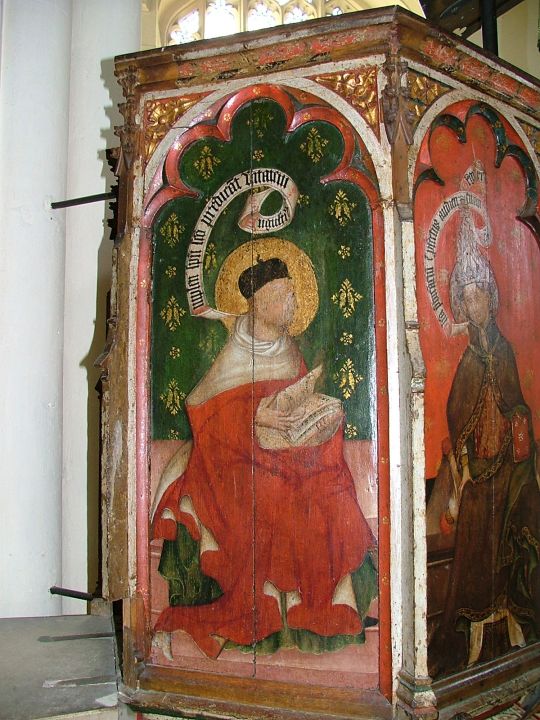
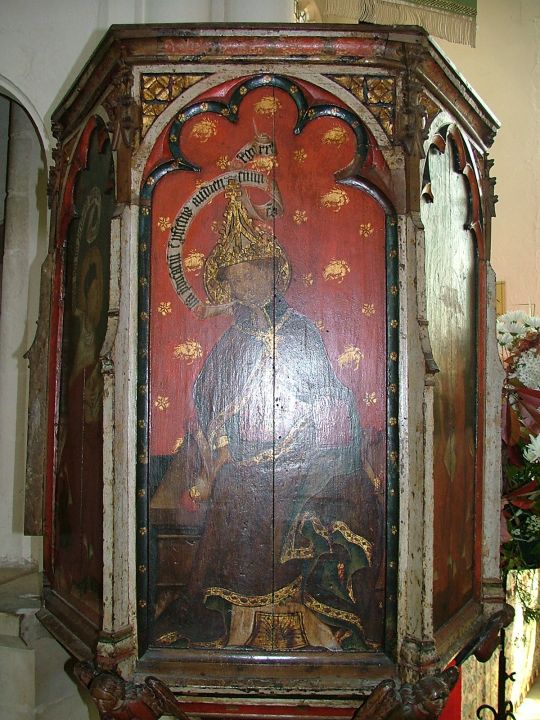
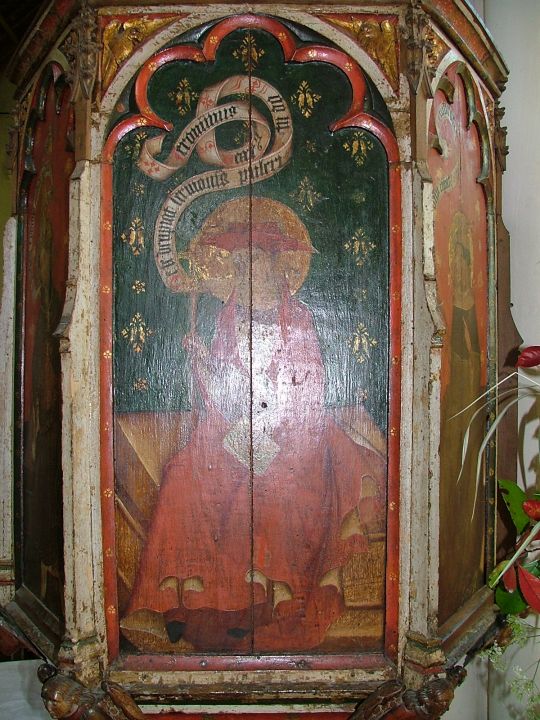
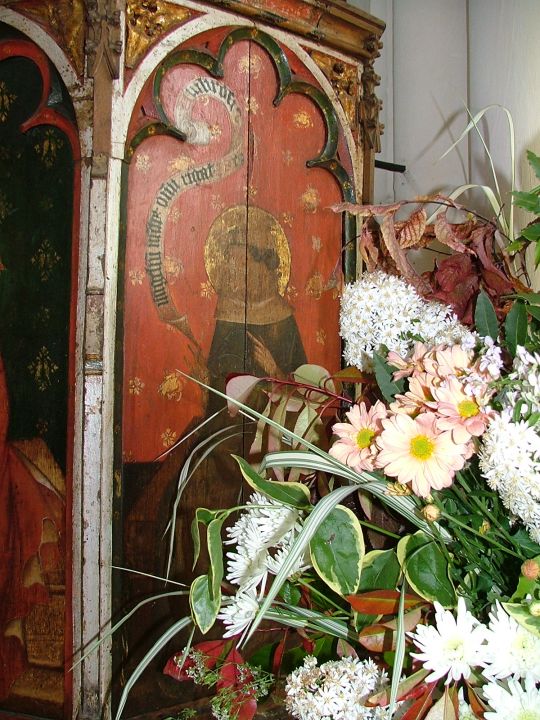
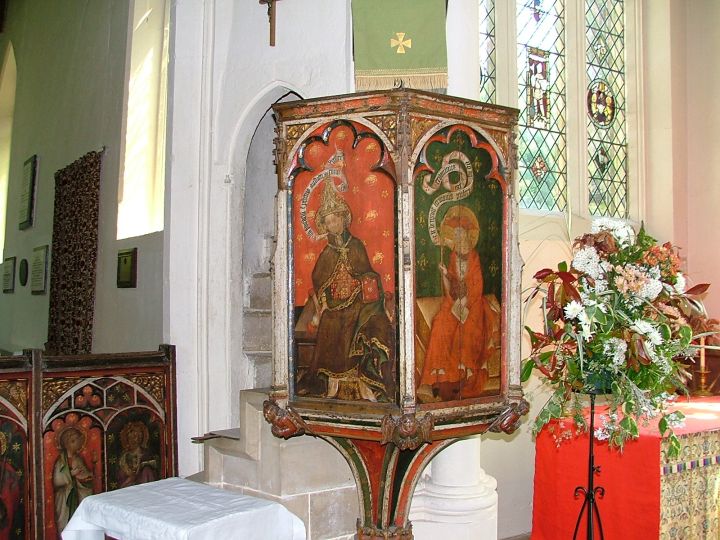
Churches site here. It has a splendid fifteenth century
font cover. I have reproduced their pictures
of the wonderful late medieval painted pulpit,
decorated with the four Latin Fathers of the Church.
We had a speculative discussion as to when exactly
the pulpit would have been used within the context
of the liturgy when it was installed.


Augustine

Gregory

Jerome

Ambrose

We then went on to West Acre - a medieval church
substantially restored in what must, I imagine, have
originally been a Laudian style in 1638. There is an
account here. Immediately to the west of the tower
are the substantial ruins of the gatehouse of the
Augustinian priory of West Acre, and parts of its ruins
could be seen in the grounds of the house beyond. In the
parish church was a plan of what had been recovered
in excavations of the monastic site. The presence of
two substantial, if not enormous, monastic foundations
in adjoining communities from the late eleventh and early
twelfth centuries is yet another indicator of the wealth of
medieval East Anglia - notably evidenced by the
wondrous array of churches from those centuries.
On Sunday morning I went to Mass at the relatively
modern church of St Dominic in Downham Market.
The fairly recent extension has been further augmented
in recent years with a handsome and dignified Sanctuary
arrangement in stone, which provided a good setting
for a dignified liturgy yesterday morning. The picture
below is of the statue of St Dominic which forms part
of the reredos.