Once I was a clever boy learning the arts of Oxford... is a quotation from the verses written by Bishop Richard Fleming (c.1385-1431) for his tomb in Lincoln Cathedral. Fleming, the founder of Lincoln College in Oxford, is the subject of my research for a D. Phil., and, like me, a son of the West Riding. I have remarked in the past that I have a deeply meaningful on-going relationship with a dead fifteenth century bishop... it was Fleming who, in effect, enabled me to come to Oxford and to learn its arts, and for that I am immensely grateful.


Showing posts with label St Dominic Downham Market. Show all posts

Thursday, 9 September 2010

St Dominic's Downham Market


I posted recently that I had attended Sunday Mass at St Dominic's in Downham Market. Joe Shaw has some photographs of the church and something about it on his LMS Chairman blog. He visited it as part of a walking pilgrimage to Walsingham. I am copying his section about the church in Downham Market, and the work Fr Eggleston has done to enhance the appearance of the building.

Joe Shaw says:
The Catholic church of St Dominic at Downham Market ... is where the notorious Fr Oswald Baker refused to say the Novus Ordo from 1970 to 1975, when the Diocese took back control of the church; incredibly, he continued to live at the Presbytery, saying Mass elsewhere, until 1989, forcing his replacement to live down the road.

The church started life as a stable; since Fr Baker's time it has been extended, sideways.

2010 08 20_7559

The altar was originally on the left wall, where you can just see some votive candles.

2010 08 20_7562

The present Parish Priest, who is just about to leave, Fr Edmund Eggleston, has done great things to the sanctuary, which was little more than a wooden table in front a brick wall before. The limestone is all due to him, including a good permanent altar, which allowed the church to be formally consecrated for the first time. (Wooden altars are always classed officially as 'temporary'; a church with one can be blessed, but not consecrated.)

2010 08 20_7569

The Mass was of St Bernard; the fine vestments belong to Fr Eggleston.

The patronal statue of St Dominic, on the right, reminds us of the Dominican Sisters who initiated regular Catholic worship in Downham, in a chapel carved out of a large house next to this site.


I would endorse Joe Shaw's comments - what has been achieved at St Dominic's is a handsome setting for the liturgy in a somewhat unusual plan. It shows what can be done to enhance a church building.

Monday, 2 August 2010

Church crawling in Norfolk

I have just returned from a most enjoyable weekend visiting
friends in north-west Norfolk. It was a great pleasure to meet
up with them again and catch up on news and plans for the future.

There was the additional pleasure of having some time with them
to do some church-crawling - something very easy in Norfolk
with its vast wealth of medieval churches. I like that part of
Norfolk, having got to know parts of it on pilgrimages to
Walsingham over the years. The train journey provided a
fine view of Ely cathedral and it occurred to me that the profile
of the west tower may well have inspired the design of that of
Great St Mary's in Cambridge.


The first visit was to St Edmund in Downham Market,
where my friends are currently living. The church was
in the possession of Ramsey abbey in the middle ages
and the building has a style less typical than other
Norfolk churches. It has a fine painted consecration
cross in the Lady Chapel from, I would guess - I did
not have Pevsner to hand - of about 1300, and some
interesting stones built into the exterior, including two
parts of a rather interesting grave slab. The church is on
quite an eminence, with the town clustered around it,
looking west across the drained fenland. It is easy to
see why it became a fuocus for settlement, commanding
that view to the west and the gradual slope eastwards
of the fertile low hills of west Norfolk.
We visited the delightful town of Castle Acre,
which has the great earthworks of its eponymous
castle, a town gate, the substantial remains of the
Cluniac priory founded in 1089, and the fine
medieval church of St James the Great. This was
a return visit for me, having been there almost
twenty years ago, but still very welcome. We
concentrated on this visit on the parish church.
There is a good account of it on the Norfolk
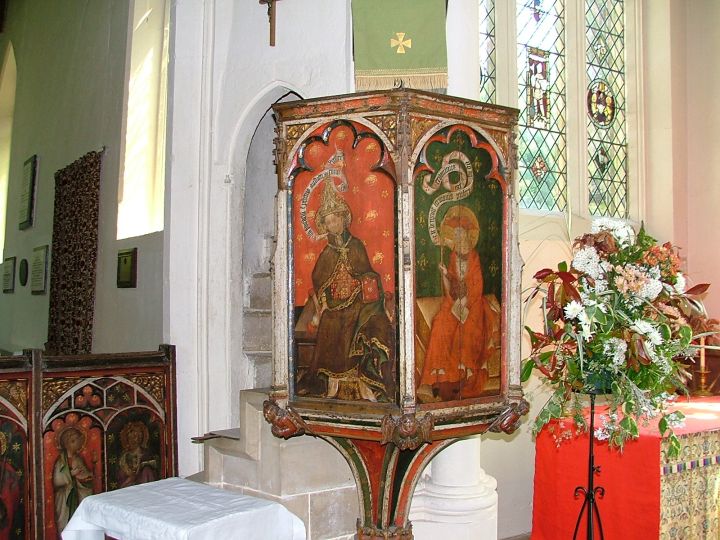
Churches site here. It has a splendid fifteenth century
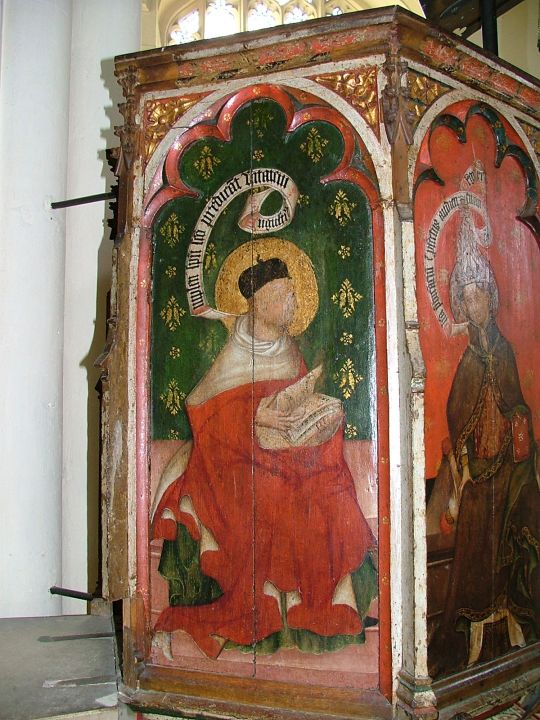
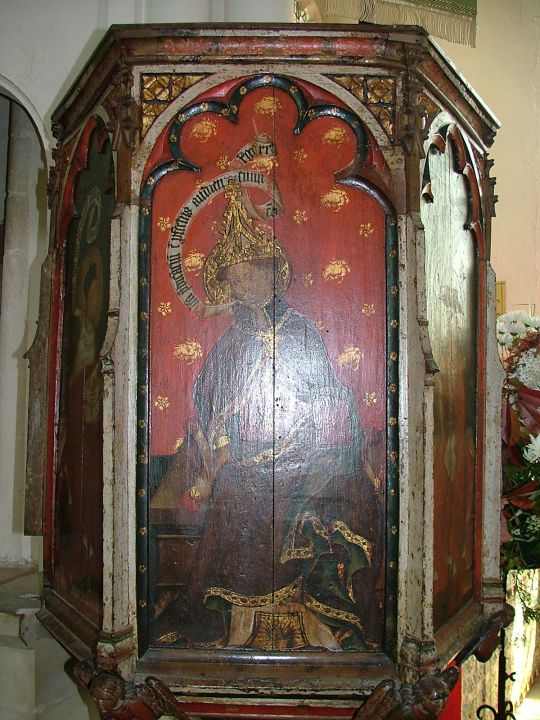
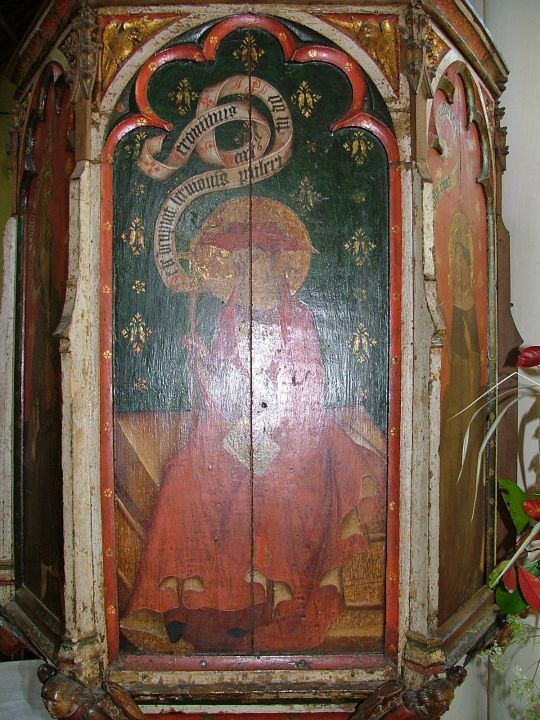
font cover. I have reproduced their pictures
of the wonderful late medieval painted pulpit,
decorated with the four Latin Fathers of the Church.
We had a speculative discussion as to when exactly
the pulpit would have been used within the context
of the liturgy when it was installed.


Augustine

Gregory

Jerome

Ambrose

We then went on to West Acre - a medieval church
substantially restored in what must, I imagine, have
originally been a Laudian style in 1638. There is an
account here. Immediately to the west of the tower
are the substantial ruins of the gatehouse of the
Augustinian priory of West Acre, and parts of its ruins
could be seen in the grounds of the house beyond. In the
parish church was a plan of what had been recovered
in excavations of the monastic site. The presence of
two substantial, if not enormous, monastic foundations
in adjoining communities from the late eleventh and early
twelfth centuries is yet another indicator of the wealth of
medieval East Anglia - notably evidenced by the
wondrous array of churches from those centuries.
On Sunday morning I went to Mass at the relatively
modern church of St Dominic in Downham Market.
The fairly recent extension has been further augmented
in recent years with a handsome and dignified Sanctuary
arrangement in stone, which provided a good setting
for a dignified liturgy yesterday morning. The picture
below is of the statue of St Dominic which forms part
of the reredos.