Once I was a clever boy learning the arts of Oxford... is a quotation from the verses written by Bishop Richard Fleming (c.1385-1431) for his tomb in Lincoln Cathedral. Fleming, the founder of Lincoln College in Oxford, is the subject of my research for a D. Phil., and, like me, a son of the West Riding. I have remarked in the past that I have a deeply meaningful on-going relationship with a dead fifteenth century bishop... it was Fleming who, in effect, enabled me to come to Oxford and to learn its arts, and for that I am immensely grateful.


Friday, 19 November 2010

Statement on establishing the Ordinariate


Press release

Issued by the Catholic Communications Network

Implementation of the Apostolic Constitution Anglicanorum Coetibus


The Establishment of a Personal Ordinariate in England and Wales

Much has been achieved over many years as a result of the dialogue and the fruitful ecumenical relations which have developed between the Catholic Church and the Anglican Communion. Obedient to the prayer of the Lord Jesus Christ to His Heavenly Father, the unity of the Church remains a constant desire in the vision and life of Anglicans and Catholics. The prayer for Christian Unity is the prayer for the gift of full communion with each other. We must never tire of praying and working for this goal.

During his visit to the United Kingdom in September, His Holiness Pope Benedict XVI was therefore keen to stress that the Apostolic Constitution Anglicanorum Coetibus: "...should be seen as a prophetic gesture that can contribute positively to the developing relations between Anglicans and Catholics. It helps us to set our sights on the ultimate goal of all ecumenical activity: the restoration of full ecclesial communion in the context of which the mutual exchange of gifts from our respective spiritual patrimonies serves as an enrichment to us all."i

It is now just over one year since the Apostolic Constitution was published. The Pope's initiative provided for the establishment of personal Ordinariates as one of the ways in which members of the Anglican tradition may seek to enter into full communion with the Catholic Church. As the Holy Father stated at that time, he was responding to petitions received "repeatedly and insistently"ii by him from groups of Anglicans wishing "to be received into full communion individually as well as corporately."iii Since then, it has become clear that a number of Anglican clergy and their faithful do indeed wish to bring their desire for full ecclesial communion with the Catholic Church to realisation within an Ordinariate structure.

In collaboration with the Congregation for the Doctrine of the Faith (CDF) in Rome, the Bishops of England and Wales have been preparing for the establishment of an Ordinariate early in January 2011. Although there may be practical difficulties in the months ahead, the Bishops are working to address these at a national and local level.

Five Anglican Bishops who currently intend to enter the Ordinariate have already announced their decision to resign from pastoral ministry in the Church of England with effect from 31 December 2010. They will enter into full communion with the Catholic Church early in January 2011. During the same month, it is expected that the Decree establishing the Ordinariate will be issued and the name of the Ordinary to be appointed announced. Soon afterwards, those non-retired former Anglican Bishops whose petitions to be ordained are accepted by the CDF, will be ordained to the Catholic Diaconate and Priesthood for service in the Ordinariate.

It is expected that the retired former Anglican Bishops whose petitions to be ordained are accepted by the CDF, will be ordained to the Catholic Diaconate and Priesthood prior to Lent. This will enable them, together with the Ordinary and the other former Anglican Bishops, to assist with the preparation and reception of former Anglican clergy and their faithful into full communion with the Catholic Church during Holy Week.

Before the beginning of Lent, those Anglican clergy with groups of faithful who have decided to enter the Ordinariate will then begin a period of intense formation for ordination as Catholic priests.

At the beginning of Lent, the groups of faithful together with their pastors will be enrolled as candidates for the Ordinariate. Then, at a date to be agreed between the Ordinary and the local diocesan Bishop, they will be received into the Catholic Church and confirmed. This will probably take place either during Holy Week, at the Mass of the Lord's Supper on Holy Thursday or during the Easter Vigil. The period of formation for the faithful and their pastors will continue to Pentecost. Until then, these communities will be cared for sacramentally by local clergy as arranged by the diocesan Bishop and the Ordinary.

Around Pentecost, those former Anglican priests whose petitions for ordination have been accepted by the CDF will be ordained to the Catholic Priesthood. Ordination to the Diaconate will precede this at some point during Eastertide. Formation in Catholic theology and pastoral practice will continue for an appropriate amount of time after ordination.

In responding generously and offering a warm welcome to those seeking full ecclesial communion with the Catholic Church within the Ordinariate, the Bishops know that the clergy and faithful who are on that journey of faith will bring their own spiritual treasures which will further enrich the spiritual life of the Catholic Church in England and Wales. The Bishops will do all they can to ensure that there is effective and close collaboration with the Ordinariate both at diocesan and parish levels.

Finally, with the blessings and encouragement they have received from Pope Benedict's recent Visit, the Catholic Bishops of England and Wales are resolved to continue their dialogue with other Christian Churches and Ecclesial Communities on that journey towards the communion in faith and the fullness of unity for which Christ prayed.

Footnotes

i Oscott College, 19 September 2010
ii Apostolic Constitution 'Anglicanorum Coetibus', 4 November 2009
iii ibid

Thursday, 18 November 2010

Liturgical enrichment and reconciliation

Fr Sean Finnegan has an excellent article on his Valle Adurni blog about the ways in which there appears to be growing appreciation of the concenpt of mutual liturgical enrichment between the Extraordinary and Ordinary Forms of Mass. You can read it here. It presents evidence of many hopeful developments and should encourage all concerned with the genuine restoration and renewal of the liturgy.

Wednesday, 17 November 2010

St Hugh of Lincoln


Today is the feast of St Hugh of Lincoln, Carthusian saint and Bishop of Lincoln 1186-1200. There is a biography here.


Saint Hugh of Lincoln with his swan,
Altarpiece from the Carthusian monastery of Saint-Honoré, Thuison, near Abbeville, France, ca 1490-1500
Art Institute of Chicago


St Hugh's holds one of his attributes, the Christ Child rising from the chalice, alluding to a vision he had. There are other recorded examples of such visions at his time, suggesting a concern for the reality of the Real Presence and Transubstantiation.

His other, better known attribute is the swan. This was a fierce swan which lived at the episcopal manor at Stow in Lindsey but which was a docile pet to the saint, followed him around and watched over him when he was asleep.

St Hugh's stole is preserved at the Carthusian house at Parkminster in Sussex. It was on display at Lincoln in 1986 as part of the octocentenary celebrations. His body is thought to still lie somewhere within the cathedral at Lincoln, where a curious bronze superstructure has been added in recent years to the remains of the base of the shrine of St Hugh's Head in the Angel Choir.

St Hugh was the principal saint of Lincoln cathedral and seen as role model for his successors. This can be seen in their referenc eto him bu adding his arms to their monuments in the cathedral. In the case of Bishop Fleming - "my bishop" - the fact that Fleming developed close links with the Carthusian order whilst Bishop of Lincoln, and that John Stone, the Carthusian of Sheen when he wrote his Metrificatio around Fleming's own tomb verses went so far as to ascribe Fleming's failure to be translated to the see of York in 1424-5 as being due to the intervention of St Hugh.

Queen Mary I and Cardinal Reginald Pole


November 17th is the anniversary of the deaths on the same day in 1558 of Queen Mary I and of her cousin and Archbishop of Canterbury, Cardinal Reginald Pole.

In recent years both Queen and Cardinal, as well as her husband King Philip, have the subjects of new biographies which seek to present them in a much more favourable and nuanced light, and taking ccount of new research and understandings of sixteenth century life and realities. This process is continuing, and although it may take some time before everyone is speaking of "Good Queen Mary" her reign, and the considerable progress made during it in restoring Catholicism is being reappraised and understood more impartially. There have been a series of recent biographies and other studies of the Queen which have presented a much more balanced account than has been usual, and we await my friend John Edwards' biography of her in the Yale English Monarchs series. Henry Kamen's King Philip is a very readable account of the life of her husband, who emerges as a far more human and attractive figure than he is often presented in popular perception.

There is a continuing series of articles about the Queen at the website Mary Tudor- Renaissance Queen There is a catalogue of portraits of the Queen here.

This stained glass depiction of Queen Mary and her husband King Philip is little known in this country but which is contemporary.

http://tudorhistory.org/groups/mary_philip_window.jpg
Queen Mary I and King Philip II

From a window in Sint Janskerke Gouda, The Netherlands, made in 1557

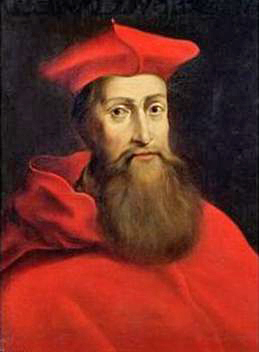
File:Cardinal Reginald Pole.jpg

Cardinal Reginald Pole

Image: Wikipedia


For many years Pole was awaiting an academic biographer; this gap has been filled to a considerable extent with the publication of Thomas F. Mayer's Reginald Pole: Prince and Prophet (Cambridge Studies in Early Modern British History), although it is not always the easiest book to read.

The Queen and Pole's considerable efforts to re-establish Catholicism in England have most recently been studied in Eamonn Duffy's Fires of Faith.

Two years ago, on the 450th anniversary of the Cardinal's death, and long before I started blogging I served as thurifer at a Requiem Mass in the Extraordinary Form for Cardinal Pole in the chapel of his college, Magdalen here in Oxford. These photographs, taken by Br Lawrence Lew, O.P., appeared, together with the link to his Flickr set of the Mass, on the NLM site.


    photo

    The Mass, organized by the Latin Mass Society, was celebrated in the chapel of Magdalen College, with the permission of the President and Dean. Cardinal Pole had been an undergraduate in this college, and it was a privilege for us to assist in the Mass celebrated in the Extraordinary Form in this beautiful (essentially) medieval chapel. The Mass included absolutions at the catafalque, which bore the Cardinal's arms
    The celebrant was Fr John Osman, parish priest of Dorchester-on-Thames, and the Mass was expertly and prayerfully sung by the Schola of Bl. Thomas Abel, Oxford University's Gregorian chant society, which was founded by the current Chairman of the LMS, Dr Joseph Shaw.

    Elevation of the Sacred Host

    More photos in my Flickr set.

    Royal engagement


    http://d.yimg.com/a/p/afp/20101117/capt.photo_1290009150008-2-0.jpg

    Image from Yahoo

    As a loyal subject of the Crown I would want to join in with the congratulations to Prince William and Miss Middleton on the announcement of their engagement, and add my prayers and good wishes.

    Several thoughts occur to me at this time.

    Firstly this engagement again appears to confirm the trend not only in this country but also elsewhere amongst European royal houses away from dynastic marriages.

    Secondly, from what I have managed to see and read, the Prince and his bride-to-be appeared more confident and assured than his parents did when they were interviewed in 1981 at the time of their engagement. It is surely something of an ordeal for any couple to be interviewed, however discreetly, about their choice of spouse.

    Thirdly before the wedding some of the media coverage will be such as to make even the most
    ardent monarchist like myself begin to cringe.

    Fourthly, sooner or later the usual suspects will be whining and complaining about cost or whatever, and betraying their fundamentally mean spirited nature - but no surprise in that.

    Fifthly, when the wedding takes place the overwhelming majority here, and in the Queen's other realm will rejoice with the happy couple and wish them well. There will be a national feeling of celebration and renewed hope in the future. It is something to look forward to, a real investment in a living and continuing tradition.


    Tuesday, 16 November 2010

    St Margaret of Scotland and St Edmund of Abingdon


    Today is the feast of both St Margaret of Scotland and of St Edmund of Abingdon, both of whose relics are now preserved on the continent. I have based this post in part on John Dillon's post on the Medieval Church History discussion group site.

    Margaret of Scotland was the eldest daughter of the English prince Edward Aetheling, the son of King Edmund II, who fled following his father's death in 1016. Margaret was born during her father's exile in Hungary. A book which covers this period of his life and that of his family in a way which combines scholarship with an enthusiastic pursuit of a hitherto unexamined topic is Gabriel Ronay's The Lost King of England.

    In 1057 Edward returned to England, bringing his family with them, but died before he could meet his half-uncle Edward the Confessor. His son Edgar Aetheling was involved in the Anglo-Saxon resistance to the Norman Conquest and in 1068 he fled with Margaret and with other members of the family fromNorthumbria and ended up in Scotland, where Margaret soon married king Malcolm III. Their marriage took place in Dunfermline at the church of the Holy Trinity at which Margaret soon established a priory (it became an abbey in 1128) and in which she was buried opposite the altar. The abbey website is here , the history section of which brings out the abbey's role as a centre of royal devotion and burial down to the early fifteenth century and beyond. The twelfth century nave of the abbey survives and shows very much the influence of the cathedral at Durham, as can be seen here.It is a reminder of a medieval Catholic Scotland of which so little survives.
    A forceful and pious woman, St Margaret sought to bring Scottish church practices into line with those she had experienced elsewhere.

    There is a fuller biography, which brings out her impact on Scottish cultural life, here with useful links from it to other biographies on the same site, and a picture of the chapel she is aid to have built at Edinburgh castle - it was the one building not destroyed on the castle site by the Scots when they dismantled the fortress during the War of Independence against Edward I of England.

    She died on this day in 1093, shortly after hearing of King Malcolm's death in battle against the English. Amongst her eight children were four Kings of Scots, Edmund, Edgar, Alexander I and David I, who continued her policy of regenerating the Scottish church with his series of monastic foundations in the lowlands, and Maud or Matilda who married Henry I of England, thus uniting in their daughter Matilda and her son Henry II the Anglo-Saxon and Norman houses

    Margaret's early twelfth-century Vita by Turgot, prior of Durham (BHL 5325) ascribes to her various miracles. By then her feast was already being celebrated today. A translation of her relics within the new church which had been consecrated in 1147 occurred in 1180 and in 1250 they were translated again to a shrine in a newly built chapel at the east end. Her undocumented canonization is thought to have occurred either in 1250 or in 1251. Margaret's shrine there was very popular in the later Middle Ages. Miracles at it are reported in a collection in Robert Bartlett( ed) The Miracles of Saint Ebbe of Coldingham and Saint Margaret of Scotland (Oxford: Oxford University Press, 2003); a brief description of the shrine occurs in a hymn to Margaret. by the poet James Foullis of Edinburgh (d. 1549). The abbey was sacked in 1560; what is believed to be the base of her shrine survives in the churchyard. St Margaret's relics are now said to be in the Escorial.


    St Edmund of Abingdon, Archbishop of Canterbury, often surnamed Rich, albeit apparently without medieval authority for this form of his name, was born at Abingdon circa 1175. His parents were named Reginald and Mabel and his father was given the sobriquet dives ('rich'). Raised ascetically by his mother, Edmund was schooled at Oxford and as a youth pledged himself to celibacy. As a token of that he is said to have placed a ring on the finger of the statue of Our Lady in St Mary's church in Oxford, and the ring could not thereafter be removed.

    He later studied at Paris and taught theology at Oxford from 1214 (probably) until his election as Archbishop of Canterbury on 20 September 1233 (royal approval was given on 10 October, which would have been around the start of Michaelmas Term). During his time as a teaching theologian Edmund. wrote both a moral gloss on the Psalms and a very successful treatise on the spiritual life, Speculum ecclesie, that also circulated in versions in Anglo-Norman and Middle English.

    Edmund.'s consecration ensued on 2 April 1234. In that year he worked successfully to prevent a general civil war between Henry III and rebel barons. During his relatively brief prelacy he attempted to reconcile jurisdictional aspects of English canon and common law, an initiative that saw fruit on the canon law side in 1237.

    In his last years he was seriously at odds with the monastic chapter of his cathedral over his intent to form a college of canons in the diocese and over the chapter's assertion of the right to elect its own prior. He died in France in 1240 on his way to Rome to prosecute a case against the Canterbury monks and was buried at the Cistercian abbey of Pontigny, where he had recently stayed and where he is said to have requested confraternity. At their general chapter in the following year the Cistercians formally asked for Edmund's canonization. After further postulations from England and France, commissions of inquiry were authorized in 1244; canonization followed in 1246. Records of his canonization process survive, as do several Vitae composed within the decade following his death.

    This is his tomb at Pontigny as it is today

    http://ic2.pbase.com/o4/11/382111/1/110648457.6TtTnlbo.14TombofStEdmundD30049824.jpg


    The Five Bishops and the Ordinariate

    A friend has forwarded to me an expanded, online, version of an article by Professor Diarmuid MacCulloch about the Five Bishops (as I write that I wonder if they will be remembered like the Seven Bishops of 1688) and the Ordinariate from The Times of last week. You can read it here.

    My reaction is, I think, to quote the immortal words of Mandy Rice-Davies "Well he would say that would n't he? "

    I would merely add to that the point that if that is how their fellow Anglicans view Anglo-Catholics you can hardly blame the latter for seeking the full ecclesial unity that their position is predicated upon. The problem surely is for those who want to stay in a communion where they are not wanted.

    Fortunately many, on both banks of the Tiber are praying for the success of the Ordinariate and those planning to avail themselves of it.

    The Westminster pavement


    At the time of the Papal visit I posted about the image of the Pope standing on the wonderful thirteenth century cosmati sanctuary pavement of Westminster abbey. Now David Clayton, whom I knew when he was here in Oxford, has drawn attention on NLM to a post by another friend, Stratford Caldecott, and a post he has produced about the pavement. It includes a short documentary and can be found here.

    The abbey's own site about the pavement can be read here, and there is another account here , and there is also a newspaper article about its restoration here.

    http://www.westminster-abbey.org/__data/assets/thumbnail/0011/22106/912217-105.jpg

    The Queen views the great pavement in Westminster Abbey

    Image: Westminster Abbey

    If you would like to read more about the pavement there is Richard Foster Patterns of Thought: (1991), and the pavement is also discussed in J.D.North The Ambassadors' Secret. Professor North's book is a fascinating exploration of the themes and symbolism in Holbein's painting, now in the National Gallery, of the French ambassadors to King Henry VIII in 1533, and it is a book well worth reading on its own account.