Once I was a clever boy learning the arts of Oxford... is a quotation from the verses written by Bishop Richard Fleming (c.1385-1431) for his tomb in Lincoln Cathedral. Fleming, the founder of Lincoln College in Oxford, is the subject of my research for a D. Phil., and, like me, a son of the West Riding. I have remarked in the past that I have a deeply meaningful on-going relationship with a dead fifteenth century bishop... it was Fleming who, in effect, enabled me to come to Oxford and to learn its arts, and for that I am immensely grateful.


Showing posts with label Queen Mary I. Show all posts

Saturday, 30 November 2024

National Reconciliation 1554


Today is the 470th anniversary of the formal reconciliation of England to the Catholic Church in 1554. This was effected when the Papal Legate, Cardinal Reginald Pole, formally absolved the country from schism in the presence of the monarchs, King Philip and Queen Mary and the assembled Lords and Commons. 

http://tudorhistory.org/groups/mary_philip_window.jpg
King Philip and Queen Mary
A 1557 window in Sintjanskerke in Gouda in The Netherlands

Image: Once I was Clever Boy

For the Queen in particular, this must have been an occasion of profound joy, the culmination of an extraordinary and extended annual mirabilis since she heard of her half-brother’s death in the July of the previous year. In the intervening months she had gained the throne and been crowned, negotiated her marriage to the now King Philip, seen off Wyatt’s rebellion, married the most eligible man in Europe, believed herself to be expecting an heir, and had finally undone her father’s break with Rome, and potentially all that had flowed from it. 

There were doubtless a considerable variety of opinions amongst the great and the good as they knelt to receive the Legate’s blessing, but the majority appear to have accepted it.
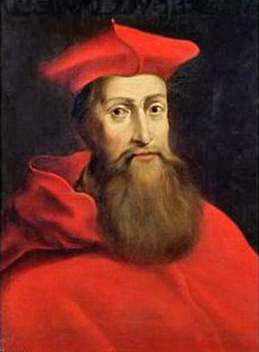
File:Cardinal Reginald Pole.jpg
Cardinal Reginald Pole

Image: Wikipedia 

Cardinal Pole must also have had mixed emotions at what he was facilitating as he may well have reflected on the loss of his immediate family and other relatives in 1538-41, and on the task that now confronted him. To see how seriously he set about restoring and reviving the Catholic faith of England I do recommend reading Eamonn Duffy’s Fires of Faith.

One man who was there did articulate his feelings. That was the Bishop of Winchester, Stephen Gardiner, the officiant at the Queen’s Coronation and wedding, and Lord Chancellor. 
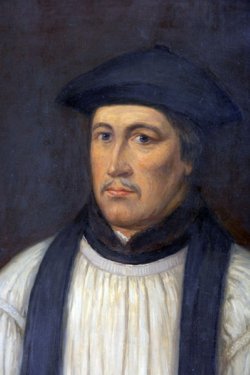
Bishop Stephen Gardiner

Image: Shakespeareandhistory.com

Having survived the upheavals.of the Henrician and Edwardian reformations he had found a new serenity it would seem in the restoration of the Church. He requested, and received, the privilege of preaching at Paul’s Cross on the Sunday following the reconciliation. Contemporaries considered that his greatest sermon. Acknowledging the national apostasy, including his own, Gardiner stressed in ringing terms the fidelity of just two people, the Queen and the Cardinal. It is extensively quoted in my friend Glyn Redworth’s wonderful biography of Gardiner In Defence of the Church Catholic. It is a book I heartily recommend. Not only is it good history well written, but it was a key element in my conversion to full Catholicism
twenty or so years ago.

St Andrew’s Day was enjoined as an annual commemoration of the reconciliation, but that must have last been observed in 1558, only a fortnight after the deaths of Queen Mary and Cardinal Pole on the same day.

The 1554 reconciliation is definitely one of the great ‘might have beens’ of English history. 

Thursday, 1 September 2016

Another new book on Queen Mary I


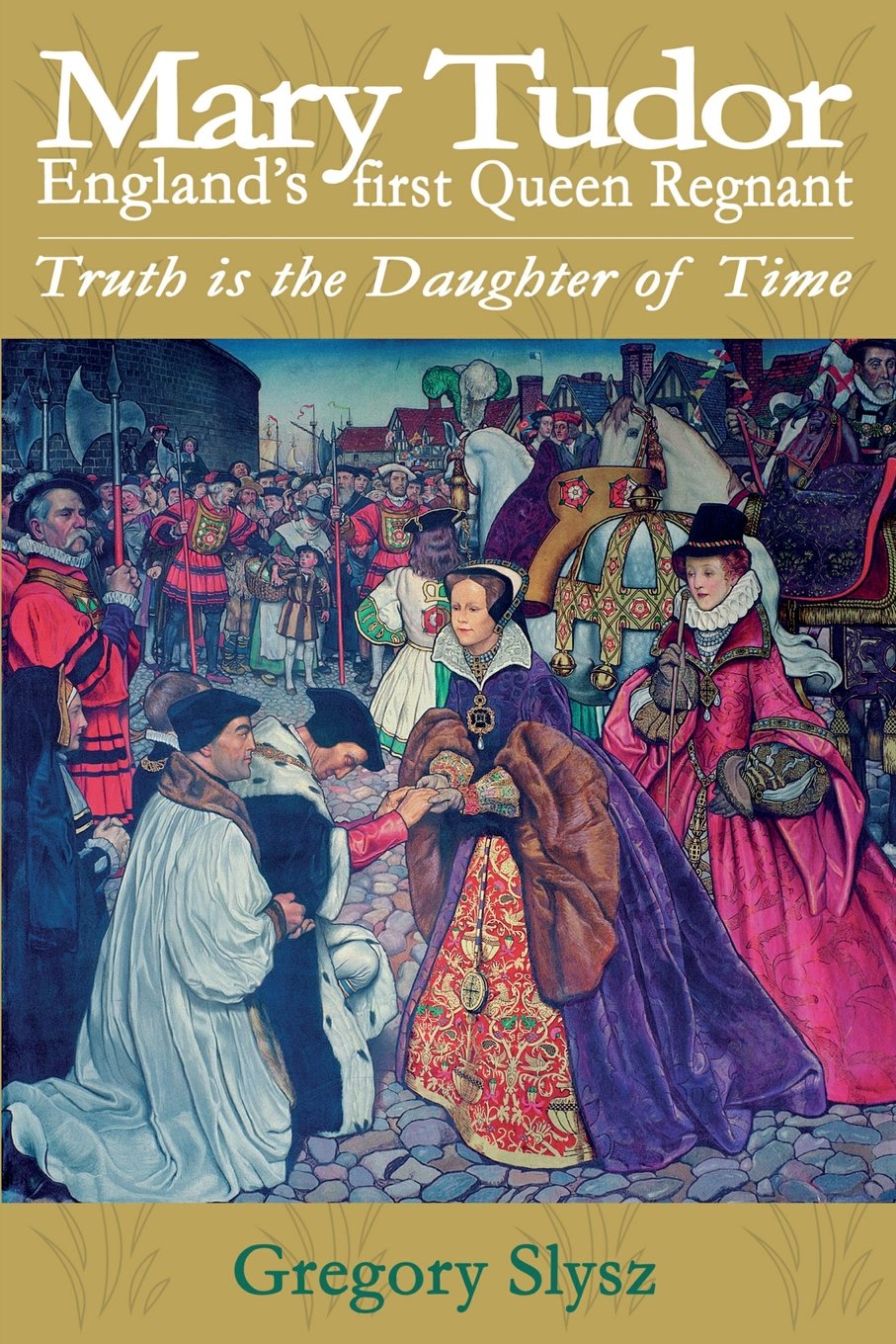
I came across another new book on the reign of Queen Mary I today. It is by Gregory Slysz and entitled Mary Tudor England's first Queen Regnant: Truth is the Daughter of Time and was published by Gracewing in 2015 ( ISBN: 978 0852448564 ) and costs £12.99.


Image: Amazon 
Part of the book's appeal is the interesting introductory section on the historiography of the reign as conveyed by near contemporaries and later generations. Indeed the influence of that historical perception of the reign is a theme which runs throught it. That widens the appeal of the book as more than an ainterpretation of the reign but also looking at issues of national identity and self-perception.

It looks to be a useful addition to the ever-expanding area of Marian studies.


Friday, 25 July 2014

The wedding of King Philip and Queen Mary


460 years ago, on St James' day 1554 Queen Mary I married King Philip of Naples, who from 1556 was King Philip II of Spain*, in Winchester cathedral. The choice of the feast day of the patron saint of Spain was doubtless seen as auspicious.

For the Queen this must have been a day of triumph. Just over a year earlier from her position as a spinster elder half sister of the deceased King Edward VI, marginalised as a Catholic and with the practise of her faith under threat, and then excluded from the succession altogether,  she staged the only successful uprising in Tudor England against the central government, saw off her opponents, set in motion the restoration of Catholicism and now married the most eligible young man in Europe. Not bad going.


Queen Mary I in 1554
A painting by Hans Eworth now at the Society of Antiquaries
The Queen is wearing the pearl La Peregrina given to her by King Philip
 
Image: Wikipedia

The basis for the wedding was the treaty negotiated earlier on in the year and made into English law by an  Act of Parliament, about which there is an article here. The background can be read in the illustrated online life of the Queen here.
The wedding ceremony itself is worthy of note in that apart from her mother's lavish wedding to Prince Arthur in St Paul's in 1501 Tudor royal weddings were not great public events, and indeed the great public royal wedding we expect today is something from the twentieth century. From 1554 until the 1920s England saw nothing comparable.

There is a detailed account of the wedding in my friend John Edward's recent biography of the Queen, published by Yale UP in their English Monarchs series.

One of the sources for our knowledge of the day is the official Herald's account, transcribed and published in the eighteenth century, and which can be read at The Marriage of Queen Mary and King Philip


King Philip and Queen Mary

Image: Wikipedia 


The blog Mary Tudor - Renaissance Queen has an account of the events of the day and of surviving buildings and other remains today here and from another blog there is also an account of the wedding which can be seen here.


A reconstruction of Queen Mary's wedding dress, created by Tanya Elliott, which was displayed at the Exhibition The Marriage of England and Spain - the 450th Anniversary of the Marriage of Philip and Mary  held from June 20-September 30, 2004 at Winchester Cathedral

(photo courtesy of Winchester Cathedral)

Queen Mary's dress was described as consisting of a mantle of brocaded cloth of gold, bordered with pearls and diamonds of great size, and lined with ermine. The dress was also gold smothered with the same precious stones, and the underskirt of white satin embroidered of silver. The French hood  - that is a headress of rounded shape is worn over a coif, and with a black veil attached to the back, that is very like a modern tiara in shape - in black velvet was surmounted by a double row of large diamonds.

 Image:home.earthlink.com 

The Queen had a noted fondness for jewellery, and one of the King'swedding gifts to her was the pearl La Peregrina, of which there is a history here. In most of her portraits the Queen is depicted wearing it. 
On her death it was returned to the King. 


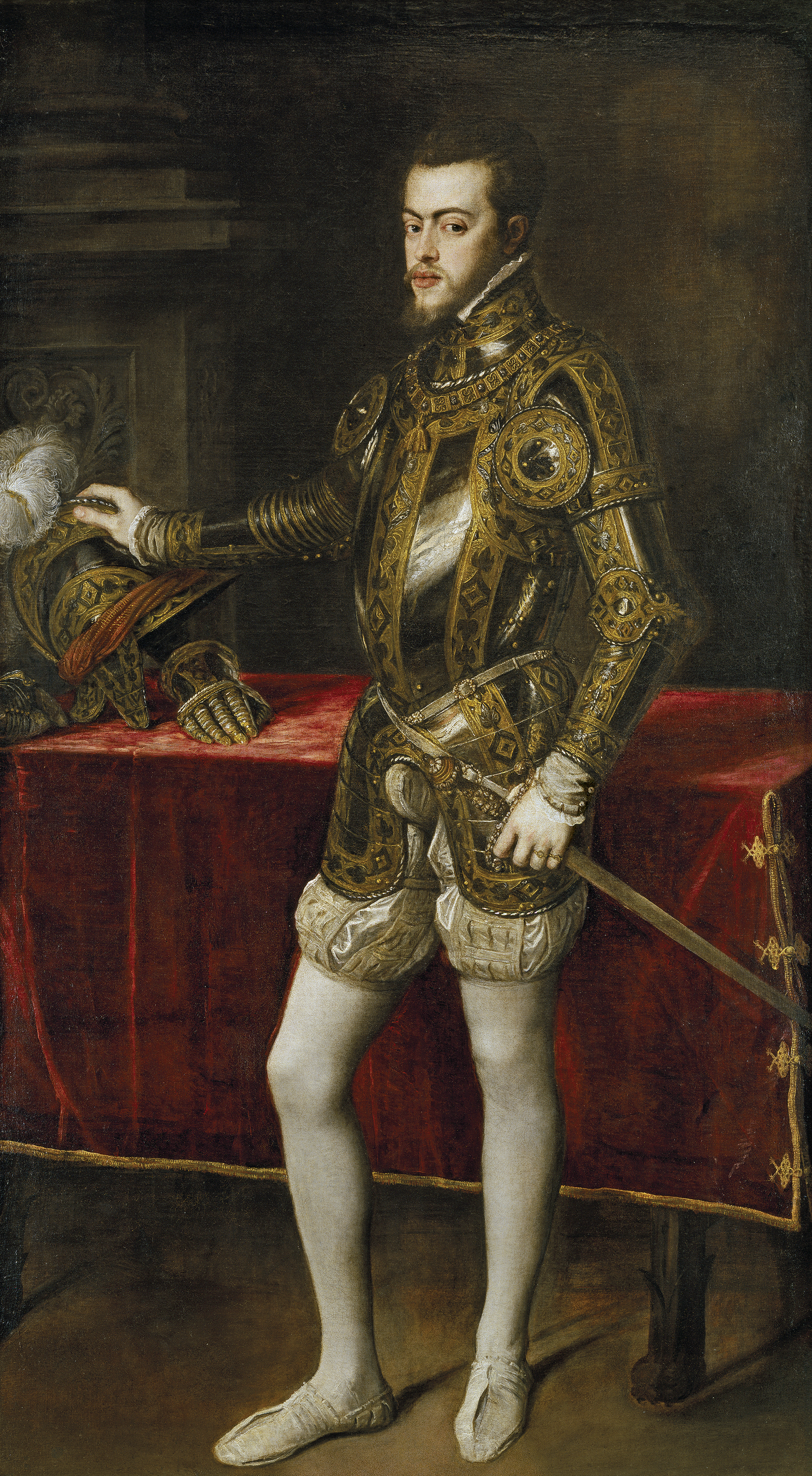
King Philip
A potrait by Iitian of 1551, now in the Prado

Image: Wikipedia

King Philip, eleven years younger than his wife, may indeed have married her out of Habsburg familial duty to his father, and have been irke dby the restrictions the marriage treaty placed upon his exercise of power, but in both public and private he appears to have been attentive to the Queen who became fdeeply enamoured of him. Contemporaries quoted in Henry Kamen's excellent biography King Philip considerd that if the English populace hasd more access to him he would have won their regard as well. A reserved man, who appears to have disliked much of the outward display called upon for European monarchs at the time, he does not appear to have been a natural linguist and spoke little English, nor, and this was to be a problem for him later in ruling the Netherlands, Flemish or Dutch. He nad his wife communicated in Spanish, French and Latin. His youthful high spirits, clerly described by Kamen were kept under control, and the punctuillious, reserved monarch of the future was being formed.

One formal consequence of the wedding was a change in the Royal Arms. Few instances of these now survive. One can be seen in Trinity College here in Oxford. This was founded in 1554 and teha rms are painted over the fireplac ein the hall, but in their present form appear to be entirely nineteenth century. At Windsor Castle on the outside of the lodgings of the Military Knights of Windsor there is a restored version of the arms carved in stone, as can be seen in the article College of St George - Windsor Castle - Royal Arms of Philip and Mary

File:Coat of Arms of England (1554-1558).svg 

A modern rendering of the arms of King Philip and Queen Mary

Image:Wikipedia

* Strictly speaking the King's titles were more complex than that simple description. The modern form King of Spain was not used before the 1870s. King Philip would have been styled variously King of Spains and the Indies or King of Castile, Leon, Aragon, Navarre, and all the other subsidiary titles of the Spanish crown. On this see List of titles and honours of the Spanish Crown and  Many titles of King Philip II of Spain 

Sunday, 17 November 2013

Religious change in 1558


Today marks the 455th anniversary of a set of events in 1558 which shaped the future religious history of England. On that day there occurred the deaths, early in the morning, of Queen Mary I and, later in the same day, that of Cardinal Pole of Canterbury, and the accession of Queen Elizabeth I. With these events the 1559 settlement of the Church of England became possible.


Queen Mary I

Image:simondickinson.com

If Queen Mary had lived longer her government and bishops might well have been able to continue with further success the work they had carried out to restore Catholic belief and practice to the country, something they can now be seen to have done to a great extent as has been shown by Professor Eamonn Duffy with The Stripping of the Altars and more particularly in Fires of Faith. Given that the majority appear to have favoured traditional religion this made the likelihood of a deeper renewal of the Papal allegiance and acceptance of Tridentine initiatives would follow. For this the Queen needed a  Catholic heir. If she herself did not have child, then Elizabeth was the next heir under the 1544 Succession Act, and Elizabeth played her cards skillfully. The next Catholic heir was Queen Mary of Scots, Dauphine of France and unacceptable on those grounds to both Mary of England and her husband Philip of Spain. King Philip did not possess the crown matrimonial under the 1554 marriage treaty, so he had no continuing rights. He may have offered to marry Elizabeth - with, no  doubt, no likelihood on either side of interest - but what he sought was diplomatic security for hios domains in the Netherlands. Had he and Queen Mary I had a son then he would have joined England and Ireland in a union with the Habsburg lands in the Low Countries- which raises some intersting possibilities of what might, in theory, have happened. The crucial thing was the need for a securely Catholic heir, and that there was not.


  Reginaldus Pole (1500–1558), Cardinal Pole

Cardinal Reginald Pole
Cristoforo Dell' Altissimo
Portrait at Shute Barton

Image: National Trust/BBC My Pictures

Cardinal Pole - royal by descent, Cardinal, papabile in 1550, dangerous liberal or dangerous reactionary depending how you looked at him - by dying when he did removed the leadership of the English hierarchy at a critical time. How he would have dealt with the new Queen Elizabeth is an unknown, and, I think, unknowable. Without Queen Mary's backing he might have had to depend upon King Philip for aid against his old sparring partner Pope Paul IV, who suspected Pole ( and not only Pole of course) of heresy. How he might have got on with Pope Pius IV, elected when Pope Paul died in 1559, and the reconvened Council of Trent, which was yet to complete the restatement of Catholic belief in a time when so much seemed shifting and unsure, again raises imponderables.


Queen Elizabeth I in the 1560s
The portrait stresses the Queen's evangelical credentials, with her restrained dress and the prayer book she is holding

Image: philipmould.com

Queen Elizabeth I was to be both initially cautious in her religious policy and then bold in re-establishing asystem based on her half-brother's settlement. That it may not have been what she herself favoured is likely - David Starkey's interpretation of her as favouring a Henrician style of a Catholic style combined with evangelical reforms, a liturgy with ceremony and certainly the crucifix as well as music appears convincing to me. A Papal settlement was not acceptable - had not the Pope bastardized her in the womb as she herself said, and her legitimacy and right of succession was central to her  being. Unfortunately for the new Queen, and to her surprise, the surviving Marian bishops were not prepared to abandon the barque of Peter - well, all save Bishop Kitchen of Llandaff - and she was forced to deprive them. Finding replacements led her to men less attracted than she was by the more traditional forms of worship. Given an international settlement at Cateau-Cambresis which brought peace to Europe the new Queen had more room to manoeuvre diplomatically, and to play anot especially string hand very skillfully. By not pushing conformity too far, although legislation existed to do that, the Queen and her ministers maintained a consensus that for a few years proved manageable. However both Ctaholic and Puritan opposition remained, and bevcame more assertive as time, and the reign, went on. Nevertheless the curious compromise that is  the 1559 Settlement is one which, for all its cobbling together, has survived for more than 450 years. Not even the Civil War and regicide in the mid-seventeenth century could destroy it. I am somewhat surprised more was not done to mark the 450th anniversary in 2009. The pity of it is that under the second Queen Elizabeth the Church of England seems to be doing to itself what its adversaries have failed to do over the previous four hundred years.

Had Queen Elizabeth died in 1562, as she very nearly did of smallpox, then the country would have faced a real crisis. The Council were divided as to who to approach as the next heir - Lady Catherine Grey or Henry Earl of Huntingdon. The Queen solved the problem by recovering, but had she not done so her legacy would be very unclear. With either of those two candidates on the throne a more Protestant Church of England might well have ensued, as of course might Catholic opposition, not to mention Queen Mary I of Scots, as  yet unbesmirched by scandal...

If for Queen Mary I the succession was a continuing dilemma, then so it was for her half-sister - indeed almost more so. Queen Elizabeth I held out against naming an heir for almost forty five years, and turned the whole matter into  a national concern that dare not really speak its name. Their father's break with the Papacy and Rome had made the nation's religious life a matter for the monarch to determine, and yet there was no way to determine the way a new monarch might take the Supreme Headship or Governorship. Not until 1688-9 and 1701 was a settlement made to limit that range of possibilities.


Saturday, 6 July 2013

The death of King Edward VI


Today is the 460th anniversary of the death at Greenwich Palace of the fifteen year old King Edward VI in 1553.

Despite attempts by the government to keep the news of the King's failing health quiet rumours had clearly got out, and those with aninterst in what was to happen were ready to make the moves they had anticipated. In his last months the King, a convinced reformed protestant thanks to his spiritual formation even before his father's death, appears to have taken the lead in the moves to side-step the 1544 Act of Succession which settled the Crown on his two half-sisters, the Lady Mary and the Lady Elizabeth, and then reverted to male succession with the heirs male of his father's younger sister the Duchess of Suffolk through her daughters. This excluded the otherwise superior claim of Queen Mary of Scots, and her Lennox cousins.

The King, anxious to prevent the accession of the Lady Mary, a devout Catholic, profoundly attached to the Catholic Mass, though she may well have kept quiet about her attachment to the Papacy, now sought to leave the Crown by his will, as though it were his private property - a power conferred on his father, but not on him. By his new declaration the Crown was to pass to Lady Jane Grey, excluding both the daughters of King Henry VIII and Lady Jane's mother, Frances Duchess of Suffolk. For this reason the future Queen Elizabeth I appears as monarch never to have trusted the two surviving Grey sisters, Lady Catherine and Lady Mary, and watched their matrimonial misadventures with a beady royal eye and vigilance. For this see Leanda de Lisle's joint biography of the Greys The Sisters who would be Queen

Having got many of the Council on side the young King may have believed it would all go as he wished. His chief minister, the Duke of Northumberland, who on this analysis emerges less as a die-hard Protestant than as a politique par excellence in all things - hence perhaps his last minute return to Catholicism in the last days of his life and his question even on the scaffold as to whether or not he could still serve Queen Mary - the offer was declined and the axe fell - had made his own moves. His son Lord Guildford Dudley had been married to Lady Jane that spring and Northumberland and the Council moved to proclaim her as Queen. So began the tragi-farce of the reign of Queen Jane.

Meanwhile from her estates in Essex the Lady Mary, apprised of what was happening by those contacts at Court sympathetic to her claims, moved north into Suffolk to Framlingham castle, gathered support, and in what has been described as the one successful rebellion against a Tudor government saw off the challenge to her rights and became Queen Mary I, and, as her half-brother had feared, set about restoring Catholicism. The difficulties she faced included the amount of physical and spiritual damage wrought in the reign of King Edward - whatever she might have achieved had she been spared to pursue her policy of restoration for longer, she found she faced a determined protestant minority willing to die for their beliefs; that would not have been the same six years earlier when their father died.

Friday, 30 November 2012

St Andrew's Day 1554


It was on St Andrew's Day in 1554 that England was formally absolved from schism and received back as a kingdom into the bosom of the Catholic Church.

Led by King Philip and Queen Mary the Lords and Commons knelt before the Papal Legate, Cardinal Reginald Pole and besought absolution which was granted by the Legate in the name of Pope Julius III.

For the Queen this must have been one of the happiest days of her life, the vindication of all she had hoped and no doubt prayed for for a quarter of a century.
St Andrew's day was appointed as aperpetual celebration of the reconciliation, but that can have last happened in 1558, just after the Queen's death.

As I have written before it was reading about the part played in this process by Bishop Stephen Gardiner in Glyn Redworth's superb biography of him,  In Defence of the Church Catholic that removed on eof the last props of my Anglo-Catholic position and influenced, indirectly my own path to Rome in 2005. In particular there is the text of the great sermon preached by Gardiner at Paul's Cross on the Sunday following the reconciliation - it is very well worth reading.

Which brings us neatly up to date. In the 1980s there did appear to be apossibility of some form of organic reunion of the Anglican Church with Rome - remember ARCIC in 1982. That may well have been afudge in advanc eof the papal visit of that year, but there was, not so long ago, a real hope of such an outcome. Now we know better, as is indicated in this post from Fr Tim Finigan  Goal of corporate reunion no longer realistically exists.

The way to unity now lies clearly with individual reconcilition either through the Ordinariate or as a traditional convert. But think what might have been in the 1550s or even in our own times!

Thursday, 17 November 2011

Good Queen Mary


Amongst my birthday presents was a signed copy from the author, my friend John Edwards, of Mary I: England's Catholic Queen, the latest in the Yale UP series of biographies of English monarchs.


I was delighted both to be given a copy of the book, and to find what a superb piece of work it appears to be - I say appears to be merely because I have only had a chance to glance at it and read some passages rather than devour it cover to cover. It has received some excellent reviews, and from what I have seen deservedly so. As John Edwards' expertise is rooted in late medieval and sixteenth century Hispanic studies he has explored as no-one appears to have done hitherto the full, Spanish dimension of Queen Mary's formation and the wider context of her marriage to King Philip.

I must get on and read the book through, but thought that the anniversary of the death of the Queen, and of Cardinal Archbishop Pole, which falls today, was a good occasion upon which to draw attention to the book. It is also a good occasion, as Fr Blake urges his readers in Death of Catholic England, upon which to pray for the repose of the souls of the Queen and the Cardinal.

My post from last year Queen Mary I and Cardinal Reginald Pole has pictures of the Requiem celebrated for Carsdinal pole in 2008 at magdalen, his Oxford college.

Wednesday, 17 November 2010

Queen Mary I and Cardinal Reginald Pole


November 17th is the anniversary of the deaths on the same day in 1558 of Queen Mary I and of her cousin and Archbishop of Canterbury, Cardinal Reginald Pole.

In recent years both Queen and Cardinal, as well as her husband King Philip, have the subjects of new biographies which seek to present them in a much more favourable and nuanced light, and taking ccount of new research and understandings of sixteenth century life and realities. This process is continuing, and although it may take some time before everyone is speaking of "Good Queen Mary" her reign, and the considerable progress made during it in restoring Catholicism is being reappraised and understood more impartially. There have been a series of recent biographies and other studies of the Queen which have presented a much more balanced account than has been usual, and we await my friend John Edwards' biography of her in the Yale English Monarchs series. Henry Kamen's King Philip is a very readable account of the life of her husband, who emerges as a far more human and attractive figure than he is often presented in popular perception.

There is a continuing series of articles about the Queen at the website Mary Tudor- Renaissance Queen There is a catalogue of portraits of the Queen here.

This stained glass depiction of Queen Mary and her husband King Philip is little known in this country but which is contemporary.

http://tudorhistory.org/groups/mary_philip_window.jpg
Queen Mary I and King Philip II

From a window in Sint Janskerke Gouda, The Netherlands, made in 1557

File:Cardinal Reginald Pole.jpg

Cardinal Reginald Pole

Image: Wikipedia


For many years Pole was awaiting an academic biographer; this gap has been filled to a considerable extent with the publication of Thomas F. Mayer's Reginald Pole: Prince and Prophet (Cambridge Studies in Early Modern British History), although it is not always the easiest book to read.

The Queen and Pole's considerable efforts to re-establish Catholicism in England have most recently been studied in Eamonn Duffy's Fires of Faith.

Two years ago, on the 450th anniversary of the Cardinal's death, and long before I started blogging I served as thurifer at a Requiem Mass in the Extraordinary Form for Cardinal Pole in the chapel of his college, Magdalen here in Oxford. These photographs, taken by Br Lawrence Lew, O.P., appeared, together with the link to his Flickr set of the Mass, on the NLM site.


    photo

    The Mass, organized by the Latin Mass Society, was celebrated in the chapel of Magdalen College, with the permission of the President and Dean. Cardinal Pole had been an undergraduate in this college, and it was a privilege for us to assist in the Mass celebrated in the Extraordinary Form in this beautiful (essentially) medieval chapel. The Mass included absolutions at the catafalque, which bore the Cardinal's arms
    The celebrant was Fr John Osman, parish priest of Dorchester-on-Thames, and the Mass was expertly and prayerfully sung by the Schola of Bl. Thomas Abel, Oxford University's Gregorian chant society, which was founded by the current Chairman of the LMS, Dr Joseph Shaw.

    Elevation of the Sacred Host

    More photos in my Flickr set.