Once I was a clever boy learning the arts of Oxford... is a quotation from the verses written by Bishop Richard Fleming (c.1385-1431) for his tomb in Lincoln Cathedral. Fleming, the founder of Lincoln College in Oxford, is the subject of my research for a D. Phil., and, like me, a son of the West Riding. I have remarked in the past that I have a deeply meaningful on-going relationship with a dead fifteenth century bishop... it was Fleming who, in effect, enabled me to come to Oxford and to learn its arts, and for that I am immensely grateful.


Showing posts with label Windsor Castle. Show all posts

Sunday, 9 July 2017

Royal Palaces of the Hundred Years War


History Extra has an illustrated article on Royal palaces of the Hundred Years’ War which is of interest and links in with other posts I have written, such as those on the Très Riches Heures of the Duke of Berry and castles such as Vincennes.


The article is introduced as follows: Made famous in popular history by the battle of Agincourt, Joan of Arc and Edward the Black Prince, the Hundred Years' War was an epic conflict between two nations, England and France. As Anthony Emery explains, over the course of the war the balance of architectural power moved from religious to secular domination; the Gothic style of architecture continued to develop and the palace-fortress became the pre-eminent form of a residence. Read the full story here.

I think it does bring out the point that these really were palace-fortresses, and not just stark military establishments, in what was an age of royal and aristocratic luxurious living.


Wednesday, 6 April 2016

Windsor Castle


The recent reports about plans to develop visitor facilities and open up more of the Royal Apartments at Windsor Castle included this picture of  the undercroft in the Upper Ward of the castle which dates from the rebuilding of the residential part of the complex in the 1360s. I have seen the point made that, proportionately, King Edward III spent as much on these works as King Louis XIV did at Versailles three centuries later. The surviving portions suggest something of the scale of what the Kingcreated, and which underlie later rebuildings and reconstructions. The present plans envisage turning this into the restaurant for visitors.

The 14th-Century Undercroft at Windsor 

King Edward III's undercroft at Windsor Castle

Image: Mark Fiennes/Royal Collection Trust/ Daily Telegraph 

Friday, 25 July 2014

The wedding of King Philip and Queen Mary


460 years ago, on St James' day 1554 Queen Mary I married King Philip of Naples, who from 1556 was King Philip II of Spain*, in Winchester cathedral. The choice of the feast day of the patron saint of Spain was doubtless seen as auspicious.

For the Queen this must have been a day of triumph. Just over a year earlier from her position as a spinster elder half sister of the deceased King Edward VI, marginalised as a Catholic and with the practise of her faith under threat, and then excluded from the succession altogether,  she staged the only successful uprising in Tudor England against the central government, saw off her opponents, set in motion the restoration of Catholicism and now married the most eligible young man in Europe. Not bad going.


Queen Mary I in 1554
A painting by Hans Eworth now at the Society of Antiquaries
The Queen is wearing the pearl La Peregrina given to her by King Philip
 
Image: Wikipedia

The basis for the wedding was the treaty negotiated earlier on in the year and made into English law by an  Act of Parliament, about which there is an article here. The background can be read in the illustrated online life of the Queen here.
The wedding ceremony itself is worthy of note in that apart from her mother's lavish wedding to Prince Arthur in St Paul's in 1501 Tudor royal weddings were not great public events, and indeed the great public royal wedding we expect today is something from the twentieth century. From 1554 until the 1920s England saw nothing comparable.

There is a detailed account of the wedding in my friend John Edward's recent biography of the Queen, published by Yale UP in their English Monarchs series.

One of the sources for our knowledge of the day is the official Herald's account, transcribed and published in the eighteenth century, and which can be read at The Marriage of Queen Mary and King Philip


King Philip and Queen Mary

Image: Wikipedia 


The blog Mary Tudor - Renaissance Queen has an account of the events of the day and of surviving buildings and other remains today here and from another blog there is also an account of the wedding which can be seen here.


A reconstruction of Queen Mary's wedding dress, created by Tanya Elliott, which was displayed at the Exhibition The Marriage of England and Spain - the 450th Anniversary of the Marriage of Philip and Mary  held from June 20-September 30, 2004 at Winchester Cathedral

(photo courtesy of Winchester Cathedral)

Queen Mary's dress was described as consisting of a mantle of brocaded cloth of gold, bordered with pearls and diamonds of great size, and lined with ermine. The dress was also gold smothered with the same precious stones, and the underskirt of white satin embroidered of silver. The French hood  - that is a headress of rounded shape is worn over a coif, and with a black veil attached to the back, that is very like a modern tiara in shape - in black velvet was surmounted by a double row of large diamonds.

 Image:home.earthlink.com 

The Queen had a noted fondness for jewellery, and one of the King'swedding gifts to her was the pearl La Peregrina, of which there is a history here. In most of her portraits the Queen is depicted wearing it. 
On her death it was returned to the King. 


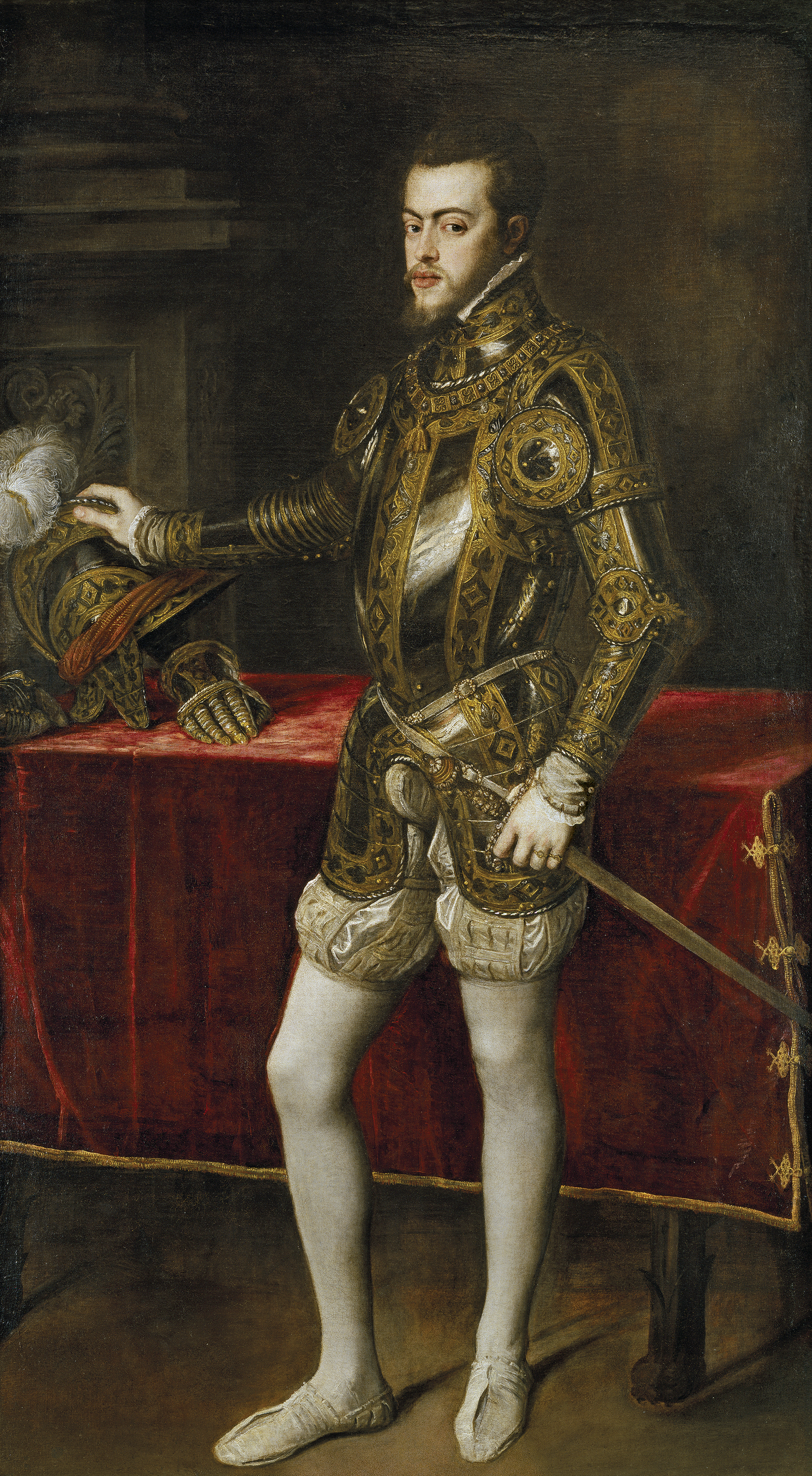
King Philip
A potrait by Iitian of 1551, now in the Prado

Image: Wikipedia

King Philip, eleven years younger than his wife, may indeed have married her out of Habsburg familial duty to his father, and have been irke dby the restrictions the marriage treaty placed upon his exercise of power, but in both public and private he appears to have been attentive to the Queen who became fdeeply enamoured of him. Contemporaries quoted in Henry Kamen's excellent biography King Philip considerd that if the English populace hasd more access to him he would have won their regard as well. A reserved man, who appears to have disliked much of the outward display called upon for European monarchs at the time, he does not appear to have been a natural linguist and spoke little English, nor, and this was to be a problem for him later in ruling the Netherlands, Flemish or Dutch. He nad his wife communicated in Spanish, French and Latin. His youthful high spirits, clerly described by Kamen were kept under control, and the punctuillious, reserved monarch of the future was being formed.

One formal consequence of the wedding was a change in the Royal Arms. Few instances of these now survive. One can be seen in Trinity College here in Oxford. This was founded in 1554 and teha rms are painted over the fireplac ein the hall, but in their present form appear to be entirely nineteenth century. At Windsor Castle on the outside of the lodgings of the Military Knights of Windsor there is a restored version of the arms carved in stone, as can be seen in the article College of St George - Windsor Castle - Royal Arms of Philip and Mary

File:Coat of Arms of England (1554-1558).svg 

A modern rendering of the arms of King Philip and Queen Mary

Image:Wikipedia

* Strictly speaking the King's titles were more complex than that simple description. The modern form King of Spain was not used before the 1870s. King Philip would have been styled variously King of Spains and the Indies or King of Castile, Leon, Aragon, Navarre, and all the other subsidiary titles of the Spanish crown. On this see List of titles and honours of the Spanish Crown and  Many titles of King Philip II of Spain 

Friday, 30 May 2014

A visit to St George's Chapel Windsor


Today I went on an excursion organised by the Oxford University Heraldry Society to St George's Chapel at Windsor Castle - my first visit to the castle for over fifty years.

We had a fairly early start from Oxford, as we were booked in at the Chapel for 10.30. So up betimes and off to Summertown in North Oxford for my lift to Windsor. Being between other roadusers travelling times we made good progress. The jorney took us through Slough, and this, my first visit, brought home to me what Betjeman wrote so long ago about it - "Come kindly bombs and fall on Slough/ It isn't fit to live there now"...

On arrival at the King Henry VIII gate of the castle it was a slightly disconcerting sign of the times to be met by the usual attendants plus a policeman armed with a serious looking gun. Nevertheless the welcome to our group was very friendly and we had two of the Military Knights to acts as guides to the chapel and to the Garter plates of the Knights of the Garter in their stalls in the choir.

St George's Chapel.jpg (153080 bytes)


 The choir of St George's Chapel

Image:mrffriends.org

File:Castell de Windsor - Capella de Sant Jordi.JPG

The banners of the Knights of the Garter

Image: Wikipedia 

The tour of the Chapel enabled me to see things I recalled vividly from my previous visit, plus things I had missed, such as the Beaufort chantry with the tomb of the first Earl of Worcester and, in the south choir aisle, the onetime home of the Cross Gneth, plus things that are not always accessible, such as the Rutland chapel with the tomb of Lord and Lady Roos and the brass of her parents Anne Duchess of Exeter, sister of King Edward IV  and King Richard III, and her second husband Sir Thomas St Leger. The chapel is full of  tombs and memorials of interest to anyone with a sense of history and genealogy - you almost fall over deceased monarchs - there are ten sovereigns buried in the chapel.


Stall plates

The earliest surviving Garter plate, which is of Sir Ralph Basset, together with those of later Knights 

Image;stgeorges-windsor.org

The tour of the stalls with the Garter plates was a rare opportunity to get a close view of this amazing collection. To view them all would take an age, but our guide, who has complied a new cross-referenced list of the plates, pointed out those of the first Dukes of Marlborough and Wellington, of Winston Churchill, Clement Attlee, Edward Heath, Margaret Thatcher and John Major amongst Prime Ministers, whilst the array of foreign royalty was amazingly rich. Starting with Charles the Bold of Burgandy and Emperor Maximilian I along the way - and we had to keep moving forward through the lines of the range of stall beneath the Knight's ones, I spotted, inter alia, numerous Portuguese monarchs down to King Manuel II, King Alfonso XIII of Spain, Emperor Haile Selassie,King Ferdinand I of Romania, King Charles X of France, and some other French Kings' plates could be seen in the further distance. There were two plates from the fourteenth century - though possibly not originally in the Chapel - and several of participants in the events of the Wars of the Roses.

I was a little disappointed that some of the most recent plates, such as those of the Earl of Wessex and of the Duke of Cambridge, had abandoned the traditional medieval French for English in their inscriptions - by contrast Lady Thatcher's stall plate was, for all her supposed Euro-scepticism, in traditional French.

After our tour we came out by the Dean's cloister and went for buffet lunch in the basement - the Dungeon - of the Curfew Tower, before having a tour of the Archives of the Chapel and Order. These included displays of early fifteenth century account rolls of the Dean and Chapter with the earliest references to the Garter plates, records of nominations by the Knights to fill vacancies - a practice which durvived until the time of Queen Victoria's widowhood - and which survived in an early sicxteenth century manuscript recovered by chance in London from the clearance of a private collection and returned to King George VI, and plans of the stalls and their plates.

We also were shown items from the library of the Chapel, including a Caxton, and finally the permanent display of treasures, including the illuminated Black Book commissioned by King Henry VIII about 1534-5, and which was on show at the Greenwich exhibition about him in 1991, and has group portraits of the King surrounded by the Knights of the Garter, including Emperor Charles V, King Francis I, King James V and King Ferdinand I.

The Black Book of the Garter 

The Black Book, named after its black velvet binding, is the first surviving register of the Garter. It was begun in 1534 when Henry VIII was married to Anne Boleyn. However it incorporates material from earlier registers (which are now lost) dating to the reign of Henry V. The text is in Latin and it contains statutes, an account of the foundation of the Order and the record of ceremonies and elections. It is finely written and richly illuminated in the Flemish style. There are representations of the founder of the order, Edward III and his wife Philippa along with Henry V.

The pages depicted here are on the reign of Henry VIII and the ceremonies of the Order for 1534. Above left, Henry VIII is surrounded by twenty-five knights in the robes of the Order; bottom left and right, the knights in armorial surcoats, process to chapel where, above right, the three junior knights arrive.

The Black Book shows the impact of the Reformation as in later admissions, various decorations of the Order that are depicted have been mutilated and wiped out to eliminate ‘superstitious’ elements.

Image and text :little-miss-sunnydale on Flickriver.com 


As well there is  in the display the Red Book, commissioned by Queen Elizabeth I, and the Blue Book from the reign of King Charles I. Also on display were a tally list of votes in the papal conclave of 1676 - how that got to Windsor is unknown - and handwritten nominations by several seventeenth century Knights, including the future King James II.

This was fascinating day out, and I am very grateful to the organisers for arranging it. If any reader gets the chance to have such a tour I warmly recommed doing so. In any case Windsor is so rich in fascinating things to see that any visit, or indeed repeated visits, is definitely something to do.