Once I was a clever boy learning the arts of Oxford... is a quotation from the verses written by Bishop Richard Fleming (c.1385-1431) for his tomb in Lincoln Cathedral. Fleming, the founder of Lincoln College in Oxford, is the subject of my research for a D. Phil., and, like me, a son of the West Riding. I have remarked in the past that I have a deeply meaningful on-going relationship with a dead fifteenth century bishop... it was Fleming who, in effect, enabled me to come to Oxford and to learn its arts, and for that I am immensely grateful.


Showing posts with label Order of the Garter. Show all posts

Sunday, 23 April 2017

Great George


Today is the feast of St George and a day in which in England teh order of the Garter come sto mind as a celebration of knightly virtues on the day of our national patron saint.

In recent months I have found these posts about insignia from the Order in the Royal Collection on Pinterest and thought they could be shared to mark the occasion.

The first is taken from the Royal Collection website and is about the Stuart insignia on display in Edinburgh Castle alongside the Honours of Scotland:

Great George, made by Robert Vyner for Charles II, 1661, thence by descent to Prince Henry Benedict Stuart, Cardinal York; acquired by George IV. Rev.

The back of the figure of St George and the Dragon

Image: Pinterest from Royal Collection Trust website

This magnificent Great George was supplied to Charles II in 1661 by the Royal goldsmith, Robert Vyner. It was described as ‘A v. large enamelled George set with 20 large diamonds and one hundred and odd lesser diamonds’. Charles II is depicted wearing it, together with the new coronation regalia, in John Michael Wright’s portrait of c.1670. The Great George was illustrated with Charles II’s other insignia in Ashmole’s History of the Garter, 1672. It has subsequently lost the flowing cloak worn by St George and the large diamond-set fleur-de-lis suspension loop with which it was attached to the collar. Some of the surviving stones are sixteenth century cuts and indicative of the reuse of stones following the Restoration. The oak leaves on the underside are, perhaps, an allusion to the Boscobel Oak in which Charles II hid to escape from Cromwell’s forces after the Battle of Worcester in 1651.

The Garter collar follows the style of collars produced after the Restoration. Its construction is significantly different from earlier seventeenth century collars and the finish of the reverse suggests hasty production. Collars made immediately after the Restoration included twenty-six roses and knots and weighed around 30 oz. This collar, with its twenty-one knots and weighing 33 oz 10 dwt, is therefore smaller in terms of knots and garters. The Jewel House began supplying heavier collars with twenty-one roses and knots in 1685 and it is therefore likely that this collar was made shortly after James II’s accession.

Both collar and George were taken by James II into exile in France in 1688. They appear as ‘A Collar of the order with a George to it of Diamonds’ valued at 6,000 livres in James II’s posthumous inventory drawn up at Saint-Germain on 20 July 1703. Prince James Edward Stuart is depicted wearing them in Francesco Trevisani’s portrait of c.1719-20.

The collar and George were not listed with other pieces bequeathed to the Prince of Wales by Henry Benedict, Cardinal York, in 1807. The Prince asked for their whereabouts to be investigated and in 1811 William Hill took up the task on the advice of General Mackenzie. Hill discovered that the collar and George, which were described as being ‘once in possession of Charles 2d’ had been given (by Cardinal York?) as security for debts. The whereabouts of the pieces was still unresolved at the time of the Congress of Vienna in 1814 and the topic was raised by the Prince Regent with Cardinal Consalvi when the two men met in July of that year. The Cardinal was able to inform the British Foreign Secretary, Lord Castlereagh, of the condition of the items when they met in Vienna in October 1815.

Although it is not known when the Prince received the collar and George they were certainly in his possession by 1825 when he wore the George at a Waterloo dinner at Carlton House: ‘He [George IV] ... acquainted his guests that the George which he reserved for his own wearing was the same which had been worn by Charles I, Charles II, and James II and was bequeathed by Henry IX, Cardinal of York to the present king’.

In 1830 the collar and George were deposited on loan by William IV in Edinburgh Castle where they remain on display with the Honours of Scotland.

Text adapted from Ancient and Modern Gems and Jewels in the Collection of Her Majesty The Queen, London, 2008


The Royal Collection website has a series of detailed expandable photographs of the items here

Jewel of the English Order of the Garter, Dresden, 1693-1694. Gold, enamel, 23 diamonds, a ruby. H 7,4 cm. Inventory number: VIII 263. Green Vault © Staatliche Kunstsammlungen Dresden 2016

This is a Lesser George  - worn on the riband of the Order - with diamonds and a ruby dated to 1693-4 and in the Green Vault in Dresden

Image: Pinterest

GREAT BRITAIN_From the Royal Collection - Lesser George of gold, jeweled all over, mainly with diamonds, probably made for George II before 1752; possibly remounted for George III, 1765; altered for Queen Victoria, 1858. 

A Lesser George probably made for King George II before 1752 and  possibly remounted for King George III in 1765. It was altered for Queen Victoria in 1858 when the eight large diamonds were replaced and used in the Coronation necklace, and replaced in the badge by clusters of smaller stones

Image: Pinterest from the Royal Collection Trust

George badge of the Order of the Garter, belonging to King George III. 1775-1800 Diamond, ruby, sapphire, amethyst, silver and gold Great

A Great George that belonged to King George III
Dated to 1775-1800

Image: Pinterest from the Royal Collection Trust

https://i.pinimg.com/236x/f3/7f/0c/f37f0c5ba9450f94dfcdc5a4ff8141e0.jpg

The reverse of the Great George 
 
Image: Pinterest from the Royal Collection Trust


One of the magnificent items bequeathed to the Queen Elizabeth from King George VI, was the
The Marlborough Great George
The Royal Collection
badge of the Marlborough Great George. This magnificent diamond and precious stone garter badge of St. George had been made for King George IV by an unknown jeweler, but has been altered by both Rundell, Bridge and Rundell as well as Garrard’s.

This badge was worn by King George VI in 1937 and was later worn by Queen Elizabeth II at her coronation in 1953. Her Majesty always wears it on Garter Day and at the State Opening of Parliament. The creation of the badge came about when King George IV noticed one worn by the Duke og Malborough and ordered a copy of the piece made for himself.

The badge was recently on display at Buckingham Palace as part of the 2010 “Queen’s Year” exhibition which gave citizens of Britain a chance to view objects in use by the Queen throughout her daily life in a year.

Adapted from stalkingthebelleepoque.blogspot.co.uk


Monday, 14 September 2015

John Duke of Bedford


Today is the 580th anniversary of the death of John of Lancaster, Duke of Bedford (1389–1435), the third son of King Henry IV, and, after the death in 1422 of his eldest brother King Henry V, Regent of France and, when in England, of this realm also for King Henry VI.


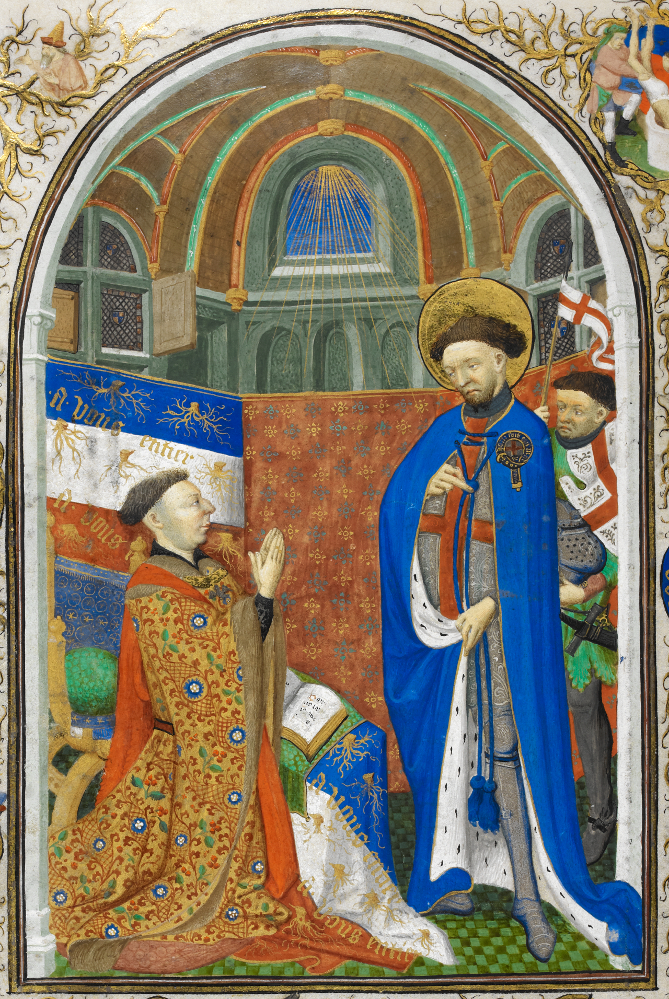
 Duke John kneels before St George, who wears the mantle and garter of the Order of the Garter.
The Duke's badge of a root forms the background to the border.
From the Bedford Book of Hours, circa 1423.
  Image: Wikimedia


http://photos.geni.com/p13/da/51/6c/ff/5344483dc85717bb/john_duke_of_bedford_kg_-_stall_plate_large.jpg


The Duke's Garter Plate at Windsor 

Image:geni.com
 
Jenny Stratford's life of Duke John in the Oxford DNB can be read here. There is a short, illustrated, online account of him at  John of Lancaster, 1st Duke of Bedford

https://upload.wikimedia.org/wikipedia/commons/thumb/e/e2/John,_Duke_of_Bedford_-_British_Library_Add_MS_18850_f256v_-_detail.jpg/220px-John,_Duke_of_Bedford_-_British_Library_Add_MS_18850_f256v_-_detail.jpg
  
 The Duke in close-up from the image shown above


 Image: Wikipedia

An able soldier and administrator under both his father and brother he spent the years of his regency in actively pursuing the Lancastrian cause in France, winning the battle of Verneuil in 1424 - as I often point out to people this was the last major English military victory on the continent until Blenheim, almost exactly 280 years later to the day, in 1704. He was involved in keeping political peace at home with the feuds between his younger brother Humphrey Duke of Gloucester and their uncle Bishop, and later Cardinal, Beaufort, and between wavering allies in the Dukes of Brittany and Burgundy.  His death was a major blow to the English cause in France. A cultured intelligent and able prince he was to prove irreplaceable.

The Duke was also a notable collector and patron of the arts and two pages from his earlier Book of Hours and Psalter from 1414 which went to the British Library in 1928-30 can be seen at http://www.artfund.org/supporting-museums/art-weve-helped-buy/artwork/816/the-psalter-and-book-of-hours-of-john-duke-of-bedford-medieval


Anne, Duchess of Bedford (detail) - British Library Add MS 18850 f257v cropped.jpg

The Duke's first wife, Anne of Burgundy
Detail from the Bedford Book of Hours

Image:Wikipedia


Duchess Anne kneels before St Anne, the Virgin Mary and the Christ Child

From the Bedford Book of Hours

Image: Wikimedia 


Friday, 30 May 2014

A visit to St George's Chapel Windsor


Today I went on an excursion organised by the Oxford University Heraldry Society to St George's Chapel at Windsor Castle - my first visit to the castle for over fifty years.

We had a fairly early start from Oxford, as we were booked in at the Chapel for 10.30. So up betimes and off to Summertown in North Oxford for my lift to Windsor. Being between other roadusers travelling times we made good progress. The jorney took us through Slough, and this, my first visit, brought home to me what Betjeman wrote so long ago about it - "Come kindly bombs and fall on Slough/ It isn't fit to live there now"...

On arrival at the King Henry VIII gate of the castle it was a slightly disconcerting sign of the times to be met by the usual attendants plus a policeman armed with a serious looking gun. Nevertheless the welcome to our group was very friendly and we had two of the Military Knights to acts as guides to the chapel and to the Garter plates of the Knights of the Garter in their stalls in the choir.

St George's Chapel.jpg (153080 bytes)


 The choir of St George's Chapel

Image:mrffriends.org

File:Castell de Windsor - Capella de Sant Jordi.JPG

The banners of the Knights of the Garter

Image: Wikipedia 

The tour of the Chapel enabled me to see things I recalled vividly from my previous visit, plus things I had missed, such as the Beaufort chantry with the tomb of the first Earl of Worcester and, in the south choir aisle, the onetime home of the Cross Gneth, plus things that are not always accessible, such as the Rutland chapel with the tomb of Lord and Lady Roos and the brass of her parents Anne Duchess of Exeter, sister of King Edward IV  and King Richard III, and her second husband Sir Thomas St Leger. The chapel is full of  tombs and memorials of interest to anyone with a sense of history and genealogy - you almost fall over deceased monarchs - there are ten sovereigns buried in the chapel.


Stall plates

The earliest surviving Garter plate, which is of Sir Ralph Basset, together with those of later Knights 

Image;stgeorges-windsor.org

The tour of the stalls with the Garter plates was a rare opportunity to get a close view of this amazing collection. To view them all would take an age, but our guide, who has complied a new cross-referenced list of the plates, pointed out those of the first Dukes of Marlborough and Wellington, of Winston Churchill, Clement Attlee, Edward Heath, Margaret Thatcher and John Major amongst Prime Ministers, whilst the array of foreign royalty was amazingly rich. Starting with Charles the Bold of Burgandy and Emperor Maximilian I along the way - and we had to keep moving forward through the lines of the range of stall beneath the Knight's ones, I spotted, inter alia, numerous Portuguese monarchs down to King Manuel II, King Alfonso XIII of Spain, Emperor Haile Selassie,King Ferdinand I of Romania, King Charles X of France, and some other French Kings' plates could be seen in the further distance. There were two plates from the fourteenth century - though possibly not originally in the Chapel - and several of participants in the events of the Wars of the Roses.

I was a little disappointed that some of the most recent plates, such as those of the Earl of Wessex and of the Duke of Cambridge, had abandoned the traditional medieval French for English in their inscriptions - by contrast Lady Thatcher's stall plate was, for all her supposed Euro-scepticism, in traditional French.

After our tour we came out by the Dean's cloister and went for buffet lunch in the basement - the Dungeon - of the Curfew Tower, before having a tour of the Archives of the Chapel and Order. These included displays of early fifteenth century account rolls of the Dean and Chapter with the earliest references to the Garter plates, records of nominations by the Knights to fill vacancies - a practice which durvived until the time of Queen Victoria's widowhood - and which survived in an early sicxteenth century manuscript recovered by chance in London from the clearance of a private collection and returned to King George VI, and plans of the stalls and their plates.

We also were shown items from the library of the Chapel, including a Caxton, and finally the permanent display of treasures, including the illuminated Black Book commissioned by King Henry VIII about 1534-5, and which was on show at the Greenwich exhibition about him in 1991, and has group portraits of the King surrounded by the Knights of the Garter, including Emperor Charles V, King Francis I, King James V and King Ferdinand I.

The Black Book of the Garter 

The Black Book, named after its black velvet binding, is the first surviving register of the Garter. It was begun in 1534 when Henry VIII was married to Anne Boleyn. However it incorporates material from earlier registers (which are now lost) dating to the reign of Henry V. The text is in Latin and it contains statutes, an account of the foundation of the Order and the record of ceremonies and elections. It is finely written and richly illuminated in the Flemish style. There are representations of the founder of the order, Edward III and his wife Philippa along with Henry V.

The pages depicted here are on the reign of Henry VIII and the ceremonies of the Order for 1534. Above left, Henry VIII is surrounded by twenty-five knights in the robes of the Order; bottom left and right, the knights in armorial surcoats, process to chapel where, above right, the three junior knights arrive.

The Black Book shows the impact of the Reformation as in later admissions, various decorations of the Order that are depicted have been mutilated and wiped out to eliminate ‘superstitious’ elements.

Image and text :little-miss-sunnydale on Flickriver.com 


As well there is  in the display the Red Book, commissioned by Queen Elizabeth I, and the Blue Book from the reign of King Charles I. Also on display were a tally list of votes in the papal conclave of 1676 - how that got to Windsor is unknown - and handwritten nominations by several seventeenth century Knights, including the future King James II.

This was fascinating day out, and I am very grateful to the organisers for arranging it. If any reader gets the chance to have such a tour I warmly recommed doing so. In any case Windsor is so rich in fascinating things to see that any visit, or indeed repeated visits, is definitely something to do.


Monday, 28 April 2014

Devotion to St George


Today is the liturgical commemoration of St George this year - but on that point do look at Fr Hunwicke's post S George??. To mark the feast of the national patron saint here are some late medieval English depictions of him. This was the period in which his cult was widespread and images of him must have been plentiful. However time and chance as well as religious and political upheavels have robbed us of most of them. Those which do survive are often damaged.


File:Saint George and the Dragon alabaster sculpture.jpg 

St George and the Dragon
English polychromed alabaster, 1375-1420
National Gallery of Art, Washington D.C.

Image:Wikipedia 


Altar with St George and the Dragon, presented to Queen Margaret of Anjou, wife of King Henry VI by the first Earl of Shrewsbury, and made in Rouen in 1445. Kneeling at the altar are the Knights of the Garter

This looks similar as acomposition to the statue above,and to such spectaular surviving pieces as the statue of St George which survives in Stockholm, and about which I have posted beforehand in
.
Image: wars of theroses.devhub.com


Medieval glass from St Winnow, Cornwall


Haddon Hall in Derbyshire has this figure, notable for his ginger moustache

Images: aclerkofoxford.blogspot.  

photo

This fine mid-fifteenth century figure of St George, in St Martin Coney Street in York.
Originally in the clerestory of the church the figure survived the bombing of 1942 and has been re-set in a window in the restored south aisle

Image;Steve Day on Flickr 


photo

The figure in its original situation before 1942
Left to right: St Christopher, St Gabriel, the Virgin Mary and St George, with donors below.

Image: jmc4 - Church Explorer on Flickr

If stained glass has been vulnerable to iconoclastic reformers and revolutionaries, not to mention bombs and neglect, so too have been wall paintings. In addition to the one I featured in Medieval Wall paintings uncovered in Wales, here is one of the best surviving examples from England:


 St. George, wall-painting in St. Gregory's Church, Norwich, c.1500

Image:Shafe.co.uk 


St George and the dragon (watercolour detail)

St George and the Dragon

This detail is from a watercolour painting by the Great Yarmouth artist Cornelius Jansson Walter Winter (1821-1891), drawn from the wall-painting discovered in St Gregory's Norwich in 1861.
The wall-painting is thought to be one of the finest and most complete medieval depictions of St George to be found in England, and this painting gives an idea of what its original appearance may have been.

Image: BBC - Picture courtesy of the Norwich Castle Museum And Art Gallery


St George pray for us

Tuesday, 23 April 2013

Praying to St George


John Duke of Bedford, Regent of France, kneels in prayer before St George. The saint is shown wearing the mantle of a Knight of the Garter. The Garter can be seen below his left knee.

From the Bedford Book of Hours

Image;Wikipedia

This part of the manuscript can be dated to 1423-30. The Book of Hours is now in the British Library as Addnl.MS 18850. There is an online article about the Bedford Hours here.

The extremely useful biography of the Duke by Jenny Stratford from the Oxford Dictionary of National Biography can be read here, and there is a shorter online account with some useful links here.


May St George pray for all those nations and foundations under his patronage.


Monday, 28 November 2011

The Way of Salvation - details


Following on from my previous post I have found a view of part of Andrea di Firenze's The Way of Salvation which shows some of the figures of the ecclesiastical and temporal hierarchy in more detail, including the figure of the Knight of the Garter, who is very prominent in the centre foreground. Ages ago I read a piece which tried to identify him, but have not got it to hand.

http://mystudios.com/artgallery/paintings/129501-130000/129692/size1.jpg

Image:mystudios.com

Here are two more details:

The first shows the figures to the left of the previous group, with members of various religious orders and a bishop:

http://farm4.static.flickr.com/3177/2412179516_715443080d_z.jpg?zz=1

The Dominicans preaching:

photo

Images: arthistory390 on Flickr


Finally, here is a detail from the upper right of the painting:

http://www.brightcecilia.net/gallery2/d/1522-2/Andrea+da+Firenze.jpg

Image:brightscecilia.com