Once I was a clever boy learning the arts of Oxford... is a quotation from the verses written by Bishop Richard Fleming (c.1385-1431) for his tomb in Lincoln Cathedral. Fleming, the founder of Lincoln College in Oxford, is the subject of my research for a D. Phil., and, like me, a son of the West Riding. I have remarked in the past that I have a deeply meaningful on-going relationship with a dead fifteenth century bishop... it was Fleming who, in effect, enabled me to come to Oxford and to learn its arts, and for that I am immensely grateful.


Showing posts with label Dunfermline abbey. Show all posts

Saturday, 7 June 2014

King Robert I

Today is the 685th anniversary of the death of King Robert I of Scots.

Robert the Bruce (Brus) or, as he became in 1306, King Robert I of Scots, was born on 11 July 1274, almost 740 years ago. As King of Scots from 25 March 1306 until his death, although not recognised as such by the English until 1328 and the Treaty of Northampton, he is arguably the greatest, and certainly one of the greatest of Scottish monarchs. His assertion of independence, his victory at Bannockburn in 1314, the writing by his nobility of the Declaration of Arbroath in 1320, and his successful campaigns against King Edward II in the north of England ensured the survival of Scotland as an seperate kingdom. The grant by Pope John XXII to him of the right for his succcessors to be anointed as monarchs was a further expression of sovereignty, and in advance of several other European kingdoms.

That said the events of the early fourteenth century should perhaps be looked upon with caution in making decisions about Scottish independence today in the twenty-first century. unity in diversity after so long aperiod of Union seems the right answer to me. Nonetheless without King Robert I the Scots (and, to the extent they are paying any attention at all, the English) would not be having the current debate about Scottish independence. It was King Robert, and not the semi-terrorist Wallace - the utterly appalling film Braveheart notwithstanding - who forged or reforged the national identity of his kingdom.

He was the son of Robert Bruce, 6th Lord of Annandale, and Marjorie, Countess of Carrick, and was born at Turnberry Castle. Although it is unknown whether Turnberry Castle is his actual birthplace, the fact that he spent his boyhood residing in the castle is not in doubt. Little now remains of the castle, its few stone smarked by the lighthouse which is a landmark near the golf course at Turnberry.
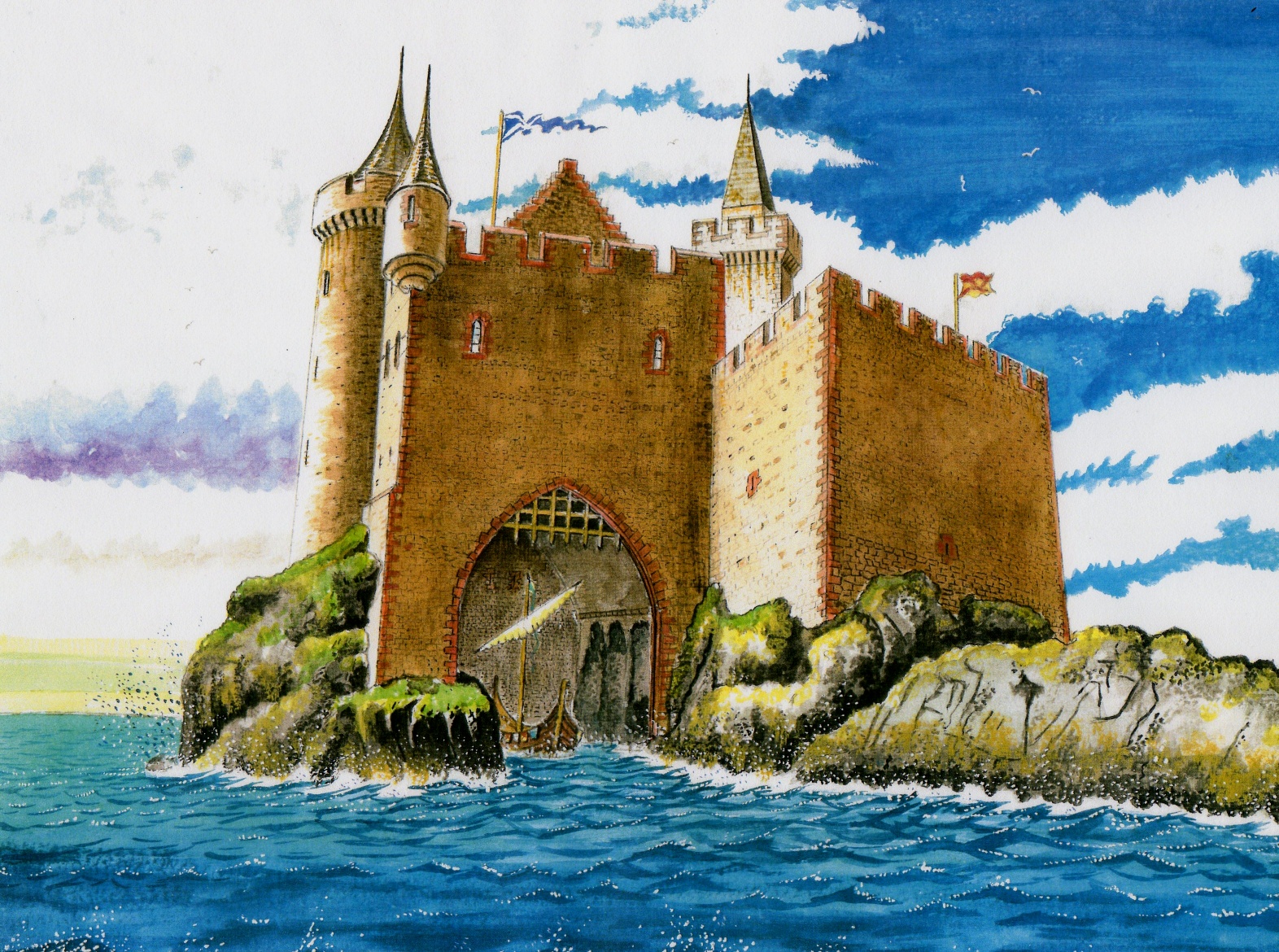


Reconstruction of Turnberry Castle. 
Click on the images to view full-size.  Copyright:Andrew Spratt.
Images:Maybole.org 

There is more about the castle and its history from the same website which can be viewed here.

The King's last years were marked by illness, and from a cast of his skull, found in 1818, at Dunfermline where he was buried a scientist, Richard Neave, has recreated the closest ever likeness of Robert the Bruce. This reveals the leprosy ravaged face of the warrior King Robert I at the age of 55, just before his death. It shows how the condition destroyed the cartilage in his nose causing it to collapse, and also shows a huge wound down his skull, fractured bones around the eye and a toothless mouth.


A facial reconstruction of King Robert I

Image:yannatry.blogspot.com

Cast of Robert's Skull, Dumfries Museum


Cast of the King's scull - Dumfries Museum


Image: undiscoveredscotland.co.uk


The King died at his manor house at Cardross near Dunbarton on the Firth of Clyde and his body was buried at Dunfermline Abbey, the shrine of St Margaret of Scotland, but his heart was removed and was to be taken on Crusade by Sir James Douglas, before eventually being buried at Melrose Abbey.

The link National Museums Scotland - Robert Bruce has expandable images of the King's Great Seal, of some of his coins and of artifacts associated with him and of fragments of his original tomb from Dunfermline.

Robert's Tomb, Dunfermline Abbey Church

The modern tomb of King Robert I at Dunfermline Abbey
Image: undiscoveredscotland.co.uk 


Tuesday, 16 November 2010

St Margaret of Scotland and St Edmund of Abingdon


Today is the feast of both St Margaret of Scotland and of St Edmund of Abingdon, both of whose relics are now preserved on the continent. I have based this post in part on John Dillon's post on the Medieval Church History discussion group site.

Margaret of Scotland was the eldest daughter of the English prince Edward Aetheling, the son of King Edmund II, who fled following his father's death in 1016. Margaret was born during her father's exile in Hungary. A book which covers this period of his life and that of his family in a way which combines scholarship with an enthusiastic pursuit of a hitherto unexamined topic is Gabriel Ronay's The Lost King of England.

In 1057 Edward returned to England, bringing his family with them, but died before he could meet his half-uncle Edward the Confessor. His son Edgar Aetheling was involved in the Anglo-Saxon resistance to the Norman Conquest and in 1068 he fled with Margaret and with other members of the family fromNorthumbria and ended up in Scotland, where Margaret soon married king Malcolm III. Their marriage took place in Dunfermline at the church of the Holy Trinity at which Margaret soon established a priory (it became an abbey in 1128) and in which she was buried opposite the altar. The abbey website is here , the history section of which brings out the abbey's role as a centre of royal devotion and burial down to the early fifteenth century and beyond. The twelfth century nave of the abbey survives and shows very much the influence of the cathedral at Durham, as can be seen here.It is a reminder of a medieval Catholic Scotland of which so little survives.
A forceful and pious woman, St Margaret sought to bring Scottish church practices into line with those she had experienced elsewhere.

There is a fuller biography, which brings out her impact on Scottish cultural life, here with useful links from it to other biographies on the same site, and a picture of the chapel she is aid to have built at Edinburgh castle - it was the one building not destroyed on the castle site by the Scots when they dismantled the fortress during the War of Independence against Edward I of England.

She died on this day in 1093, shortly after hearing of King Malcolm's death in battle against the English. Amongst her eight children were four Kings of Scots, Edmund, Edgar, Alexander I and David I, who continued her policy of regenerating the Scottish church with his series of monastic foundations in the lowlands, and Maud or Matilda who married Henry I of England, thus uniting in their daughter Matilda and her son Henry II the Anglo-Saxon and Norman houses

Margaret's early twelfth-century Vita by Turgot, prior of Durham (BHL 5325) ascribes to her various miracles. By then her feast was already being celebrated today. A translation of her relics within the new church which had been consecrated in 1147 occurred in 1180 and in 1250 they were translated again to a shrine in a newly built chapel at the east end. Her undocumented canonization is thought to have occurred either in 1250 or in 1251. Margaret's shrine there was very popular in the later Middle Ages. Miracles at it are reported in a collection in Robert Bartlett( ed) The Miracles of Saint Ebbe of Coldingham and Saint Margaret of Scotland (Oxford: Oxford University Press, 2003); a brief description of the shrine occurs in a hymn to Margaret. by the poet James Foullis of Edinburgh (d. 1549). The abbey was sacked in 1560; what is believed to be the base of her shrine survives in the churchyard. St Margaret's relics are now said to be in the Escorial.


St Edmund of Abingdon, Archbishop of Canterbury, often surnamed Rich, albeit apparently without medieval authority for this form of his name, was born at Abingdon circa 1175. His parents were named Reginald and Mabel and his father was given the sobriquet dives ('rich'). Raised ascetically by his mother, Edmund was schooled at Oxford and as a youth pledged himself to celibacy. As a token of that he is said to have placed a ring on the finger of the statue of Our Lady in St Mary's church in Oxford, and the ring could not thereafter be removed.

He later studied at Paris and taught theology at Oxford from 1214 (probably) until his election as Archbishop of Canterbury on 20 September 1233 (royal approval was given on 10 October, which would have been around the start of Michaelmas Term). During his time as a teaching theologian Edmund. wrote both a moral gloss on the Psalms and a very successful treatise on the spiritual life, Speculum ecclesie, that also circulated in versions in Anglo-Norman and Middle English.

Edmund.'s consecration ensued on 2 April 1234. In that year he worked successfully to prevent a general civil war between Henry III and rebel barons. During his relatively brief prelacy he attempted to reconcile jurisdictional aspects of English canon and common law, an initiative that saw fruit on the canon law side in 1237.

In his last years he was seriously at odds with the monastic chapter of his cathedral over his intent to form a college of canons in the diocese and over the chapter's assertion of the right to elect its own prior. He died in France in 1240 on his way to Rome to prosecute a case against the Canterbury monks and was buried at the Cistercian abbey of Pontigny, where he had recently stayed and where he is said to have requested confraternity. At their general chapter in the following year the Cistercians formally asked for Edmund's canonization. After further postulations from England and France, commissions of inquiry were authorized in 1244; canonization followed in 1246. Records of his canonization process survive, as do several Vitae composed within the decade following his death.

This is his tomb at Pontigny as it is today

http://ic2.pbase.com/o4/11/382111/1/110648457.6TtTnlbo.14TombofStEdmundD30049824.jpg