Once I was a clever boy learning the arts of Oxford... is a quotation from the verses written by Bishop Richard Fleming (c.1385-1431) for his tomb in Lincoln Cathedral. Fleming, the founder of Lincoln College in Oxford, is the subject of my research for a D. Phil., and, like me, a son of the West Riding. I have remarked in the past that I have a deeply meaningful on-going relationship with a dead fifteenth century bishop... it was Fleming who, in effect, enabled me to come to Oxford and to learn its arts, and for that I am immensely grateful.


Showing posts with label St John Lateran. Show all posts

Sunday, 25 May 2025

Papal Rome


Last Sunday morning I watched online the Papal Inauguration Mass from the Vatican and this afternoon I watched the Pope take possession of his cathedral, the Archbasilica of St John Lateran, and celebrate Mass there.

Both celebrations were dignified examples of the Latin novus ordo and definitely suggest a concern for the way in which the liturgy is celebrated under the current dispensation.

In respect of the Inaugural Mass I would obviously prefer to see a Papal Coronation. I remember watching that of Pope Paul VI in 1963, which was only an edited down broadcast later that evening by the BBC, and I have cheerfully sat through the lengthy black-and-white video of the television coverage of the 1958 coronation of Pope John XXIII. I still recall my shock at the decision not to have a coronation by Pope John Paul I and genuine disappointment it was not revived by his two successors. 

If one had seen previous Papal Inaugurations before the taking possession of the Lateran was something I had not seen, and maybe it was not available beyond the occasional newspaper photograph or newsreels of the Papal blessing from the loggia in 1958. To watch this was more of a reminder of the antiquity of the Papacy than the liturgy last Sunday. This was taking place in the much rebuilt, yet still essentially the building dedicated in 324, the oldest continuously  used church in Latin Christendom, the residence and administrative centre of the Popes until 1304, the place whence, inter alia  Leo I, Gregory I, Gregory VII, Innocent III and Boniface VIII governed the church  and which is still the cathedral and possession of the Pope, 1701 years later

Wikipedia has a useful introduction to the history and architecture of the Lateran, as well as its full and resonant titles as the mother church of Christendom, at Archbasilica of Saint John Lateran


Saturday, 19 December 2015

Bl.Pope Urban V


December 19th is the feast day of Bl. Urban V, who was Pope from 1362 until his death on this day in 1370. John Dillon has once again posted about him on the Medieval Religion discussion group.

The nobly born Guillaume de Grimoard was a well educated Benedictine who made his profession at Saint-Victor in Marseille and who became abbot first of Saint-Germain at Auxerre and later of Saint-Victor. Though not a cardinal, he had been a Papal legate in Italy several times in the decade before his election to the Papacy in 1362. Taking the name Urban, he cut the rate of tithes in half, supported students through bursaries and the foundation of colleges, and sponsored many building projects, especially in his native Lozère, where he funded continued work on the recently begun but already fire-damaged cathedral of Mende, and in Rome. Many of the latter's churches were in great disrepair and the basilica of St. John in the Lateran had to be largely rebuilt after succumbing to a fire in 1360.

In 1367 he fulfilled a previously announced intention by changing his residence from Avignon to Rome. On 1 March 1368 Urban's preparations to say Mass in the Papal chapel (the Sancta Sanctorum) of the Lateran basilica led to the discovery there of the putative heads (cranial fragments) of Sts. Peter and Paul, which latter he then had placed in new reliquaries; on 15 April 1370 these were enshrined in a newly built ciborium over the basilica's high altar. Urban commemorated this happy event, so thematically significant for his renewal of the Roman Papacy, on at least one of his seals; reference to it would become standard in his Italian iconography.

The move to Rome was motivated in part by a desire on Urban's part to effect a reunion with the Greek church and by his perception that Rome, rather than Avignon, was a better stage from which to promote the crusade against the Turks that he had proclaimed in 1363. The latter was not a success, while the Greek policy resulted in the personal conversion, in Rome, of the Emperor John V but not in any greater Eastern adherence to Latin Christianity. Moreover, outbreaks of plague and violence in the city and armed struggles with condottieri elsewhere in Italy gradually soured Urban on the idea of ruling from Rome. Disappointing many Italians and also St. Birgitta of Sweden, he returned to Avignon in early September of 1370. Urban died on December 19th of the same year. He was buried in Avignon; two years later his remains were moved to the abbey church of Saint-Victor in Marseille.

His cult was immediate and initially widespread. The Kings of France and Denmark promoted Urban's cause and a canonization inquest recorded in 1382 produced a number of miracles. Ultimately, though, his candidacy became an unfulfilled project of the Avignon papacy, stalling out in the conflicts of the Great Schism. Pius IX beatified him in 1870.

A few visuals from Urban V's pontificate:

A Papal bulla bearing the images of St. Peter (at right) and St. Paul (at left):
http://tinyurl.com/yendt2x
A bolognino (coin of the Papal state) issued by Urban V:
http://tinyurl.com/4mff7x
A gold florin issued by Urban V:
http://tinyurl.com/53jd6h

The ciborium in St. John Lateran, sculpted by Giovanni di Stefano and erected in 1370:
http://flickr.com/photos/annoysius/2937878704/sizes/l/
http://flickr.com/photos/annoysius/2937030761/sizes/l/
Giovanni di Bartolo's reliquaries (1370) of Sts. Peter and Paul in the ciborium:


https://www.flickr.com/photos/brunello2412/5885876874/


Some period-pertinent images of Bl. Urban V:

a) as depicted (twice) on the engraved arms of a later fourteenth-century reliquary cross of Bohemian manufacture (c. 1370) in the treasury of the cathedral of St. Vitus in Prague:


b) as depicted in a later fourteenth-century copy, probably from Bohemia, of the Vaticinia de summis pontificibus (?early 1370s; St. Gallen, Kantonsbibliothek, Vadianische Sammlung, VadSlg Ms. 342, p. 13):
http://www.e-codices.unifr.ch/de/vad/0342/13

c) as portrayed in his later fourteenth-century gisant (early 1370s) in the Musée du Petit Palais in Avignon:


d) as depicted (holding bust-length portraits of Sts. Peter and Paul) by Simone dei Crocifissi (Simone de Filippo) in a later fourteenth-century panel painting (c. 1375) in the Pinacoteca nazionale in Bologna:


Detail view:


e) as depicted in a pen-and-ink drawing in a later fourteenth-century historical miscellany (Aix-en-Provence, Bibliothèque Paul-Arbaud, MO 63, fol. 70v):


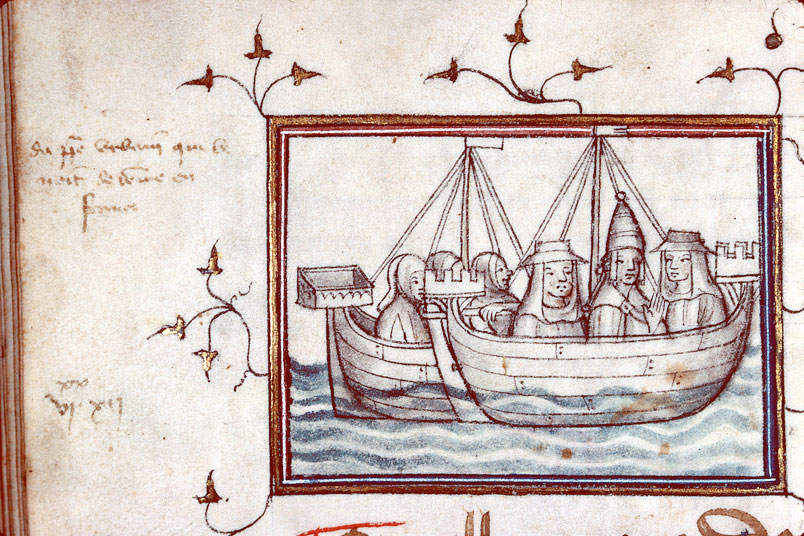
f) as depicted (with two cardinals; going by ship toward Rome) in a pen-and-ink drawing in margine in a later fourteenth-century historical miscellany (Avignon, Bibliothèque-Médiathèque Municipale Ceccano, ms. 1348, fol. 96v):


Mis-en-page:
http://tinyurl.com/28n7awl

g) as depicted (holding a paten bearing miniature busts of St. Peter and St. Paul) in a remounted late fourteenth-century fresco in the chiesa di Santa Maria della Croce (a.k.a. chiesa di Casaranello) at Casarano (LE) in Apulia:


h) as depicted (at far left, enthroned; second from left, King Peter I of Cyprus; at centre, Florimont de Lesparre making his apologies to the king) in a late fourteenth-century copy of Guillaume de Machaut's La prise d'Alexandrie (c. 1380-1395; Paris, BnF, ms. Français 9221, fol. 235v):
http://gallica.bnf.fr/ark:/12148/btv1b6000795k/f494.item.zoom

i) as depicted (with two cardinals; going by ship from Rome to Avignon) in a late fourteenth-century copy of Bernard Guidonis' Fleurs des chroniques (after 1384; Besançon, Bibliothèques municipales, ms. 677, fol. 102v):


j) as depicted (holding a tablet with bust-length portraits of Sts. Peter and Paul) in a probably late fourteenth-century fresco in the chiesa di San Francesco in Terni:


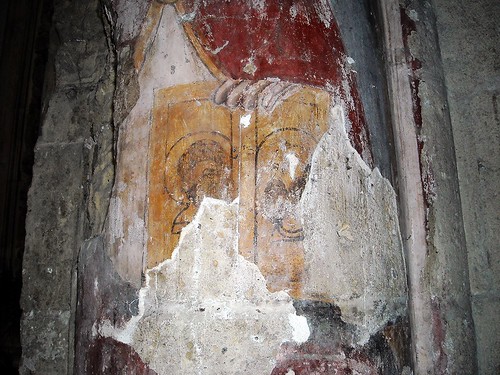
k) as depicted (holding a diptych with bust-length portraits of Sts. Peter and Paul) in a badly degraded probably late fourteenth-century fresco in the chiesa di Sant'Eligio Maggiore in Naples:


Detail view of the diptych of SS Peter and Paul:
http://farm6.static.flickr.com/5506/14455126726_906d5fbbdd.jpg

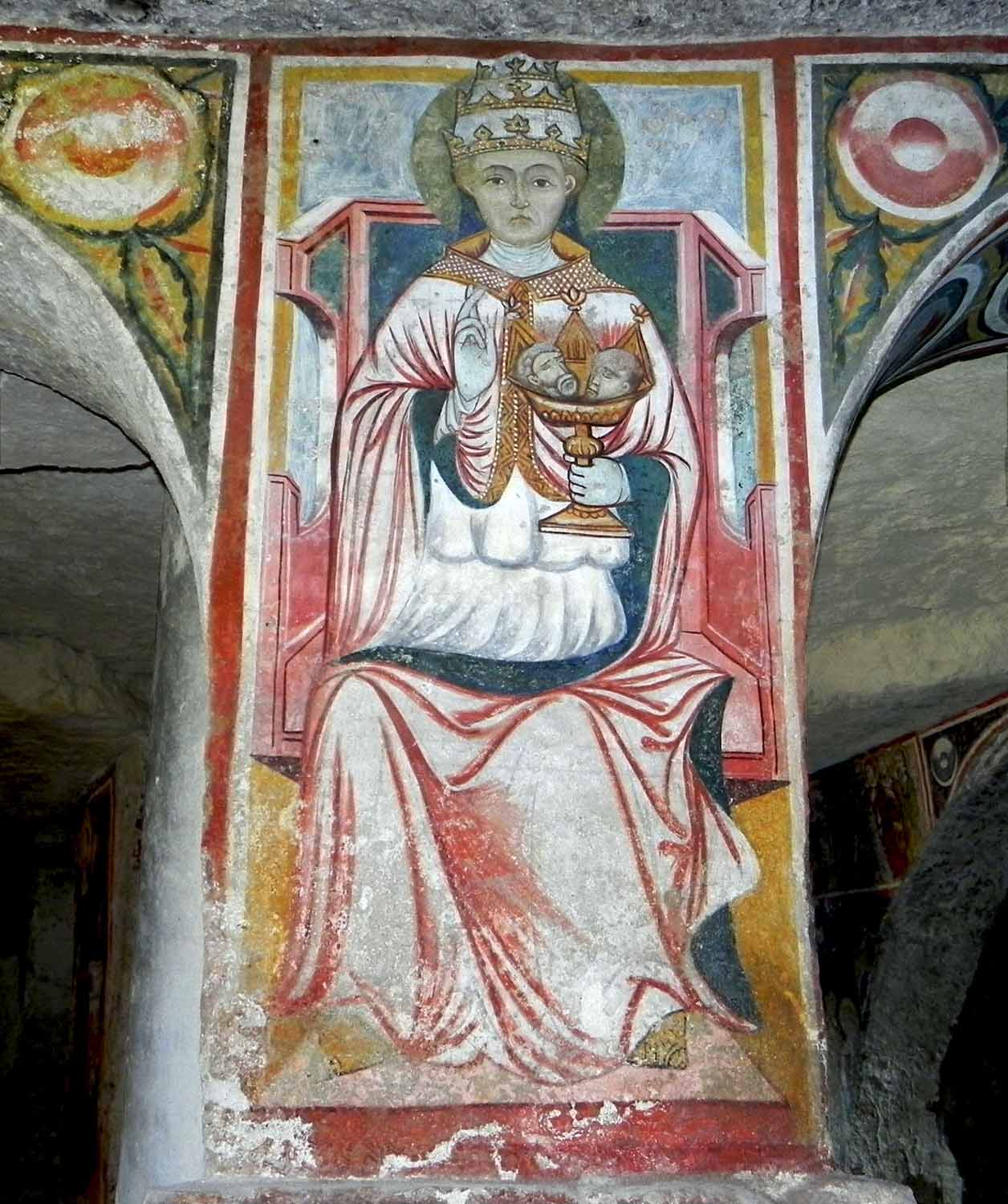
l) as depicted (holding a chalice containing miniature heads of Sts. Peter and Paul) in the late fourteenth- or early fifteenth-century frescoes of the rupestrian chiesa / cripta di Santa Croce ai Lagnoni in Andria (BT) in Apulia:


m) as depicted in an earlier fifteenth-century copy from Köln of the Vaticinia de summis pontificibus (c. 1401-1425; Paris, BnF, ms. Latin 10834, fol. 5v):


n) as depicted (holding a book surmounted by miniature busts of St. Peter and St. Paul) in an early fifteenth-century panel painting (c. 1410), seemingly of Italian origin, in the chapelle Saint-Privat in Mende's cathédrale Notre-Dame-et-Saint-Privat:


o) as depicted in an earlier fifteenth-century copy from northern Italy of the Vaticinia de summis pontificibus (c. 1410-1415; Kremsmünster, Stiftsbibliothek, Hs. CC Cim. 6, fol. 7r):

Vaticinium 13


p) as depicted in an earlier fifteenth-century copy from Florence of the Vaticinia de summis pontificibus (c. 1426-1450; London, BL, MS Harley 1340, fol. 7r):
http://www.bl.uk/catalogues/illuminatedmanuscripts/ILLUMINBig.ASP?size=big&IllID=51685

q) as depicted in an earlier fifteenth-century copy from Umbria of the Vaticinia de summis pontificibus (before 1431; Paris, BnF, ms. Nouvelle acquisition latine 2130, fol. 8r):


r) as depicted (at right; at left, St. Birgitta of Sweden) by Johannes Rosenrod in an earlier fifteenth-century fresco (1437) in Tensta kyrka, Tensta (Uppsala län):


Wednesday, 11 November 2015

Lateran IV


Today marks the 800th anniversary of the opening of the Fourth Lateran Council. Opened by Pope Innocent III on November 11th 1215 it closed on the following November 30th and was, of course, one of the most significant of General Councils of the Catholic Church.

 https://upload.wikimedia.org/wikipedia/commons/0/05/Innozenz3.jpg

Pope Innocent III
The best known contemporary image of the Pope. 
I have seen it suggested that his pallium is conciously depicted in an archaic manner, and that in fact he would have worn it as it is today.

Image: wikipedia

Attended by 71 Patriarchs and metropolitans ( Archbishops ), 412 Bishops and 900 Abbots and Priors it passed seventy decrees, decrees which have shaped belief and practice ever since.


https://6de66d01811c9fba4e731ad0be3310f4246bac27.googledrive.com/host/0B2kKrwK1SsX0YVV2NU00RjJac2s/images/LateranIVsmall.jpg

  Lateran IV in session by Matthew Paris

Image:lateraniv.com
Pope Innocent appears to have seen the Council not as an end in itself but very much as equipping the Church for mission and expansion, for deepening the spiritual life of the faithful and for unity and the crusade.

Whether it fulfilled his hopes may be open to discussion but it certainly defined the Church as it was to be in the High and Late Middle ages. In the sixteenth century it was the point of reference for much of the debate between critics and defenders of what was then the established order.

There is an online introduction to the Fourth Lateran Council at  Fourth Council of the Lateran

The Council's profession of faith is here:

Chapter I. The Catholic Faith
Firmly we believe and we confess simply that the true God is one alone, eternal, immense, and unchangeable, incomprehensible, omnipotent and ineffable, Father and Son and Holy Spirit: indeed three Persons but one essence, substance, or nature entirely simple. The Father from no one, the Son from the Father only, and the Holy Spirit equally from both; without beginning, always, and without end; the Father generating, the Son being born, and the Holy Spirit proceeding; consubstantial and coequal and omnipotent and coeternal; one beginning of all, creator of all visible and invisible things, of the spiritual and of he corporal; who by His own omnipotent power at once from the beginning of time created each creature from nothing, spiritual, and corporal, namely, angelic and mundane, and finally the human, constituted as it were, alike of the spirit and the body. For the devil and other demons were created by God good in nature, but they themselves through themselves have become wicked. But man sinned at the suggestion of the devil. This Holy Trinity according to common essence Undivided, and according to personal properties distinct, granted the doctrine of salvation to the human race, first through Moses and the holy prophets and his other servants according to the most methodical disposition of the time.
And finally the only begotten Son of God, Jesus Christ, incarnate by the whole Trinity in common, conceived of Mary ever Virgin with the Holy Spirit cooperating, made true man, formed of a rational soul and human flesh, one Person in two natures, clearly pointed out the way of life. And although He according to divinity is immortal and impassible, the very same according to humanity was made passible and mortal, who, for the salvation of the human race, having suffered on the wood of the Cross and died, descended into hell, arose from the dead and Ascended into heaven. But He descended in soul, and He arose in the flesh, and He ascended equally in both, to come at the end of time, to judge the living and the dead, and to render to each according to his works, to the wicked as well as to the elect, all of whom will rise with their bodies which they now bear, that they may receive according to their works, whether these works have been good or evil, the latter everlasting punishment with the devil, and the former everlasting glory with Christ.
One indeed is the universal Church of the faithful, outside which no one at all is saved , in which the priest himself is the sacrifice, Jesus Christ, whose body and blood are truly contained in the sacrament of the altar under the species of bread and wine; the bread (changed) into His body by the divine power of transubstantiation, and the wine into the blood, so that to accomplish the mystery of unity we ourselves receive from His (nature) what He Himself received from ours. And surely no one can accomplish this sacrament except a priest who has been rightly ordained according to the keys of the Church which Jesus Christ Himself conceded to the Apostles and to their successors. But the sacrament of baptism (which at the invocation of God and the indivisible Trinity, namely, of the Father and of the Son and of the Holy Spirit, is solemnized in water) rightly conferred by anyone in the form of the Church is useful unto salvation for little ones and for adults. And if, after the reception of baptism anyone shall have lapsed into sin, through true penance he can always be restored. Moreover, not only virgins and the continent but also married persons pleasing to God through right faith and good work merit to arrive at a blessed eternity.

Source: catholicism.org

All the Canons can be read in translation or summary on the Fordham Medieval Sourcebook pages at Lateran IV - Internet History Sourcebooks Project

http://imageweb-cdn.magnoliasoft.net/bridgeman/fullsize/xir177147.jpg

Pope Innocent III
The other surviving contemporary portrait. A mosaic in the Basilica of St John Lateran,
and which depicts the pallium as worn in succeeding centuries.

Image:likesuccess.com

Image:

Tuesday, 9 November 2010

Feast of the Dedication of the Lateran Basilica


Today is the feast of the Dedication of the Lateran Basilica - the Mother and Head of All Churches of the World.

http://upload.wikimedia.org/wikipedia/commons/a/a2/Lateran_basilica.png

The eighteenth century facade

There are Wikipedia accounts of the basilica here and of the adjoining palace here.

As a liturgical feast today emphasises and is a sign of our unity under the jurisdiction of the Bishop of Rome, whose cathedral it is.

http://0.tqn.com/d/goitaly/1/0/x/6/-/-/basilica-st-john-lateran-8.jpg

The apse and the throne of the Pope


Historically, as the first church built with the sanction and encouragement of the Emperor Constantine after the battle of the Milvian bridge and the edit of Milan, it links in a very tangible way the Church today to that of the era of Constantine and the Peace of the Church.

As a building which has, inevitably, been added to, extended, rebuilt and repaired over the centuries, and has witnessed centuries of papal use - it was the principal residence of the Popes until 1303 - it illustrates the concept of the development of doctrine within the continuing unity of the Church in its very construction and fabric. A living stone, ever old, ever new, the ecclesia semper reformanda.

http://www.a-1associates.com/Photo%20Essays/Italy/St%20John%20Lateran/9.jpg

The High Altar.

Within the canopy are preserved what are believed to be the heads
of SS Peter and Paul