Once I was a clever boy learning the arts of Oxford... is a quotation from the verses written by Bishop Richard Fleming (c.1385-1431) for his tomb in Lincoln Cathedral. Fleming, the founder of Lincoln College in Oxford, is the subject of my research for a D. Phil., and, like me, a son of the West Riding. I have remarked in the past that I have a deeply meaningful on-going relationship with a dead fifteenth century bishop... it was Fleming who, in effect, enabled me to come to Oxford and to learn its arts, and for that I am immensely grateful.


Showing posts with label St Edmund cult. Show all posts

Thursday, 20 November 2014

More on St Edmund


Cate Gunn posted a piece about St Edmund on the Medieval Religion discussion group today which I thought might interest my readers. I have slightly adapted it:


Edmund was born about 840/841 and elected king of East Anglia aged 14.  It is believed he was crowned on the hillside at Bures, overlooking the beautiful Stour valley . He was renowned for his piety in his personal life, and desire for justice. He led the defence of his Christian realm against the Danish chiefs Hinguar and Hubba; Hinguar laid his land waste and killed the people ‘men, women and innocent children’ (according to the account from Alefric’s Lives of Saints translated by Anne Dineen); Edmund refused to defile his hands with Hinguar’s blood but ‘mindful of his Saviour’ he discarded his weapons and imitated Christ’s example. In order to save his people, he submitted to the invaders; he was ‘bound and humiliated and beaten with sticks. Soon the King was taken to a tree rooted in the ground and tied and was beaten there with whips for a long time; and he always, between the beatings, called with true faith to Christ the Saviour. Then, because of his faith, the heathens became made angry, for he called on Christ to help. They shot him then with arrows, as in sport, until he was all covered with arrows like a hedgehog’s bristles, as Sebastian was.’  Finally his head was chopped off. Other sources suggest that he may have had the ‘Blood Eagle’ carved on his back.  This martyrdom is supposed to have occurred on 20th November 869/70, maybe at Hoxne in Suffolk.

When his men went later to recover his body, they couldn’t find his head; eventually it was found guarded by a wolf, who surrendered it and followed the procession to the grave in Heglesdune wood.  Years later the body was removed to Beodricksworth [variously spelt] where a church was built, later to become the great abbey of Bury St Edmunds. When Edmund’s coffin was opened the body was found to be incorrupt and the head reattached to the body, with only a thin red mark round the neck.

Edmund’s shrine was guarded by the Benedictine Ailwin, but when, around the year 1010 there was fresh trouble, the body was moved to London for safety, where it rested in St Gregory’s church. At this time, the martyr’s fame increased; when peace returned Ailwin wanted to take the body back to Suffolk, but Alphun, Bishop of London, planned to retain it and take it instead to St Paul’s. Edmund, however, seemed to have other ideas, and the coffin became too heavy to move until Alphun relented and Ailwin was able to leave London with the body in procession. All along the route people turned out to offer respect to the martyr, and were rewarded with miracles of healing.

Edmund’s body was returned in 1013, and last year a pilgrimage followed the route from London to Bury St Edmunds to celebrate the 1000th anniversary.

Edmund’s cult is discussed in the essays in St Edmund, King and Martyr: Changing Images of a Medieval Saint, ed. by Anthony Bale, published York Medieval Press/Boydell & Brewer 2009.

Modern statue of St Edmund by Dame Elizabeth Frink outside the west front of the abbey

Image;eadt.co.uk


St Edmund and his abbey


Today is the feast of St Edmund, King and Martyr. My post from 2010 about him can be read at St Edmund, and there is a good online account of him and his cult, and the possible whereabouts of relics, together with a useful set of links and discussion, and a good bibliography here.


Stedmundcrownedbyangelspierpontms736f42.jpg

St Edmund crowned by Angels
From a Bury St Edmunds manuscript of circa 1130
Pierpoint Morgan Library New York

Image: Wikipedia

Traditionally said to have been martyred at Hoxne his shrine church was, of course, at Bury St Edmunds, where it was served by a major Benedictine foundation until 1539.

There is a very detailed year by year history of the abbey and its lands at the St Edmundsbury Chronicle site.

I have posted about the twelfth century ivory cross, now in New York, which is believed to have been made for the abbey in The Bury St Edmunds Cross.

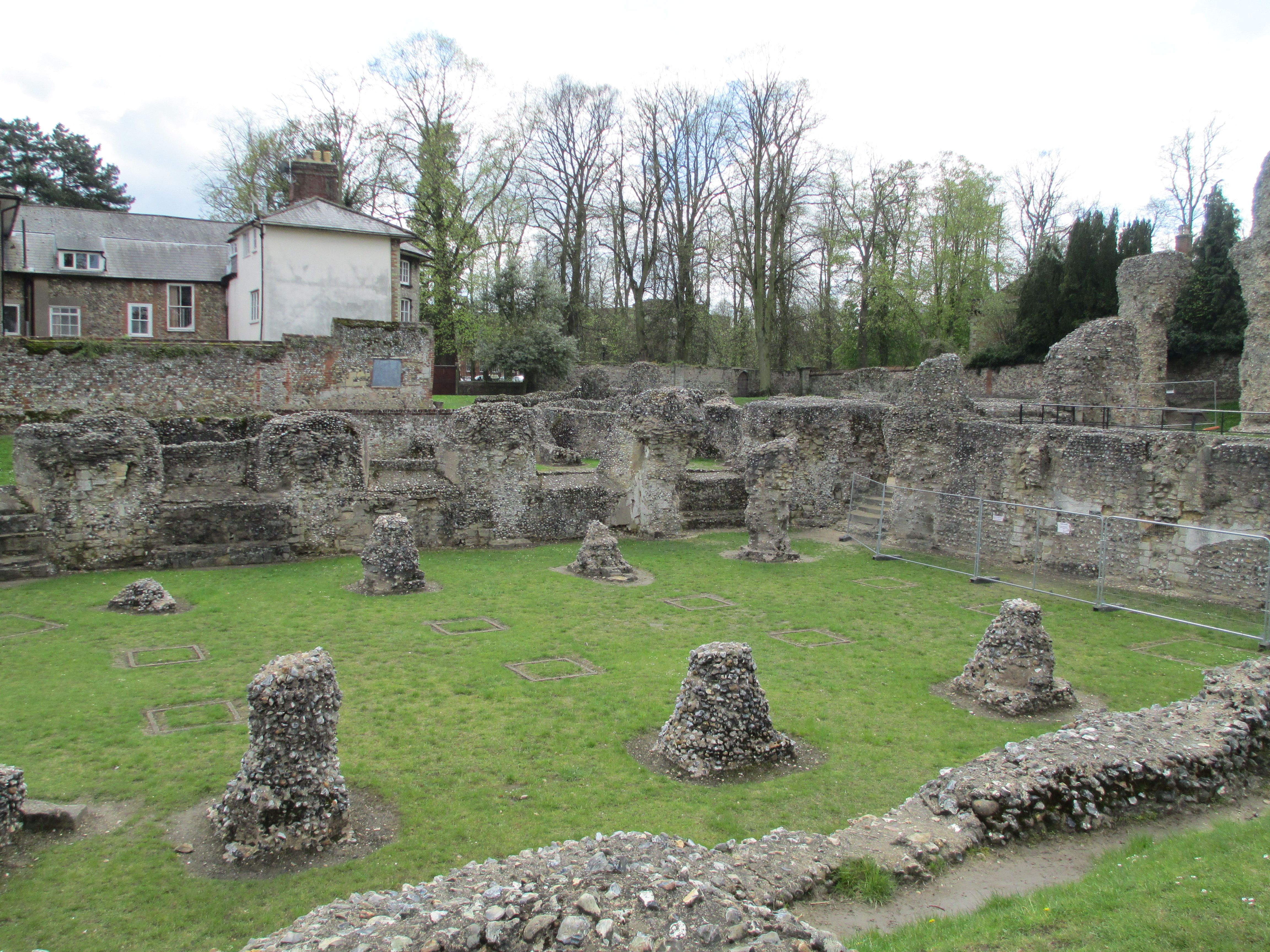
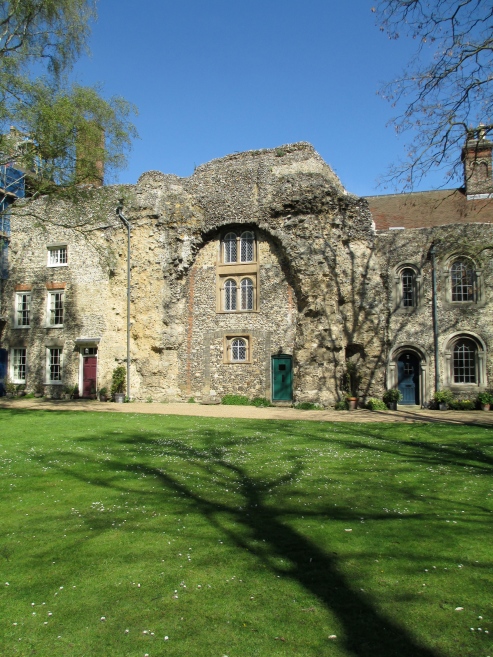
The loss of the great church at Bury is agreat and irreparable loss, and all that survices today are foundations and pieces of rubble core - in an area short of ashlar the nasonry was doubtless quickly recycled. A portion of the west front remains, incorporated into later houses. The sheer scale of destruction is shocking and awesome.


Bury St Edmunds abbey today - the view from the east
At the rear is the splendid tower from 2000 of the Anglican cathedral

Image:Wikipedia

bury st 5

One of the more substantial pieces of rubble core walling

Images:historicalragbag.wordpress.com


bury st 3

The crypt which lay under the sanctuary and choir from the north-east

Image: historicalragbag.wordpress.com


The overall design looks to me to owe a lot to the great abbey at Cluny, both in its plan and its massing of the structure and the towers, not least the octagonal ones on the west front - very reminiscent of the transeptal ones at the Burgundian abbey. The central western tower and the apsidal chapels recall Ely, and the recessed arches Lincoln, and were a feature reinterpreted at Peterborough in the fourteenth century.

bury st8


bury st door

The remains of the west front of the abbey church

Image: historicalragbag.wordpress.com


One building that has survived the destruction of the abbey is the Norman Tower. It was built 1120-1148 and was designed to be both a gateway to the abbey church and a belfry for the church of St James next door, and to which it still serves as a bell tower. It was funded by Abbot Anselm instead of a pilgrimage to Santiago de Compostella. It is a tantalising view of what the whole church must have been like.


bury st 7

The Norman Tower
To the left is the present cathedral, and the remains of the west front of the abbey church can be seen to the rear on the right

Image: historicalragbag.wordpress.com

To envisage the complete abbey does, then, require the work of historians, archaeologists and architects as well as artists.


A model in the abbey grounds at Bury St Edmunds showing the abbey in its earlier phase, before the collapse of the west tower in 1430-31 and its subsequent rebuilding
The present cathedral is the church to the immediate north-west of the abbey in the rear centre

Image:bystargooseandhanglands.blogspot.co.uk


The model from the sourtth-east

Image nigelpurdy.co.uk


http://www.stedmundsburychronicle.co.uk/abbey/churchc16plan.jpg

A plan by A.B. Whittingham of the abbey church at the time of the Dissolution

Image:stedmundsburychronicle.co.uk

There is a virtual reconstruction of the abbey in a Virtual Reality model created in 1998. This can be accessed here and following the links should enable readers to view it. This shows the abbey church as first completed, and is good for the exterior. The interior is less convincing, especially as, for some reason, it aligns the shrine north-south. not east-west.

The late thirteenth century Lady Chapel to the north of the choir - in asimilar position to those at other great East Anglian Benedictine houses at Ely, Peterborough and Ramsey - may have looked somwhat like St Etheldreda's Holborn, the choir of Merton Chapel in Oxford or the nave of York Minster.

In 1430 Abbot Samson's central tower over the west front of the great church collapsed. It came down over a period of days as firstly only the south side fell. Then came the east side, but great jagged parts of the north and west side would stand for the next year or so before rebuilding could begin. The Abbot, William Curteys, blamed the negligence of previous sacrists and the excessive ringing of the bells. M.R. James wrote in 1895 that the two collapses were a year apart, the south side falling in December 1430, and the east side falling in December 1431. In 1432 the tower was taken down and rebuilt. Unfortunately its design appears unrecorded - was it a reconstruction or a new design?

Then in Jaunuary 1465 the roof of the church caught fire when workmen left their leadpans unattended during their morning break. The central tower spire fell in and the choir was burned out. Again the nature and appearance of the repair is unrecorded.

http://www.stedmundsburychronicle.co.uk/Chronicle/1066-1216pics/wfrontmod.jpg

A modern reconstruction of the west front of the abbey as it may have appeared from the mid-fifteenth century

Image: stedmundsburychronicle.co.uk


http://www.stedmundsburychronicle.co.uk/Chronicle/1216-1539pics/Abbey1415.jpg

A reconstruction of Bury St Edmunds in the later middle ages

Image:stedmundsburychronicle.co.uk


Despite its destruction the abbey still looms as a ghostly presence over this very attractive market town, and the cult and story of St Edmund are clearly still promoted by the churchand teh local authority.

In addition Bury now possesses in the cathedral of the diocese of St Edmundsbury and Ipswich, created in 1914, and using the medieval church of St James, which lies adjacent to the remains of the west front, a noble church. Of all the twentieth century cathedral extensions in England this is by far the best, a delicate and subtle set of additions to this very late medieval Perpendicular building. Designed by Stephen Dykes-Bower it comprises transepts, a new choir and finally a central tower (paid for by the bequest of the architects estate in 2000 as a Millenium project), plus a cloister and cathedral hall including some Victorian work that was removed to extend the building. Scholarly and thoughtful, respectful of its setting, and very far indeed far from the cheap-looking and nasty extensions of some other Anglican cathedrals, it is a beautiful and prayerful creation, and very well worth going to look at.


Saturday, 20 November 2010

St Edmund


Today is the feast of St Edmund King and Martyr.

Edmund (d. 869 or 870). was a king of the East Angles slain in battle against invading Danes. He has very brief notices in the Anglo-Saxon Chronicle (under 870) and in Asser's Vita Alfredi (cap. 33). His veneration as a saint is first documented from coinage of the later ninth and early tenth centuries. Abbo of Fleury's late tenth-centuryPassio of Edmund. (BHL 2392) presents him as a willing victim for his people who sacrifices himself to certain torture and death in order to prevent further bloodshed. Abbo further relates the miraculous Inventio of Edmund's head by Christians who already had his body - the head was found being guarded by a wolf - and his later translation to a splendid church at the royal vill of Beadericesworth which in consequence became known as Bury St Edmunds, with one of the greatest of English Benedictine houses.

In the Pierpont Morgan Library in New York  MS M.736 is a richly illustrated, earlier twelfth-century (ca. 1125-35) miscellany of texts related to Edmund, probably compiled at or for the abbey which held his relics. The catalogue description of the manuscript can be read here. The images can be seen here.

To search the catalogue for descriptions start at http://corsair.themorgan.org/ and click on "Search the catalog". In the next screen enter in the box marked "Find This", limit this search to "Medieval Images only", and click on "Search".

The above paragraphs are adapted and extended from John Dillon's post for today on the Medieval Religion discussion group site.

The Wikipedia entry on St Edmund can be read here.

St Edmund's extensive cult meant that he was a frequent patron of churches and a subject for artists, notably in East Anglia.
The second article on this page is a review of a book on the subject and auseful introduction in itself. Here are two examples in stained glass:

photo

Saxlingham Nethergate, St Mary, Norfolk

Mid-13th century panel showing the Martyrdom of St Edmund. It may have come from the other church in the village, Saxlingham Thorpe, the parishioners of which were told in 1688 to give up their church and come and worship in this church. Here Edmund offers up to heaven the arrows of his martyrdom.

Photo by Gordon Plumb

photo

Holy Trinity, Long Melford, Suffolk

Margaret Peyton, St Edmund with Abbot Richard Hengham 1474-79 kneeling at his feet between Margaret and Thomas Peyton.
Photo by Gordon Plumb


Detail from the Wilton Diptych.

The classic depiction of St Edmund as a royal saint for a royal patron, King Richard II


I think it is to be regretted that St Edmund does not appear in the National Calendar for the Catholic Church in England - perhaps that is something the Anglican Patrimony can help to change. Until the fifteenth century he was a national saint, and after St Edward the Confessor the great royal exemplar. The abbey was a frequent host to medieval monarchs.

There is an account of the abbey itself from Wikipedia here , and the Victoria County History account of the monastery can be read here.

There is a tour of the present remains of the great church, once one of the largest in medieval England, here. It concludes with this reconstruction of the abbey on the eve of the dissolution. In some respects it is, I suspect, a little fanciful, but it does give some idea of the scale of the abbey.

5

In many ways it would have resembled the surviving cathedrals at Ely, Norwich and Peterborough. The later medeval form of the apse may have been similar to what one still sees at Norwich. The great west front is related to those of Ely, Lincoln and Peterborough, and possibly also the remains at Kelso. The basic design of a western tower flanked by octagonal chapels is repeated in the nineteenth century Upper Basilica at Lourdes - though I know of no link between the two to explain the design reappearing sebveral centuries later in another country .

The church had a great number of treasures. One which appears to survive is an ivory altar cross in the Cloisters Museum in New York. The story of its acquisition and identification is discussed in Thomas Hoving's rather awful King of the Confessors; the Wikipedia article about the cross offers auseful critique of Hoving's work and can be read here. It is a tragedy the cross was not saved for the British Museum in 1963 rather than going abroad. That is also true of the Pierpont Morgan manuscript I linked to above - that went in the 1920s.

Writing of tragedy, the abbey was surrendered in 1539 - the last abbot is said to have died shortly afterwards of a broken heart. There was the possibility of utilising it as the cathedral for anew diocese for Suffolk, but that nevwe happened. the body of Henry VIII's sister Mary, sometime, and briefly, Queen of France, and later Duchess of Suffolk, who had been buried in the abbey in 1533 was removed to St Mary's church and the abbey church destroyed - yet another of the catastrophic artistic and cultural casualties of the English "reformation"

The cathedral of the modern Anglican diocese of St Edmundsbury and Ipswich, established in 1914, has been created by extending the late medieval church of St James completed in 1503 immediatedly to the north west of the abbey church. The result, ins in my opinion on eof the best pieces if twentieth century church building. It was designed by Stephen Dykes Bower, whose scholarly gothic-revival style was not always appreciated. When I saw it I was most impressed. Since then, using the bequest made by Dykes-Bower himself, the central tower has been completed to his design and funded in as a Millenium project. It was completed in 2005.


photo

photo

Photos from Flickr by Cliff Vale and M. Taza

When I stayed with my mother in Bury St Edmunds, which we both thought a particularly attractive and stylish as well as historic town, in 1973 we agreed how much we liked the new work in the cathedral, but she said I would doubtless have wanted to rebuild the abbey church. True.