Once I was a clever boy learning the arts of Oxford... is a quotation from the verses written by Bishop Richard Fleming (c.1385-1431) for his tomb in Lincoln Cathedral. Fleming, the founder of Lincoln College in Oxford, is the subject of my research for a D. Phil., and, like me, a son of the West Riding. I have remarked in the past that I have a deeply meaningful on-going relationship with a dead fifteenth century bishop... it was Fleming who, in effect, enabled me to come to Oxford and to learn its arts, and for that I am immensely grateful.


Showing posts with label Portuguese monarchy. Show all posts

Monday, 4 July 2016

St Elizabeth of Portugal


July 4 is the feast of St Elizabeth of Portugal, the Queen of King Denis and who died in 1336, and about whom there is a biography here under her paternal name of Elizabeth of Aragon. Known as isabel in Iberia she was a Franciscan tertiary who was famed as a peacemaker and canonised in the seventeenth century, She has been seen as an exemplar of Queenly and maternal virtues.

The Order of St Isabel (or Elizabeth) was founded by King John VI in 1801 as an award for Ladies and there is an article about it at Order of Saint Isabel.

This was re-established in 1986 by Dom Duarte III with his consort as Grand Mistress of the Order.


Order of Saint Isabel.jpg

The Sash and Badge of the Order of St Isabel

Image:Wikipedia


Saturday, 11 June 2016

Portuguese Monarchists waving the flag


 The pre-1910 flag of the Kingdom of Portugal

Image:MadMonarchist

The Special Correspondent has sent me this link to a Twitter post about a demonstration by Portuguese monarchists in Lisbon yesterday: https://twitter.com/ZsuzsannaKun/status/741663202887520260


https://s-media-cache-ak0.pinimg.com/564x/c8/9b/02/c89b02cebd56d7d6d9b4e953a42b0343.jpg 

The Arms of the Kings of Portugal

Image:pinterest.com


Monday, 9 May 2016

King Joao I of Portugal's Livro da Montaria


Earlier this evening I attended a meeting of the Oxford Bibliographic Society at the Weston Library at which there was a lecture "Lost and Found:The Fifteenth-century Manuscript of  João of  Portugal's Livro da Montaria" which was given by Dr Juan-Carlos Conde of Magdalen College.


King João I

Image: Wikipedia

King João reigned from 1385 until his death in 1433; there is an online biography of him at
John I of Portugal

His family were certainly not lacking in literary and intellectual pursuits, and at some point in the years 1415-33 the Livro da Montaria ( Book of Hunting ) was composed. Hunting was an important part of courtly life, building team spirit, developing skills as horsemen and generally keeping the aristocracy fit.

The tradition of such works was extensive: Dr Conde cited the treatise of Emperor Frederick II on falconry, the writings of Dom Manuel, of King Alfonso XI of Castile's book on hunting and one written by a Castilian prisoner from the battle of Aljubarrotta in the years1385-8 on falconry. The Clever Boy thought also of  The Master of Game on hunting written by Edward Duke of York (d.1415)

King João 's is the most important such book written in Portugal and was in the library of his son King Duarte I. The Royal Library in Madrid has copies from the 14th and 15th century of King Alfonso XI's Libro de la Montaria which were owned by Queen Isabella the Catholic

Of King João's book only two copies were known until recently - one is a late 18th-early19th century copy in the Lisbon National Library and and a Coimbra copy of 1897. They from come from a 17th century copy made in 1626 at the Jesuit college in Montforte de Lemos in Galicia in Spain. In 1990 there resurfaced in the Lisbon Fundacao Oriente what is reasonably certainly a direct copy of the original, and this was published in 2009. In 2010 the copyist of 1626 was identified as Spanish, which explains ceertrain features in the manuscript.

In 2000 at Montforte de Lemos fragments of a medieval manuscript of the Livro were found: this was a page which had been reused to bind notarial records. It was presumed that the rest of the manuscript was lost. This was clearly a presentation copy, and in date quite close to time of composition. There was no proof but this could be part of King Duarte's own manuscript. This page was removed but is to be reunited to the remains subsequently found.

In 2013 more pages were found in the archives at Lugo comprising 10 whole pages, parts of 10 more plus 4 fragments amounting to 30 pages in total. They were binding notarial documents from 1721-61 and the discovery attracted considerable attention in El Pais


All the surviving portions are by the same hand, with related ornamental devices, the remains of a a presentatuion copy with corrections

A 1503 decree of Queen Isabella I regarding notaries was the most important since one of King Alfonso X in the mid -thirteenth century, and was not replaced until 1862. This 1503 decree establishe dthat notaries must keep full copies of their documents in volumes. Most ordinary binding was in parchment, and as printing was coming more and more into fashion, old manuscripts were lost as printed books became more popular, parchment from older works was used to make or bind paper. Thus the Fragmento Roncesvalles survives as one page used as a folder. Other such fragments are of an early novel and in the Alba Library a 10th century page fom S.Luke's Gospel. At Burgos a 12th century folio page similarly survives in the S.Clara archives.With the important text of King Alfonso X's Siete Partidas printed copies replaced manuscript ones.

About a third is now available of the original text of King João, which then makes possible a comparison with the 1626 manuscript copy to see how accurate that is.

As to why there are no more copies Dr Conde pointed out that less survives generally in the way of manuscripts in Portugal.

This was a fascinating historical and bibliographical story - it was just a pity so few people were there to actually hear the lecture.


 The tomb of King João and his Queen Philippa of Lancaster in the abbey at Batalha

Image:heraldica.hypothoses.org


Thursday, 23 October 2014

King Luis I of Portugal


The Mad Monarchist blog often has postings which are biographies of monarchs,including some who are less well known. A recent one which can be read at King Luis I of Portugal, and it brings out the difficulties facing the monarchy by the later nineteenth century. King Luis emerges as awell intentioned ruler, but perhaps lacking the flair of his elder brother. 

The article draws upon illustrative materail in the Portuguese edition of Wikipedia, and is a better account of the King and his reign than the English Wikipedia article.
 

LodewijkPortugal.jpg

King Luis I

King of Portugal and the Algarves 1861-1889

Image:Wikipedia

I posted about his elder brother and predecessor in King Pedro V, the Beloved


Sunday, 4 August 2013

The death of King Sebastian of Portugal


Today is the 435th anniversary of the battle of Alcazarquivir in northern Morocco, and the, presumed, death of King Sebastian of Portugal, who had led the invasion force in 1578. I say presumed because his body was never identified with certainty, and thus was begun the tradition of Sebastianism - looking for the return of the missing King.


Dom Sebastian of Portugal


King Sebastian of Portugal- a portrait from the year before his death

Image;traditioninaction.org


There is an online account of King Sebastian here.

For Portugal the consequences were significant. King Sebastian was 24, unmarried and childless. His closest relative and successor was his great uncle, Cardinal Henry, who reigned for the next two years, and died in 1580 without determining the succession. There is an account of the Cardinal King here. The various claimants at that point and the ensuing conflict are outlined in these online articles Struggle for the throne of Portugal , War of the Portuguese Succession and The Descendants of Manuel I of Portugal.

The successful claimant was to be King Philip II of Spain, whose mother was a Portuguese Infanta and was also uncle to King Sebastian, and who also had asizeavle army to hand. He therefore became King Philip I of Portugal, His son and grandson succeeded him in ruling apersonal union of the two crowns until 1640 when the revolt led by the Duke of Braganza, descended from Duchess Catherine, another claimant in 1580-81, together with her husband who had a claim of his own. The success of the rising led to the Duke becoming King John IV and thereby restoring Portuguese independence.


In the years following Alcazarquivir various claimants presented themselves as King Sebastian, only to be despatched, but the idea of his return persisted in the Portuguese territory Brazil until the eighteenth century.

The idea of the return of a lost national leader whose death is not well attested or occurred in a remote place is well known - there are the stories of King Arthur and the Emperor Frederick Barbarossa sleeping until summoned in the nation's hour of need. Similarly imposters and claimants turn up as with the Princes in the Tower, King Louis XVII or the mysteries surrounding the death of the Emperor Alexander I in 1825 and the fate of the Grand Duchess Anastasia in Russia.

Whilst looking on the internet for background on the events King Sebastian's life I found a very interesting, and indeed thought provoking article - it is an academic study, if not actually a dissertation, by an American historian. I am not sufficiently knowlegeable on the topic to express acritical opinion, but the author makes a good case for their argument and how one might understand the King's reign and his motivation for the invasion that ended in his death. It can be read at


Tuesday, 2 July 2013

The death of King Manuel II


Today is the eighty first anniversary of the sudden death of King Manuel II of Portugal at Fulwell Park Twickenham in 1932. He was 42 and died from a tracheal oedema. I started this post last year to mark the eightieth anniversary but it never got finished, so I am publishing it this year.

After the 1910 revolution the King lived in England, settling at Fulwell Park in Twickenham, near the former  home of members of his mother's family, the house of Orleans. Whilst there he wrote his important history of Portuguese literature, supported national charities during the Great War and was also a patron of the local church at which he worshipped, and leading figure in the local community.

There is an illustrated online biography of the King here, which gives dwertails as to his death and the funeral ceremonies, which inclued the transfer of his body to Lisbon for burial in the Royal Pantheon.

There is a more detailed biography with photographs and a wealth of detail from the blog Unveiling the Portuguese Monarchy  at King Manuel II, "The Patriot".


A photograph of the King taken only hours before his death

Image: Wikipedia

On YouTube I found this video made by a  local reseacher about the King's life at Fulwell and about surviving memorials to his time in Twickenham:


Monday, 6 May 2013

The Acclamation of King Manuel II in 1908


Today is the 105th anniversary of the ceremonial Acclamation of King Manuel II as King of Portugal and the Algarve in 1908. The formal oath taking before the Cortes was, it would appear, very similar in form to the inauguration of the present King of the Netherlands which took place last week. That is to say, it was ceremonial oath-taking before the representitives of the realm, and in the presence of the regalia. No King of Portugal was crowned after 1640 when the newly crowned King John IV, the first monarch of the house of Braganza, bestowed his crown upon the Virgin Mary as true Queen of the realm. The tradition odf anointing and coronation was particularlya feature of the house of Aviz, Kings from 1385/6 until 1580, and deriving from English influences and contacts in the deacades when they established themselves as rulers of the kingdom.


File:SMF Manoel II.jpg

King Manuel II on the day of his Acclamation

At his side are the Crown and sceptre of King John VI. The King is wearing the mantle of King Luis I,
and his Orders include the Collar of the Order of the Tower and the Sword, and the red, green and violet riband of the Three Orders, that is the ancient crusading Orders of Christ, Aviz and Santiago.
 
Image: Wikipedia

File:Mantel of Luís I.jpg

The Mantle of King Luis I, used also by King Carlos I and King Manuel II

Image: Wikipedia

File:Crown of João VI.png

The Crown and Sceptre of King John VI, made in Rio de Janeiro in 1817

Image: Wikipedia

There is more about the Portuguese regalia at the link Portuguese Crown Jewels.

I found on YouTube this very interesting compilation of photographs of the events of the day of the Acclamation in 1908:


Friday, 1 February 2013

Royal funeral ceremonies in Portugal in 1908


I have posted before in Regicide in Lisbon about the assassination of King Carlos I of Portugal and of his son the Prince Royal Luis Felipe on this day in 1908. 

I recently came across this archive film on YouTube of the funeral procession of the murdered King and his heir. The quality is not high by modern standards but it is not only interesting as a record of the day and I was particularly struck by the black hangings on the hearse and the horses drawing it - a survival of a much older practice as depicted in records of royal funerals of past centuries. 


Here is another YouTube video, this time of the centenary commemoration of the murders held at the Royal Pantheon of St Vincent in 2008, with Dom Duarte in attendance:

Saturday, 1 December 2012

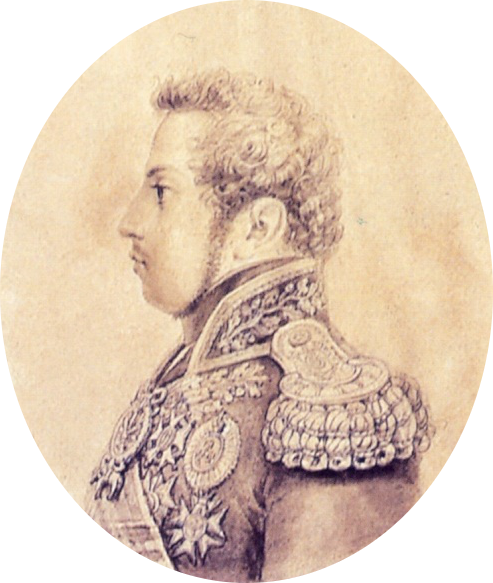
Coronation of Emperor Pedro I of Brazil 1822


Today is the 190th anniversary of the coronation of Dom Pedro I, the first Emperor of Brazil, in 1822.


File:Pedro I Imperador 1823 (crop).png

Emperor Pedro I in 1823

Image: Wikipedia

The Emperor, born in 1798, and the son of King Joao VI of Portugal, was in many ways the architect of Brazilian indepedence, and is still hailed as such. As Regent he had proclaimed Brazil's independence on September 7th 1822, and was acclaimed Emperor on October 12th. In 1826 he was also King Pedro IV of Portugal from March to May in succession to his father before abdicating the throne in favour of his daughter Queen Maria II. In 1831 he abdicated as Emperor in favour of his son Pedro II so as to invade Portugal on behalf of his daughter whose position, and that of the liberal constitionalists was being disputed by Pedro's younger, more traditionalist, brother as King Miguel I. Having secured his daughter's rights he used the title Duke of Braganza, and died in 1834.

There is an illustrated online biography of the Emperor and his remarkable career here.

The crown used for his coronation was made quickly and in 1841 replaced with a new one for the coronation of Emperor Pedro II, as detailed here.

The fact of their being a Brazilian coronation is in itself interesting. The parent monarchy in Portugal had abandoned the ceremony with the accession of King Joao IV in the successful revolt for independence against King Philip III ( IV of Spain ) in 1640. King Joao had then proclaimed the Virgin Mary as Queen of Portugal.

The coronations of both the reigning Emperors of Brazil, and indeed the fact that the present Portuguese crown was made in Rio de Janeiro during the long residence of King Joao VI there as an exile from the Peninsular War, points perhaps to a romantic revival in such ceremonial and an appreciation of its value in the early nineteenth century.

Saturday, 24 December 2011

Another regal anniversary


Last year we saw the thirty-fifth anniversary of the accession of the King of Spain to the throne, and this year has seen the twentieth anniversary of the King of Norway and the thirtieth of the Queen of the Netherlands, whilst this coming new year will witness the fortieth anniversary of the Queen of Denmark and, of course, our own Queen's Diamond Jubilee. With these in mind perhaps one can spare a thought and a prayer for the de jure King of Portugal who today marks the thirty-fifth anniversary of his father's death and his inheritance of the claim to the throne. Dom Duarte III and the Portuguese people deserve better than the present situation of the country offers.

Dom Duarte's website can be seen at Portuguese Monarchy, and there are other sites devoted to the history of the Most Faithful Kings at Real Familia Portuguesa and at Unveiling the Portuguese Monarchy.

Friday, 11 November 2011

King Pedro V, the Beloved


Today is 150th anniversary of the death of King Pedro V of Portugal in 1861. He died of cholera at the age of only 24, and his death was to be within days or weeks of those of two of his younger brothers. The son of Queen Maria II and her King-consort husband Ferdinand of Saxe-Coburg he was thus related to the Coburg network of the royal families of Europe. He succeeded his mother as King in 1853, aged 16, and until his majority his father acted as regent until 1855.

http://www.royalcollection.org.uk/egallery/images/collection_large/421642.jpg

The future King Pedro V as Prince Royal and Duke of Braganza

Image:royalcollection.org.uk

There is a biography of the King here , and an excellent, much more detailed one with a fine selection of illustrations here.

http://image2.findagrave.com/photos250/photos/2004/294/9687760_109842793214.jpg

State portrait of King Pedro V

Image: findagrave.com

http://www.bidviews.com/howardki/hportucorc.jpg

A description of the King's oath taking in 1855

Image:cgi.ebay.com

His marriage to his short-lived Queen Stephanie of Hohenzollern has produced no children before her premature death in 1859 and he was to be succeeded by his brother, King Luis I.


King Pedro V in his early years as monarch

Image: Wikipedia
http://images.ookaboo.com/photo/s/Pedro_V_de_Portugal_s.jpg

King Pedro V in later years

Image:ookaboo.com

The death of King Pedro was not only a personal tragedy, but may have been one for the Portuguese monarchy. Just as his mother had been apopular ruler so King Pedro was both popular and dedicated to his people and improving the life of the nation - very much a Coburg trait. He became known as Pedro the Beloved. Had he lived longer and continued on the path that appears to have been in his mind there might have been an avoidance of the national decline that occurred under King Luis I and King Carlos I and enabled forces opposed to the monarchy and traditional life to blame the Crown and argue, disastrously, for change.

Tuesday, 8 February 2011

Monarchy - past, present and future?


The Mad Monarchist is a blog I like to keep up with. Today he has an interesting reflective piece of the anniversaery of the beheading of Mary Queen of Scots in 1587 and the implications of the manner of her condemnation. I have added a comment of my own on his site, and you can read his article here.

At the end of last month he had a piece which links in with my post a week ago about the Regicide in Lisbon. It is about the success of the Monarchist movement in Portugal in encouraging abstention in the recent election of a new republican head of state. His post can be read here.


Tuesday, 1 February 2011

Regicide in Lisbon


To day is the anniversary of the assassination of King Carlos I and the Prince Royal Luis Felipe in Lisbon in 1908.

File:L'attentat de Lisbonne.jpg

A contemporary artist's impression of the assassination and Queen Amelie using her bouquet to strike at the killers.
.
Photo: Wikimediacommons


The dreadful events of that February day and the background to the attack on the monarchy as an institution are described  here. There are also online biographies of the King and the Prince Royal.

As I have written before the overthrow of the monarchy in Portugal two and a half years later did nothing to resolve the problems of a country facing the challenges of a changing world. By removing the institution which had created the country and represented its independence, and which, of its very nature, should and could command loyalty and be a focus for stability Portugal was fated to years of revolution, instability, authoritarianism, more revolution, and continuing relative decline. The overthrow of the monarchy was followed by attacks on the Church - this was the political background to the visions at Fatima. What happened in Portugal in those years was a foretaste of what was to happen later in many other European countries, and never to their betterment.

Fidelity to the cause of the monarchy remains strong in the country, and today tends to be a focal point, with Requiem Masses being celebrated for the King and Prince. It is perhaps similar in spirit to English commemoration sof King Charles I.

Three years ago to mark the centenary of the murders I arranged a Requiem in the Extraordinary Form for them here in Oxford.

Thanks to one of my registered Followers, Francisco, I discovered the very impressive blog Real Familia Portuguesa which has a great deal about the assassinations and their commemoration, as well as about the Monarchist movement in Portugal and the Braganza family today. It also has an excellent  series of links to other related blogs. It has an automatic English translation, with the attendent curiosities of style, but that is easily adjusted to.

Saturday, 22 January 2011

St Vincent


Today is the feast of St Vincent of Saragossa, a deacon martyred in the early part of Diocletian's persecution.

He is venerated as the patron of Lisbon, where there survives the St Vincent Panels, a wonderful set of paintings of the veneration of the saint by representitives of the realm of Portugal and dated to the 1460s. It is attributed to the artist Nuno Gonçalves who was working in the years 1450-71. The six panels include some sixty portraits of the leading figures in the life of the kingdom under King Duarte I and King Afonso V. In recent years there has been considerable scholarly debate about the identification of the figures in the painting and there is a good, illustrated, account here.

File:Painéis de São Vicente3.jpg

One of the two central panels depicting St Vincent.

He is flanked by King Duarte I and his Queen Eleanor of Aragon, with King Afonso V and his Queen Isabella of Coimbra kneeling in front with their son, the future King John II on the right.

The panels are a marvellous record of the men and women who shaped Portugal's destiny as it embarked on its great era of expansion, encouraged by Dom Henry the Navigator who appears n the panals, and also of the ruling elite of mid-fifteenth century European kingdom.


Wednesday, 6 October 2010

Portuguese postscript

In the light of my previous post you will not be surprised to learn that last night, to mark the anniversary, a friend and I went off and drank to to the health of Dom Duarte III and the cause of the Portuguese monarchy.


TRH the Duke and Duchess of Bragança,
D. Duarte and D. Isabel,
the de jure King and Queen of Portugal

The website of the Royal house can be found at Portuguese Monarchy

Monday, 4 October 2010

Nothing to celebrate

October 4th-5th is the centenary of the 1910 revolution in Portuga1 which led to the exile of the monarchy and established a republican regime. Doubtless there will be celebrations as October 5th "Republic Day" is the current national day in Portugal.

I would venture to suggest that there is nothing for the Portuguese to celebrate and a great deal for them to regret in this anniversary, when the nation repudiated the institution that had created it eight centuries earlier.

There is a biography of King Manuel II, who was forced into exile, here.

View Image

King Manuel II in robes of state with the crown of King John VI


A colour version of the above portrait. The King is wearing the riband of the Three Orders - the three ancient crusading Orders of of Aviz (green), Christ (red) and Santiago (purple) - and the collar of the Order of the Tower and the Sword, founded by King Afonso V in the fifteenth century


No one could deny that Portugal at the beginning of the twentieth century faced serious problems as a nation. Overthrowing the monarchy and the traditional order appealed to some as a solution; they appear to have been influenced by the example of the French Third Republic. This was, of course, patently wrong as a solution, and not the answer to the issues facing the country. In 1908 King Carlos I and the Prince Royal Luis Felipe were assassinated in Lisbon and King Manuel narrowly escaped the death in the same attack. There is a good account of the background and the murders here.There are also online biographies of the King and the Prince Royal. This was a clear example of that terrible tendency to resort to violence to attack and destroy the established order that culminated in the Sarajevo assassination in 1914.

In 2008, when the Lisbon government forbade participation in commemorations of those terrible events of representitives of the state and the armed forces, it was left to the Royal House to recall the King and Prince. Incidentally on the anniversary I arranged a Requiem Mass in the Extraordinary Form for them here at the Oratory in Oxford.

Now clearly one can ask who would want to be ruled by regicides or their allies. After the 1910 revolution - more a coup by disaffected members of the military and their radical allies - there were a series of left wing, radical, anti-clerical governments, political instability and coups, and attempts to restore the King. This is the backbround to the apparitions at Fatima in 1917, when the Portuguese church was under attack. From 1928, and certainly from 1932 until 1974 there was Salazar's Estado Novo. Now I can see that the underlying cobncept of applying Catholic social teaching as a basis for government has much to commend it, but as an actual system it became unresponsive to a world that was changing, and lacked the mechanism to achieve peaceful change and development. The result was that change with the 1974 revolution led to a return to political radicalism and instability in the period 1974-6 indeed the real fear of a communist takeover. Post 1976 the country has become part of the EU and followed the contemporary European paths of relativism and pseudo liberalism.

The obvious contract is with its immediate neighbour Spain. There the rstoration of the monarchy in the constitution in 1947 meant that after 1975 it could as an institution articulate the national mood, and achieve a successful transition and development. That is not to say I agree with all that has been done in terms of social policy in Spain in recent years; it is to say that Spain has managed successfully to blend its historic institutions and nature with a world that continues to change.

The failure to reinstate the monarchy underlies many of the instabilities of Portuguese politics. Thus even in 1910 the arms of the state remained oin a new nationalflag of conciously partisan, republican design as here. Since the 1920s the country has, whilst remaining a republic, displayed an ambivalent attitude to the Monarchy. Thus King Manuel's body was returne din 1932 with full honours and buried in the family vault, and in the following years the then President had two ADCs - one republican, the other monarchist. Several of the chivalric orders of the monarchy were restablished (with slightly changed insignia). There was talk of a restoration under Salazar, and the law of exile revoked. In that era the Monarchist party was the only political novement that was permitted other than the government party. This ambivalence has continued since 1974 - thus when the Duke of Braganza and claimant to the throne, D. Duarte Pio married in 1995, the guest of honour was the President of the Republic and the ceremony was carried live in television - despite attempts to disrupt coverage by leftists. Today Dom Duarte acts and can be seen as a representitive of the country.

A hundred years on from the events of 1908-10 I am firmly of the opinion that the loss of the monarchy was a loss, a catastrophic loss for Portugal. As a nation it needs to return to the roots whence it is sprung. Rather than celebrating the revolution of 1910 it should undo the damage and restore the Monarchy.

The Mad Monarchist has a pair of linked articles on the events of 1910 and their aftermath here.

Monday, 12 April 2010

Making a Real vexillogical point


The Mad Monarchist has a heartening story from Portugal about a peaceful protest in this centenary year of the forcing into exile of King Manuel II. Now hauling down one flag and replacing it with another may not be that dramatic - though reasonably so given the location in the cases cited - but it does indicate a youthful bravado and exhuberance that seems to bear witness to the fact that there appears to considerable support amongst young people in Portugal for the Monarchist cause.