Once I was a clever boy learning the arts of Oxford... is a quotation from the verses written by Bishop Richard Fleming (c.1385-1431) for his tomb in Lincoln Cathedral. Fleming, the founder of Lincoln College in Oxford, is the subject of my research for a D. Phil., and, like me, a son of the West Riding. I have remarked in the past that I have a deeply meaningful on-going relationship with a dead fifteenth century bishop... it was Fleming who, in effect, enabled me to come to Oxford and to learn its arts, and for that I am immensely grateful.


Showing posts with label Fatima. Show all posts

Sunday, 13 May 2012

Our Lady of Fatima


I suspect a lot of parishes are holding their May Devotion to Our Lady today on what would otherwise be the freast of Our Lady of Fatima, and on the 95th anniversary of the first apparition of Our Lady in the Cova de Iria in 1917.

http://wordincarnate.files.wordpress.com/2010/10/our-lady-of-fatima-11.jpg

Our Lady of Fatima

wordincarnate.wordpress.com

The message Our Lady delivered at Fatima was to a revolution afflicted country in a war-torn world, but it is one equally applicable to the circumstances of the present time. To turn to Christ in a spirit of repentance should be our response to the diverse and complex series of problems which confront the world today.
In particular the message of Fatima seems profoundly bound up with the survival of Christian European civilisation, and that is an issue with which we should indeed be concerned.
Our Lady of Fatima pray for us!


Thursday, 13 October 2011

The Miracle of the Sun


Today is the anniversary of the Miracle of the Sun at Fatima in 1917 and I am sharing an advertisement I received today from that excellent organisation Aid to the Church in Need about the latest film about the Fatima apparitions. I have not so far seen this film, although I did successfully recommend it for the DVD loan collection of the Oxford Union Library.

Aid to the Church in Need is pleased to offer the inspiring film Fatima The 13th Day - A Story of Hope at a bargain price!

Written and directed by Ian and Dominic Higgins, the film retells the story of the young seers at Fatima, bringing alive the events of May to October in 1917.

On this day 94 years ago, people descended on the Cova da Iria in Portugal to witness a miracle - known as the Miracle of the Sun - that the children had been told to preach by Blessed Mary.

Many pilgrims went barefooted, reciting the Rosary as they went, when the miracle occured as promised.

Archbishop Vincent Nichols of Westminster called the award-winning film "a remarkable re-telling of the story of Fatima... I believe that many will be deeply touched by the film."

Fatima The 13th Day - A Story of Hope DVD. Photo: Aid to the Church in Need

Fatima has a special connection with Aid to the Church in Need, as the charity was consecrated to Our Lady of Fatima by its founder, Father Werenfried van Straaten.

Available at a bargain price of just £15.99 plus P&P - get your copy now!


Friday, 13 May 2011

Our Lady of Fatima


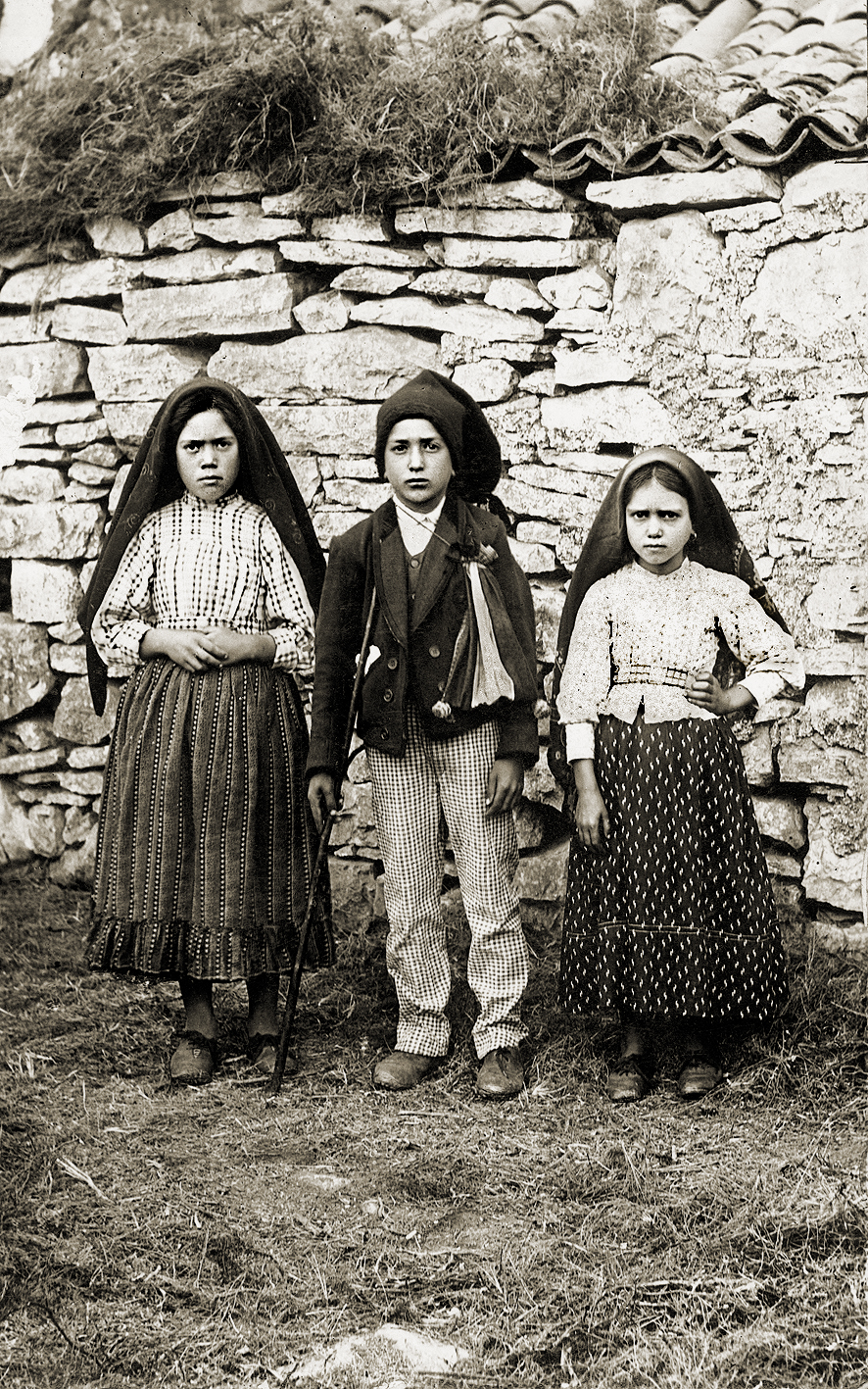
Today is the feast of Our Lady of Fátima, celebrating the first apparition of Our Lady there to the three shepherd children on this day in 1917. These continued on the 13th of each month until the 'Miracle of the Sun' on October 13th that year.

There is an online account of the apparitions and history of the shrine here.

The story of Fatima is one that is truly extraordinary, and one which confronts so many prevailing preconceptions in our society. In itself it is call to faith, and one that is challenging and demanding. What the children of Fatima saw and relayed was no easy religious option, no easy comfort, but an awareness of spiritual and indeed physical combat with dark and dreadful forces.

Monday, 4 October 2010

Nothing to celebrate

October 4th-5th is the centenary of the 1910 revolution in Portuga1 which led to the exile of the monarchy and established a republican regime. Doubtless there will be celebrations as October 5th "Republic Day" is the current national day in Portugal.

I would venture to suggest that there is nothing for the Portuguese to celebrate and a great deal for them to regret in this anniversary, when the nation repudiated the institution that had created it eight centuries earlier.

There is a biography of King Manuel II, who was forced into exile, here.

View Image

King Manuel II in robes of state with the crown of King John VI


A colour version of the above portrait. The King is wearing the riband of the Three Orders - the three ancient crusading Orders of of Aviz (green), Christ (red) and Santiago (purple) - and the collar of the Order of the Tower and the Sword, founded by King Afonso V in the fifteenth century


No one could deny that Portugal at the beginning of the twentieth century faced serious problems as a nation. Overthrowing the monarchy and the traditional order appealed to some as a solution; they appear to have been influenced by the example of the French Third Republic. This was, of course, patently wrong as a solution, and not the answer to the issues facing the country. In 1908 King Carlos I and the Prince Royal Luis Felipe were assassinated in Lisbon and King Manuel narrowly escaped the death in the same attack. There is a good account of the background and the murders here.There are also online biographies of the King and the Prince Royal. This was a clear example of that terrible tendency to resort to violence to attack and destroy the established order that culminated in the Sarajevo assassination in 1914.

In 2008, when the Lisbon government forbade participation in commemorations of those terrible events of representitives of the state and the armed forces, it was left to the Royal House to recall the King and Prince. Incidentally on the anniversary I arranged a Requiem Mass in the Extraordinary Form for them here at the Oratory in Oxford.

Now clearly one can ask who would want to be ruled by regicides or their allies. After the 1910 revolution - more a coup by disaffected members of the military and their radical allies - there were a series of left wing, radical, anti-clerical governments, political instability and coups, and attempts to restore the King. This is the backbround to the apparitions at Fatima in 1917, when the Portuguese church was under attack. From 1928, and certainly from 1932 until 1974 there was Salazar's Estado Novo. Now I can see that the underlying cobncept of applying Catholic social teaching as a basis for government has much to commend it, but as an actual system it became unresponsive to a world that was changing, and lacked the mechanism to achieve peaceful change and development. The result was that change with the 1974 revolution led to a return to political radicalism and instability in the period 1974-6 indeed the real fear of a communist takeover. Post 1976 the country has become part of the EU and followed the contemporary European paths of relativism and pseudo liberalism.

The obvious contract is with its immediate neighbour Spain. There the rstoration of the monarchy in the constitution in 1947 meant that after 1975 it could as an institution articulate the national mood, and achieve a successful transition and development. That is not to say I agree with all that has been done in terms of social policy in Spain in recent years; it is to say that Spain has managed successfully to blend its historic institutions and nature with a world that continues to change.

The failure to reinstate the monarchy underlies many of the instabilities of Portuguese politics. Thus even in 1910 the arms of the state remained oin a new nationalflag of conciously partisan, republican design as here. Since the 1920s the country has, whilst remaining a republic, displayed an ambivalent attitude to the Monarchy. Thus King Manuel's body was returne din 1932 with full honours and buried in the family vault, and in the following years the then President had two ADCs - one republican, the other monarchist. Several of the chivalric orders of the monarchy were restablished (with slightly changed insignia). There was talk of a restoration under Salazar, and the law of exile revoked. In that era the Monarchist party was the only political novement that was permitted other than the government party. This ambivalence has continued since 1974 - thus when the Duke of Braganza and claimant to the throne, D. Duarte Pio married in 1995, the guest of honour was the President of the Republic and the ceremony was carried live in television - despite attempts to disrupt coverage by leftists. Today Dom Duarte acts and can be seen as a representitive of the country.

A hundred years on from the events of 1908-10 I am firmly of the opinion that the loss of the monarchy was a loss, a catastrophic loss for Portugal. As a nation it needs to return to the roots whence it is sprung. Rather than celebrating the revolution of 1910 it should undo the damage and restore the Monarchy.

The Mad Monarchist has a pair of linked articles on the events of 1910 and their aftermath here.

Thursday, 13 May 2010

The Pope at Fatima


Mass: Pope Benedict XVI leads the Rosary at the Chapel of the Apparitions in Fatima's Sanctuary


Pope Benedict XVI leads the Rosary at the Chapel of the Apparitions in Fatima's Sanctuary

Here, in case you have not seen it, and courtesy of Zenit, is the prayer Pope Benedict XVI pronounced at the Chapel of Apparitions upon arriving yesterday at the Shrine of Our Lady of Fatima.

Holy Father:
Our Lady, Mother of all men and women, I come before you as a son visiting his Mother, and I do so in company with a multitude of brothers and sisters. As the Successor of Peter, to whom was entrusted the mission of presiding in the service of charity in the Church of Christ and of confirming all in faith and in hope, I wish to present to your Immaculate Heart the joys and hopes as well as the problems and sufferings of each one of these sons and daughters of yours who are gathered in the Cova di Iria or who are praying with us from afar. Mother most gentle, you know each one by name, you know each one’s face and personal history, and you love them all with maternal benevolence that wells up from the very heart of Divine Love. I entrust and consecrate them all to you, Mary Most Holy, Mother of God and our Mother.

Cantors and Assembly: We sing to you and we praise you, O Mary

Holy Father:

The Venerable Pope John Paul II, who visited you three times here in Fatima
and thanked the "unseen hand" that rescued him from death in the assassination attempt on 13 May in Saint Peter’s Square almost thirty years ago, wanted to offer to the Shrine of Fatima a bullet which gravely wounded him and was placed in the crown of the Queen of Peace. It is a profound consolation to know that you are crowned not only with the silver and gold of our joys and hopes, but also with the "bullet" of our anxieties and sufferings. I thank you, beloved Mother, for the prayers and sacrifices that the shepherd-children of Fatima offered for the Pope, led by the sentiments that you inspired in them in the apparitions. I also thank all those who, every day, pray for the Successor of Peter and for his intentions, that the Pope may be strong in faith, bold in hope and zealous in love.

Cantors and Assembly:
We sing to you and we praise you, O Mary

Holy Father:

Beloved Mother of us all, here in your Shrine at Fatima I consign
the Golden Rose that I have brought from Rome as a homage of gratitude from the Pope for the marvels that the Almighty has worked through you in the hearts of so many who come as pilgrims to this your maternal home. I am sure that the shepherd-children of Fatima, Blessed Francisco and Jacinta and the Servant of God Lucia of Jesus, are united with us at this hour of prayer and jubilation.

Cantors and Assembly:
We sing to you and we praise you, O Mary