


Royal Central has a post today about the highest Danish order of Chivalry which I am reproducing, with minor corrections and apologies for it being off-centre in alignment - and adding a second post
about the Order and a few extra points of my own afterwards. This year is the 570th anniversary of its foundation, if it does go back to 1457....
Taking a look at the Order of the Elephantby Oskar Aanmoen |
The Order of the Elephant is the highest Danish Order one can receive and is usually handed out only to members of royal families or heads of state. The order was founded by the Danish monarch in 1457, and after a short break, it was reintroduced in 1580. Since then it has been distributed to a number of people.
It was His Majesty King Christian I of Denmark and Norway who introduced the order in 1457. The King was married to Dorothea of Brandenburg, and the brotherhood was most likely inspired by the Brandenburg Swan Order, which was established in 1440.

Coat of arms of Frederick IV of Denmark and Norway surrounded by the collars of the Order of the Elephant and the Order of the Dannebrog.
Photo: Sodacan via Wikimedia Commons.
The Order was approved by Pope Sixtus IV in 1474. During King Christian II's reign, the brotherhood ceased, but it was restored as the royal knight order under the rule of His Majesty King Frederick II. The Order consisted of only one class and has insignia designed with an elephant as the badge. The elephant has been the symbol of the Order until today.
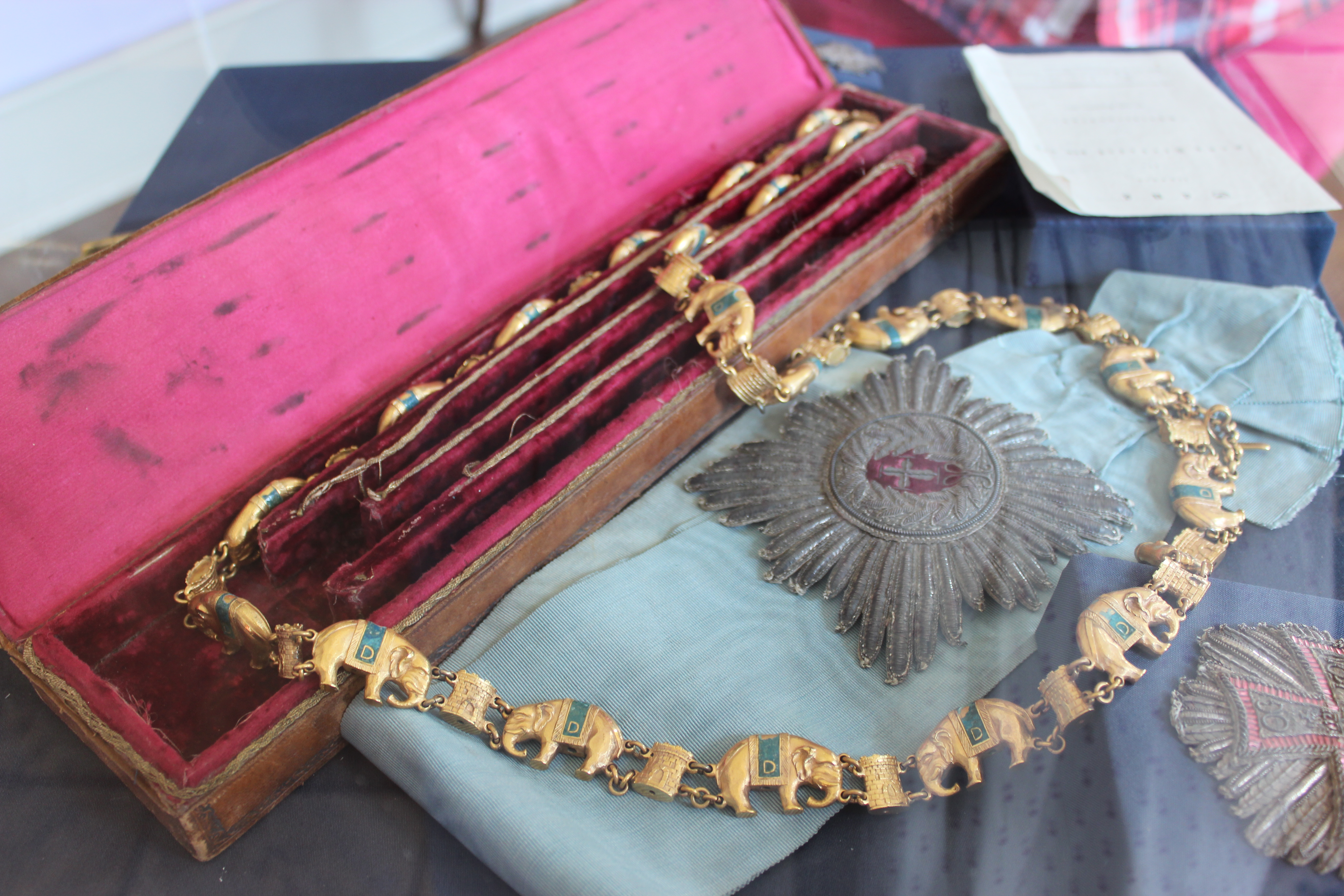
An older version of the Order exhibited at the museum.
Photo: Toxophilus via Wikimedia Commons.
Until 1808, the order was distributed to only royals, but after 1808, the order has been presented to non-royals. From 1892, it was also awarded to the Queen of Denmark, not just the King, and from 1958 the Order of the Elephant has been fully open to all women, regardless of whether they are royal or not.
Denmark's ruling monarch is the head of the order; this is today Her Majesty Queen Margrethe II. Today, the Order is administered by the “order-chapter,” which is subject to the Danish Royal Court. The Order of the Elephant still holds its headquarter in Frederiksborg Castle Church and the coat of arms of all the recipients of the order.

Frederiksborg Castle, with the elephant fountain in front.
Photo: Johan Jacob Bruun via Wikimedia Commons.
During the Second World War, a number of influential people from the allied countries were honoured with the Order of the Elephant. In 1945, Field-Marshal Bernard Montgomery and General (later US President) Dwight D. Eisenhower were appointed as knights. In 1950, the order was awarded to Winston Churchill, although he was no longer the Prime Minister of the United Kingdom.
As of today, approximately 800 people have been awarded the order, and during the rule of Her Majesty Queen Margrethe II, the Elephant Order has only been given to one ordinary Danish citizen, which occurred in 2000.
 The Collar of the Order is made of gold, in alternating links of towers and elephants. This is only worn on two occasions every year – the New Year’s Court and the Sovereign’s birthday.
There is more about the Order in this post from the blog unofficialroyalty.com:
The two Royal Orders of Chivalry in Denmark are The Order of the Elephant (Elefantordenen) and The Order of Dannebrog (Dannebrogordenen). The granting of either Order is solely at the pleasure of the Sovereign, unlike some other countries where they are granted on the advice of the government.
The Order of the Elephant
Although the statutes defining this order were established in 1693 by King Christian V, its history dates back to the 15th century. It is believed to originate with a religious group who conferred a similar emblem to members of the Danish aristocracy during the reign of King Christian I (1450-1481). This consisted of a badge of the Virgin Mary holding her Son within a crescent moon, surrounded by the rays of the sun, hanging from a collar of links in the form of elephants. After the religious group died out, King Frederick II continued to award a badge of an elephant, with his profile on its side. This is believed to have been inspired by the chaplain’s badge from the religious group, which was also in the shape of an elephant. In 1693, King Christian V established the statutes for the Order as we know it today. These statutes were amended in 1959, allowing women to be created members. There is only one class – Knight of the Order of the Elephant.
As with most orders of chivalry, the Danish sovereign is the head of the order. While at one time the Order was granted primarily to foreign royalty and Danish noblemen, it is now granted primarily to members of the Danish Royal Family and foreign Heads-of-State. On rare occasions, it has been granted to a commoner.
The Badge of the Order is a white-enamelled gold elephant, with a cross on one side, and the reigning Sovereign’s monogram on the other. The elephant holds a tower on its back, and a Moor holding a spear on its neck. The badge is primarily worn suspended from the Sash of the order. This sash, made of light blue silk moiré, is worn over the left shoulder, with the badge resting on the right hip.
The Star of the Order is an eight-point silver star, with a cross of diamonds on a red disc. This is surrounded by a silver wreath of laurel leaves. The Star is worn on the left breast whenever the sash is worn.
in 2012. Some of the dates in that post and its sources are slightly different to the ones given in the post above, indicating the rather obscure early days of the Order. As a revival of the late seventeenth century it is rather like the two revivals of the Order of the Thistle by King James VII in 1687 and by Queen Anne in 1703.

King Christian V in the robes of the Order.
These are very similar in design to the contemporary robes of the Order of the Garter and the French Royal orders. The red mantle with white lining uses the national colours of Denmark
It was King Christian V who issued new statutes for the Order in 1693, in the earlier days of Danish absolutism.
Image: A Polar Bears Tale Blog
The Chapel of the Danish Royal Orders is at Frederiksborg Castle, A more than 300 years old – and still living – tradition of displaying the armorial plates of Knights of the Order of the Elephant and Knights Grand Cross of the Order of the Dannebrog in the Chapel of the Royal Orders has resulted in an impressive collection of heraldry. The current armorial plates are the work of Ronny Andersen (Royal Herald Painter). The armorial plate of Crown Princess Mary can be seen on the link to the Chapel given at the beginning of this paragraph.

The Crown Prince and Crown Princess of Denmark wearing the riband and star of the Order of the Elephant
Crown Prince Frederik is also wearing the star and neck badge of the other Danish Order, that of the Dannebrog
Image: Daily Mail
Why the Elephant? Elephants were no more common in fifteenth century Denmark than they are now. The probable reason why the elephant was chosen to symbolize the Order was that the battle elephant was used as a symbol of the champion of Christianity, roused by the sight of Christ's blood. In addition the elephant was the symbol of chastity and purity. Medieval typology found several symbolic links between Christ and the elephant, and it is significant that the central medallion of the star of the Order bears the cross as its device.
There is a List of Knights of the Order of the Elephant covering the period from the reign
of King Christian IX ( 1863-1906) down to the present day.


