Once I was a clever boy learning the arts of Oxford... is a quotation from the verses written by Bishop Richard Fleming (c.1385-1431) for his tomb in Lincoln Cathedral. Fleming, the founder of Lincoln College in Oxford, is the subject of my research for a D. Phil., and, like me, a son of the West Riding. I have remarked in the past that I have a deeply meaningful on-going relationship with a dead fifteenth century bishop... it was Fleming who, in effect, enabled me to come to Oxford and to learn its arts, and for that I am immensely grateful.


Showing posts with label Long Melford church stained glass. Show all posts

Tuesday, 13 October 2015

St Edward the Confessor


Today is the feast of the Translation of St Edward the Confessor.

This evening the Oxford Oratory marked the day with Compline, a sermon and Benediction. we were encouraged in advance to pray for the conversion of England. St Edward is not only a national patron and patron of the monarchy, but he is also a local man, having been born at Islip, which lies to the north-east of Oxford.

http://catholicsaints.info/wp-content/gallery/saint-edward-the-confessor/saint-edward-the-confessor-01_0.jpg

St Edward the Confessor holding the ring returned by St John the Evangelist
From the Wilton Diptych

Image: catholicsaints.info

Compline was sung in the traditional Latin form by the clergy and the choir. The sermon was preached by Fr Jerome, who began by querying, but very respectfully, Mgr. Ronald Knox's assessment of St Edward as being, in temporal terms, a failure - the Mgr's sermon on St Edward is the second reading in today's Office of Readings.
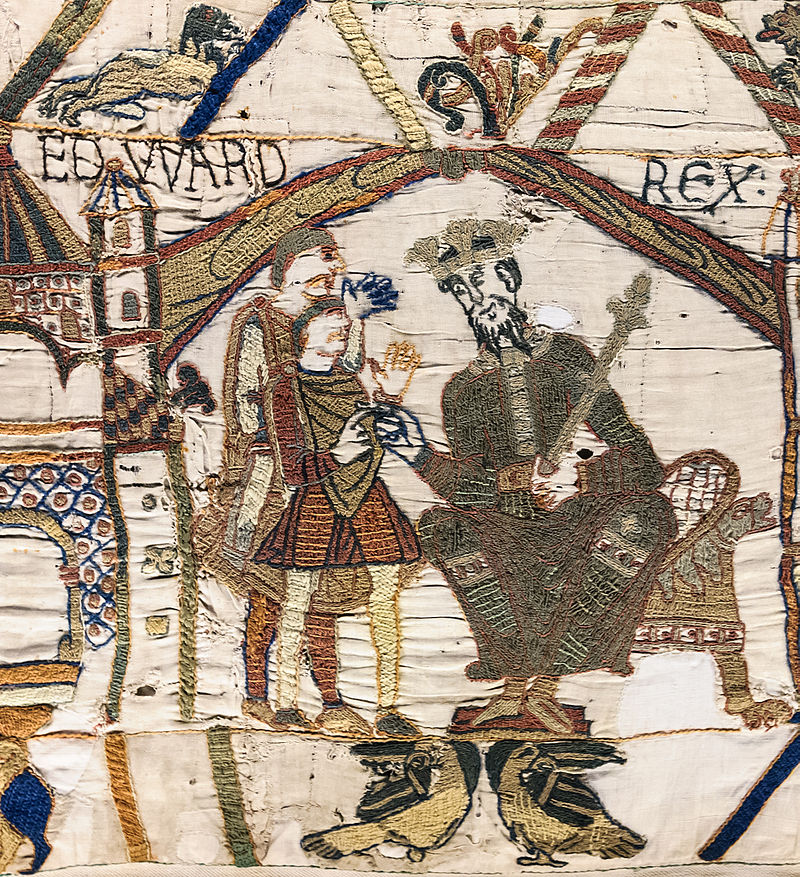
 Bayeux Tapestry scene1 EDWARD REX.jpg

St Edward the Confessor as shown on the Bayeux Tapestry

Image:Wikipedia

As King the Confessor reigned for almost as long as his four predecessors, died in possession of his throne, set an example of good government and pious care for the poor - symbolised by the story of his giving his ring to a beggar, who was in reality St John the Evangelist - and was married faithfully to his Queen, Edith. This example of a sustained if childless marriage was something Fr Jerome highlighted, with no doubt all the reports and rumours swirling round the current Synod in Rome in mind.

Gordon Plumb posted these stained glass images of St Edward on the Medieval Religion discussion group:

York Minster, Great East Window, 1d, left-hand figure c.1408:
https://www.flickr.com/photos/22274117@N08/17079983721
and detail:
https://www.flickr.com/photos/22274117@N08/17079223292

York Minster, Great East Window, 1d, arms of Edward the Cofessor c.1408:
https://www.flickr.com/photos/22274117@N08/17080737435

North Luffenham, St John the Baptist, 2c, early 14thC.:
https://www.flickr.com/photos/22274117@N08/21110955533

Cockayne Hatley, St John the Baptist, Bedfordhire, nIII, 1a early 14thC.:
https://www.flickr.com/photos/22274117@N08/2285002785

Wrangle, St Mary and St Nicholas, nVII, A 4, c.1410-30:
https://www.flickr.com/photos/22274117@N08/8170499758

York Minster, sXXXIV, 5c early 14thC, head 15thC.:
https://www.flickr.com/photos/22274117@N08/4934716140

Oxford, Balliol College Chapel, sIII, 1c, c.1529:
https://www.flickr.com/photos/22274117@N08/5901643848

Harpley, St Lawrence, Norfolk, wI, A6, 15th C.:
https://www.flickr.com/photos/22274117@N08/3320361898

Long Melford, Holy Trinity, Suffolk, nXVII (right-hand figure):
https://www.flickr.com/photos/22274117@N08/2230905801

Heydour, St Michael, Lincolnshire, nVI, 2a, c.1360:
https://www.flickr.com/photos/22274117@N08/3450473166

All of which makes me think that I really ought to get around to reading Frank Barlow's full biography of the King rather than just the shorter pieces by the Professor.


Saturday, 8 August 2015

St Dominic - images and reflections


To mark St Dominic's feast Gordon Plumb has posted a photograph of the saint on the Medieval Religion discussion group. It comes from the surviving stained glass in Long Melford church in Suffolk, and can be viewed at :

https://www.flickr.com/photos/22274117@N08/2226559836

In the panel St Dominic is shown wearing blue because the black of the Dominican habit would be counter-productive in stained glass, and is usually replaced therefore with blue glass.

By following the links underneath the figure readers can access the whole of  Gordon Plumb's archive of photographs of the glass in Holy Trinity Long Melford. Though only some of the glazing survived the activities of enthusiastic reformers what does survive, both devotional and the remarkable portraits of fifteenth century donors is of very high quality and an indication of what once filled the windows not only at Long Melford but across East Anglia.

Even in a county rich in late medieval churches Long Melford is exceptional in its quality and contents, and its liturgical life before the disruptive changes of the sixteenth century is cited by Eamon Duffy in The Stripping of the Altars.


St Dominic
This painting preserves the tradition of his auburn hair, and that as he grew older he retained a complete tonsure.

Image; dominicains.ca


St Dominic
His hair may be depicted less accurately, but he has his distinctive emblems of the star and the lily, indicating his purity of life.

Image: parish.rcdow.org.uk

Stephanie Mann also has a post on Supremacy and Survival about St Dominic and the history of the Order of Preachers in the British Isles, and with a link at the conclusion to another related post. These can be viewed at  Happy Feast of St. Dominic


St Dominic.

Image: CatholicCulture.org


Monday, 8 August 2011

St Dominic in art and faith


Today is the feast of St Dominic, who died in 1221 and was canonized in 1234.

His shrine tomb is in Bologna, and there is an article about it and about the reliquary of his skull here. The Arca is piece made in two stages, in the thirteenth and fifteenth centuries. Here is acontemporary photograph:


http://upload.wikimedia.org/wikipedia/commons/6/65/Shrine_of_Saint_Dominic,.JPG

Image: Wikipedia

Arca di San Domenico

An older photograph showing the altar with a fine display of candles

Image: www.artand architecture.org.uk

This is a photograph of his head reliquary, made by the Bolognese goldsmith Jacopo Roseto in 1383


In England the Thornham Parva retable from the early fourteenth century survives in a small Suffolk parish church, but is thought that, together with afrontal now in the Musee de Cluny in paris, originally belonged to the Dominican friary in Thetford. On the left is St Dominic, and on the right the first Dominican martyr, St Peter Martyr:

http://www.inkoosmill.co.uk/images/retable02.jpg

The Thornham Parva retable

Image:inkoosmill.co.uk

There is more about the retable with details of the figures here.

Also in Suffolk there is this later fifteenth century English stained glass representation of St Dominic, from the remains of the beautiful glazing of Holy Trinity church at Long Melford:

photo

A figure of St Dominic with at his feet either Henry Hardman or William Thwaytes.

Window nXIX,2a

St Dominic is shown in blue rather than the black of his Order as the latter colour would only be used for details in glass due to its opacity.

Image: Gordon Plumb's photostream of Flickr,


This is a day upon which to give thanks for St Dominic and his Order, which is certainly present and active in Oxford - "Gods Dogs" are a very positive part of Catholic life here. It is also a day upon which I try to remember in my prayers the deceased Dominicans of the medieval house in Pontefract, about which I posted recently.