Once I was a clever boy learning the arts of Oxford... is a quotation from the verses written by Bishop Richard Fleming (c.1385-1431) for his tomb in Lincoln Cathedral. Fleming, the founder of Lincoln College in Oxford, is the subject of my research for a D. Phil., and, like me, a son of the West Riding. I have remarked in the past that I have a deeply meaningful on-going relationship with a dead fifteenth century bishop... it was Fleming who, in effect, enabled me to come to Oxford and to learn its arts, and for that I am immensely grateful.


Showing posts with label King of Poland. Show all posts

Monday, 10 November 2014

The Crusade of Varna


A conversation with one of my students a few weeks ago reminded me that the 570th anniversary of the Crusade of Varna, which culminated in the disastrous defeat of the Polish-Hungarian army at the battle of Varna on November 10th 1444. Amongst the numerous fatalities were the twenty year old King Wladyslaw III of Poland and Hungary amd the Papal Legate, Cardinal Giuliano Cesarini.

The Crusade was an ambitious plan to rescue the remains of the Byzantine Empire from the ever advancing Turks with a Papal fleet to transfer the troops from Varna to relieve Constantinople. Like the other great Crusading venture of the period, that of Nicopolis in 1396 - for which see the accounts at Crusade of Nicopolis and Battle of Nicopolis - it ended in a catastrophe for the Christian army, and in consequence paved the way for the loss of Constantinople in 1453 and eventually the Hungarian disaster at Mohacs in 1526.

In a piece about the recent book by Colin Imber The Crusade of Varna 1443-45 (Crusade Texts in Translation 14, Ashgate) it is said that "[m]ore than any other single event, it was Murad's victory at Varna that secured Ottoman domination of the Balkan Peninsula, with consequences which are still apparent today."

There is an online account of the Crusade at Crusade of Varna and of the battle itself at Battle of Varna.
To help readers unfamiliar with the period and region to understand the tangled diplomacy and politics of the period in central Europe and the Balkans it may be useful to look at the online life of the young Polish King who led the Crusade, King Wladyslaw III, who had become King of Hungary in 1440, which can be seen at Władysław III of Poland, and it may also be helpful to look at the life of his life of his father King Wladyslaw II (Grand Duke Jagiello of Lithuania), who had united Poland and Lithuania by his first marriage to Jadwiga of Poland in 1387, which can be seen at Władysław II Jagiełło. There is an illustrated online chronology of King Wladyslaw III in Polish here.


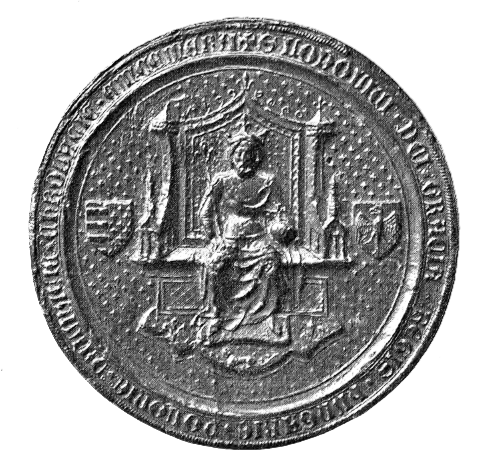
The Seal of King Wladislaw III

Image:ukrmap.su


The cenotaph to King Wladyslaw III erected in 1906 in the Wawel cathedral in Cracow

Image:modernmedievalist.blogspot.co.uk

Before I prepared this post I was unfamiliar with the story of the King's survival at Varna and of his subsequent life and marriage in Portugal, recounted in the online biography above. Such myths of the suvival of a ruler who disappears, such as those of King Harold II in England, of King Sebastian of Portugal or of King Louis XVII in Frances, or of members of the Romanov dynasty in the twentieth century, are a by no means unknown phenomemon, and point to the human desire to hope against the odds, and to create myths around young and romantic royal figures.


Monday, 10 September 2012

King Louis I of Hungary


Today is the 630th anniversary of the death in 1382 of King Louis I of Hungary and Poland, often referred to as King Louis (Lajos) the Great.

There is an illustrated online life with links of the King here  and there is one of his second wife and widow Elizabeth of Bosnia here.


The kingdoms and dependencies ruled by King Louis I after 1370

Image: Wikipedia

As a ruler he can be compared to other mid- to later fourteenth century rulers such as the Holy Roman Emperors Louis IV and Charles IV, King Edward III of England, Louis' own maternal uncle and predecessor King Casimir III the Great of Poland and Queen Margrete I of Denmark and the Union of Kalmar. All of them displayed political and diplomatic skill in advancing their territorial claims and in ruling their various kingdoms, and exercised power with style and patronage of the arts and learning.

The Angevin era  was remembered as something of a golden age and many of the national costumes for the nobility at the 1916 Coronation of Bl. King Charles IV were inspired by the Angevin era of Hungarian history.

On his death the two kingdoms went their separate ways with their inheritance by by the King's two daughters - Hungary passed to to Mary who married Sigismund of Luxemburg and Poland to her younger sister Hedwig (Jadwiga ) whose marriage to, and attendant conversion of, Jagiello of Lithuania inaugurated the Jagellonian line of Polish, and, occasionally, Hungarian Kings.

File:Ludwik Węgierski seal 1370.PNG

Great Seal as used after 1370 with the arms of Hungary and Poland flanking his throne

Image:Wikipedia

Queen Elizabeth's crown is preserved in Zadar:


Image:Wikipedia

As King he is often thought to the first European monarch known to have used Chinese porcelain tableware, as the surviving flagon known as the Fonthill vase, now in Dublin, is thought to have been his his, and thus indicates something of the court culture of these years.

File:Fonthill vase by Barthelemy Remy 1713.jpg

The Fonthill vase before the loss of its mounts, and bearing the Angevin arms

Image: Wikipedia


However the following article on the excellent Medieval Hungary blog questions the traditional link between the vase and King Louis, and associates it rather with the Angevin court in Naples of Queen Joanna II in the early fifteenth century. It shows the vase as it appears today and can be read here.


Another example of the artistic and material culture of the period, or from just before Louis' accession can be found in the British Museum.

Hungarian Crucifix of circa 1330
Image: British Museum website

The cross consists of silver plaques arranged on a wooden core. They are decorated with gilding and translucent enamels. The enamels surrounding the figure of Christ depict Christ in Majesty (at the top), the Virgin and St John the Evangelist (at each side) and the figure of Adam rising from his tomb (at the bottom). On the back are represented the Lamb of God and the four symbols of the Evangelists. Smaller quatrefoils of stylized floral motifs and birds are arranged intermittently along the arms and body of the cross.

The coat of arms of Hungary and the insignia of the Hédervári family appear around the six-sided knop at the foot of the cross. The cross may have been made to commemorate the death of Desso Hédervári whose heroic sacrifice in 1330 saved the life of King Charles I (1288-1342). Desso dressed in the king's armour, allowing Charles to escape a Romanian ambush.

The Italian character of the enamels has led to suggestions that the cross was made by a Sienese goldsmith, Peter Gallicus, who was working at the Hungarian court in the 1330s. The enamels were certainly executed by an artist with a detailed knowledge of Italian techniques.

There is an introduction, together with links, about the sculpture and applied arts of the era here.

.Another remarkable survival from this era was found during excavations in the Royal Castle at Buda, first built in its present form by King Louis' brother Stephen of Slavonia. It is an heraldic Cloth of Estate with the Hungarian Royal Arms. It dates from the later middle ages, and had survived in a waterlogged condition in a blocked well shaft. I have seen photographs of it online, but have so far been unsuccessful in finding them again.

The life and reign of King Louis the Great indicates the significance and sophistication of central Europe in the period and make one realise how interesting, if in the English speaking world unduly neglected, a subject the medieval history of the region is.

Friday, 30 September 2011

The Crown of Poland


Whilst researching my recent post about the Crown of St Wenceslas I came accross an online article about the Polish crown, known as that of Boleslaw the Brave. The article can be read here, and I have copied the picture below from it; the article also has a picture of the medieval Coronation sword which has survived.


The Modern Reconstruction of the Crown of Poland


The crown was made for King Wladislaw I (Ladislas) the Short or Elbow-high who was crowned as King in Crakow on January 20 1320, following his unification of the fragmented Polish kingdom. Following the late eighteenth century partitions of Poland it came into the possession of the Prussians who deliberately destroyed it in 1809 - very bad form that in my opinion - but a reconstruction was made in 2001.

Now that the crown has been reconstructed the only thing lacking is someone to wear it. In virtually any other European country that would not be a problem, but, of course, in Poland, with the elective monarchy as it came into being fron the 1570s, it is. There are certainly various families who have worn the original crown who might stake a semi-hereditary claim, including the house of Saxony, and also a branch of the Habsburgs who looked to an independent restored Polish monarchy during the Great War.