Once I was a clever boy learning the arts of Oxford... is a quotation from the verses written by Bishop Richard Fleming (c.1385-1431) for his tomb in Lincoln Cathedral. Fleming, the founder of Lincoln College in Oxford, is the subject of my research for a D. Phil., and, like me, a son of the West Riding. I have remarked in the past that I have a deeply meaningful on-going relationship with a dead fifteenth century bishop... it was Fleming who, in effect, enabled me to come to Oxford and to learn its arts, and for that I am immensely grateful.


Showing posts with label King Henry II. Show all posts

Thursday, 19 December 2024

The Coronation of King Henry II and Queen Eleanor in 1154


Today is the 870th anniversary of the coronation at Westminster of King Henry II and his Queen, Eleanor of Aquitaine.

Henry II of England - Wikipedia
King Henry II from the Gospels of his son-in-law Duke Henry the Lion of Saxony

Image: Wikipedia 

Wikipedia has a good and detailed biographical account of the King and his reign, which discusses, inter alia, his education, appearance and style of living and governance, at Henry II of England


The same site has a very good online account of Queen Eleanor’s long and remarkable life at

Eleanor of Aquitaine


She was Duchess of Aquitaine in her own right, and nine years older than the twenty one year old.King. Her previous marriage to King Louis VII of France was annulled early in 1152 and eight weeks later she married the nineteen year old Henry, Having campaigned as a teenager in England he was already established as Duke of Normandy and the next year by treaty was recognised as heir to King Stephen. The rather unexpected death of the latter in October 1154 brought this determined and energetic couple to the English throne.


The coronation was carried out by the Archbishop of Canterbury, Theobald of Bec.

The new King was crowned with one of the crowns that had belonged to his mother’s first husband the Emperor Henry V, and which she had brought to England as his widow. 


The outward ceremonial of kingship appears to have mattered little to King Henry. After a few recorded ‘crown-wearings’ on July 17th 1157, or at Easter the following year - authorities vary - he and Queen Eleanor laid their crowns on the altar of Worcester Cathedral or the shrine of St Willian and swore not to wear them again.


Little survives of the Westminster that saw that coronation day beyond some of the claustral buildings of the abbey and the shell of Westminster Hall, which was the work of King William II. In 1154 the new King and Queen moved on to celebrate their Christmas Court at Bermondsey Abbey across the Thames rather than at Westminster.


Together with their sons King Richard I and King John, King Henry and Queen Eleanor are well reported by contemporary chroniclers and writers, shaped by the literary models of their time, as well as in the emerging and continuing records of royal administration. As a result the Angevin monarchs emerge more vividly on the modern printed page than their later medieval descendants often do.

Walter Map, who was a member of the peripatetic Angevin court, recorded his impressions of life there - with maybe the emphasis of a skilled raconteur making the most of a good story on occasion - in De nugis curialum 

In it he writes of the King as follows:

He was slow in settling the business of subjects, whence it happened that many, before their affairs were settled, died or departed from him dejected and empty-handed under the compulsion of want. It was another of his faults that, whenever he was lounging, which happened rarely, he never allowed approach to him, in answer to the prayers of the good, but, remaining in inner chambers tightly closed, he was accessible to those only who seemed unworthy of such access. His third fault was that he was impatient of peace, and felt no qualm in harassing almost the half of Christendom. In these three was his sin; in regard to the rest he was strikingly good, and in all respects lovable, for no one ever surpassed him in gentleness and affability. 

Whenever he went forth, he was caught up by the crowd, carried from place to place and forced to go where he desired not; and, what is remarkable, he gave ear patiently to individuals, and even when assaulted, now by general cries, now by violent hauls and pushes, to none on this account did he bring disgrace or make it serve as a pretext for his anger. And when he was too sorely tried he held his peace and fled to spots of peace. He was never haughty or puffed up; he was sober and restrained and pious, loyal and far-seeing, generous and often victorious, and a doer of honour to the good.

On occasion, indeed famously, King Henry could very publicly, lose his temper ( he did not have red hair for nothing ) as, most famously with “Will no -one rid me of this turbulent priest?” Another instance is recorded by John of Salisbury, although I am not alone in strongly suspecting that the King was channeling his anger to achieve the maximum effect:

I heard that when the king was at Caen and was vigorously debating the matter of the king of Scotland, he broke out in abusive language against Richard du Hommet for seeming to speak somewhat in the king of Scotland’s favor, calling him a manifest traitor. And the king, flying into his usual temper, flung his cap from his head, pulled off his belt, threw off his cloak and clothes, grabbed the silken coverlet off the couch, and sitting as it might be on a dungheap, started chewing pieces of straw.


The effigies of King Henry II and Queen Eleanor as they are now displayed at Fontevrault Abbey

Image: historicalragbag.com


Thursday, 17 July 2014

Chasse royale at Chinon


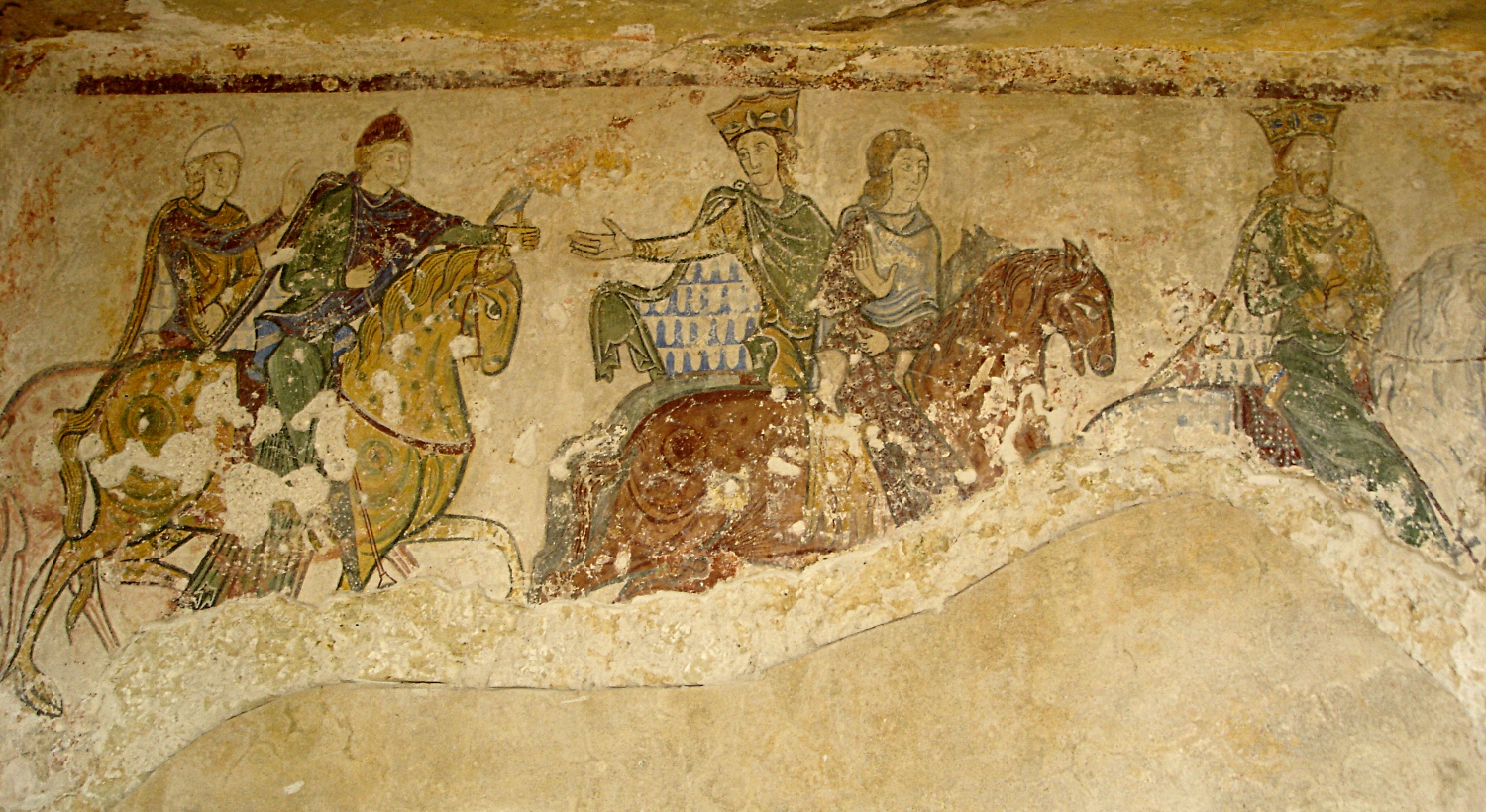
When I wrote my recent post King Henry II I added to it, almost as an afterthought, an image of the painting of the King and his family in the chapel of St Radegonde in Chinon, slightly adapting the accompanying text. I reflected as I did so that the suggestion that it has something to do with Queen Eleanor's captivity after 1173 struck me as something of a non sequitor. A comment by reader suggested that the latest thought is taht the painting depicts not Queen Eleanor but Henry the Young King and his brothers riding after their father. The key point was the position of the clasp of the cloak. As a result I thought I would look into more about the painting.

File:Chasse royale, fresque de la chapelle Sainte-Radegonde.JPG

The Chasse royale fresco

Image:Wikipedia

The painting is in Sainte-Radegonde, a chapel half built into the rock-face and about twenty minutes walk outside the town. There are pictures of the chapel and an account in a blog here which I have used and edited in writing this post . An underground natural spring at the back of the current chapel was a in pre-Christain times the site of pagan worship. The site was Christianized in the sixth century when St Radegonde came to visit a hermit called John ( Jean Le Reclus, or St John of Chinon) who lived and was buried there,  and hence, ultimately, the dedication of the chapel.


St Radegonde herself was born circa 520 in the kingdom of Thuringia, in  central Germany. She and a brother were taken hostage by their uncle, who had killed their father to claim the crown of the kingdom. When this uncle refused to honor a treaty with the Merovingians he lost his kingdom and his life when the Franks invaded Thuringia.  Radegonde and her brother were again captured and she was forced to marry Clothaire, a son of Clovis, the first King of the Franks. Marriage did not suit Radegonde but piety did, and she soon assumed the life of an ascetic. Radegonde eventually learned that her brother had led a revolt against her husband's rule of their native lands and had been assassinated by order of Clothaire. She repudiated her husband, took sanctuary, and eventually became a nun. Clothaire did not take kindly to his wife's abandonment and Radegonde sought spiritual direction from Jean Le Reclus in the face of obstacles Clothaire placed in her way. She founded L'Abbaye de Saint-Croix at Poitiers and was revered by the women who joined her there. The convent declined following her death in 587 but Radegonde's personal legend strengthened;part of her legend credits her with single-handedly killing a marauding, nun-killing dragon. She was canonised in the ninth century and a number of towns, churches and chapels in both France and England were dedicated to her, and an abbey founded in Dover in her honour in 1191.


The entrance to the chapel

At Chinon itself the two naves of the chapel were created in the twelfth century, one carved directly out of the rock, and the other one built.

Queen Eleanor would have been familiar with Radegonde given their shared city of Poitiers, and could well have identified with a Queen consort with familial troubles.

Jean of Chinon was supposedly a refugee from the Saxon raids on Britain, Radegonde revered him for his wisdom and spiritual direction, so much so that legend has it that upon his death Radegonde had a chapel built here to house his remains. 

If Queen Eleanor of Aquitaine considered St Radegonde to be a saint of particular personal devotion, then it is not unreasonable that she  may have endowed this chapel, or visited it when in Chinon, and that her personal interest was indicated by the wall painting of her family. That is assuming that this is not just a scene from the life of St Radegonde. Identifying the Planatgenets with figures from the life of a saint would not be unusual, but the likelihood does appear to be that this does depict King Henry II and his family, whether as themselves or as representitives of figures in the life of the chapel's patroness.

In addition to its subject matter, this painting is of outstanding quality in its execution, its vivacity and the variety of colours.

As to the precise subject matter there have been many theories. One is taht it depivcts King John's marraige in 1200 to Queen Isabella, but that does not seem to fit with the other figures.

The oft repeated suggestion that it depicts Quuen Eleanor's detention after 1173 or her release seems unsclear, and also not something to be depicted - the Angevins doubtless had some regard for presenting an ouwardly serene impression of dynastic unity for as long as possible.


A general view of the chapel apse. The figure of Christ in Majesty suggests Cluniac influence.


The Plantagenet group is on the upper part of the right hand wall


 The painting from below


The Chasse royale


A more detailed view of the left hand side of the painting


Given the indications of a family group, then surely it is King Henry II in the lead. The presumption has been that it is Queen Eleanor is in the centre, and probably her daughter Joanna, later Queen of Sicily beside her - the other daughters Matilda Duchess of Saxony and Leanora Queen of Castile were married and absent, so this may be meant to be the family who might be at court.

Then which sons are in the rear? The future Kings Richard and John does not fit with the dynastic dynamics. Is it the Young King and Richard, but that excludes the younger sons Geoffrey and John.

if the painting is after 1183 or 1186 then the two decesed sons can be excluded, but that raises all kinds of additional problems.The idea that it is a servant beside Eleanor seeems unlikely - this is a depition of ahierarchical family, not asnapshot of how peopel might actually have travelled.  If it is after 1189 and it is King Richard I leading then it is suggested Queen Eleanor could be riding with his Queen Berengaria but that seems unlikely given not only her lack of a crown,but her posture is wrong for awoman of her station.

However if all the figures are male, them it is clearly King Henry II, the Young King - so after 1170, but before 1183 when he died - and the other sons Richard, Geoffrey (who died in 1186) and John.


Queen Eleanor or King Henry the Young King?

Images :eleanorfootsteps.blogspot.co.uk

The blog author is convinced the regal figure is Queen Eleanor. Personally I am inclined to the solution that it is King Henry and his four sons after 1170. The Young King, fifteen when he was crowned, is shown beardless and with the longish hair of a youth, as are the other three figures. If it is agroup image of the Angevins it is, of course, both stylised and contrived - medieval Kings did not go hunting in their state robes anymore than their successors did or do. The painting suggests a united family of father an dfour sons out enjoying themselves. The reality may have been different, but this was the impresson aimed for by the artist and whoever commissioned him. maybe it was Queen Eleanor and maybe it was her fervent prayer to St Radegonde that it might be so.  

Other paintings, depicting the story of Sainte Radegonde and Saint John, were made during the 17th century. The chapel was deconsecrated following the French Revolution and used as dwelling places. In 1878, it was bought and restored as a sanctuary by a benefactress of Chinon, Madame Charre. It is doubtless to her that we should give gratitude for preserving this remarkable painting.


Sunday, 6 July 2014

King Henry II


825 years ago, on July 6th 1189, King Henry II died at the castle at Chinon.

There can be little doubt as to the importance of King Henry II to the history of England, of the British isles and to France, or of his continuing legacy. There is an online illustrated account of him here, which reflects the historiographical issues his reign poses.

Thomas K. Keefe's academic account of him from the Oxford Dictionary of National Biography can be read here

Of the various full-length biographies clearly the standard one is W.L.Warren's massive and magisterial biography in the Yale series on English Monarchs. It is a while since I ploughed my way through that, but it is a work full of detail and insights into the practice of medieval kingship.

Tombs of Henry II and Eleanor of Aquitaine in Fontevraud Abbey

The effigies of King Henry II and Queen Eleanor at Fontevrault Abbey

Image:hoocher.com

I have written beforehand of how moving it was for me in 1993 to actually stand and look at those so well-known effigies of the King and Queen, and of King Richard I and Queen Isabella, wife of King John, in the wondrous church at Fontevrault. An experience I will never forget. Here was the heartland of the Angevin empire - if indeed it was such a thing - strectching in the twelfth century south to the Pyrennes and far to the north to the overlordship of Scotland and the newly acquired Lordship of Ireland...


English: Effigy of Henry II of England in the ...


The head of the effigy of King Henry II

gImage:Wikipedia

As a man and as a ruler the King was far more complex and subtle I think than the popular image of him, whether derived from chroniclers at the time or modern playwrights and actors - the King is a gift to all of them. That is why Warren's book, and the work of other academic historians on Henry FitzEmpress should be read.


Royal cortege, wall painting from the chapel of Sainte-Radegonde in Chinon.

The scene is usually interpreted to represent the departure of Queen Eleanor of Aquitaine into captivity following the revolt of 1173. King Henry II  precedes Eleanor and Joan, their daughter. Richard the Lion Heart and Henry the Young King take up the rear. An alternative interpretation is that this may be a scene from the cycle of the legend of Radegonde (Queen and saint, died 587)  to whom Queen Eleanor was especially devoted. A third possibility is that it combines both themes, with the Angevins seen as reflecting the life of the Merovingian Queen.

Image:mondes-normandes.caen.fr 


Tuesday, 11 June 2013

The Young King


Today is the 830th anniversary of the death at Martel near Limoges of Henry the Young King, the eldest of the sons of King Henry II and Queen Eleanor of Aquitaine to reach maturity. Their second son he was born on February 28th 1155, just after his father's accession and coronation. He himself was crowned in his father's lifetime as King in 1170 - an action which enraged St Thomas of Canterbury as the coronation, a privilege of his see, was performed by Archbishop Roger Pont L'Evêque of York - but died in 1183, six years before his father. As a result he has tended to disappear from regnal lists, and indeed he has no numeral indicator; maybe we should follow the German practice and designate him King Henry (III), but that would cause confusion. Still it should be remembered that there have been nine, not merely eight, crowned English Kings called Henry - and if you are Jacobite in sympathies, then there is also Cardinal York...

One attempt to draw attention to his life is a blog Henry the Young King which offers interesting posts about him.

There is an online account of him here, which cites this description of him :  

A Latin poem by a court official written to commemorate the coronation hints at the charisma of this young prince. There he is described as a charming youth of striking beauty, tall but well proportioned, broad-shouldered with a long and elegant neck, pale and freckled skin, bright and wide blue eyes, with a thick mop of the reddish-gold hair characteristic of his dynasty.


Henry the Young King.jpg

The Coronation of Young King Henry

Image; Wikipedia

As that online account and Elizabeth Hallam's life of him in the Oxford DNB, which can be read here, show he was not universally popular with his contemporaries. This aspect is discussed in the post
A Lovely Place of Sin from the blog about his life.


Given little real authority by his father he spent much of his time jousting. A popular and affable young man, but perhaps not the strongest character - Gerald of Wales wrote of him and his brother Richard that they were "both tall in stature, rather above the middle size, and of commanding aspect. In courage and magnanimity they were nearly equal; but in the character of their virtues there was great disparity... [Henry] was admirable for gentleness and liberality...had a commendable suavity... commended for his easy temper... remarkable for his clemency... the vile and undeserving found their refuge in [Henry]... was the shield of bad men... was bent on martial sports... bestowed his favours on foreigners... [Henry's] ambition magnanimously compassed the world." 

His father's reported statement about him has genuine pathos - "He cost me much, but I wish he had lived to cost me more."


http://theplantagenets.com/wp-content/uploads/2010/10/Yungking.jpg 

The head of the effigy of theYoung King in Rouen cathedral

Image: the plantagenets.com

His Queen was Margaret of France, daughter of King Louis VII and his second wife Constance of Castile; Margaret's elder half sisters, being the daughters of Queen Eleanor from her first marriage, were thus the Young King's half sisters as well. They had a son William who lived for three days in 1177. Following Henry's death she returned to the French court and married secondly King Béla III of Hungary  - thus becoming the only Queen of both England and Hungary.


Henry the Young King

The effigy in the choir ambulatory at Rouen cathedral

Image:professor-moriarty.com


Henry the Young King

A close-up of the face

Image:professor-moriarty.com


One consequence of his death was that when his brother Richard succeeded their father as King in 1189 there was not a division of the Angevin empire within France, as might have happened if the Young King and lived and Ricahrd had been left as Duke of Aquitaine. As it was the Duchy remained linked to the English crown until 1453.
 
In the weeks before his death the Young King had been plundering shrines such as St Martial at Limoges and Roqueamadour to fund a campaign against his father; struck down by dysentery he spent his last days, as is recounted in the Wikipedia article cited above, in penitence and seeking forgiveness. This, and doubtless the reaction to the death of a handsome young ruler who had a considerable following, led to an attempt to present him as a potential saint. As a result his body, on its journey for interment was Rouen as he had requested, was seized for burial at Le Mans by the Bishop before being recovered by the Dean of Rouen and taken to the cathedral there, where it was finally buried on July 22nd. The effigy over his tomb appears similar to that over the heart burial of his brother King Richard I which is also in the choir, and probably dates from the years after 1200.

 
The seal of Henry the Young King

Image; Henry the Young King blogspot


Tuesday, 5 March 2013

The birth of King Henry II


Today is the 880th anniversary of the birth of the future King Henry II at Le Mans in 1133. There is an illustrtaed online life of the King with useful notes and bibliography here.


King Henry II
The head of the effigy at Fontevrault Abbey

Image:humphreysfamilytree.com


His parents were Geoffrey V, Count of Anjou and Matilda of England who had married in 1128. The marriage secured the southern border of Normandy and hopefully Matilda's position as heiress to her father King Henry I. The seizure of the English crown by her cousin King Stephen in 1135-6 led to almost two decades of civil war and conflict before King Henry II succeeded to the throne in the autumn of 1154 at the age of 21.


File:Parents of
 Henry II.jpg


Count Geoffrey of Anjou and the Empress Matilda
The depiction of the Count is from his enamel tomb cover from Le Mans, that of the Empress, who died in 1167, from the Gospels of Henry the Lion of 1175-88

Image:Wikimedia

The reign of the King is well known, and the article linked to above gives a good account. There is a good character study from the BBC website here, and there are some interesting miscellanea following the genealogical information given here.

Like his  Norman ancestors and his descendents as Kings he was a zealous defender of the royal authority - that is how his legal reforms or developments should be seen. As has been pointed out in that respect the nineteenth century tendency to see him as an almost Gladstonian figure is anachronistic - King Henry was a man of the twelfth century through and through. 

By combining his own paternal and maternal inheritance with that of his wife, Eleanor of Aquitaine, he created not only the so called Angevin Empire - and however he envisaged its future management after his own lifetime - but extended it with his grant and conquest of Ireland and assertion of overlordship of Scotland. Thereby he laid down, or re-emphasised, the dominant themes of English royal foreign policy for centuries to come.

An energetic man with the habit of dashing across his teritories he appears to have had little time ( in either sense) for the ceremonialof kingship, dispensing with the thrice yearly Crown-wearings of his ancestors for example. Given the absence of his successor King Richard I from England for most of his reign it was not until the time of King John and his son King Henry III that the country saw much of ceremonious ritual kingship.

There is plenty of evidence for the fact that King Henry II had a temper - most famously in the story of the death of St Thomas of Canterbury. The King's reputation may well have been one he encouraged - I suspect the more extreme stories, such as him whilst still in bed tearing up letters that angered him, followed by then ripping up the the coverlet and finally throwing himself on the floor and chewing the rushes were either stories deliberately circulated to create the appropriate impression or staged by the King for the same reason.


http://merlin.allegheny.edu/employee/a/acarr/anjouhistory/pix/mapplantagenet2.gif

France in 1180

Image:merlin.allegheny.edu


http://hoocher.com/Henry_II_of_England/Tombs_of_Henry_II_and_Eleanor_of_Aquitaine_in_Fontevraud_Abbey_Two.jpg

The effigies of King Henry II and QueenEleanor at Fontevrault

Image:hoocher.com

Wednesday, 25 July 2012

A Royal wedding in 1137


Today has been the 875th anniversary of the marriage of King Louis VII of France to Eleanor Duchess of Aquitaine in 1137.

Louis VII, born in 1120, had been junior King since his coronation in 1131, during the lifetime of his father King Louis VI and was a man of a rather monastic frame of mind, pious and devout, who had spent much of his upbringing at St Denis, which had received the extensive patronage of his father. King Louis VI was presumably dying when his son married - and died a week later on August 1st . Louis and Eleanor were to be crowned again as King and Queen on the following Christmas Day. 


The seal of King Louis VII
Image: his.nicolas.free.fr

Eleanor, Duchess of Aquitaine in her own right, and ruling the extensive territories that the Duchy comprised stretching across south-west France had been born in 1122 or 24. She was a high spirited young woman, a product of the southern culture that was in some contrast to that of the northern Capetian heartland. On a purely personal level it is perhaps not surprising that the marriage was unhappy, and the fact that their two children were both daughters did not help in an age when male primogeniture was vital for the unity of the realm. 


The effigies of Queen Eleanor and King Henry II at Fontevrault Abbey

Image: Wikimedia commons


As a result the marriage of Louis and Eleanor was dissolved in March 1152, and Eleanor promptly married the nineteen year old Henry Count of Anjou, who in 1154 became King Henry II of England, and ruler of a vast netweork of territories from Scotland to the Pyrennes. Her new husband was very different in temperament and achievement to King Louis. The marriage was stormy at times but they were to have a large family of both sons and daughters, including three crowned Kings of England - Henry The Young King, Richard I and John, and their daughters included Queens of Castile and Sicily.

For King Louis the consequences dominated the rest of his reign until his death in 1180, when the French crown passed to his son by his third marriage, who became King Philip II, and who was to manage to break up the Angevin Empire in 1202-4.  Had the marriage of Louis VII and Eleanor provided the vital male heir, let alone been happy, the unification of the kingdom as royal domain would have been advanced far more speedily than otherwise happened - the last parts of Gascony did not fall to the French Crown until 1453-4. Although the Anglo-French conflicts of the later middle ages might still have occurred due to the dynastic claim after 1328, but the political realities on the ground would have been very different, with no English base in the south-west from which to threaten the French monarchy with a military and political pincer movement.  


Image: skyscrapercity.com


Saturday, 25 February 2012

Doncaster in Scotland?


Thanks to Yahoo News and the Doncaster Free Press here is a curious bit of history that is something of a non-story in my view, but still quite entertaining in its own way. Doncaster, my father's home town, and very much a Yorkshire town, may be, it seems, actually in Scotland...

Purged of contemporary local journalese the story is as follows:

Doncaster local historians Peter Robinson and Charles Kelham have unearthed evidence that Doncaster was under Scottish rule for 21 years from 1136 to 1157. But while the town was officially signed over between the kings of England and Scotland, it seems it was never formally handed back.

Tourism manager Colin Joy said: “I love it - it is so quirky and has amused and intrigued everyone I have mentioned it to. What really intrigued me was that a formal handing back seems to be lacking.”

The pair found that during the reign of King Stephen of England, King David I of Scotland, of whom there is an online biography here, conquered parts of northern England.

A peace treaty - The Treaty of Durham - was concluded in 1136 and, as well as the county of Northumberland, Doncaster - but nowhere else in Yorkshire - was handed over to Scotland.

A second treaty three years later confirmed Scottish ownership, but in 1157, King Henry II of England simply took back the areas lost to the Scots - but without any official paperwork to seal the deal.

King David I (1124-1153) and King Malcolm IV (1153-1165)

Image: Wikipedia

Peter Robinson, the Doncaster Museum officer, said : “We have King David coins dating from that time found in Doncaster so the links are certainly there. But it is unlikely Doncaster would have been noticably affected under Scottish rule.”

‎Silver penny of King David I

Image: Wikipedia

To this I would add that I suspect Doncaster was given over as a staging post for King David on his journeys into England - his son held the Earldom of Huntingdon - and King David was the local lord rather than exercising sovereignty. Of course had his grandson not lost whatever possession he had in 1157 Doncaster might have been a potential source of continuing conflict, but it is difficult to see it surviving as a separate entity for long given the inherent power of the English monarchy.

For the young King Henry II it was no doubt a matter of taking back waht had been ceded by his less capable predecessor in the stress of civil war. The fact that the new King waited until King David I was dead may reflect gratitude for the Scottish king's support of Henry's mother, his neice, and who indeed had knighted Henry as a teeneager, in the conflict with King Stephen. Equally it may mean that this was just the first opportunity to get the border back to where it had been under King Henry I in 1135.

Of course Doncaster might have ended up with a history like Berwick on Tweed, which of course is on the border between the two realms, and which is sometimes claimed, due to its anomalous status still to be at war with Russa from the Crimean War...

Thursday, 29 December 2011

St Thomas of Canterbury at Chartres


Today is the feast of the martyrdom of St Thomas of Canterbury in 1170.

Quite apart from my work as a medieval historian as a former churchwarden at St Thomas the Martyr in Oxford he is a saint who interests me. My post about both the saint and the church from last year can be read at St Thomas of Canterbury.

As a consequence of the shock engendered by his death and the cult that developed around him St Thomas was widely depicted in art. Many of these representations in England were casualties of King Henry VIII's fulminations against veneration of St Thomas - "that traitor Becket."

Thanks to some posts on the Medieval religion discussion group by Christopher Crockett, that veteran enthusiast for all things Chartrain, I am reproducing some images from Chartres Cathedral, where Becket's supporter John of Salisbury was Bishop from 1176 until his death in 1180.

Clark Maines in an article 'A Figure of St. Thomas Becket at Chartres' in Zeitschrift für Kunstgeschichte XXXVI, 1973), pp. 163-173, identifies one of the figures on the south portal of Chartres cathedral as St Thomas. This can be read on JSTOR if you have access at http://www.jstor.org/stable/1481845 The figure on the right is, in this reading, St Thomas, trampling on King Henry II.

http://images.library.pitt.edu/cgi-bin/i/image/getimage-idx?cc=chartres;entryid=x-fcsp333610220;viewid=FCSP333610220.TIF;quality=m800;view=image


http://images.library.pitt.edu/cgi-bin/i/image/getimage-idx?cc=chartres;entryid=x-fcsp333610225;viewid=FCSP333610225.TIF;quality=m800;view=image

Images:images.library.pitt.edu

Also at Chartres in the ambulatory is a window telling the story of St Thomas, and given by the Guild of Tanners. It can be viewed, with some explanatory notes, here.