Once I was a clever boy learning the arts of Oxford... is a quotation from the verses written by Bishop Richard Fleming (c.1385-1431) for his tomb in Lincoln Cathedral. Fleming, the founder of Lincoln College in Oxford, is the subject of my research for a D. Phil., and, like me, a son of the West Riding. I have remarked in the past that I have a deeply meaningful on-going relationship with a dead fifteenth century bishop... it was Fleming who, in effect, enabled me to come to Oxford and to learn its arts, and for that I am immensely grateful.


Showing posts with label King Edward the Martyr. Show all posts

Saturday, 18 March 2017

St Edward the Martyr


Today is the feast of the martyrdom of  St Edward the Martyr. Having been King since the death of his father King Edgar in 975 he was murdered at Corfe on this day in 978.

There is an online account of  him at Edward the Martyr and my previous posts about him, with other links, can be seen at St Edward the Martyr from 2012 and at St Edward the Martyr from 2013.


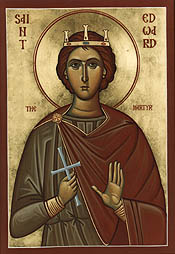
https://orthodoxwiki.org/images/8/85/Edward_the_Martyr.jpg

  Image: orthodoxwiki.org

Today in this country devotion to him appears to be strong amongst Orthodox believers and congregations. There he is venerated as a passion bearer, and perhaps fits in to their equivalent of the link or union of throne and altar. His relics are now enshrined at the Orthodox community at Brookwood in Surrey. In consequence there are several modern icons of him which I have used to illustrate this post.

http://www.catholic.org/files/images/saints/862.jpg

  Image: catholic.org

There is an Orthodox account of him, and of devotion to him, and which also includes pictures of various historic English churches under his patronage here


http://www.pravoslavie.ru/sas/image/102001/200160.p.jpg?mtime=1427718573

Image:pravoslavie.ru

Given recent developments in reconstructing the appearance of the deceased, including ones I have featured - King Richard III, King Henry of Scots and the two priest martyrs from Yorkshire - maybe something similar could be attempted with the scull of St Edward.

St Edward the Martyr pray for us 


Wednesday, 22 July 2015

The death of King Edgar


It was on July 8th 975 that there occurred the death of King Edgar. Allowing for the shift from the Julian to the Gregorian calendar in 1752 the exact anniversary can therefore be held to fall today. 

New Minster Charter 966 detail Edgar.jpg

A contemporary portrayal of King Edgar in the Winchester New Minster Charter of 966

Image: Wikipedia


The death of King Edgar 1040 years ago is important for two reasons.

His reign is important for his consolidation of what may well be described as an imperial kingship - something his uncle King Athelstan had developed in his reign between 924 and 939 as he expanded his realm - and most notably by his coronation in 973 at the abbey in Bath. This was fourteen years after his accession - though he may have had a coronation at that time - and took place when he had reached the age of ordination and took place on Whit Sunday. This was sacral kingship, celebrated in a Roman spa town, analogous to Charlemagne's Aachen. The Rite used in 973 remains the basis of the English Coronation ceremony, used most recently for the present Queen in 1953, 980 years later.

The King's subsequent visit to Chester where he was ceremonially rowed along the river Dee from the city to St John's church by several tributary kings became celebrated as an assertion and exemplification of English hegemony over Britain,

Described in the early twelfth century as having been "extremely small both in stature and bulk" by that, careful historian William of Malmesbury he was anything but slight in importance as a monarch and as a key figure in the development of the institution of the monarchy and of monasticism, exemplified in the Regularis Concordia of 973, to which there is an introduction here.


King Edgar seated between St Æthelwold and St Dunstan. From an eleventh-century manuscript of the Regularis Concordia 
British Library, Cottonian MS Tiberius A III, f2v
Image: Wikipedia

There is an online account of his reign at  Edgar the Peaceful, which has a bibliography of recent studies of the reign. The Oxford DNB life by Ann Williams can be accessed here and provides a more detailed and academic account.


Edgar King of England.jpg

The sacrality of King Edgar's monarchy is recalled in this thirteenth century illumination in an anonymous Life of King Edward the Confessor
Cambridge University Library, MS Ee.3.59: fol. 3v

Image: Wikipedia


The second reason for the significance of the death of King Edgar was that it brought about the accession of his elder son as King Edward, who was to go down in history as the Martyr, he appears to have been illegitimate or of doubtful legitimacy, and only a boy or teenager at the time. His murder three years later and replacement by his younger, legitimate half-brother King Æthelred II, seemingly with the involvement of the new king's mother, set in motion those elements of instability and lack of political legitimacy that were to haunt King Æthelred the Unready [Unraed signifying No Counsel, a pun on his name which means Good Counsel] and his reign.

There is an online account at of King Edward the Martyr at Edward the Martyr, and the Oxford DNB life, by Cyril Hart can be seen at Edward [St Edward; called Edward the Martyr] (c.962–978); this again provides a more detailed account of his life and reign.

King Edgar died at Winchester, but he was not buried there with so many of his family, but at the abbey at Glastonbury. The abbot was St Dunstan, who as Archbishop of Canterbury was a major player in the King's reign, and the compiler and celebrant of the 973 coronation. By choosing to be buried at Glastonbury - and it seems right to assume that the King did that - he maintained his identification with the Dunstanian monastic reform and confirmed its alliance with the monarchy.

There appears to have developed something of a cult around King Edgar at Glastonbury, and on the eve of the dissolution of the abbey Under the last two abbots the Edgar Chapel was built on to the east end of the monastic church to contain his remains.

Model of Glastonbury Abbey 

Reconstruction model of Glastonbury Abbey on the eve of the dissolution.
The Edgar Chapel is on the extreme left.
Image:skyscrapernews.com/All rights reserved. Copyright Holder - GNU License 


Monday, 18 March 2013

St Edward the Martyr


Today is the feast day of St Edward the Martyr, and this year is the 1,035th anniversary of his murder early in the evening of March 18th 978 at Corfe in Dorset. The killing of the teenage King, who had succeeded to the throne in 975, appears to have been so as to place his younger half-brother Ethelred, then a child, and not himself involved in any such conspiracy, on the throne. As King Ethelred II he was the most assiduous proponant of his half-brother's cult, but historians have seen the regicide of 987 as undermining from the very beginning the moral basis of King Ethelred's authority.

http://www.catholic.org/files/images/saints/862.jpg

St Edward the Martyr
A modern icon of the martyr King

Image:catholic.org
There is an illustrated online account of  St Edward's life and reign here and of his cult here.

The excellent account of his life in the Oxford Dictionary of National Biography by Cyril Hart can be read here.
Following rather ignominious burial at Wareham his body was translated to Shaftesbury and the great abbey of nuns there housed his relics and was a place of pilgrimage until the sixteenth century. There is an online account of the abbey here. Only foundations remain of the church, but the relics themselves were re-discovered during excavations in 1931, and confirmed as being of the right date and character in 1970. I recall seeing them - or possibly  pictures of them - on my visit to the abbey site in 1972.

Image result for shaftesbury abbey

A plan of the abbey at Shaftesbury

Image:British History online

Following a protracted legal dispute over custody of the relics, during which they were held in a bank vault, they are now with the St Edward the Martyr Orthodox Brotherhood at Brookwood Cemetary in Surrey. I did not manage to accompany friends on past visits at Easter from Ascot Priory when I used to spend the Triduum there.  The website of the Brotherhood has a section about St Edward which can be viewed here. It is good that the relics are once again a focus of devotion, but it is rather sad that after so many centuries at Shaftesbury that they should be removed elsewhere.

St Edward's cult survived in the Church of England in that he remained in the Calendar of the Book of Common Prayer. Here in Oxford the Tractarian Thomas Chamberlain as Vicar of St Thomas' in the nineteenth century founded a number of schools for both boys and girls, the only one of which survives is St Edward's under the patronage of the boy-martyr King. It was the association of St Edward with the monastic reforms of St Dunstan which probably inspired Canon Chamberlain, as well as the Tractarian attempt to recover devotion to English medieval saints. The school incorporates in its arms the heraldic bearings assigned in later centuries to the Kings of the house of Wessex and uses as a badge the dagger and cup symbols of St Edward's martyrdom.


Sunday, 18 March 2012

St Edward the Martyr


Were today not a Sunday it could be observed as the feast of St Edward the Martyr, the young King murdered, apparently with the connivance of his step-mother, at Corfe in Dorset on this day in 978.