Once I was a clever boy learning the arts of Oxford... is a quotation from the verses written by Bishop Richard Fleming (c.1385-1431) for his tomb in Lincoln Cathedral. Fleming, the founder of Lincoln College in Oxford, is the subject of my research for a D. Phil., and, like me, a son of the West Riding. I have remarked in the past that I have a deeply meaningful on-going relationship with a dead fifteenth century bishop... it was Fleming who, in effect, enabled me to come to Oxford and to learn its arts, and for that I am immensely grateful.


Showing posts with label King Athelstan. Show all posts

Friday, 31 March 2017

Malmesbury


Today I had amost enjoyable day out with a college friend from Oriel and it was an opportunity to talk about plans and hopes for the future.

We drove westwards to Malmesbury in northern Wiltshire. I had been there once before but for him it was a first visit. Attractive and slightly intriguing town on a hill almost surrounded by the river Avon, and having parked down by the river we climbed up the hill. The town is dominated by the remains of the medieval Benedictine abbey.

There is an online account of it at Malmesbury Abbey and more from a BBC site here.
The local museum website has more about it at Malmesbury Abbey by Athelstan Museum

Today only a fragment remains of the church, that is the majority of the nave, and most of the site is accessible, although the eastern chapels have disappeared under a path and gardens. The central tower appears to have fallen as a result of a lightening strike a few years before the dissolution, hence teh fragmentary stae of the church

 Image result for Malmesbury Abbey

A reconstruction of the lost features of the abbey superimposed on the existing remains

Image: Athelstan Museum

Image result for Malmesbury Abbey

Malmesbury Abbey from the air
In the lower part of the picture is the tower and spire, all that now remains of the church of St Paul, once the place of worship for the townspeople

 Image: malmesburybells.co.uk

http://www.rareoldprints.com/swlitf/catalogue.nsf/$profile/A331C8847EE457B08025790200360D0F/$FILE/MalmesburyAbbeyPlan_Brakspear.jpg

Plan of the abbey church

Image:rareoldprints.com

The plan has been recovered of the Norman rebuilding with its later extensions eastwards. Prior to its collapse the spire, is said to have been, at 431 feet, taller than that of Salisbury Cathedral at 404 feet.

Image result for Malmesbury Abbey

A reconstruction of the chrch and the lightning strike

 Image: Athelstan Museum

Today the especual glory of Malmesbury is the south door and porch. This is some of the most important Norman sculpture in England, encased in a late medieval outer casing. The sculpture is  sadly worn on the  outer portal but is still very impressive.
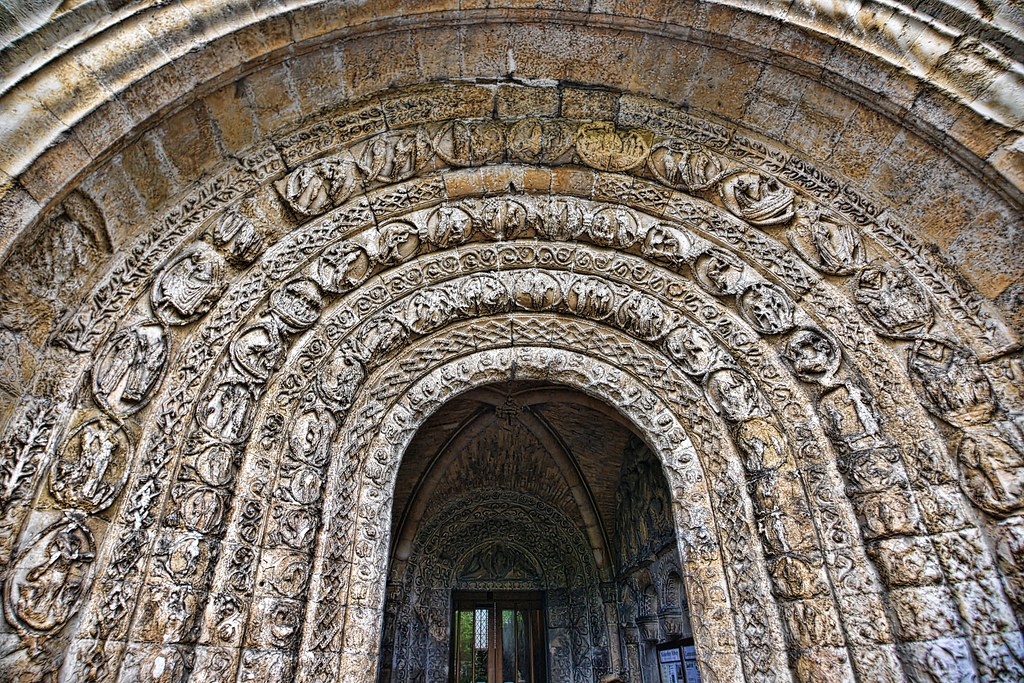
https://c1.staticflickr.com/5/4033/4619454423_77142380fb_b.jpg

 Image:staticflickr.com
Within the porch are carvings of the Apostles:


 Image:saintsandstones.net
The inner door has Christ in Majesty, flanked by angels:

Image result for Malmesbury Abbey

 Image: wikimedia commons

From what remains of the ruined west end the great west door was similar. Today this is still very striking; if it was originally painted to enhance as well as protect it the effect must have been much more intense, a powerful introduction to the House of God. This is all from a  period when Malmesbury Abbey was a leading intellectual centre, with the community including the chronicler William of Malmesbury and the house possessing a major library. This was also the era of the early eleventh century Flying Monk - Eilmer of Malmesbury. 

Image result for Malmesbury abbey

The church from the south-west

Image: Cotswold Info
 
Today about three-quarters of the nave survives. The exterior is a fourteenth to fifteenth century recasing, and inside Norman work with a gothic vault. It has arguable links to the design of the nave at Hereford both in respect of the arcades and the west end. Both churches added a western tower over the two western bays of the nave - and both collapsed wrecking catastrophic damage.

 http://www.malmesbury.com/media/k2/items/cache/e67ec824afbc9f855ad850f1b49c5b05_XL.jpg

The interior of the nave looking west to the Victorian west wall

Image: malmesbury.com


The church is now parochial and the layout of the interior reflected its modern Evangelical churchmanship. This was welcoming, but as my friend, who is a practising Muslim observed it felt like a Community centre. Yes - I know churches are communitues, but they are also more than that. I told him about the Februart half-term use of the nave as a skate park - andif you do not believe me look at  malmesbury abbey skate - Skate — Malmesbury Abbey

That said we did receive a friendly but not oppressive welcome to the abbey church, which was quite busy with other visitors.

We paid our respects to the fourteenth century tomb of King Athelstan (924-39) - arguably the first King of a unified England, and I saw there was an extensive number of books about him on sale.

Image result for King Athelstan tomb

The tomb of King Athelstan

Image: Athelstan Museum

The tomb was presumably rescued from the choir, and I assume his bones still lie is the destroyed part of the church. It is somewhat battered but the detail of, for examle, his shoes suggest this was once avery splendid tomb indeed.

Afterwards we looked at the very attractive late medieval Market Cross - a simpler version of the ones in Salisbury and Chichester, and about which there is more at Malmesbury Market Cross and at Malmesbury Market Cross by Athelstan Museum - and found the fine garden at Abbey House, but that was not open until tmorrow.

 Image result for Malmesbury market cross

Malmesbury Market Cross

Image: Pinterest 

After lunch - not at the pub called in honour of Eilmer The Flying Monk, which we did not find - and a further walk round this attractive and quite distinctive town we travelled back via Fairford - where we did not find space to park and enable me to show the wonderful stained glass in the church to my friend - to Lechlade, where we stopped for tea and so returned to Oxford.

A very enjoyable day out with a good friend and a good way to celebrate the anniversary of my reception in 2005 into the Catholic Church.


Tuesday, 17 June 2014

Vikings at the British Museum


Yesterday I visited the British Museum to see their current exhibition Vikings:life and legend. The day was organised by the new Director of the Museum of the History of Science here in Oxford for the permanent staff of the Museum and those of us who work there part-time.

This was therefore another early start but it did mean we were able to fit a lot into the day. On arrival we were welcomed and given a tour of the new World Conservation and Exhibition Center, which is linke dto the new sainsbury exhibition centre. The WCEC enables conservation and lending or receipt of items with state of the art technology, and is still in the process of being commissioned.

After this, and atour of parts of the labyrinth of passageways under the Museum, we broke for lunch. At this time of year the British Museum is very busy indeed and the Great Court around the old Reading Room is like the concourse of a railway station, not least in its echoing sounds. Nonetheless it is an imaginative use of the space.

Early afternoon we met up again to look at the recent redisplay of the Sutton Hoo finds. En route I did manage to have a reasonably good look at the Royal Gold Cup, about which I have written previously, and some other objects from medieval England and Europe.

The redisplay of the medieval material is a significant improvement on the previous dispalys, and the Sutton Hoo treasure is very much, and rightly, centre stage. The designer of the display spoke about the use of new technology as it had been used to highlight these wonderful things, and the helmet and other items from the seventh century court of a dynasty with strong Scandinavian was an excellent lead-in to the exhibition on the ninth to eleventh century Vikings.

We were given an introduction to the exhibition by Gareth Williams, one of the organisers and co-editor of the accompanying book. The BM's website has an introductory press-release which can be read at Vikings: life and legend.

The Museum's last exhibition on the theme had been in 1980, and this one, organised in conjunction with the National Museum of Denmark in Copenhagen and one in Berlin was built around a core of objects which each participating museum then presented in their own way. One change since 1980 was a change in official thinking in Russia - no longer is the period seen as purely Slavic - the Vikings of Rus are no longer air-brushed out of history. and on Now there is access to material from there and from the Ukraine. The present exhibition focussed on new discoveries the extent of Scandinavian migration and trade links in what nmight be termed the late Iron Age, but that the term Viking was an infinitely better selling ploy to modern audiences! Whilst it brought out the wealth of the period, it did not seek to avoid the fact that this was also a violent age - the "Fluffy Vikings" of a few years ago in historical presentation are consigned to their own interpretive past.

The exhibition is in the new sainsbury gallery, but the first two rooms were crowded and the expereince somewhat uncomfortable, with low light levels, other than that illuminating the objects, background dialogue in Scandinavian languages to provide a type of "mood-music" and crowds pressing around the display cases. Once you got accustomed to that then there were splendid things to see.

I was struck by the richness and splendour of the material culture of the Viking elite with their jewellery for both men and women and splendid swords, and records of red cloaks and evidence of substantial houses - as illustrated by the reconstrucyted example at Borg in Norway.

Amongst the discoveries on display was the Vale of York hoard, found a few years ago near Harrogate, and apparently buried about 927 when King Athelstan first occupied the Kingdom of York.

In the main exhibition space wa steh highlight of the whole display - the largest Viking ship found (to date), from Roskilde. Ironically it came to light as plans were carried out to extend the ship museum there. It probably required forty pairs of rowers, and though only about 20% of the timbers survive the cradle in which it is displayed indicated the scale of the vessel. In its day it was, I suspect, the equivalent of later ships such as the Grace Dieu of King Henry V, the Vasa of King Gustavus Adolphus, a pre-1914 Dreadnought or a modern aircraft carrier. Dated to circa 1025 it may well have been commissioned by King Cnut following his conquest of Norway and using timber from there to impress his subjects and potential enemies by his authority. In that sense it still works.


Nearby was a facsimile of the  Jellinge stone erected at Jellinge in Jutland to commemorate King Gorm the Old and his Queen by their son King Harold Bluetooth in the late tenth century. Coloured as it would have been originally, and with the Crucifixion on one side and a distinctive dragon on the other - hence the use of the term Jellinge style - and its inscription in which King Harold listed his achievements of ruling Denmark, acquiring Norway and making the Danes Christian, it is, like the ship, an expression of growing royal authority in Scandinavia. That process, which included the development of coinage, derived no doubt from contact with Englsih and Frankish society on raids and traing expeditions.

Showing that not all Viking raids were successful there was a display of some of the remains of the Vikings killed in the Ridgeway Hill massacre near Weymouth about the year 1000. Clearly the Anglo-Saxons were not always defeated, and quite nifty at eliminating what may well be the fifty or so members of a Viking ship crew with raiding in mind which ventured onto the Dorset coast.

There were interesting displays about Viking pre-Christian religious belief - which now appears shamanistic in may respects, and included the warrior tradition of going berserk in battle, that is believing oneself to have bear-like strength and fighting without armour, being probably under the influence of hallucinogenic plants. The Lewis chessmen, who were on display, biting the tops of their sheilds are possibly under such influence. There was also a stone Manx cross fragment linking Christ and the Norse gods.

The legacy of the Vikings was illustrated not only by place-names, especially in counties such as Lincolnshire, and the many words in English of Viking origin, but also a map illustrating Norwegian DNA and its distribution, and indeed concentrations, in the areas of Scandinavian settlement in Britain - the Vikings are still with us in England because they are, so to speak, part of us.

The exhibition shop was very tempting, and with awide range of goods to buy. I managed not to succumb, but did rather fancy a tie with parts of the Bayeux tapestry reproduced on it and cuff-links with the Sutton Hoo helmet as their face.

A splendid exhibtion once one got through the initial log-jam of visitors and plenty to feast the eyes and the historical imagination. Many thanks indeed to the Directory of the Oxford MHS for organising the day.


Thursday, 23 January 2014

The Earliest English Royal Books


I have been meaning to finish writing this post for ages, and over the Christmas and New Year holiday I have found both my notes and the opportunity - and could just about decifer my handwriting on several scraps of paper. Last year in January I went to meeting of the Oxford Bibliographical Society to hear a lecture on "The Earliest English Royal Books" given by Prof. Richard Gameson from Durham University, and it was one of the most interesting and insightful lectures I have ever had the good fortune to hear.

The topic had arisen as a presentation he had made to the British Library in connection with the planning of their recent exhibition on the Old Royal Library, presented by King George III to the British Museum, and in it Prof.Gameson had outlined the importance of royal patronage of books in the Anglo-Saxon era. This he now presented to his hearers in Oxford with clarity, profound knowledge and understanding, as well a delightfully eccentric line in humour.

He began by referring to the earliest surviving catalogue of English Royal books, that of 1535, when the Royal library of 143 books was at Richmond Palace, and was a collection stemming from 1479 when it was inaugurated by King Edward IV. This leads to questions as to whether such catalogues do record the real range of books available to medieval monarchs and princes, and how books were categorised.

With the Anglo-Saxon world we have no Ex-Libris or library lists, and on a palaeographic approach the historian is more concerned with the scriptorium than with the owner. Furthermore there is a poor survival rate for books from this period.

The earliest English royal books of whose existence we can be certain are the service books of the chapel established about 580 for the Christan Queen Berth when she married the still pagan King Ethelbert of Kent. In the context of the life of the royal household such establishments did not necessarily mean that the kings were literate, but rather, as with the early law codes, that this was a society that was using the written word.

In the following century the scholarly King Aldfrith of Northumbria (685-704/5)possessed books, and collected them - we have record of his exchanging land for a Codex. With St Aldhelm (639-709) we have an intellectual of royal birth who goes into the Church, became an Abbot and then Bishop, and it is possible to reconstruct his library from references in his works, although none of his own manuscrpts survive.

Bede sent books to his King  and the court was a clearing house for such things. The King of East Anglia commissioned Felix's Life of St Guthlac. King Offa gave a Bible made at Jarrow to the cathedral at Worcester. Kings redistributed books around their realms.

Queen Osburgh is said to have encouraged the literary interests of her most famous son King Alfred (871-899), and he was certainly personally literate in later life. As King he gathered scholars around him and encouraged the copying and distribution of texts.

By his time it is possible to distinguish three classes of royal manuscripts - personal possessions for prayer and study or a life such as that by Asser, official texts such as law codes in Latin or Old English which were central to governance, and manuscripts that came into and went again from the king's possession.

Asser records that King Edward the Elder (899-924) owned books and learnt the psalter, and carried the collection forward to the next generation.


From the reign of his son King Athelstan (924-939) two manuscripts are known from his court, and we know of six or seven gifts he made to monasteries where they survived.

Unfortunately the Cottonian fire of 1731 claimed one with an illumination of the King with St Cuthbert, but the other example happily survives:


File:Athelstan.jpg

King Athelstan  and St Cuthbert

Image:Wikipedia

In the painting the saint is shown blessing the King who is reading - rather than presenting the book to Cuthbert - and the King is shown as literate, a man well able to exercise rulership.

I should add that Prof Gameson did offer an alternative interpretation of the picture - King Athelstan is offering a box of chocolates to the saint and saying "Personally I don't like the strawberry cremes" - I think that academic joke is now inextricably fixed in my mind with this famous depiction of Anglo-Saxon kingship.

To return to serious matters - the suggestion was made that King Athelstan saw books as diplomatic currency, and that it was the role of the King to give such books away to those who would use them.

His nephew King Edgar (957/9-975) is known to have presented a Gospel Book to the monastery at Ely and the two illustrated Canterbury copies of the Regularis Concordia are probably royal dedication copies:
 
King Edgar and St Dunstan

King Edgar and St Dunstan from the Canterbury Regularis Concordia

Image:traditioninaction.com 

The other famous contemporary manuscript depiction of King Edgar is the Winchester New Minster charter, probably commissioned by Bishop Aethelwold, but with the King's approval:

Circa 966: Cover from Charter for the dedication of New Minster, a Benedictine Abbey in Winchester England - King Edgar in supplication before Christ in majesty

The New Minster Charter circa 966
King Edgar offers prayers to Christ in Glory

Image:orthodoxartjournal.org

No books are recorded from the household of King Ethelred II (978-1016), but his eventual successor and supplanter King Cnut had a sacraments and psalter which was given to him by a monk of Peterborough, and which the King gave to Cologne. Emma of Normandy, Queen to both these Kings is known to have owned books and was the recipient of the Enconium Emma Reginae, as can be seen here:

http://www.anglo-saxons.net/images/emma_fullsize.jpg

Queen Emma is presented with the Enconium Emma Reginae
Her two sons, the future King Harthacnut and King Edward the Confessor, are peering round the curtain

Image: anglo-saxon.net


Queen Edith had a life of her husband King Edward the Confessor, Kings William I and William II are known to have given books to continental monasteries and King Henry I gave books to Waltham abbey, including one by Adelard of Bath.

Prof. Gameson then proceeded to look analytically at these books. In terms of quantity he had looked at eighteen individuals at fifteen courts, and he considered the evidence far from negligible as to royal ownership of books and comparable to what is known from the continent for the period. Given the passage of time this was not a bad survival rate for acytual manuscripts or for knowledge of books which no longer survive. King Aldfrith and King Alfred may have been exceptional but royal books were significant throughout the period.

The range was not easy to assess. Church books one would expect and they would be valued for their importance and quality. He believed there would have been a wide range of others, if only we could identify them. The Exeter Book from the reign of King Edgar is the type of book one might expect him to have had and the court or the Church a likely source.

Where these  royal books were made is unclear - as on the continent there is little evidence. Charlamagne and Lothair had a court scriptorium. There is nothing to distinguish such a source from a monastic one. King Alfred may have had such an institution in the latter part of his reign and King Athelstan had ascribe who wrote books. Much of the products of such work would have been legal texts, handbooks and also annals.

Royal imagery has survived in some manuscripts such as the New Minster charter depiction of King Edgar whilst the image of Queen Emma from the Enconium was rarer. The earliest known is that of King Athelstan with St Cuthbert, and that was sixty to seventy years earlier than continental examples. These all suggest royal appreciation of the importance of books and can be seen as part of the Alfredan inheritance.

One of the key points made was that royal books were regularly given away, and we know of these gifts from the records of the recipient monasteries. It was of the nature of royal collections for their contents to be transitory. It was seen as a charitable and pious thing to make texts available to those who could use them - the King was an educational benefactor by giving books to monks and churches. This approach may well have lain behind the great Library of King Charles V of France (1364-80) whose more than 917 volumes were later transferred by John Duke of Bedford to London and dispersed. I would add that that would also be a motivation for Duke Humphrey's great gift to Oxford of the latest classical texts in the 1430s - they were collected to be passed on for wider use, not hoarded as a private collection.

Anglo-Saxon royal books can be classified by type. Firstly there are those from the chapel - missals, homilies, both old and new, and which were in the care of the chaplains. Secondly there were reference works - law books, the text of the Anglo-Saxon Chronicle, educational texts such as those copied under King Alfred. Thirdly there were individual possessions, which would obviously would vary with the different interests of individual owners. Fourthly there were royal gift books of high prestige - including ones which might have been encouraged an outside scriptorium to produce.

We may have little hope of identifying individual manuscripts as parts of an Anglo-Saxon royal collection. For later centuries there is more hope of identifying owners, but Prof Gameson considered what had once existed as significant as later collections, and maybe more important than that of the Norman kings. The importance of the King and court as a centre of textual distribution was striking. it is difficult to measure the success of such gift giving, but distribution was seen as preferable to hoarding.

All in all a wonderfully stimulating and informative lecture, which I hope I have done at least some justice to in these notes.


Tuesday, 20 March 2012

St Cuthbert


Today is the 1325th anniversary of the death of St Cuthbert in 687, and his traditional feast day. The modern calendar commemeorates him on September 4th, the date of the translation of his relics in 1104, but this, his dies natalis seems much the more appropriate day.

St Cuthbert was Bishop of Lindisfarne and died at his hermitage on Inner Farne. My reflections from 2010 on a visit there in 1989 can be read in my post Lindisfarne. To those I would add a note to draw attention to the inherent symbolism in Cuthbert, the Northumbrian hermit monk, whose consecration at York in 685 by the very cosmopolitan St Theodore of Tarsus, Archbishop of Canterbury, "the last known student of the school of Athens" linked the eastern and north-western limits of Christendom and virtually the whole breadth of the known Christian world.

The biography in the Oxford DNB by David Rollason and R. B. Dobson can be read here, and there is another online account here.

These both discuss the relics of St Cuthbert which survive from his time, or which were given to his body and shrine in the later Anglo-Saxon period. They are described and discussed here, and there is a separate, and longer, article on the St Cuthbert Gospels here. These were plavced in his coffin in the late seventh century and from their size it seems reasonable to believe that they were his own property and used by him on his travels and in his hermitage. They were removed from the tomb at the reformation and eventually came into the possession of Stonyhurst. There is currently an appeal by the British Museum to raise the money to buy this very important manuscript and display it in London and Durham on a six monthly basis.


http://www.pasthorizonspr.com/wp-content/uploads/2011/07/Cuthbert-copyright-British-Museum.jpg

The St Cuthbert Gospels

Image:pasthorizonspr.com/ Copyright British Museum

Probably the best known of the artifacts found in his grave was his pectoral cross, and its design has been re-used in many representations in Durham and Northumberland.

http://www.cushnieent.force9.co.uk/WebSitePhotoGallery/cuthbertcross_files/pectoral.jpg

St Cuthbert's Pectoral Cross

Image: cushneentforce9.co.uk

Devotion to St Cuthbert was widespread, and in the north often reflects the reputed wanderings of the monks with the relics of St Cuthbert, St Oswald and others, and also the later prestige of the see of Durham and its widespread estates. However the cult also trvalled southwards and he was popular in tenth century Wessex, and commemorated by churches such as St Cuthbert in Wells and by the devotion of the West Saxon dynasty to him. As they established their authority in the north after 924 paying respect to St Cuthbert was not only a matter of devotion but also a matter of political tact and the recognition of local custom and practice.

File:Athelstan.jpg

King Athelstan presents copies of St Bede's two Lives of St Cuthbert to the saint in his shrine at Chester-le-Street in 934

Image:Wikipedia from MS at Corpus Christi College Cambridge

Since 1104 St Cuthbert has rested within the walls of Durham cathedral, and his burial place is still a place of pilgrimage. With him in the coffin is, or was, the head of St Oswald, the King of Northumbria killed in battle in 641. As a consequence this came to be one of St Cuthbert's attributes and so he is normally depicted as a vested bishop holding a King's head.

photo

Stained glass figure of St Cuthbert holding the head of St Oswald c.1320
Christ Church Cathedral Oxford

Image: Lawrence Lew OP on Flickr


Early in the fifteenth century Thomas Langley, Bishop of Durham from 1406 -1437, gave the glass of the great window of the south choir transept in York Minster, filling it with the story of St Cuthbert, and balanced by that on the north containing the life of St William of York.

photo

The St Cuthbert window
York Minster

Image: Rev.Gordon Plumb on Flickr

photo

The central figure of St Cuthbert holding the head of St Oswald

Image: Rev.Gordon Plumb on Flickr

There is also this link from Gordon Plumb to a comprehensive set of images of the Cuthbert window here; each one is expandable. Not only do the scenes recount the story of St Cuthbert but are a splendid set of portraits of leading figures at the time and depictions of early fifeenth century life. I know from the experience of trying to look at the panels when in the Minster that this is a much easier way of looking at this marvellous window.

May St Cuthbert continue to pray for the Church and Realm


Thursday, 6 May 2010

King Athelstan


File:Athelstan.jpg

King Athelstan presenting a copy of Bede's two lives of St Cuthbert to the saint in his shrine at Chester-le-Street in 934. This is the earliest surviving royal Anglo-Saxon portrait (Corpus Christi Cambridge MS 183, fol. 1v).

Image: Wikipedia


Last night I was at a very lively and stimulating lecture given by Prof. Sarah Foot to the Oxford University History society. Her subject was King Athelstan, of whom she has recently completed the biography in the Yale English Monarchs series. She started by asking how many of those students present had heard ofAthelstan before the lecture was publicised - not all had.

Her talk concentrated on Athelstan - King for 924 to 939 - not just as first King of an England we would call by that name, but also as the first King of Britain. In that he was to be emulated bt his nephew Edgar 958-975, but not again until Edward I sought, and ultimately failed, to impose unity in the late thirteenth century.

She also had some splendid insights into the practical politics which underlay tenth- century kingship, the political and international marriage alliances and also the significance of relics to Athelstan, whose great collection ended up at Exeter cathedral.

Athelstan was the first English King to wear a crown rather than a ceremonial helmet, and the crown depicted in the manuscript shown above and on some of his coinage portraits well be an attempt to depict what he actually wore.

She also spoke about the way in which from the sixteenth century Athelstan slipped from the historical memory and how his grandfather Alfred emerged as
the unifying English King par excellence., in part because of his part in developing the use of the English language.

I look forward to finding the time to read what will, based on the academic good humour Prof. Foot displayed in her talk, I am sure be a very readable as a well as scholarly book.