Once I was a clever boy learning the arts of Oxford... is a quotation from the verses written by Bishop Richard Fleming (c.1385-1431) for his tomb in Lincoln Cathedral. Fleming, the founder of Lincoln College in Oxford, is the subject of my research for a D. Phil., and, like me, a son of the West Riding. I have remarked in the past that I have a deeply meaningful on-going relationship with a dead fifteenth century bishop... it was Fleming who, in effect, enabled me to come to Oxford and to learn its arts, and for that I am immensely grateful.


Showing posts with label King Edgar. Show all posts

Wednesday, 22 July 2015

The death of King Edgar


It was on July 8th 975 that there occurred the death of King Edgar. Allowing for the shift from the Julian to the Gregorian calendar in 1752 the exact anniversary can therefore be held to fall today. 

New Minster Charter 966 detail Edgar.jpg

A contemporary portrayal of King Edgar in the Winchester New Minster Charter of 966

Image: Wikipedia


The death of King Edgar 1040 years ago is important for two reasons.

His reign is important for his consolidation of what may well be described as an imperial kingship - something his uncle King Athelstan had developed in his reign between 924 and 939 as he expanded his realm - and most notably by his coronation in 973 at the abbey in Bath. This was fourteen years after his accession - though he may have had a coronation at that time - and took place when he had reached the age of ordination and took place on Whit Sunday. This was sacral kingship, celebrated in a Roman spa town, analogous to Charlemagne's Aachen. The Rite used in 973 remains the basis of the English Coronation ceremony, used most recently for the present Queen in 1953, 980 years later.

The King's subsequent visit to Chester where he was ceremonially rowed along the river Dee from the city to St John's church by several tributary kings became celebrated as an assertion and exemplification of English hegemony over Britain,

Described in the early twelfth century as having been "extremely small both in stature and bulk" by that, careful historian William of Malmesbury he was anything but slight in importance as a monarch and as a key figure in the development of the institution of the monarchy and of monasticism, exemplified in the Regularis Concordia of 973, to which there is an introduction here.

King Edgar seated between St Æthelwold and St Dunstan. From an eleventh-century manuscript of the Regularis Concordia 
British Library, Cottonian MS Tiberius A III, f2v
Image: Wikipedia

There is an online account of his reign at  Edgar the Peaceful, which has a bibliography of recent studies of the reign. The Oxford DNB life by Ann Williams can be accessed here and provides a more detailed and academic account.


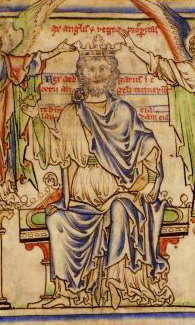
Edgar King of England.jpg

The sacrality of King Edgar's monarchy is recalled in this thirteenth century illumination in an anonymous Life of King Edward the Confessor
Cambridge University Library, MS Ee.3.59: fol. 3v

Image: Wikipedia


The second reason for the significance of the death of King Edgar was that it brought about the accession of his elder son as King Edward, who was to go down in history as the Martyr, he appears to have been illegitimate or of doubtful legitimacy, and only a boy or teenager at the time. His murder three years later and replacement by his younger, legitimate half-brother King Æthelred II, seemingly with the involvement of the new king's mother, set in motion those elements of instability and lack of political legitimacy that were to haunt King Æthelred the Unready [Unraed signifying No Counsel, a pun on his name which means Good Counsel] and his reign.

There is an online account at of King Edward the Martyr at Edward the Martyr, and the Oxford DNB life, by Cyril Hart can be seen at Edward [St Edward; called Edward the Martyr] (c.962–978); this again provides a more detailed account of his life and reign.

King Edgar died at Winchester, but he was not buried there with so many of his family, but at the abbey at Glastonbury. The abbot was St Dunstan, who as Archbishop of Canterbury was a major player in the King's reign, and the compiler and celebrant of the 973 coronation. By choosing to be buried at Glastonbury - and it seems right to assume that the King did that - he maintained his identification with the Dunstanian monastic reform and confirmed its alliance with the monarchy.

There appears to have developed something of a cult around King Edgar at Glastonbury, and on the eve of the dissolution of the abbey Under the last two abbots the Edgar Chapel was built on to the east end of the monastic church to contain his remains.

Model of Glastonbury Abbey 

Reconstruction model of Glastonbury Abbey on the eve of the dissolution.
The Edgar Chapel is on the extreme left.
Image:skyscrapernews.com/All rights reserved. Copyright Holder - GNU License 


Thursday, 23 January 2014

The Earliest English Royal Books


I have been meaning to finish writing this post for ages, and over the Christmas and New Year holiday I have found both my notes and the opportunity - and could just about decifer my handwriting on several scraps of paper. Last year in January I went to meeting of the Oxford Bibliographical Society to hear a lecture on "The Earliest English Royal Books" given by Prof. Richard Gameson from Durham University, and it was one of the most interesting and insightful lectures I have ever had the good fortune to hear.

The topic had arisen as a presentation he had made to the British Library in connection with the planning of their recent exhibition on the Old Royal Library, presented by King George III to the British Museum, and in it Prof.Gameson had outlined the importance of royal patronage of books in the Anglo-Saxon era. This he now presented to his hearers in Oxford with clarity, profound knowledge and understanding, as well a delightfully eccentric line in humour.

He began by referring to the earliest surviving catalogue of English Royal books, that of 1535, when the Royal library of 143 books was at Richmond Palace, and was a collection stemming from 1479 when it was inaugurated by King Edward IV. This leads to questions as to whether such catalogues do record the real range of books available to medieval monarchs and princes, and how books were categorised.

With the Anglo-Saxon world we have no Ex-Libris or library lists, and on a palaeographic approach the historian is more concerned with the scriptorium than with the owner. Furthermore there is a poor survival rate for books from this period.

The earliest English royal books of whose existence we can be certain are the service books of the chapel established about 580 for the Christan Queen Berth when she married the still pagan King Ethelbert of Kent. In the context of the life of the royal household such establishments did not necessarily mean that the kings were literate, but rather, as with the early law codes, that this was a society that was using the written word.

In the following century the scholarly King Aldfrith of Northumbria (685-704/5)possessed books, and collected them - we have record of his exchanging land for a Codex. With St Aldhelm (639-709) we have an intellectual of royal birth who goes into the Church, became an Abbot and then Bishop, and it is possible to reconstruct his library from references in his works, although none of his own manuscrpts survive.

Bede sent books to his King  and the court was a clearing house for such things. The King of East Anglia commissioned Felix's Life of St Guthlac. King Offa gave a Bible made at Jarrow to the cathedral at Worcester. Kings redistributed books around their realms.

Queen Osburgh is said to have encouraged the literary interests of her most famous son King Alfred (871-899), and he was certainly personally literate in later life. As King he gathered scholars around him and encouraged the copying and distribution of texts.

By his time it is possible to distinguish three classes of royal manuscripts - personal possessions for prayer and study or a life such as that by Asser, official texts such as law codes in Latin or Old English which were central to governance, and manuscripts that came into and went again from the king's possession.

Asser records that King Edward the Elder (899-924) owned books and learnt the psalter, and carried the collection forward to the next generation.


From the reign of his son King Athelstan (924-939) two manuscripts are known from his court, and we know of six or seven gifts he made to monasteries where they survived.

Unfortunately the Cottonian fire of 1731 claimed one with an illumination of the King with St Cuthbert, but the other example happily survives:


File:Athelstan.jpg

King Athelstan  and St Cuthbert

Image:Wikipedia

In the painting the saint is shown blessing the King who is reading - rather than presenting the book to Cuthbert - and the King is shown as literate, a man well able to exercise rulership.

I should add that Prof Gameson did offer an alternative interpretation of the picture - King Athelstan is offering a box of chocolates to the saint and saying "Personally I don't like the strawberry cremes" - I think that academic joke is now inextricably fixed in my mind with this famous depiction of Anglo-Saxon kingship.

To return to serious matters - the suggestion was made that King Athelstan saw books as diplomatic currency, and that it was the role of the King to give such books away to those who would use them.

His nephew King Edgar (957/9-975) is known to have presented a Gospel Book to the monastery at Ely and the two illustrated Canterbury copies of the Regularis Concordia are probably royal dedication copies:
 
King Edgar and St Dunstan

King Edgar and St Dunstan from the Canterbury Regularis Concordia

Image:traditioninaction.com 

The other famous contemporary manuscript depiction of King Edgar is the Winchester New Minster charter, probably commissioned by Bishop Aethelwold, but with the King's approval:

Circa 966: Cover from Charter for the dedication of New Minster, a Benedictine Abbey in Winchester England - King Edgar in supplication before Christ in majesty

The New Minster Charter circa 966
King Edgar offers prayers to Christ in Glory

Image:orthodoxartjournal.org

No books are recorded from the household of King Ethelred II (978-1016), but his eventual successor and supplanter King Cnut had a sacraments and psalter which was given to him by a monk of Peterborough, and which the King gave to Cologne. Emma of Normandy, Queen to both these Kings is known to have owned books and was the recipient of the Enconium Emma Reginae, as can be seen here:

http://www.anglo-saxons.net/images/emma_fullsize.jpg

Queen Emma is presented with the Enconium Emma Reginae
Her two sons, the future King Harthacnut and King Edward the Confessor, are peering round the curtain

Image: anglo-saxon.net


Queen Edith had a life of her husband King Edward the Confessor, Kings William I and William II are known to have given books to continental monasteries and King Henry I gave books to Waltham abbey, including one by Adelard of Bath.

Prof. Gameson then proceeded to look analytically at these books. In terms of quantity he had looked at eighteen individuals at fifteen courts, and he considered the evidence far from negligible as to royal ownership of books and comparable to what is known from the continent for the period. Given the passage of time this was not a bad survival rate for acytual manuscripts or for knowledge of books which no longer survive. King Aldfrith and King Alfred may have been exceptional but royal books were significant throughout the period.

The range was not easy to assess. Church books one would expect and they would be valued for their importance and quality. He believed there would have been a wide range of others, if only we could identify them. The Exeter Book from the reign of King Edgar is the type of book one might expect him to have had and the court or the Church a likely source.

Where these  royal books were made is unclear - as on the continent there is little evidence. Charlamagne and Lothair had a court scriptorium. There is nothing to distinguish such a source from a monastic one. King Alfred may have had such an institution in the latter part of his reign and King Athelstan had ascribe who wrote books. Much of the products of such work would have been legal texts, handbooks and also annals.

Royal imagery has survived in some manuscripts such as the New Minster charter depiction of King Edgar whilst the image of Queen Emma from the Enconium was rarer. The earliest known is that of King Athelstan with St Cuthbert, and that was sixty to seventy years earlier than continental examples. These all suggest royal appreciation of the importance of books and can be seen as part of the Alfredan inheritance.

One of the key points made was that royal books were regularly given away, and we know of these gifts from the records of the recipient monasteries. It was of the nature of royal collections for their contents to be transitory. It was seen as a charitable and pious thing to make texts available to those who could use them - the King was an educational benefactor by giving books to monks and churches. This approach may well have lain behind the great Library of King Charles V of France (1364-80) whose more than 917 volumes were later transferred by John Duke of Bedford to London and dispersed. I would add that that would also be a motivation for Duke Humphrey's great gift to Oxford of the latest classical texts in the 1430s - they were collected to be passed on for wider use, not hoarded as a private collection.

Anglo-Saxon royal books can be classified by type. Firstly there are those from the chapel - missals, homilies, both old and new, and which were in the care of the chaplains. Secondly there were reference works - law books, the text of the Anglo-Saxon Chronicle, educational texts such as those copied under King Alfred. Thirdly there were individual possessions, which would obviously would vary with the different interests of individual owners. Fourthly there were royal gift books of high prestige - including ones which might have been encouraged an outside scriptorium to produce.

We may have little hope of identifying individual manuscripts as parts of an Anglo-Saxon royal collection. For later centuries there is more hope of identifying owners, but Prof Gameson considered what had once existed as significant as later collections, and maybe more important than that of the Norman kings. The importance of the King and court as a centre of textual distribution was striking. it is difficult to measure the success of such gift giving, but distribution was seen as preferable to hoarding.

All in all a wonderfully stimulating and informative lecture, which I hope I have done at least some justice to in these notes.


Saturday, 11 May 2013

The Coronation of King Edgar 973


May 11th 973 was Pentecost Sunday and the day chosen for the coronation - or perhaps or probably - re- coronation of King Edgar at Bath abbey. Today is therefore the 1040th anniversary of that event.


http://www.nndb.com/people/748/000093469/edgar-i-1-sized.jpg

King Edgar
This illumination from 966 shows him already crowned, seven years before the ceremony of 973

Image:nndb.net

The life of the King by Ann Williams from the Oxford Dictionary of National Biography can be read here. He may not have been the most physically impressive of monarchs - William of Malmesbury (c.1080-1143) described his as being " extremely small both in stature and bulk..."  in his Gesta Regum Anglorum - but he was an extremely successful ruler, and his coronation at Bath proved to be the precedent for all subsequent such ceremonies. Thus the coronation of the present Queen 980 years later in 1953, followed the lines laid down for her ancestor.

It was not the first coronation of an English king - Mercian and West Saxon rulers had been crowned before him, but the ceremony at Bath appears to have been conceived to emphasise the divinely sanctioned royal authority of king as not hitherto. It may have originate d in a reworking of the idea of a ceremonial crown wearing, as was certainly the later practice of Anglo-Norman kings at Christmas, Easter and Pentecost, and elevated to a new, amplified  rite of coronation.
King Edgar may had been consecrated first time upon his accession in Mercia c. 957 or in Wessex c. 959, but there is no contemporary source to verify it. A doubtful evidence is given in the work of Ralph of Diceto, who recorded two consecrations of Eadgar. According to Ralph, the allegedly first consecration was performed by Archbishop Oda at Canterbury:
Edgarus rex Anglorum Dunstanus abbas ab eo revocatus, ecclesiae Wigonensis electus antistes, consecratus est ab Odone Cantuariensi archiepiscopo apud Cantuariam.
If Ralph recorded a true historical fact, it could not have happened later than in 961, when Archbishop Oda died, but the validity of this claim is hard to prove. On the contrary, the consecration of Eadgar at Bath in 973 is well documented in the Anglo-Saxon Chronicle, which includes a poetic account of this solemn ceremony held on Pentecost day (11 May 973). Further details are found in John of Worcester's entry for 973:
Edgar the Pacific, king of England, received the benediction of the bishops SS. Dunstan and Oswald, and all the other bishops of England; and was crowned and anointed as king with great pomp and ceremony at the city of Acamann [Bath?] ... on the fifth of the ides of May, being Whitsunday.
Ralph of Diceto recorded that this consecration was performed by two archbishops, Dunstan of Canterbury and Oswald of York:

Eadgarus rex Anglorum ab archiepiscopis Dunstano Dorobernensi et Oswaldo Eboracensi consecratus est in regem in civitate Acheman, qui duos filios Eadmundum et Egelredum ex Ælfritha Ordgari ducis filia suscepit.

The choice of Bath for this great occasion seems likely to have been dictated by several factors. As the largest town in Somerset it was at the heaert of both the West Saxon dynasty's patrimony, and close to Dunstan's base at Glastonbury abbey. Bath was a Roman settlement in origin, and Anglo-Saxon kings often liked to emphasie ther inhertance from the Roman empire. Like Aachen, coronation place and administrative centre for Charlemagne and his successors, Bath had thermal springs which had been a Roman spa, and continued to be used for healing. The symbolism of baptism and regeneration, of healing and life giving waters would be appreciated by those attending.

The choice of Pentecost also emphasied the King's sacrality, marked out to rule on the great feast of the bestowal of the Holy Spirit. The King and Archbishop stressed this further by holding the coronation when the King was  29, or, more signifiantly, in his 30th year - 30 being the minimum age for episcopal consecration.

Following the coronation the King travelled to Chester, where he was ceremonially rowed along the river Dee from the city to the church of St John the Baptist by six or, according to later writers, eight tributary kings. This symbolised King Edgar's ascendancy as head of the the rulers of Britain. In later centuries it was recalled, notably in the Stuart era, where the scene was depicted on King Charles I's great ship Sovereign of the Seas - and one of the shortlived sons of the future King James II was named Edgar in honour of the Anglo-Saxon monarch.


Something of the politico-religious ethos and culture of the reign can be seen in this complete view of Winchester New Minster charter of 966 - one of the great surviving treasures of the period - showing the King, flanked by saints, offering his charter for the abbey to Christ in Majesty:


New Minster charter of 966
 BL Cottonian MS  Vespasian A viii

Image: Wikipedia

A similar idea of the royal state kept by the King and his archbishop can also be seen here:


King Edgar and St Dunstan


King Edgar and St Dunstan from the Canterbury Regularis Concordia 

Image:traditioninaction.com