Once I was a clever boy learning the arts of Oxford... is a quotation from the verses written by Bishop Richard Fleming (c.1385-1431) for his tomb in Lincoln Cathedral. Fleming, the founder of Lincoln College in Oxford, is the subject of my research for a D. Phil., and, like me, a son of the West Riding. I have remarked in the past that I have a deeply meaningful on-going relationship with a dead fifteenth century bishop... it was Fleming who, in effect, enabled me to come to Oxford and to learn its arts, and for that I am immensely grateful.


Showing posts with label Danish monarchy. Show all posts

Tuesday, 18 July 2017

The Order of the Elephant


Royal Central has a post today about the highest Danish order of Chivalry which I am reproducing, with minor corrections and apologies for it being off-centre in alignment - and adding a second post
about the Order  and a few extra points of my own afterwards. This year is the 570th anniversary of its foundation, if it does go back to 1457....


Taking a look at the Order of the Elephant

by Oskar Aanmoen
The Order of the Elephant is the highest Danish Order one can receive and is usually handed out only to members of royal families or heads of state. The order was founded by the Danish monarch in 1457, and after a short break, it was reintroduced in 1580. Since then it has been distributed to a number of people.
It was His Majesty King Christian I of Denmark and Norway who introduced the order in 1457. The King was married to Dorothea of Brandenburg, and the brotherhood was most likely inspired by the Brandenburg Swan Order, which was established in 1440.
Coat of arms of Frederick IV of Denmark and Norway surrounded by the collars of the Order of the Elephant and the Order of the Dannebrog. 
Photo: Sodacan via Wikimedia Commons.
The Order was approved by Pope Sixtus IV in 1474. During King Christian II's reign, the brotherhood ceased, but it was restored as the royal knight order under the rule of His Majesty King Frederick II. The Order consisted of only one class and has insignia designed with an elephant as the badge. The elephant has been the symbol of the Order until today.
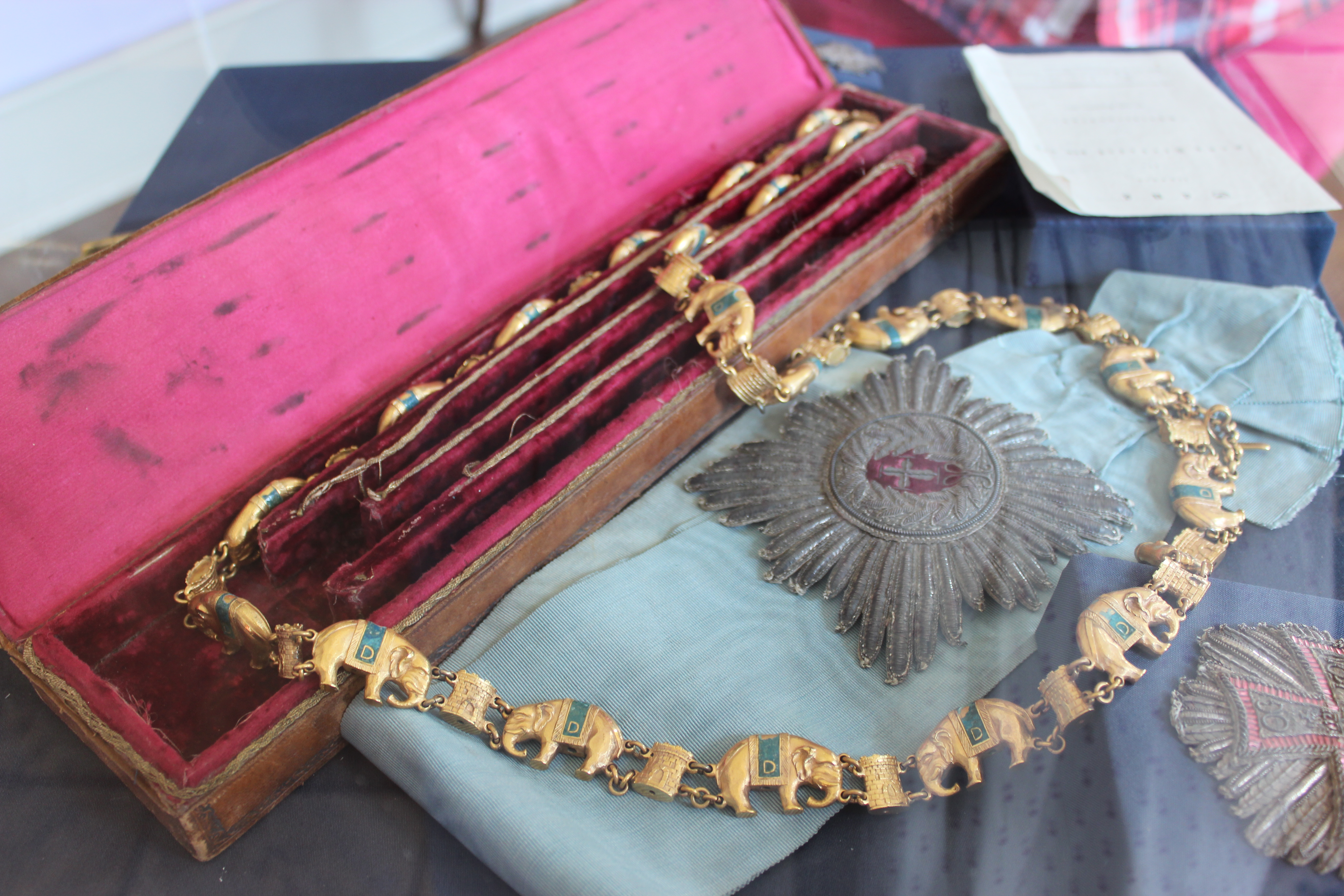
An older version of the Order exhibited at the museum. 
Photo: Toxophilus via Wikimedia Commons.
Until 1808, the order was distributed to only royals, but after 1808, the order has been presented to non-royals. From 1892, it was also awarded to the Queen of Denmark, not just the King, and from 1958 the Order of the Elephant has been fully open to all women, regardless of whether they are royal or not.
Denmark's ruling monarch is the head of the order; this is today Her Majesty Queen Margrethe II. Today, the Order is administered by the “order-chapter,” which is subject to the Danish Royal Court. The Order of the Elephant still holds its headquarter in Frederiksborg Castle Church and the coat of arms of all the recipients of the order.

Frederiksborg Castle, with the elephant fountain in front. 
Photo: Johan Jacob Bruun via Wikimedia Commons.
During the Second World War, a number of influential people from the allied countries were honoured with the Order of the Elephant. In 1945, Field-Marshal Bernard Montgomery and General (later US President) Dwight D. Eisenhower were appointed as knights. In 1950, the order was awarded to Winston Churchill, although he was no longer the Prime Minister of the United Kingdom.
As of today, approximately 800 people have been awarded the order, and during the rule of Her Majesty Queen Margrethe II, the Elephant Order has only been given to one ordinary Danish citizen, which occurred in 2000.


There is more about the Order in this post from the blog unofficialroyalty.com:

The two Royal Orders of Chivalry in Denmark are The Order of the Elephant (Elefantordenen) and The Order of Dannebrog (Dannebrogordenen). The granting of either Order is solely at the pleasure of the Sovereign, unlike some other countries where they are granted on the advice of the government.

The Order of the Elephant

Although the statutes defining this order were established in 1693 by King Christian V, its history dates back to the 15th century. It is believed to originate with a religious group who conferred a similar emblem to members of the Danish aristocracy during the reign of King Christian I (1450-1481). This consisted of a badge of the Virgin Mary holding her Son within a crescent moon, surrounded by the rays of the sun, hanging from a collar of links in the form of elephants. After the religious group died out, King Frederick II continued to award a badge of an elephant, with his profile on its side. This is believed to have been inspired by the chaplain’s badge from the religious group, which was also in the shape of an elephant. In 1693, King Christian V established the statutes for the Order as we know it today. These statutes were amended in 1959, allowing women to be created members. There is only one class – Knight of the Order of the Elephant.
As with most orders of chivalry, the Danish sovereign is the head of the order. While at one time the Order was granted primarily to foreign royalty and Danish noblemen, it is now granted primarily to members of the Danish Royal Family and foreign Heads-of-State. On rare occasions, it has been granted to a commoner.
The Badge of the Order is a white-enamelled gold elephant, with a cross on one side, and the reigning Sovereign’s monogram on the other. The elephant holds a tower on its back, and a Moor holding a spear on its neck. The badge is primarily worn suspended from the Sash of the order. This sash, made of light blue silk moiré, is worn over the left shoulder, with the badge resting on the right hip.
The Star of the Order is an eight-point silver star, with a cross of diamonds on a red disc. This is surrounded by a silver wreath of laurel leaves. The Star is worn on the left breast whenever the sash is worn.
The Collar of the Order is made of gold, in alternating links of towers and elephants. This is only worn on two occasions every year – the New Year’s Court and the Sovereign’s birthday.
The Clever Boy will add that he has posted about the Order before in The Order of the Elephant
in 2012. Some of the dates in that post and its sources are slightly different to the ones given in the post above, indicating the rather obscure early days of the Order. As a revival of the late seventeenth century it is rather like the two revivals of the Order of the Thistle by King James VII in 1687 and by Queen Anne in 1703.

King Christian V in the robes of the Order.

These are very similar in design to the contemporary robes of the Order of the Garter and the French Royal orders. The red mantle with white lining uses the national colours of Denmark

It was King Christian V who issued new statutes for the Order in 1693, in the earlier days of Danish absolutism.

Image: A Polar Bears Tale Blog

Unlike the British Orders the robes are no longer worn on ceremonial occasions but the chapel at Frederiksborg is in many ways reminiscent of the chapels at St George's Windsor, St Giles in Edinburgh and that of the Order of the Bath at Westminster Abbey, and of the Chapel of the Order of the Seraphim in Sweden.

The Chapel of the Danish Royal Orders is at Frederiksborg Castle, A more than 300 years old – and still living – tradition of displaying the armorial plates of Knights of the Order of the Elephant and Knights Grand Cross of the Order of the Dannebrog in the Chapel of the Royal Orders has resulted in an impressive collection of heraldry. The current armorial plates are the work of Ronny Andersen (Royal Herald Painter). The armorial plate of Crown Princess Mary can be seen on the link to the Chapel given at the beginning of this paragraph.


The Crown Prince and Crown Princess of Denmark wearing the riband and star of the Order of the Elephant
Crown Prince Frederik is also wearing the star and neck badge of the other Danish Order, that of the Dannebrog

Image: Daily Mail


As to the symbolism of the Order I wrote as follows in 2012:

Why the Elephant? Elephants were no more common in fifteenth century Denmark than they are now. The probable reason why the elephant was chosen to symbolize the Order was that the battle elephant was used as a symbol of the champion of Christianity, roused by the sight of Christ's blood. In addition the elephant was the symbol of chastity and purity. Medieval typology found several symbolic links between Christ and the elephant, and it is significant that the central medallion of the star of the Order bears the cross as its device.

There is a List of Knights of the Order of the Elephant  covering the period from the reign 
of King Christian IX ( 1863-1906) down to the present day.


Saturday, 13 August 2016

Scandinavian Monarchies in WWII


Recently the Mad Monarchist posted an interesting piece about World War II and the Scandinavian Monarchies which draws several themes together. 

I am not quite sure if I agree with the Mad Monarchist in his tendency to see decline in the story he unfolds. Thus in Sweden the constitutional changes ( whether you agree with them or not ) consolidated into law in 1974 were ones which had developed over the preceding three-quart-rs of a century and Swedish commentastors conside rthe monarchy there more popular than in the past. I recall both before and when the present King came to the throne in 1973 journalist were inclined to write off the Swedish monarchy as finished in an age of social democracy. In reality a young King and Queen and their family held the attentuion and loyalty of the majority,and if you follow theses things at all it is clear the Swedish monarchy is no stanger to public splendour and ceremonial  - barely a bicycle in sight. It was back in 1907 that, very regretably, and on the grounds of cost, that the Swedish royal house, abandoned the coronation ritual; such a change is not recent.

Similarly in Norway the coronation ceremony has not been obligatory soon after 1906. I greatly regret that, but the more muted inaguration of King Olav V in 1957 was followed by a more elaborate ceremony in 1991 for King Harald V according to Norwegian friends.

Denmark gave up the coronation in 1863, but the monarchy retains apublic ceremonial face which is impressive.

In both Denmark and Sweden the condtitutional clashes over the King's powers were made manifest in the First World War or its aftermath, not the Second.

The article is also interesting in bringing out the differences between the the kingdoms, perhaps exacerbated for the Danes and Norwegians by Swedish neutality in the years cafter 1940.


Tuesday, 17 June 2014

Vikings at the British Museum


Yesterday I visited the British Museum to see their current exhibition Vikings:life and legend. The day was organised by the new Director of the Museum of the History of Science here in Oxford for the permanent staff of the Museum and those of us who work there part-time.

This was therefore another early start but it did mean we were able to fit a lot into the day. On arrival we were welcomed and given a tour of the new World Conservation and Exhibition Center, which is linke dto the new sainsbury exhibition centre. The WCEC enables conservation and lending or receipt of items with state of the art technology, and is still in the process of being commissioned.

After this, and atour of parts of the labyrinth of passageways under the Museum, we broke for lunch. At this time of year the British Museum is very busy indeed and the Great Court around the old Reading Room is like the concourse of a railway station, not least in its echoing sounds. Nonetheless it is an imaginative use of the space.

Early afternoon we met up again to look at the recent redisplay of the Sutton Hoo finds. En route I did manage to have a reasonably good look at the Royal Gold Cup, about which I have written previously, and some other objects from medieval England and Europe.

The redisplay of the medieval material is a significant improvement on the previous dispalys, and the Sutton Hoo treasure is very much, and rightly, centre stage. The designer of the display spoke about the use of new technology as it had been used to highlight these wonderful things, and the helmet and other items from the seventh century court of a dynasty with strong Scandinavian was an excellent lead-in to the exhibition on the ninth to eleventh century Vikings.

We were given an introduction to the exhibition by Gareth Williams, one of the organisers and co-editor of the accompanying book. The BM's website has an introductory press-release which can be read at Vikings: life and legend.

The Museum's last exhibition on the theme had been in 1980, and this one, organised in conjunction with the National Museum of Denmark in Copenhagen and one in Berlin was built around a core of objects which each participating museum then presented in their own way. One change since 1980 was a change in official thinking in Russia - no longer is the period seen as purely Slavic - the Vikings of Rus are no longer air-brushed out of history. and on Now there is access to material from there and from the Ukraine. The present exhibition focussed on new discoveries the extent of Scandinavian migration and trade links in what nmight be termed the late Iron Age, but that the term Viking was an infinitely better selling ploy to modern audiences! Whilst it brought out the wealth of the period, it did not seek to avoid the fact that this was also a violent age - the "Fluffy Vikings" of a few years ago in historical presentation are consigned to their own interpretive past.

The exhibition is in the new sainsbury gallery, but the first two rooms were crowded and the expereince somewhat uncomfortable, with low light levels, other than that illuminating the objects, background dialogue in Scandinavian languages to provide a type of "mood-music" and crowds pressing around the display cases. Once you got accustomed to that then there were splendid things to see.

I was struck by the richness and splendour of the material culture of the Viking elite with their jewellery for both men and women and splendid swords, and records of red cloaks and evidence of substantial houses - as illustrated by the reconstrucyted example at Borg in Norway.

Amongst the discoveries on display was the Vale of York hoard, found a few years ago near Harrogate, and apparently buried about 927 when King Athelstan first occupied the Kingdom of York.

In the main exhibition space wa steh highlight of the whole display - the largest Viking ship found (to date), from Roskilde. Ironically it came to light as plans were carried out to extend the ship museum there. It probably required forty pairs of rowers, and though only about 20% of the timbers survive the cradle in which it is displayed indicated the scale of the vessel. In its day it was, I suspect, the equivalent of later ships such as the Grace Dieu of King Henry V, the Vasa of King Gustavus Adolphus, a pre-1914 Dreadnought or a modern aircraft carrier. Dated to circa 1025 it may well have been commissioned by King Cnut following his conquest of Norway and using timber from there to impress his subjects and potential enemies by his authority. In that sense it still works.


Nearby was a facsimile of the  Jellinge stone erected at Jellinge in Jutland to commemorate King Gorm the Old and his Queen by their son King Harold Bluetooth in the late tenth century. Coloured as it would have been originally, and with the Crucifixion on one side and a distinctive dragon on the other - hence the use of the term Jellinge style - and its inscription in which King Harold listed his achievements of ruling Denmark, acquiring Norway and making the Danes Christian, it is, like the ship, an expression of growing royal authority in Scandinavia. That process, which included the development of coinage, derived no doubt from contact with Englsih and Frankish society on raids and traing expeditions.

Showing that not all Viking raids were successful there was a display of some of the remains of the Vikings killed in the Ridgeway Hill massacre near Weymouth about the year 1000. Clearly the Anglo-Saxons were not always defeated, and quite nifty at eliminating what may well be the fifty or so members of a Viking ship crew with raiding in mind which ventured onto the Dorset coast.

There were interesting displays about Viking pre-Christian religious belief - which now appears shamanistic in may respects, and included the warrior tradition of going berserk in battle, that is believing oneself to have bear-like strength and fighting without armour, being probably under the influence of hallucinogenic plants. The Lewis chessmen, who were on display, biting the tops of their sheilds are possibly under such influence. There was also a stone Manx cross fragment linking Christ and the Norse gods.

The legacy of the Vikings was illustrated not only by place-names, especially in counties such as Lincolnshire, and the many words in English of Viking origin, but also a map illustrating Norwegian DNA and its distribution, and indeed concentrations, in the areas of Scandinavian settlement in Britain - the Vikings are still with us in England because they are, so to speak, part of us.

The exhibition shop was very tempting, and with awide range of goods to buy. I managed not to succumb, but did rather fancy a tie with parts of the Bayeux tapestry reproduced on it and cuff-links with the Sutton Hoo helmet as their face.

A splendid exhibtion once one got through the initial log-jam of visitors and plenty to feast the eyes and the historical imagination. Many thanks indeed to the Directory of the Oxford MHS for organising the day.


Friday, 20 January 2012

The Order of the Elephant


My posts The Queen of Denmark and Danish Jubilee celebrations about the fortieth anniversary of the accession of Queen Margrethe II prompts me to post something about the oldest of the Orders of the Danish Crown - the Order of the Elephant.

Believed to have been initially founded around 1462
the Order of the Elephant was to be the Danish version of the two most famous pre-existing European Orders, the Garter (1348) and the Golden Fleece (1430), and can be seen as part of that process which led to the creation of royal chivalric Orders across the continent in the late middle ages - examples include those of the Annunciation in Savoy, the Dragon in Hungary, the Star and later that of St Michael in France, and, probably, the Thistle in Scotland.

Why the Elephant? Elephants were no more common in fifteenth century Denmark than they are now. The probable reason why the elephant was chosen to symbolize the Order was that the battle elephant was used as a symbol of the champion of Christianity, roused by the sight of Christ's blood. In addition the elephant was the symbol of chastity and purity. Medieval typology found several symbolic links between Christ and the elephant, and it is significant that the central medallion of the star of the Order bears the cross as its device. In the 1470s King Christian I had the Order confirmed by the Pope.

However with the advent of the Lutheran reform to Denmark it fell into semi-disuse, as indicated in this online article about the Order. However the Order does appear to have continued to be bestowed, as in the pictures below, and appears on coin portraits of the Kings, so the revival of 1693 appears to be a revival of an existing Order rather than the revival of an entirely dormant one.


King Christian IV (1577-1648), King of Denmark and Norway wearing the Order


Christen Thomesen Sehested,
A painting of the 1600s, before the re-establishment of the Order in 1693
artist unknown

The Danish astronomer Tycho Brahe
Another example of the Order from before 1693


Wolfgang Heimbach:
Christian Rantzau (1614-1663)

Images: A Polar Bears Tale blog


The statutes establishing it as it is today were laid down by King Christian V on 1 December 1693. The King's new system of orders of chivalry was a means to create a new structure of social rank in Denmark. With the introduction of absolutism in 1660, the old nobility had been stripped of its privileges, but the nobility was still a factor of political and economic importance. To break its power, the King sought to create a new elite of burgesses and foreigners who could be useful to the King. Alongside the Elephant was the Order of Dannebrog founded by the King in 1671.

As with the Garter, Thistle and Patrick in the United Kingdom, or Orders such as the Golden Fleece and the Holy Ghost the Order consists of only one class, that of Knight. The riband is pale blue and, like the Garter and the Thistle, is worn over the left shoulder - most Orders have the riband over the right shoulder.

Since 1693 there has been the Chapel of Orders in Fredriksborg Palace, where the arms of recipients of the Danish royal orders are displayed on the walls. The chapel witnessed eight coronations between 1671 and 1840.

Today, the Order of the Elephant is awarded according to the statutes worked out under King Christian V in 1693. The statutes were amended by King Frederick IX on 9 April 1958 by a Royal Ordinance, so that both men and women may be awarded the Order.


This Elefantorden - Order of the Elephant -
belonged to the Danish King Christian V (1646-1699)
This badge was made in 1670 by Paul Kurtz, and
the King had the castle on the elephant's back turned
into a whistle...he used it while hunting north of
Copenhagen in Dyrehaven.


King Christian V in the robes of the Order.

These are very similar in design to the contemporary robes of the Order of the Garter and the French Royal orders. The red mantle with white lining uses the national colours of Denmark


The statutes of The Order of the Elephant December 1st 1693

Images: A Polar Bears Tale blog

http://dkks.dk/assets/import/_resampled/pageimageoverlay-a61012-2wl.jpg

Collar and badge at Rosenborg Castle

http://dkks.dk/assets/import/_resampled/pageimageoverlay-a61016wl.jpg

The star of the Order

Images:dkks.dk


Thursday, 19 January 2012

Danish Jubilee celebrations


A friend has sent me the link to an illustrated article in the Daily Mail about a gala dinner for the extended and interconnected Scandinavian royal houses to celebrate the fortieth anniversary of the Queen of Denmark's reign. The style is perhaps rather typical of the paper, and the comments, as usual, fairly ( or completely) barking, but the photographs very splendid. The article can be viewed here.

Saturday, 14 January 2012

The Queen of Denmark


Today is the fortieth anniversary of the accession to the throne of Queen Margrethe II of Denmark.

There is an online biography of the Queen here, and her official website can be viewed at Danish Monarchy. To mark her jubilee the Queen gave an interview to the BBC which can be seen here.


http://www2.pictures.gi.zimbio.com/Dinner+Christiansborg+Palace+gJoMZ-D9RQ4l.jpg

The Queen of Denmark

Image:zimbio.com

Queen Margarethe combines grace and style with a forthright approach to her duties as monarch and to life in general, and is both popular and respected by her own subjects and by her admirers overseas.

Long may she reign.

Friday, 14 January 2011

The Queen of Denmark

Her Majesty The Queen, 2005

Her Majesty The Queen of Denmark

Credits: Steen Evald, from the Danish Monarchy website

Today is the 39th anniversary of the accession to the Danish throne of Queen Margrethe II in 1972. It seems appropriate to express good wishes on this occasion as Her Majesty enters the fortieth year of her reign, and also to congratulate the Crown Prince and Crown Princess on the birth of twins last Saturday.

In addition to being an exemplary monarch the Queen is both an archaeologist and an artist who is widely esteemed by her people. Her reign has seen the continuation of the stability the monarchy has brought to Denmark and it associated realms.

The excellent official website of the Danish Monarchy can be viewed at here, and there are also Wikipedia articles about the Queen and the Danish Monarchy.