Once I was a clever boy learning the arts of Oxford... is a quotation from the verses written by Bishop Richard Fleming (c.1385-1431) for his tomb in Lincoln Cathedral. Fleming, the founder of Lincoln College in Oxford, is the subject of my research for a D. Phil., and, like me, a son of the West Riding. I have remarked in the past that I have a deeply meaningful on-going relationship with a dead fifteenth century bishop... it was Fleming who, in effect, enabled me to come to Oxford and to learn its arts, and for that I am immensely grateful.


Showing posts with label Norwegian Coronation. Show all posts

Saturday, 13 August 2016

Scandinavian Monarchies in WWII


Recently the Mad Monarchist posted an interesting piece about World War II and the Scandinavian Monarchies which draws several themes together. 

I am not quite sure if I agree with the Mad Monarchist in his tendency to see decline in the story he unfolds. Thus in Sweden the constitutional changes ( whether you agree with them or not ) consolidated into law in 1974 were ones which had developed over the preceding three-quart-rs of a century and Swedish commentastors conside rthe monarchy there more popular than in the past. I recall both before and when the present King came to the throne in 1973 journalist were inclined to write off the Swedish monarchy as finished in an age of social democracy. In reality a young King and Queen and their family held the attentuion and loyalty of the majority,and if you follow theses things at all it is clear the Swedish monarchy is no stanger to public splendour and ceremonial  - barely a bicycle in sight. It was back in 1907 that, very regretably, and on the grounds of cost, that the Swedish royal house, abandoned the coronation ritual; such a change is not recent.

Similarly in Norway the coronation ceremony has not been obligatory soon after 1906. I greatly regret that, but the more muted inaguration of King Olav V in 1957 was followed by a more elaborate ceremony in 1991 for King Harald V according to Norwegian friends.

Denmark gave up the coronation in 1863, but the monarchy retains apublic ceremonial face which is impressive.

In both Denmark and Sweden the condtitutional clashes over the King's powers were made manifest in the First World War or its aftermath, not the Second.

The article is also interesting in bringing out the differences between the the kingdoms, perhaps exacerbated for the Danes and Norwegians by Swedish neutality in the years cafter 1940.


Tuesday, 29 July 2014

St Olav


In addition to today being the feast of St Martha it is also the feast day of St Olav, King of Norway, who was killed in battle on this day in 1029. He is the patron saint of Norway, and in medieval constitutional theory the eternal or perpetual King of Norway. Thus it is his crown which is the crown of the kingdom - although it is in actual fact a handsome nineteenth century piece - and Trondheim, the burial place of St Olav, became the traditional place for the crown to be kept and for the King's coronation.

There is an illustrated online account of St Olav here. I have posted about him before in St Olaf's day in 2011 and in St Eystein, in 2012. 

Here is a picture of  the striking life sizestatue of St Olav in the entrance to the church dedicated to him and which is the Norwegian church in London:

Norwegian Church and Seamen's Mission 

Image:londontown.com

 I posted about the church in Rotherhithe in A corner of London that is forever Norway earlier this year.

 This is therefore a day upon which to remember and pray for my own Norwegian friends, and for the King and people of Norway. May St Olav continue to intercede for them.

Thursday, 26 January 2012

St Eystein


Continuing the Scandinavian theme today is the feast of, amongst others, St Eystein of Nidaros (d. 1188). Eystein (also spelled Øystein; latinized as Augustinus) Erlendsson, was a member of a well connected noble family in Norway, and was perhaps educated in Paris and had been chaplain and steward to King Inge Krokrygg before the latter appointed him Archbishop of Nidaros (today's Trondheim) in 1158 or 1159, an action confirmed by Pope Alexander III in 1161 when Eystein was in Rome. Eystein promoted the adoption of canonical life by Norwegian parish priests, officiated at Norway's first royal coronation (that of Magnus Erlingsson, a minor), and fostered the cult of King St. Olaf (buried in Eystein's cathedral), whose liturgical Office he wrote and whose Miracula he expanded. During the years 1181-83, when King Magnus had been dislodged from his throne in a civil war, Eystein was an exile in England. Trondheim has remained the site for Norwegian coronations and inaugurations, and the items of the regalia are preserved there.

Miracles were reported early at Eystein's tomb and he was proclaimed a saint at a Norwegian synod in 1229. Attempts in the Middle Ages to have him canonized papally were unsuccessful. Eystein entered the Roman Martyrology in 2001 with the designation of Sanctus. The present seminary in Oslo is under his patronage

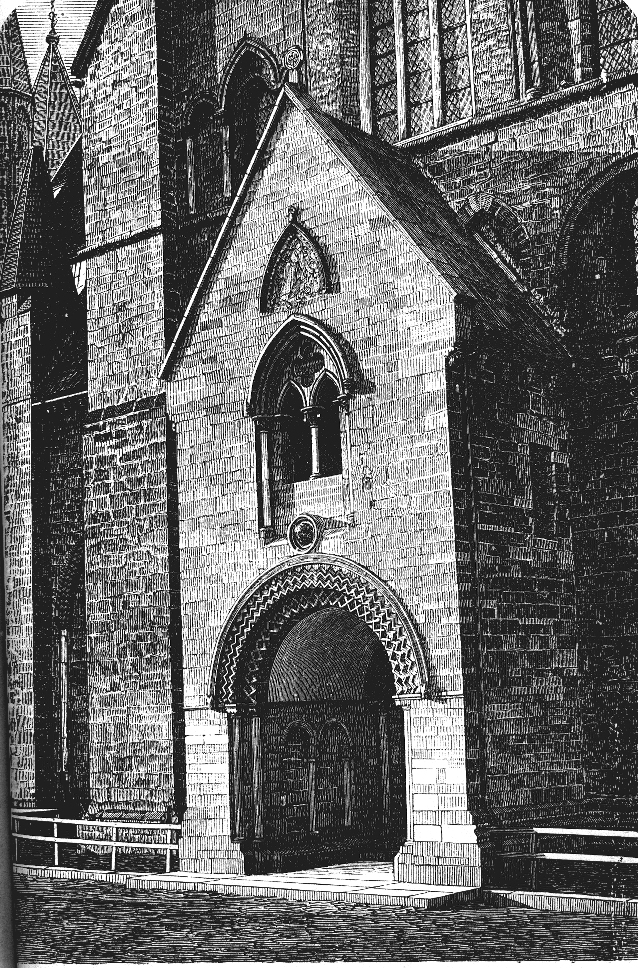
Apart from the Passio sancti Olavi (BHL 6233, 6323; part of Olav's Office), Eystein's chief monument today consists of the chapter house and the lower portions of the transepts of the since much added to and rebuilt Nidaros Cathedral in Trondheim.


The porch of the north transept of Trondheim cathedral.
A view from 1885

Image: Wikimedia

This view of the cathedral from 1857 shows the north transept and, next to the choir, the chapter house (the latter with a neo-romanesque apse added in the nineteenth century) :

http://upload.wikimedia.org/wikipedia/commons/d/db/Nidarosdom_1857.jpg

Image: John Dillon

The subsequent restoration and rebuilding work has transformed the building as can be seen in these illustrated online articles about Trondheim cathedral here and here and one about the west front can be seen here.

In the Victoria and Albert Museum there is a late fourteenth-century walrus ivory crozier head with traces of gilding which is of Norwegian origin and portrays King St. Olaf on one side and, on the other a bishop whom the V&A cautiously says "probably represents St Augustine" without further indicating whether the Augustine in question were he of Hippo or he of Nidaros. In view of his promotion of St Olaf's cult, Augustine / Eystein of Nidaros would be a good guess:


St Augustine/Eystein


St Olav

Images :Victoria and Albert Museum website

Quite apart from its indication of the cult of St Olav and St Eystein this crozier is also a reminder of the elegant sophistication of late medieval Norwegian art.

Adapted from John Dillon's post for today on the Medieval Religion discussion group

Tuesday, 17 January 2012

King Harald V of Norway


Today being the twenty-first anniversary of the accession of the King of Norway I am republishing my post about him and the Norwegian regalia which I wrote on this day last year. It can be read at The King of Norway.

In doing so may I renew my prayers and good wishes for the King and people of Norway, and especially for my Norwegian friends.

Wednesday, 22 June 2011

Norwegian Coronation 1906


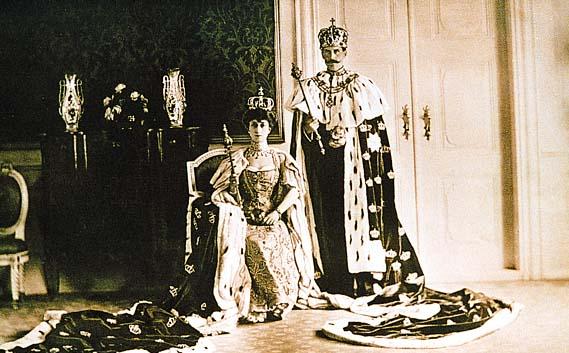
Today is also the 105th anniversary of the coronation in Trondheim cathedral of King Haakon VII and Queen Maud as King and Queen of Norway in 1906. This followed from the dissolution of the union with Sweden in 1905 and the selection of Prince Carl of Denmark and his wife Princess Maud, daughter of King Edward VII as King and Queen. The new King assumed the name Haakon, the same name as the last independent King of Norway six centuries earlier.


King Haakon VII and Queen Maud following their Coronation in 1906.

There are some fine photographs of the Coronation - the first anywhere at which the ceremonies inside the cathedral were to be photographed - and of the ceremonies around it here, as well as articles about the history of the Norwegian coronation. There is a link to archive film here.


Here are two other photographs I found of the ceremonial inside the cathedral:


photo

In this photograph the King is at the bottom left, and the Queen to the right. Her brother the Prince of Wales, the future King George V, can be clearly seen in the centre in front of the group of foreign representitives

photo


Regrettably, very regrettably in my opinion, in 1908 the Norwegian parliament removed the clause from the Constitution making coronation at Trondheim mandatory.

The argument was that in a democratic age the rite of coronation marked the King out as having a superior authority. True - he does. In consequence the Coronation was no longer required, although not abolished. It perhaps an early example of Scandinavian secularism, rather like the decision in Sweden in 1907 not to have a coronation for King Gustav V on the grounds of expense. In Norway at the accession of King Olav V in 1957 he was able to arrange a service of Benediction at Trondheim, and I understand that that in 1991 was a more elaborate occasion. There is a good article about the history of the Norwegian coronation and the modern benediction rite here.

There is an article about the Norwegian regalia - which is kept at Trondheim, expressing the concept that the King holds the Kingdom from St Olav - here, and one about the King's crown, made for King Carl Johan, here.

http://i30.photobucket.com/albums/c303/FredrikBergow/Kroner/Norgeskongekrone.jpg

The Crown of the King of Norway


http://i30.photobucket.com/albums/c303/FredrikBergow/Kroner/Norgesdronningkrone.jpg
The Crown of the Queen of Norway

photo

The Crown of the Crown Prince of Norway

Monday, 17 January 2011

The King of Norway


Today is the twentieth anniversary of the accession of King Harald V to the throne of Norway.


H.M.The King of Norway, H.M. the Queen of Norway, H.R.H. The Crown Prince and H.R.H The Crown Princess

There is a biography of the King here and an article about the Norwegian monarchy here.
In recent years the marriages of the King's children have attracted rather more international media coverage than might have hitherto been expected, and have helped to keep the Norwegian monarchy in the public gaze. The official website on the monarchy can be viewed at Norwegian Monarchy.

Today I join my Norwegian friends in expressing good wishes to their King on this anniversary.

On June 23 1991 the King and Queen attended the service for their benediction at Trondheim Cathedral, which replaces the traditional Coronation rite.

Regrettably, very regrettably in my opinion, in 1908 the Norwegian parliament removed the clause from the Constitution making coronation at Trondheim mandatory. The argument was that in a democratic age the rite of coronation marked the King out as having a superior authority. True. In consequence the Coronation was no longer required, although not abolished. It perhaps an early example of Scandinavian secularism, rather like the decision in Sweden in 1907 not to have a coronation for King Gustav V. At the accession of King Olav V in 1957 he was able to arrange a service of Benediction at Trondheim, and I understand that that in 1991 was a more elaborate occasion. There is a good article about the history of the Norwegian coronation and the modern benediction rite here.

There is an article about the Norwegian regalia - which is kept at Trondheim, expressing the concept that the King holds the Kingdom from St Olav - here, and one about the King's crown here.

http://i30.photobucket.com/albums/c303/FredrikBergow/Kroner/Norgeskongekrone.jpg

The Crown of the King of Norway


http://i30.photobucket.com/albums/c303/FredrikBergow/Kroner/Norgesdronningkrone.jpg
The Crown of the Queen of Norway

photo

The Crown of the Crown Prince of Norway


King Haakon VII and Queen Maud after their Coronation in 1906.


The Royal Arms of Norway