Once I was a clever boy learning the arts of Oxford... is a quotation from the verses written by Bishop Richard Fleming (c.1385-1431) for his tomb in Lincoln Cathedral. Fleming, the founder of Lincoln College in Oxford, is the subject of my research for a D. Phil., and, like me, a son of the West Riding. I have remarked in the past that I have a deeply meaningful on-going relationship with a dead fifteenth century bishop... it was Fleming who, in effect, enabled me to come to Oxford and to learn its arts, and for that I am immensely grateful.


Showing posts with label Henry Prince of Wales. Show all posts

Thursday, 27 March 2025

King James I and VI


Today is the four hundredth anniversary of the death of King James I and VI.

In recent years, there seems to have been renewed interest in his life and reign both as King of Scots and as King of England, even if this is sometimes you somewhat sensational nature reflecting contemporary interests and enthusiasms. His reign in England at least is perhaps now  seen as more than an interval between however one views the reign of Queen Elizabeth I and however one views the reign of King Charles I.

Much of the interest of his life and reign is brought out in an article which turned up in my inbox this morning. It is by Ed West of The Wrong Side of History and offers a useful perspective on the King. His quotations are entertaining and insightful, although it is perhaps a pity that he did turn to any other contemporary historian than Peter Ackroyd. 

In his discussion of the monarch’s attempts to create a sense of a greater Britain I was sorry to see no mention of the proposal for him to take the title Emperor of Britain. As I understood it the emphasis on King James’ slovenly appearance derives from the memoir of one disgruntled courtier, but West suggests more sources. A number of his stories were new to me, including Queen Anne ( or Anna ) shooting the royal pet dog and King James’ views on women clergy. 

One event which is not mentioned which must have been profoundly upsetting to the Royal family was the death of Henry Prince of Wales. This occasioned much grief not only within his family but to the wider nation. It must remain one of the great.”what  ifs” of British history, and I sense that King Charles I lived the rest of his life thinking about what his more confident and out-going elder brother would have done. I posted about those ideas in 2012 in Henry Prince of Wales and in 2013 in The Lost Prince

The article on King James, which is well worth perusing, can be read at The First Briton


Wednesday, 30 January 2013

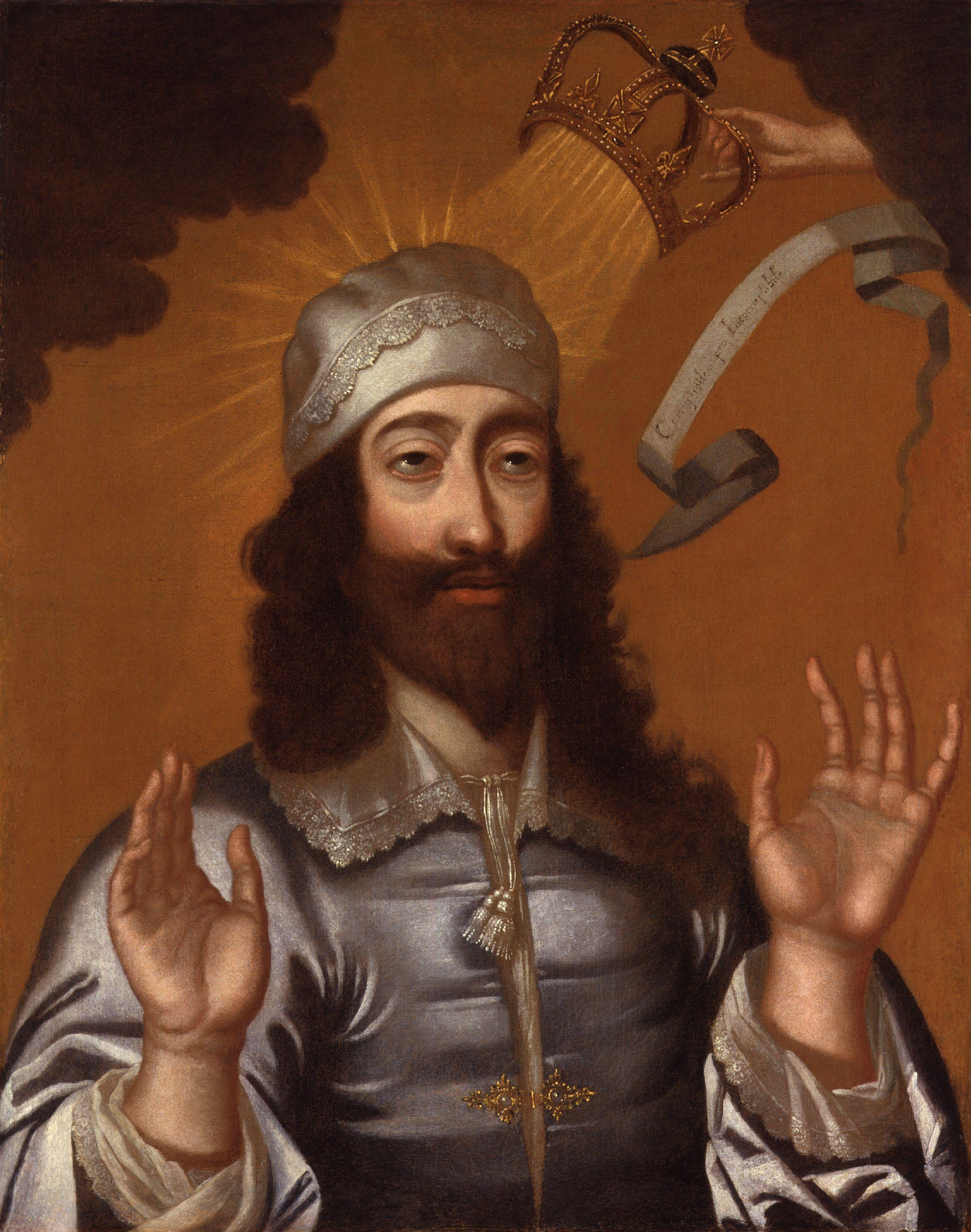
Commemorating the Royal Martyr


Today is the anniversary, the feast day if you will, of King Charles I.


Charles I (1600-1649)

King Charles I 
A portrait  after Van Dyck

Image:© National Maritime Museum, Greenwich, London

 Now it is I think fair to say, as I did on this day last year, that King Charles I frequently failed to display the political acumen necessary for the times and circumstances in which he lived. This was in part due to his nature and temperament, perhaps influenced, as I suggested recently in two posts, by a sense of mentally looking over his shoulder to the memory of his elder brother Henry. He was inclined to seek refuge in what he thought ought to happen rather than what was actually happening. It is also fair to say that his government faced entrenched problems as well as opposition that proved obdurate.

However that is not the point of commemorating him as King and Martyr.

File:King Charles I from NPG.jpg 

King Charles I - the Royal Martyr

A painting now in the National Portrait Gallery

Image:Wikipedia

It is not just respect and indeed awe at the way he approached his death, the martyrdom of a person, impressive and moving as that is in his case.

The King died as a martyr for the Church of England, and certainly for the most noble vision of it as a Catholically inclined national body. Had that vision not been preserved by the King's witness there would have been little chance of either the later seventeenth century flowering of Anglican devotion or of the impact of such ideas in generating the Oxford Movement  in the early nineteenth century. Today that vision seems to be the preserve of a minority, and a tradition valiantly upheld by the Society of King Charles the Martyr.  It is indeed appropriate that my old friends at Pusey House here in Oxford are marking the day with what they describe as a High Mass according to the Book of Common Prayer and veneration of a relic of the King.

The King died as a martyr for the Monarchy in that by refusing to compromise his rights and prerogatives in the negotiations in 1647-8 he avoided the destruction of its historic powers as an institution. The Restoration in 1660 was indeed that, the restoring of the traditional constitution, not of an enfeebled Crown.

The King died as a martyr for his people and the nation in that, as he pointed out at his trial, the people of England were not prosecuting him, but a radical military dictatorship who had seized power with Pride's Purge in 1648. Here again he reached out to the wider nation in defence of fundamental traditional rights - Subject and Sovereign might be clean different thing, but both were under threat from the clique who now sought to kill him.


The Death Mask of King Charles I
A painting at Turton Tower Lancashire

Image:BBC


My previous posts about this anniversary can be seen at The Royal Martyr , Post Mortem Patris Pro Filio and Col John Morris from 2011, and "Remember" from last year.

Saturday, 5 January 2013

The Lost Prince


Yesterday I went up to London to meet a friend and go the see the National Portrait Gallery exhibition The Lost Prince about the life and death of Henry Prince of Wales. I posted about him in November 6th with Henry Prince of Wales on the 450th anniversary of his death.


the lost prince henry stuart isaac oliver

Henry, Prince of Wales by Isaac Oliver, circa 1610-12
Miniature in the Royal Collection

Image:NPG/Observer

We began by looking at the Tudor and Stuart portraits in display in the permanent collection in the gallery. Shame to tell I had not visited the collection before, and it was a genuine delight to see pictures one knows so well from photographs in books in reality. What was especially impressive was their superb condition and lighting, as well as the presence of some less well known portraits or personalities.

The exhibition on Prince Henry was very well worth seeing, with portriats and artifacts from the Gallery, the Royal Collection, the Naval Museum at Geenwich and the British Library and other collections. 

In addition to portraits of the Prince, his immediate family, Danish relatives and his courtiers items on show included two of his suits of parade armour from the Royal Collection, some of his letters and exercise books, books presented to him, texts and illustrations for masques which celebrated the Prince and his part in national renewal and works of art he had collected. There were examples of the numerous memorial pieces in literatrure and music producedin the widepread grief at his death and the remains of his funeral effigy from Westminster Abbey. This was made to be dressed in the robes he had worn as Prince of Wales at his Investiture in 1610 - the splendidly illuminated Letters Patent showing the Prince receiving his symbols of rank from his father was also on display -  and suggests that he was of middling height rather than tall. Also in this section was the portrait commissioned by King Charles I as a memorial to his brother and copied from the miniature reproduced above which hung in the King's bedchamber at Whitehall thereafter. That, and a small volume of advice presented to the future King Charles II  on the eve of the Civil War advising him to model himself on his uncle, indicated the posthumous presence of the Prince at the Stuart court.

Departing with acopy of the handsome exhibition catalogue we went for a leisurely lunch at the Oxford and Cambridge Club in Pall Mall before an excursion into terra incognita for me as my friend went looking for computer cablesand such like in theTottenham Court Road. 

A thoroughly enjoyable and educationally informative day, and it is to be hoped that this exhibition helps to reinstate Prince Henry in the national historical conciousness and understanding.


Tuesday, 6 November 2012

Henry Prince of Wales


Four hundred years ago today, on November 6th 1612, Henry Frederick, Prince of Wales, died of typhoid at Richmond Palace. The heir to King James I and VI he was a few months short of his nineteenth birthday, and he was widely mourned.

the lost prince henry stuart isaac oliver

Henry, Prince of Wales by Isaac Oliver, c.1610-12
Miniature in the Royal Collection

Image:NPG/Observer

To mark the quartercentenary the National Portrait Gallery has mounted a major exhibition The Lost Prince about his life and death, as well as his artistic patronage. It is not insignificant how many portraits survive of the young prince. The exhibition website can be viewed here.

There are illustrated reviews of the exhibition from the Daily Telegraph here, from the Guardian, which features the remains of the Prince's funeral effigy from Westminster Abbey, where he was buried on December 7th 1612 here, and from the Observer  here.
I hope to get to visit the exhibition with friends over the New Year, and want to try and read Roy Strong's 1986 biography of Henry beforehand.
There is an illustrated online biography here  and the one by James M Sutton  in the Oxford Dictionary of National Biography can be read online here.
The Hearse of Henry, Prince of Wales by William Hole, 1612  The British Museum Photo: © The Trustees of the British Museum
The Hearse of Henry, Prince of Wales
 Engraving by William Hole, 1612

Image: The British Museum Photo: © The Trustees of the British Museum
NPG Exhibition site

As Prince of Wales Henry demonstrated a great potential as a future monarch and attracted great approbation from contemporaries. The widespread grief at his death was genuine and heartfelt.

The considerable number of portraits which survive, by Robert Peake and others, show his transition from an energetic and enthusiastic sporting teenager to the gracious handsome prince of the portraits from the end of his life by Isaac Oliver.

His death raises one of the great what-ifs or might-have-beens of British history: Had he lived and succeeded his father as King Henry IX in 1625 rather than his younger brother King Charles I what might have ensued?

Such questions are often pointless to try to answer, but with this one it is tempting to try.

Although some have suggested Henry was not favourable to Charles this appears to be based on one incident when Henry was 15 and Charles 9, and looks like fraternal teasing and nothing more. On his part Charles was concerned during his brother's illness for him and after his death commissioned a portrait which hung thereafter in his bedroom. Henry may well be responsible for encouraging Charles' interest in the visual arts, and I wonder if King Charles I spent the rest of his life mentally looking over his shoulder to what his more dashing brother might have done. On his last walk across St James' Park to the scaffold in 1649 he pointed out a tree which his brother had planted, suggesting Henry's continuing presence in his mind.

Henry had been clearly raised on Calvinistic lines, and was adevout, serious young man - and in that he was followed by hios brother. How he might have responded to the emergence of Arminianism in the years following his death - it was only then that it did so I think - is unknowable. However, like Charles he was the son of the King who famously declared "No Bishop, No King." It was not until 1618 that King James produced the Five Articles of Perth, suggesting a movement in those years which reflected a more Arminian position by the monarch himself. Henry had set his face against a Catholic marriage - his comment about not having two religions in his bed was conceivably a pointed reference to his parents' marriage - and had he maintained that argument when he did marry he might have avoided thereby the hostility brought upon Queen Henrietta Maria. Nevertheless for all his Calvinistic background (and King James had had plenty of that) the Prince refused to tolerate comments hostile to the Pope - did he see it as monarchs standing side by side in solidarity?

Henry's enthusiam for martial exploits might have tempted to intervene on bhalf of his beloved sister Elizabeth and her husband in the Thirty Years War after 1618, but King james I pursued, and stressed, a peace policy, and the financial situation of the Crown might well have precluded it. However Henry's interest in the Royal Navy was followed by his brother, with his building of ships such as the Sovereign of the Seas - and the consequent problem of paying for them with Ship Money.

Their father's concept of Divine Right Kingship would doubtless have been imbibed and inherited by the elder as well as the younger son, and Absolutism was very much a dominant political idea in seventeenth century Europe. It is perhaps worth noting the fact that it was in 1660, the year of Henry's nephew King Charles II' s Restoration in Britain, that his cousin King Frederick III established in Denmark the absolute monarchy that remainedin place until 1848.

As King Henry IX he would have faced many of the same problems as did King Charles I - a governmental system lacking finances to meet its anbitions and in need of modernisation, the economic, social and intellectual changes that increasingly thtreatene dteh seeming tranquility of King James' vision of peaceful governance. Henry might not have exacerbated the religious tensions as his brother's support for High Church ideas did, but then, again, he might well have moved on those lines as well. Such issues and challenges might have been met by a different response from King Henry IX, and the consequences might have been very different, but that is incalculable. He might have created a Danish style absolute monarchy on Protestant lines, or he might have found himself in a position very like that which engulfed his brother. We can never know.


Prince Henry Frederick (1594–1612), Prince of Wales

Henry, Prince of Wales
Portrait by Isaac Oliver


Image: BBC/National Trust