Once I was a clever boy learning the arts of Oxford... is a quotation from the verses written by Bishop Richard Fleming (c.1385-1431) for his tomb in Lincoln Cathedral. Fleming, the founder of Lincoln College in Oxford, is the subject of my research for a D. Phil., and, like me, a son of the West Riding. I have remarked in the past that I have a deeply meaningful on-going relationship with a dead fifteenth century bishop... it was Fleming who, in effect, enabled me to come to Oxford and to learn its arts, and for that I am immensely grateful.


Showing posts with label Cluny. Show all posts

Monday, 8 August 2016

The sound of medieval Cluny and Santiago


The excellent Danish based Medieval Histories site has an interesting piece about liturgical music at Cluny and at the Cluniac influenced cathedral and shrine at Santiago de Compostela which can be accessed at the following two links:

Cluny Maior ecclesia

The Sound of the Maior Ecclesia of Cluny

In 2010 a group of digital wizards recreated the Maior Ecclesia of Cluny. Now, another team has worked to reconstruct the soundscape.
Codex Calixtinus -detail

Medieval Soundscape in Santiago de Compostela

Can you recreate the medieval soundscape of cathedrals? An ingenious reconstruction of the acoustics in the Cathedral in Santiago de Compostela shows the way   Read more.

Wednesday, 11 May 2016

St Maiolus of Cluny


John Dillon posted on the Medieval Religion discussion group the following piece about one of the Holy Abbots of Cluny - a monastic tradition which has always held a great interest for me, coming as I do from a town which once had a Cluniac priory:

Maiolus (in modern French: Maïeul, Mayeul) was the fourth abbot of Cluny.  Previously archdeacon of Mâcon, from 954 he was the coadjutor of Cluny's by then blind abbot Aymard, whom he succeeded in perhaps 963.  Both the abbey and its larger community flourished under his rule.  Maiolus traveled widely, reforming Benedictine houses in today's France, Germany, and Italy.  In 972 he was seized by Muslims from Africa who had settled in Provence, was wounded while defending one of his traveling companions, and was briefly held until he was ransomed at great expense (a letter from Maiolus appealing to Cluny for his ransom and describing his captors survives).  Maiolus died on this day in 994 at Cluny's priory in Souvigny (Allier) and was laid to rest in its church, now the église prieurale Saint-Pierre-et-Saint-Paul.  His cult was immediate.  Maiolus' tomb at Souvigny quickly became a pilgrimage destination.  One of its earliest recorded visitors is St. Fulcramnus / Fulcrannus (d. 1006).  The first of Maiolus' numerous Vitae (BHL 5177-5185) was written by Cluniac monks by the end of the tenth century and went through several revisions.  Another was written in 1033 by Maiolus' immediate successor, St. Odilo of Cluny (d. 1049).


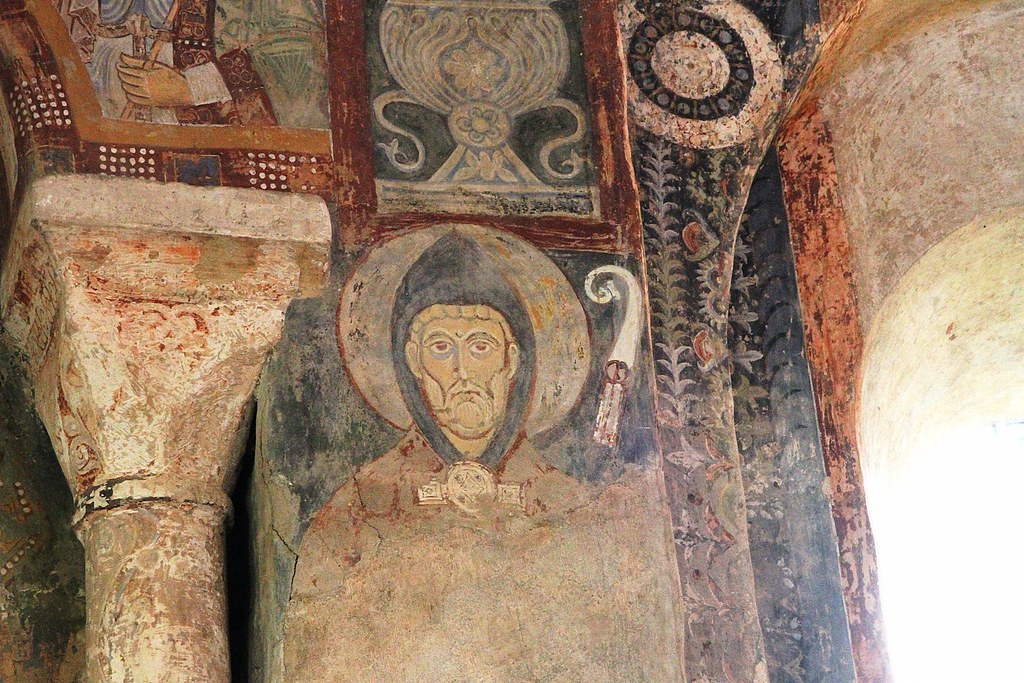
Some period-pertinent images of Maiolus of Cluny (or at least [item a] reasonably supposed to be of him):

a) as probably depicted in one of a pair of twelfth-century frescoes of sainted abbots in the chapelle des Moines at Berzé-la-Ville (Saône-et-Loire), a former dependency of Cluny:

 https://farm8.staticflickr.com/7340/9905525633_391874959e_b.jpg


https://farm8.staticflickr.com/7340/9905525633_391874959e_b.jpg

 
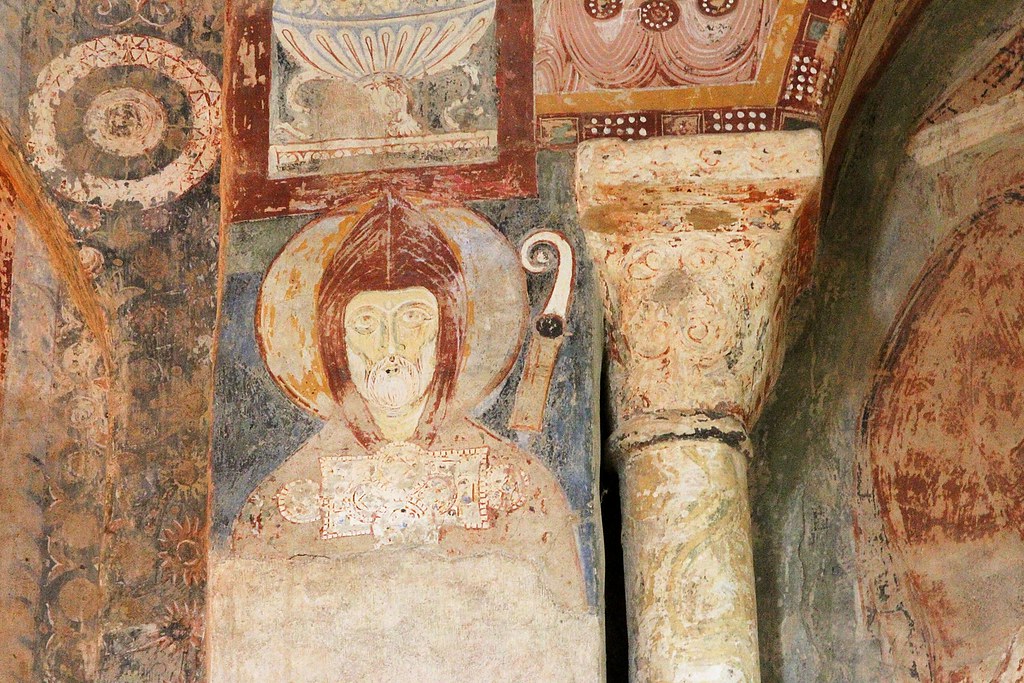
The corresponding fresco is thought probably to depict St. Odilo:

https://farm6.staticflickr.com/5529/9905518653_ace2929edf_b.jpg

 https://farm6.staticflickr.com/5529/9905518653_ace2929edf_b.jpg


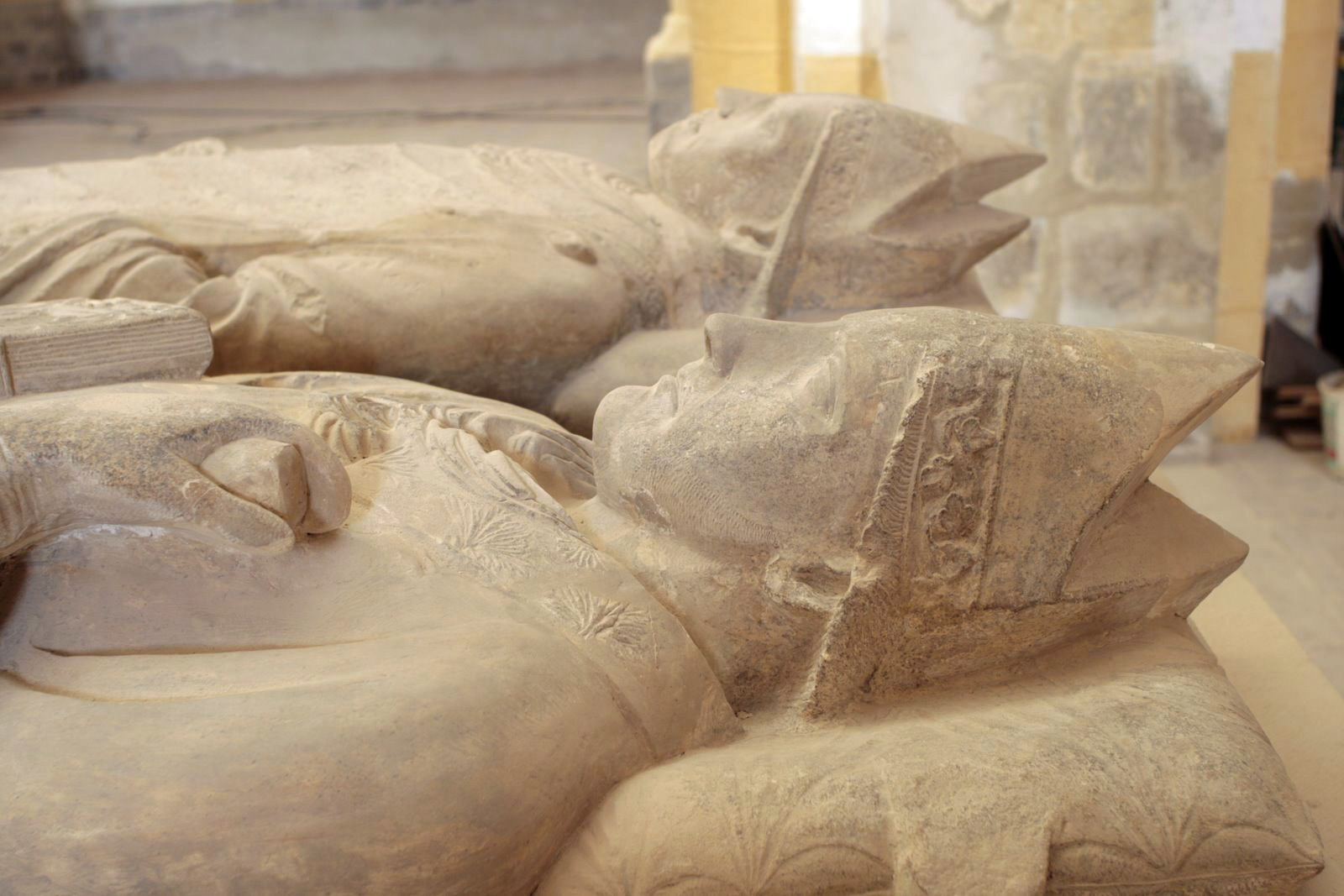
b) as portrayed in one of two thirteenth-century gisants on his and St. Odilo's double tomb in the église prieurale Saint-Pierre-et-Saint-Paul in Souvigny, shattered during the Revolution and recently reconstructed from surviving fragments (one doesn't know which figure represented Maiolus):

 http://www.moulins-tourisme.com/wp-content/uploads/2016/02/stmayeulodilon3.jpg


http://www.moulins-tourisme.com/wp-content/uploads/2016/02/stmayeulodilon3.jpg
 
That photo seems to be from the early 2000s.  As the reconstruction progressed the figures were filled in.  Some more recent views:

 https://upload.wikimedia.org/wikipedia/commons/b/bf/Tombeau_Mayeul_Odilon.jpg


http://tinyurl.com/zeyvpnj
 
http://www.panoramio.com/photo/102473571
http://www.ipernity.com/doc/philippe_28/34920861

Two informative French-language articles on the double tomb and its reconstruction:
1) Pascale Chevalier, "Les Gisants des saints Abbés Mayeul et Odilon découverts à Souvigny", in Annie Regond et Pascale Chevalier, eds., Sculptures médiévales en Auvergne: création, disparition et réapparition (Clermont-Ferrand: Presses Universitaires Blaise Pascal, 2008, pp. 63-71):
http://tinyurl.com/zs6w7ua   [Google Books preview; scroll down to p. 63]
2) Pascale Chevalier et Arlette Maquet, "La fouille des tombeaux des saints abbés de Cluny, Mayeul et Odilon et les pèlerinages à Souvigny", Bulletin Monumental 162 (2004), 87-100:
http://www.persee.fr/doc/bulmo_0007-473x_2004_num_162_2_1601

c) as depicted in a mid-fifteenth-century painting (c.1440-1450) on a door of the monumental cabinet for his relics and those of St. Odilo in the église prieurale Saint-Pierre-et-Saint-Paul in Souvigny:


http://www.ville-souvigny.com/Composants/Images/Musee/Boutique/Cartes_Postales/Serie1_Porte_StMayeul.jpg


http://tinyurl.com/zpol2gp
 
Distance view (Maiolus at left, Odilo at right):
http://www.veveri.it/img/maiolo/1.jpg
The reliquary as a whole:
http://www.ville-souvigny.com/Tourisme/Eglises_Retable_Armoire_Anglais.html

d) as depicted in two illuminations in a later fifteenth-century  Libellus missarum sancti Maioli (1465-1466; Chambéry, Bibliothèque municipale, ms. 7, fols. 1r and 15r):
http://tinyurl.com/27ags4d
http://tinyurl.com/26vzv8g

e) as portrayed in a later fifteenth-century limestone reliquary bust (c. 1480; from the former priory of Souvigny dedicated to him in Veurdre [Allier]) in the Musée Anne de Beaujeu in Moulins:

http://www.culture.allier.fr/uploads/Image/46/14025_847_Le-buste-reliquaire-de-Saint-Mayeul1.jpg

http://tinyurl.com/gnnwnug

f) as depicted (scenes) in a set of eight early sixteenth-century frescoes (c. 1515; attributed to Bernardino Lanzani) in Pavia's formerly Cluniac basilica di San Salvatore:
http://tinyurl.com/oucxge
http://tinyurl.com/q7stnf
http://tinyurl.com/or58yv
http://tinyurl.com/r2vhlu

It is good to see the saint's tomb being reconstructed.

Tuesday, 20 October 2015

St Luke


The day before yesterday, had it not been Sunday, would have been the feast of St Luke. John Dillon posted this impressive selection of images of St Luke on the Medieval Religion discussion group:

Herewith some period-pertinent images of Luke, Apostle and Evangelist. Though these do not include images of Luke's tetramorphic symbol that are essentially zoomorphic in nature, they do include a few images of the evangelist in which he is shown with human hands and feet but with the head -- and / or the wings -- of his celestial figure. Reflecting different underlying textual sources for the construction of the tetramorph, that figure sometimes appears as a calf and sometimes as an ox. Whereas it is easy to distinguish between a calf and an ox, many medieval versions of the symbol present an intermediate form that probably could best be described as a steer (or even as a young steer). To avoid having to make such distinctions, I refer throughout to the bovid in question as Luke's "calf / ox". Also not included are images of Luke painting the BVM or presenting a portrait of her that he is presumed to have painted. But I have included one image showing on an easel in Luke's study a daub of the BVM making one all the more grateful for the existence of Antonello da Messina.

a) as depicted (second from bottom at right; below him, St. James) among the roundels of apostles framing the Theotokos and Christ Child in a sixth-century tapestry icon from Egypt in the Cleveland Museum of Art:


Detail view:

 http://artimages.clevelandart.org/cma/ump.di?e=307D8802E08BE7BB81F5DAEBAEA9481E33982E61D90EC0AE01177BFEE8912E34&s=21&se=875710911&f=1967.144det06_w.jpg


b) as depicted (with his calf / ox) in an earlier sixth-century mosaic (between 527 and 548) on the north wall of the presbytery of Ravenna's basilica di San Vitale:

 San Vitale Basilica: #29205


c) as depicted (with his calf / ox) in the late seventh- or early eighth-century Lindisfarne Gospels (London, BL, Cotton MS Nero D IV, fol. 137v):
http://imageweb-cdn.magnoliasoft.net/britishlibrary/supersize/pod86.jpg

d) as depicted (with his calf / ox) in a full-page illumination in the late eighth-century Godescalc Gospels (between 781 and 783; Paris, BnF, ms. Nouvelle acquisition latine 1203, fol. 2r):
http://tinyurl.com/proz2av
Detail view:
http://rubens.anu.edu.au/htdocs/bytype/manuscripts/survey/0001/150.JPG

e) as depicted in a later eighth- or earlier ninth-century pocket Gospels from Ireland (London, BL, Add. MS 40618, fol. 21v):
http://tinyurl.com/npr73rp

f) as depicted (with his calf / ox) in the Luke and John portion of the very late eighth- or early ninth-century Lorsch Gospels (before 814; Città del Vaticano, BAV, cod. Pal. lat. 50, fol. Iv):
http://bibliotheca-laureshamensis-digital.de/bav/bav_pal_lat_50/0008

g) as depicted (with his calf / ox) in a ninth-century Gospels of Breton origin (Alençon, Bibliothèque municipale, ms. 84, fol. 66v):
http://www.enluminures.culture.fr/Wave/savimage/enlumine/irht2/IRHT_052521-p.jpg

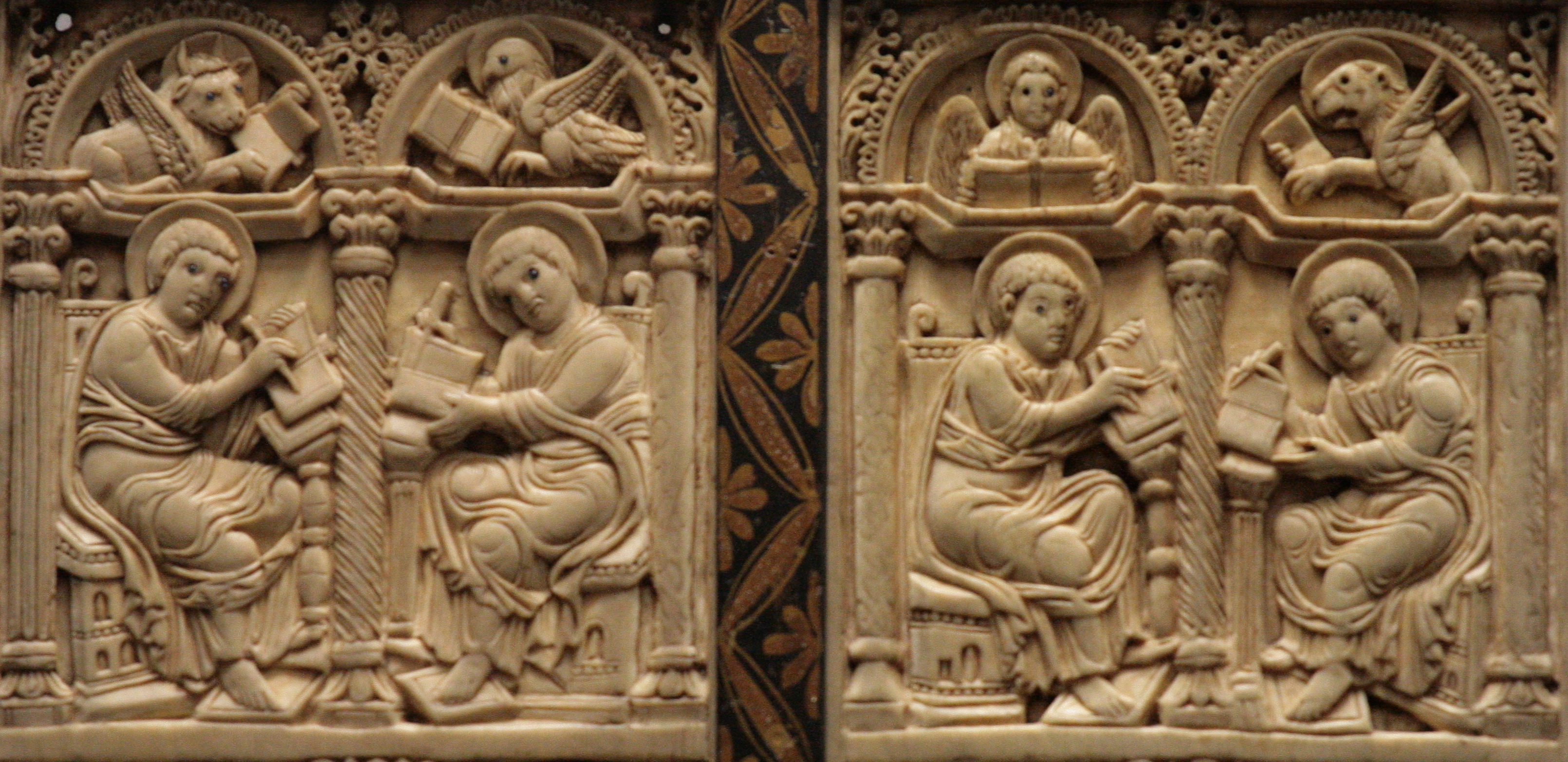
h) as depicted (in the leaf at left at upper left, with his calf / ox and facing St. John the Evangelist) on the early ninth-century Harrach Diptych (c. 810; a Carolingian ivory from Aachen) in the Schnütgen Museum in Köln (on long-term loan from the Sammlung Ludwig):
https://www.flickr.com/photos/27305838@N04/8405620365
Detail view of the uppermost registers of those two leaves:
http://rationalfaiths.com/wp-content/uploads/2012/04/IMG_0857b2.jpg

i) as depicted (with his calf / ox) in the earlier ninth-century Ebbo Gospels (betw. 816 and 835; Épernay, Bibliothèque municipale, ms. 1, fol. 90v):
http://tinyurl.com/nw2nc3a

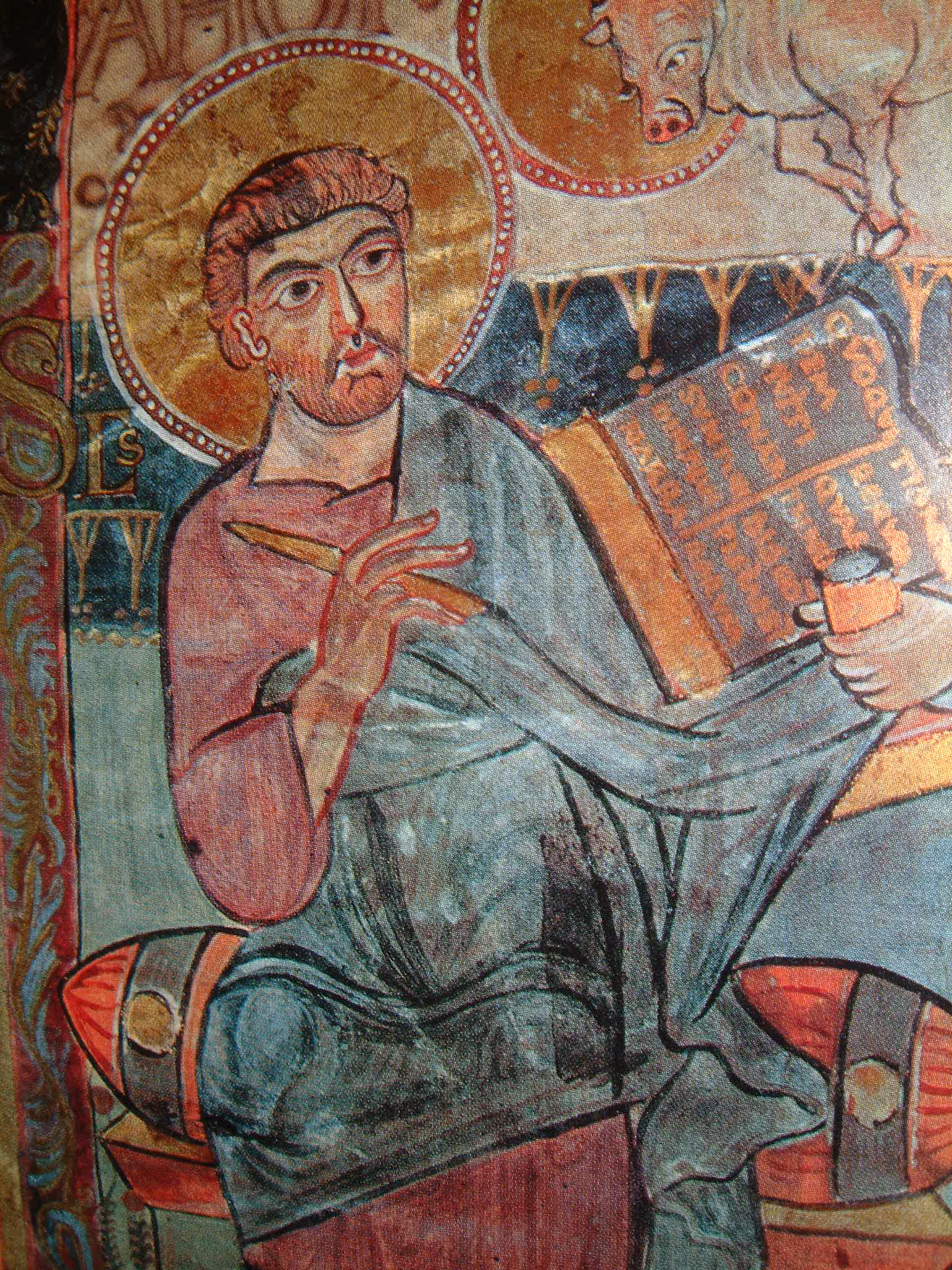
j) as depicted in a full-page illumination in a late ninth- or early tenth-century Gospels from Landévennec (Oxford, Bodleian Library, MS Auct. D. 2. 16, fol.101v):
http://image.ox.ac.uk/images/bodleian/ms.auct.d.2.16/101v.jpg

k) as depicted in a tenth-century Gospels from Constantinople (Paris, BnF, ms. Coislin 195, fol. 240v):
http://tinyurl.com/299thvo

l) as depicted in an early tenth-century Gospels of Breton origin, perhaps from Landévennec (908-909; Troyes: Médiathèque Grand-Troyes [until very recently: Médiathèques de l'Agglomération Troyenne], ms. 960, fol. 71v):
http://www.enluminures.culture.fr/Wave/savimage/enlumine/irht2/IRHT_052416-p.jpg

m) as depicted in a partly preserved mid-tenth-century New Testament probably from Constantinople (London, British Library, MS Add 28815, fols. 76v and 162v):
http://www.bl.uk/manuscripts/Viewer.aspx?ref=add_ms_28815_f076v
http://www.bl.uk/manuscripts/Viewer.aspx?ref=add_ms_28815_f162v
Another portion of the same manuscript is now BL, Egerton MS 3145

n) as portrayed in high relief (second from right) on one side of a later tenth-century ivory reliquary casket, probably from Constantinople, in the Metropolitan Museum of Art, New York:
http://www.metmuseum.org/collection/the-collection-online/search/464238?img=3

o) as depicted (with his calf / ox) in the late tenth- or early eleventh-century Gospels of Otto III (Munich, BSB, clm 4453, fol. 139r):

 http://www.wga.hu/art/zgothic/miniatur/1001-050/1/1gospel5.jpg


p) as depicted in a full-page miniature in the late tenth- or eleventh-century Codex Theodosianus (a Gospels lectionary) belonging to the Holy Monastery of the God-trodden Mount Sinai in St. Catherine (South Sinai governorate) in Egypt (cod. gr. 204, fol. 12r):
http://www.icon-art.info/hires.php?lng=en&type=1&id=2466

q) as depicted (with his calf / ox) in an eleventh-century Gospels of northern French origin (Paris, BnF, ms. Arsenal 592, fol. 105v):
http://tinyurl.com/qjphnha

r) as depicted (with his calf / ox) in the early eleventh-century Limburg Gospels (Köln, Dombibliothek, Codex 218, fol. 108v):
http://tinyurl.com/p6czmca

s) as depicted (with his calf / ox) in the early eleventh-century Reichenau Gospels (Munich, BSB, clm 4453, fol. 127v):
http://daten.digitale-sammlungen.de/bsb00004502/image_264

t) as depicted in the earlier eleventh-century mosaics (restored between 1953 and 1962) in the narthex of the church of the Theotokos in the monastery of Hosios Loukas near Distomo in Phokis:
http://tinyurl.com/nphh2vm

u) as depicted in an earlier eleventh-century Gospels from Constantinople (Paris, BnF, ms. Grec 64, fol. 101v):
http://gallica.bnf.fr/ark:/12148/btv1b105157462/f212.image

v) as depicted (with his calf / ox) in a later eleventh-century Gospels seemingly from southeastern France, perhaps Arles (Reims, Bibliothèque municipale, ms. 13, fol. 92v):
http://www.enluminures.culture.fr/Wave/savimage/enlumine/irht6/IRHT_097742-p.jpg

w) as depicted in the later eleventh-century mosaics (c. 1065) in the niches in front of the main door in the narthex in Venice's basilica cattedrale patriarcale di San Marco:

 San Marco mosaics - Lower niches with the evangelist St. Luke

Detail view:
https://www.flickr.com/photos/28433765@N07/5319481115

x) as depicted in the later eleventh-century Cologne Gospels (c. 1076-1100; London, BL, Harley MS 2820, fol. 120r):
http://www.bl.uk/manuscripts/Viewer.aspx?ref=harley_ms_2820_f120r

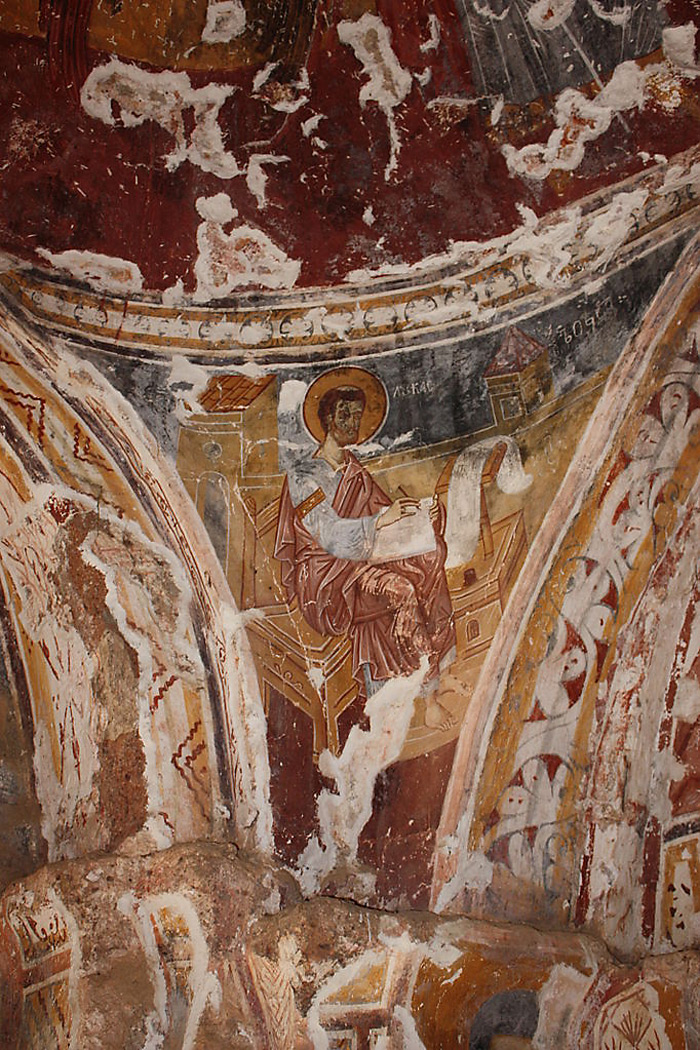
y) as depicted in the eleventh- and twelfth-century frescoes of the Elmali Church (Apple Church) at Göreme (Nevşehir province) in Turkey:
http://www.pbase.com/dosseman/image/41536848

z) as depicted (with his calf / ox) in a fragmentary leaf from a late eleventh- or early twelfth-century bible (c. 1100) from the abbey of Cluny in the Cleveland Museum of Art:


aa) as depicted in a twelfth-century Gospels, perhaps from Constantinople, with commentary (Paris, BnF, ms. Grec 189, fol. 206v):
http://tinyurl.com/ojfbdcb

bb) as depicted (with his calf / ox) in a twelfth-century Gospels from Metz (Paris, BnF, ms. Latin 9395, fol. 93r):
http://gallica.bnf.fr/ark:/12148/btv1b103088868/f187.item

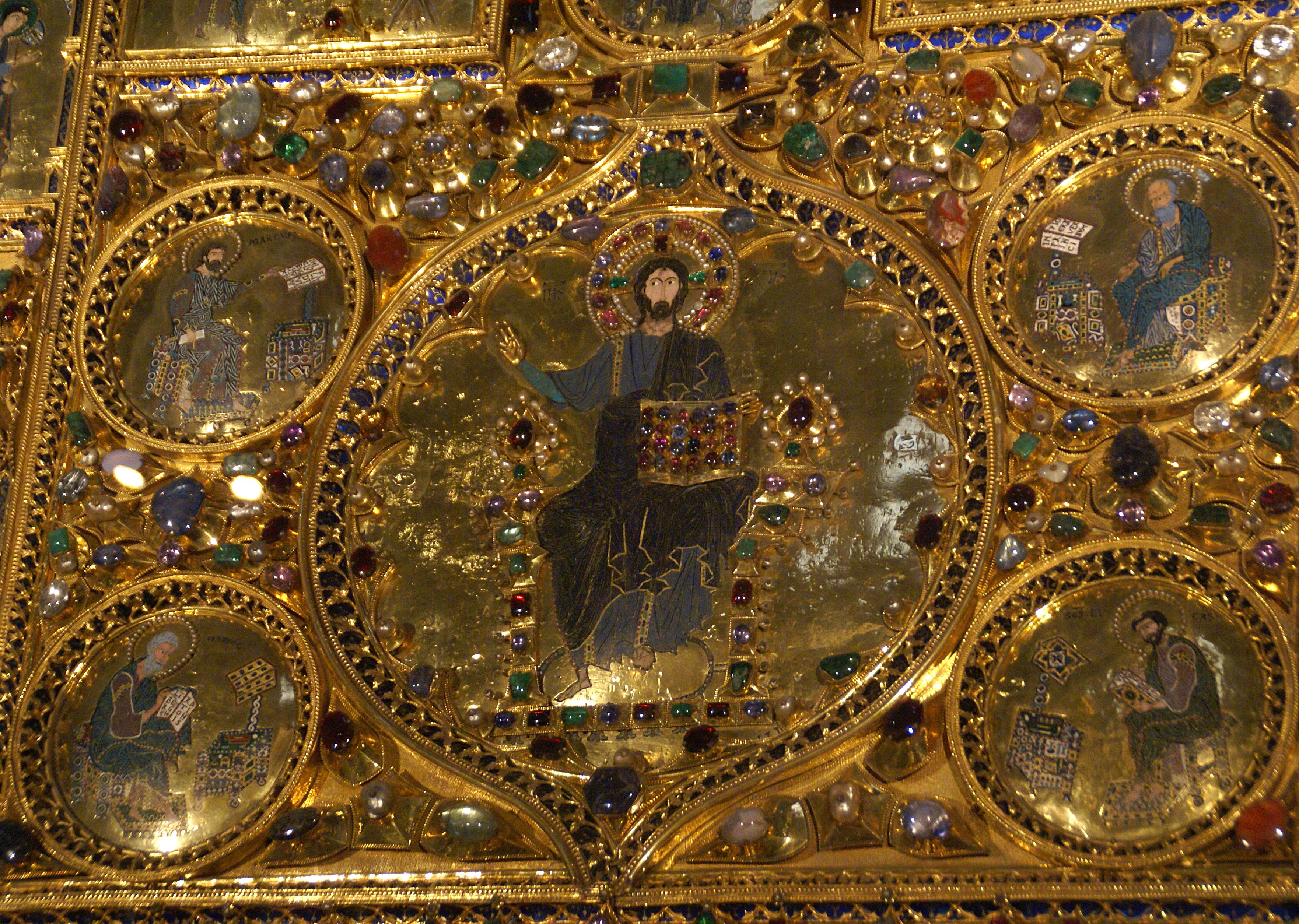
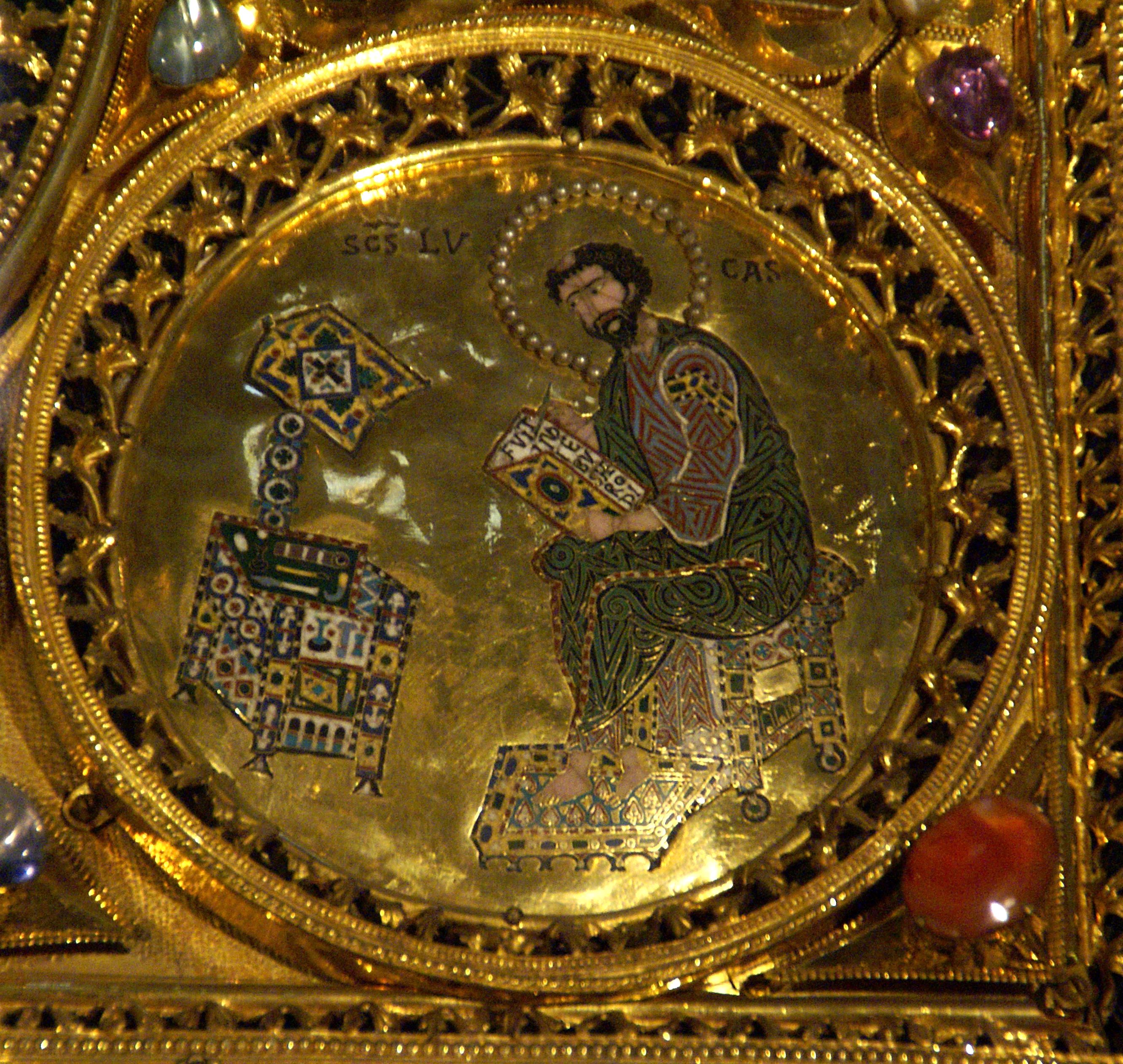
cc) as depicted (at lower right) in one of the early twelfth-century roundels of the evangelists on the central panel, commissioned in Constantinople in 1105 and bearing inscriptions in Latin, of the Pala d'Oro ("Golden Altar-frontal") in Venice's basilica cattedrale patriarcale di San Marco:


Detail view (Luke's roundel):


dd) as depicted in an earlier twelfth-century Gospels from Agen or from the abbey of Moissac (Paris, BnF, ms. Latin 254, fol. 46v):
http://gallica.bnf.fr/ark:/12148/btv1b8426051s/f96.item.zoom

ee) as depicted in an earlier twelfth-century Gospels lectionary from the abbey of Saint-Évroult d'Ouche (betw. 1113 and 1133; Rouen, Bibliothèque municipale, ms. 31, fol. 88r):
http://www.enluminures.culture.fr/Wave/savimage/enlumine/irht6/IRHT_100216-p.jpg

ff) as depicted in an earlier twelfth-century Gospels from the abbey of Saint-Bénigne in Dijon (c. 1126-1150; Dijon, Bibliothèque municipale, ms. 2, fol. 429v):
http://www.enluminures.culture.fr/Wave/savimage/enlumine/irht6/IRHT_093452-p.jpg
Detail view:
http://www.enluminures.culture.fr/Wave/savimage/enlumine/irht6/IRHT_093453-p.jpg

gg) as depicted (upper register at right) in the mid-twelfth-century apse mosaics (completed in 1148) of the basilica cattedrale della Trasfigurazione in Cefalù:

 http://www.wga.hu/art/zgothic/mosaics/3cefalu/5cefalu.jpg


hh) as depicted (with his calf / ox) in a later twelfth-century Bible from the abbey of Saint-Sulpice in Bourges (betw. 1176 and 1200; Bourges, Bibliothèque municipale, ms. 3, fol. 323v):
http://www.enluminures.culture.fr/Wave/savimage/enlumine/irht8/IRHT_146690-p.jpg

ii) as depicted in a pendentive of the later twelfth-century Crossing Cupola / Ascension Cupola (betw. 1176 and 1200) in Venice's basilica cattedrale patriarcale di San Marco:
http://tinyurl.com/onxulat

jj) as portrayed (at right, below his calf / ox; at left, St. Mark) in a late twelfth-century jamb statue on the Galluspforte (the north portal; c. 1180-1190) of the Basler Münster:
https://www.flickr.com/photos/martin-m-miles/7110881499/

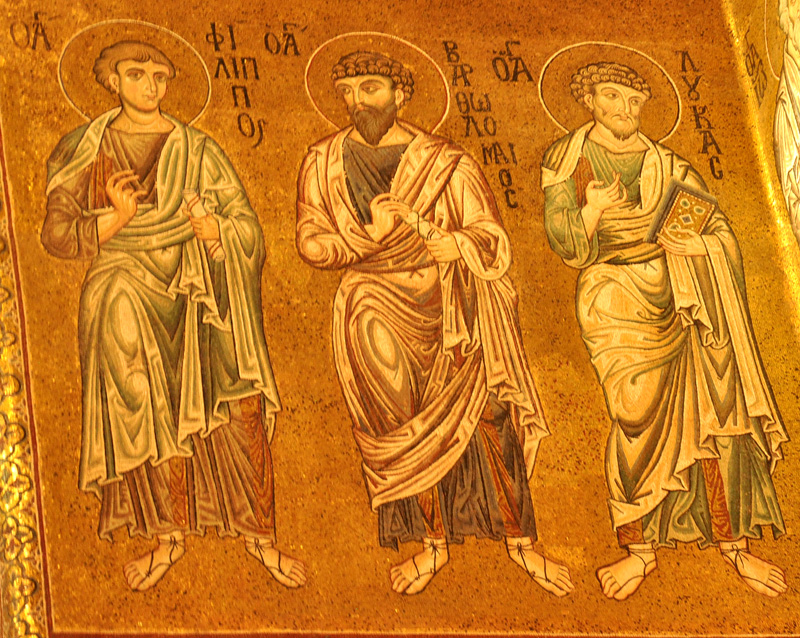
kk) as depicted (at right, after Sts. Philip and Bartholomew) in the late twelfth-century mosaics (ca. 1182) in the sanctuary of the basilica cattedrale di Santa Maria Nuova in Monreale:
http://www.christianiconography.info/sicily/philipBartholomewLuke.smal.jpg

ll) as depicted (with his calf / ox) in two places in the late twelfth-century Souvigny Bible (Moulins, Médiathèque Communautaire de l'agglomération de Moulins, ms. 2, fols. 329v and 342):
1) At the beginning of his gospel:
http://www.enluminures.culture.fr/Wave/savimage/enlumine/irht4/IRHT_080149-p.jpg
2) At the beginning of St. Jerome's commentary on Luke:
http://www.enluminures.culture.fr/Wave/savimage/enlumine/irht4/IRHT_080152-p.jpg

mm) as depicted (with two oxen) in the twelfth- or thirteenth-century Red Gospels of Ganjasar (Chicago, University of Chicago Library, Goodspeed Manuscript Collection, ms. 949, fol. 139v):
http://goodspeed.lib.uchicago.edu/view/index.php?doc=0949&obj=282

nn) as depicted in a thirteenth-century bible possibly of Italian origin (Le Puy-en-Velay, Bibliothèque du Puy en Velay, ms. 1, fol. 315v):
http://www.enluminures.culture.fr/Wave/savimage/enlumine/irht4/IRHT_080585-p.jpg

oo) as portrayed in an earlier thirteenth-century vault boss (c. 1215-1225?) in an apsidial chapel in the église Saint-Serge in Angers:
http://tinyurl.com/p4o7fdh

pp) as depicted (at far left) in the earlier thirteenth-century apse mosaic (1220) of the basilica di San Paolo fuori le Mura in Rome:

 https://upload.wikimedia.org/wikipedia/commons/1/16/Apse_mosaic_of_the_Basilica_of_Saint_Paul_Outside_the_Walls.jpg

qq) as depicted in a later thirteenth-century fresco (between 1260 and 1263) in a pendentive in the church of the Holy Apostles in the Patriarchate of Peć at Peć in, depending on one's view of the matter, either the Republic of Kosovo or Serbia's province of Kosovo and Metohija:
http://tinyurl.com/d269b75

rr) as depicted on a pendentive of the third cupola of Joseph in the later thirteenth-century mosaics (c. 1260-1270) of the north narthex in Venice's basilica cattedrale patriarcale di San Marco:
http://tinyurl.com/otgswrd
Detail view:
http://tinyurl.com/pnjbhph

ss) as depicted by Toros Roslin in the later thirteenth-century Walters T'oros Roslin Gospels (a.k.a. Sebastia Gospels of 1262) from Armenian Cilicia (1262; Baltimore, Walters Art Museum, ms. W.539, fol. 200v):
http://tinyurl.com/qjcen74

tt) as depicted (lower register at left; with his calf / ox) by Cimabue in a later thirteenth-century fresco (between 1277 and 1283) in the crossing vault of the upper church of the basilica di San Francesco in Assisi:
http://tinyurl.com/qd4xaz2
Detail view (Luke):
http://tinyurl.com/pqvquzd

uu) as depicted in the late thirteenth-century Burney Gospels (1285; London, BL, MS Burney 20, fol. 142v):
http://www.bl.uk/manuscripts/Viewer.aspx?ref=burney_ms_20_f142v

vv) as depicted (with his calf / ox) in the late thirteenth-century Livre d'images de Madame Marie (c. 1285-1290; Paris, BnF, ms. Nouvelle acquisition française 16251, fol. 74r):
http://tinyurl.com/n9c8h9r

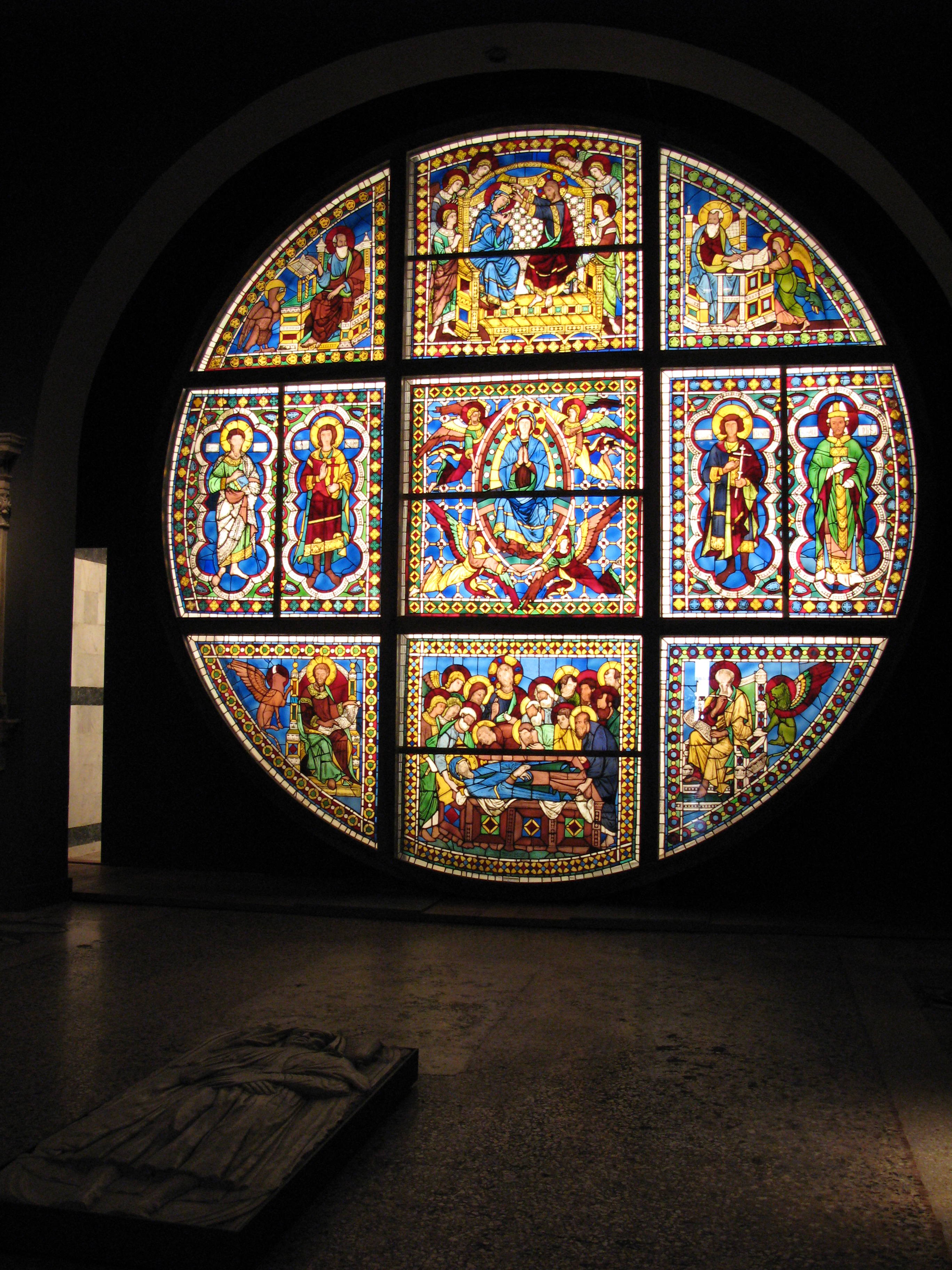
ww) as depicted (at lower left; with his calf / ox) by Duccio di Buoninsegna in his relatively recently restored late thirteenth-century great window (1287-1288) for Siena cathedral (now in the Museo dell'Opera della Metropolitana):

 https://upload.wikimedia.org/wikipedia/commons/b/b0/Opera_del_Duomo_-_Siena.jpg


xx) as portrayed in high relief (with his calf / ox) by Arnolfo da Cambio on his late thirteenth-century ciborium (1293) in the basilica di Santa Cecilia in Trastevere in Rome:

http://www.wga.hu/art/a/arnolfo/3/05evange.jpg


yy) as depicted (with his calf / ox) in a fourteenth-century bible (Bible des Célestins / Bible of Charles V; Paris, BnF, ms. Arsenal 590, fol. 447r):
http://gallica.bnf.fr/ark:/12148/btv1b84581342/f901.item.zoom

zz) as depicted in an earlier fourteenth-century fresco (between c. 1312 and 1321/1322) in a pendentive in the monastery church of the Theotokos at Gračanica in, depending on one's view of the matter, Serbia's province of Kosovo and Metohija or the Republic of Kosovo:
http://tinyurl.com/33shq5u

aaa) as depicted in the earlier fourteenth-century frescoes (between c. 1317 and 1324) in a pendentive in the church of St. Demetrius in the Patriarchate of Peć at Peć in, depending upon one's view of the matter, either Serbia's province of Kosovo and Metohija or the Republic of Kosovo:
http://tinyurl.com/nnfom4q

bbb) as depicted in an earlier fourteenth-century copy of the Legenda aurea in its French-language version by Jean de Vignay (ca. 1326-1350; Paris, BnF, ms. Français 185, fol. 68v):
http://tinyurl.com/oud2tng

ccc) as depicted (at left, flanking the risen Jesus on the road to Emmaus; at right, St. Cleophas / Clopas) in an earlier fourteenth-century panel (later 1320s or 1330s) in a window (W 14 [also s VI]; "Vie surnaturelle du Christ" or "After the Passion") in Strasbourg's cathédrale Notre-Dame:
http://www.cathedrale-strasbourg.fr/popgallery.aspx?pic_id=2595&cat_id=118

ddd) as depicted (with his calf / ox) in an earlier fourteenth-century French-language legendary of Parisian origin with illuminations attributed to the Fauvel Master (c. 1327; Paris, BnF, ms. Français 183, fol. 73r):
http://tinyurl.com/p6nm8g5

eee) as depicted (with his calf / ox) by Simone Martini in an earlier fourteenth-century panel painting (1330s) in the J. Paul Getty Museum, Los Angeles:
http://tinyurl.com/nmmlw2f
http://www.wga.hu/art/s/simone/7last/5luke.jpg

fff) as depicted (with his calf / ox) in an earlier fourteenth-century copy, from the workshop of Richard and Jeanne de Montbaston, of the Legenda aurea in its French-language version by Jean de Vignay (1348; Paris, BnF, ms. Français 241, fol. 280r):
http://tinyurl.com/o7ebse7

ggg) as depicted (top centre) in a mid-fourteenth-century copy (c. 1355) of Ulrich of Lilienfeld's Concordantiae caritatis (Lilienfeld, Stiftsbibliothek, Cod. 151, fol. 220v):
http://tarvos.imareal.oeaw.ac.at/server/images/7005011.JPG

hhh) as depicted in a later fourteenth-century Gospels from the monastery of Gamałiēl in Xizan (Paris, BnF, ms. Arménien 333, fol. 124v):
http://tinyurl.com/objf9o3

iii) as depicted (with his calf / ox) in a later fourteenth-century panel painting (between 1357 and 1367) by Theodoric of Prague and workshop in the Holy Cross Chapel, Karlštejn Castle (near Prague):

 http://tarvos.imareal.oeaw.ac.at/server/images/7014179.JPG

http://tarvos.imareal.oeaw.ac.at/server/images/7014179.JPG

jjj) as depicted (at right; at left, St. John the Baptist) by Giovanni da Milano in a later fourteenth-century panel painting (c. 1360; from his dismembered Ognissanti Polyptych) in the Galleria degli Uffizi, Florence:

https://upload.wikimedia.org/wikipedia/commons/f/f2/Giovanni_da_milano%2C_polittico_di_ognissanti_03.jpg


kkk) as depicted in the later fourteenth-century frescoes (1360s and 1370s; restored, 1968-1970) in the church of St. Demetrius in Marko's Monastery at Markova Sušica:
http://tinyurl.com/o6mf7wv

lll) as depicted by the Master of the Misericordia in a later fourteenth-century panel painting (ca. 1365-1370) in the Pinacoteca di Brera, Milan:

 http://www.artearti.net/assets/channel_images/4070/dal_giglio_al_david_25.jpg

NB: As those who have looked closely at what Luke appears to be writing will have guessed, this image is reversed. An expandable grayscale image is here:
http://tinyurl.com/ooows8t

mmm) as depicted by Jacopo di Cione and workshop in a later fourteenth-century panel painting (ca. 1365-1370) in the National Gallery, London:
http://tinyurl.com/q9sj5e4

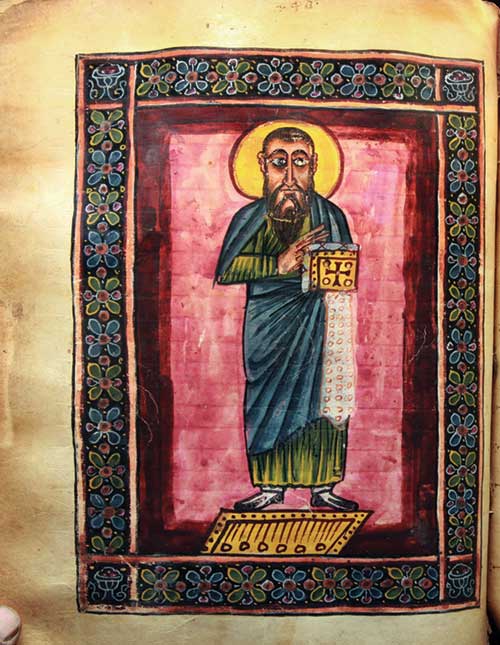
nnn) as depicted on a later fourteenth-century single leaf from Lake Tana in Ethiopia (between 1375 and 1400; Baltimore, Walters Art Museum, Ms. W/840):
http://tinyurl.com/ode87jk

ooo) As depicted on a pendentive in the late fourteenth-century frescoes of the cathedral of the Transfiguration of the Savior in Tsalenjikha, Georgia:
http://www.truechristianity.info/img/churches/georgia/tsalenjikha_cathedral_4.jpg

ppp) as depicted by Giovanni di Benedetto and workshop in a late fourteenth-century Franciscan missal of Milanese origin (ca. 1385-1390; Paris, BnF, ms. Latin 757, fol. 206v):
http://gallica.bnf.fr/ark:/12148/btv1b8470209d/f416.image.r=

qqq) as depicted (with his calf / ox) by Spinello Aretino in two late fourteenth-century vault frescoes in Florence and vicinity:
1) in the chiesa di San Miniato al Monte in Florence (1387-1388):
http://tinyurl.com/phygyhs
2) in the oratorio di Sante Caterina delle Ruote in Bagnoli a Ripoli (ca. 1388; restored, 1996-1998):
http://tinyurl.com/oe5jcn8

rrr) as depicted (with his calf / ox) in an early fifteenth-century copy of Guiard des Moulins' Bible historiale (Paris, BnF, ms. Arsenal 5058, fol. 476v):
http://tinyurl.com/nt89ndw
http://gallica.bnf.fr/ark:/12148/btv1b8458142m/f362.item.zoom

sss) as portrayed by Nanni di Bianco in an early fifteenth-century statue (c. 1408-1415) formerly on the facade of Florence's cattedrale di Santa Maria del Fiore and now in the Museo dell'Opera del duomo there:
http://tinyurl.com/owdz729
As seen from below:
http://tinyurl.com/nkqr4qb

ttt) as depicted (with a companion that looks more like the lion of St. Mark than either a calf or an ox) in the early fifteenth-century Hours of René of Anjou (ca. 1410; London, BL, MS Egerton 1070, fol. 104v; image expandable):
http://www.bl.uk/manuscripts/Viewer.aspx?ref=egerton_ms_1070_f104v

uuu) as depicted in an early fifteenth-century copy of the Elsässische Legenda aurea (1419; Heidelberg, Universitätsbibliothek, Cod. Pal. germ. 144, fol. 163r):
http://digi.ub.uni-heidelberg.de/diglit/cpg144/0341

vvv) as depicted in a full-page illumination in the earlier fifteenth-century Radoslav Gospel from Serbia (1428-1429; Saint Petersburg, National Library of Russia, ms. РНБ. F.I.591, fol. 3r):
http://tinyurl.com/q872my7

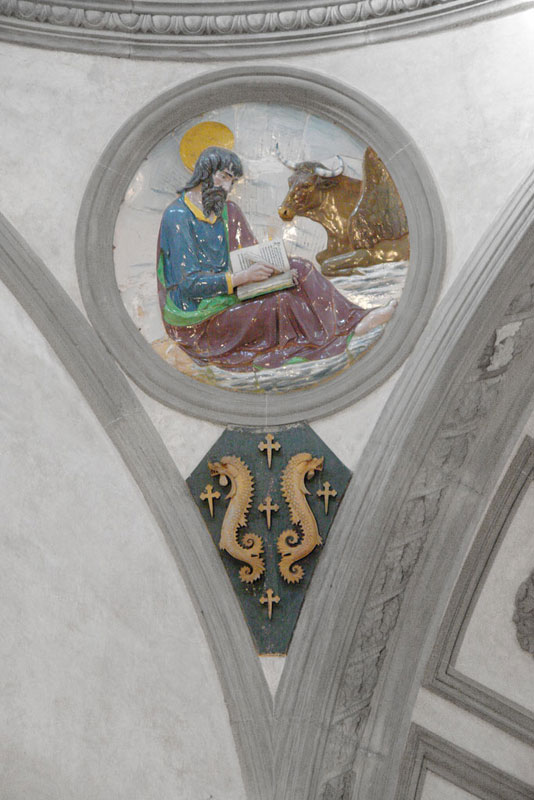
www) as portrayed in high relief (with his calf / ox) by Donatello in an earlier fifteenth-century terracotta roundel (between 1428 and 1445) in the old sacristy of Florence's basilica di San Lorenzo:
http://www.wga.hu/art/d/donatell/2_mature/sacristy/1sacri11.jpg

xxx) as depicted (with his calf / ox) by Piero della Francesca in a mid-fifteenth-century vault fresco (ca. 1450-1460) in the cappella dei Santi Michele e Pietro in Rome's basilica di Santa Maria Maggiore:
http://tinyurl.com/qxwmdpj

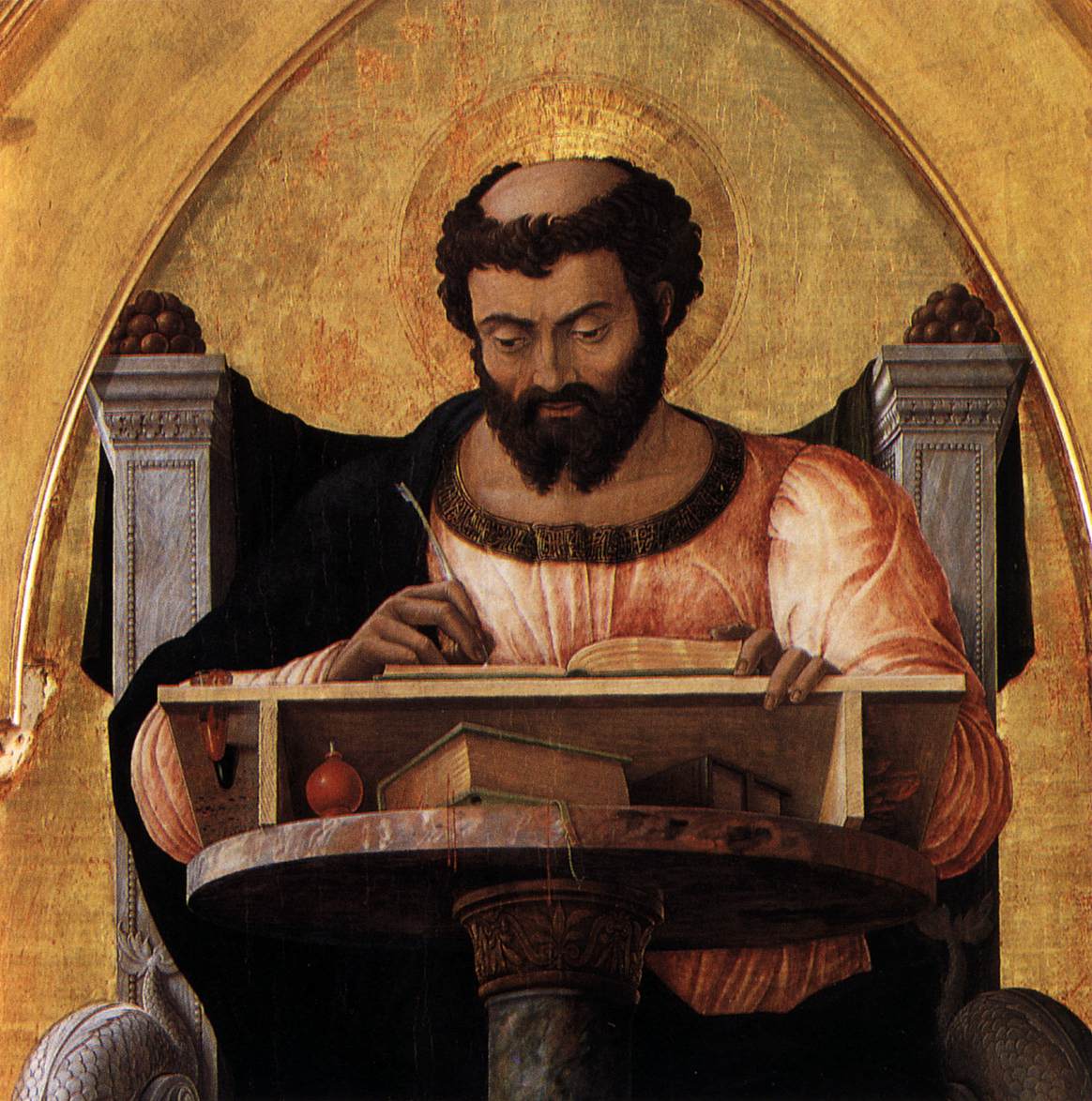
yyy) as depicted by Andrea Mantegna in his mid-fifteenth-century St. Luke altarpiece (commissioned in 1453) in the Pinacoteca di Brera in Milan:

 http://www.wga.hu/art/m/mantegna/02/sanluca4.jpg

Detail view:

 http://www.wga.hu/art/m/mantegna/02/sanluca6.jpg


zzz) as depicted by Filippo Lippi in a mid-fifteenth-century vault fresco (c. 1454) in the sanctuary of Prato's cattedrale di Santo Stefano:
http://www.wga.hu/art/l/lippi/filippo/1450pr/01stluke.jpg

aaaa) as portrayed in high relief in a mid-fifteenth-century glazed terracotta roundel, variously ascribed to Luca della Robbia and workshop or to the aged Donatello, on a pendentive in the Cappella dei Pazzi (completed in 1460) in the Santa Croce complex in Florence:
http://www.florentinermuseen.com/foto/cappella%20pazzi/image/2.jpg

bbbb) as depicted (with his calf/ ox) in a later fifteenth-century panel painting (c. 1460-1470) on a Sunday-side wing of an altar in the Katholische Wallfahrtskirche Sankt Wolfgang in St. Wolfgang, a locality of Velburg (Lkr. Neumarkt in der Oberpfalz) in Bayern:

 http://tarvos.imareal.oeaw.ac.at/server/images/7021949.JPG


cccc) as depicted (at left, with his calf / ox; at right, St. Mark) on a section of the later fifteenth-century rood screen (c. 1480) in the church of All Saints, Morston (Norfolk):
https://www.flickr.com/photos/paulodykes/7482944470
Detail view (at left, the calf / ox):
https://www.flickr.com/photos/paulodykes/7482805504

dddd) as depicted (with his calf / ox and with a painting of the BVM) in a later fifteenth-century copy of the Legenda aurea in its French-language translation by Jean de Vignay (ca. 1480-1490; Paris, BnF, ms. Français 245, fol. 141r):
http://tinyurl.com/nooaell

eeee) as depicted (with his calf / ox) in a late fifteenth-century panel painting (c. 1480-1500) on an outer wing of the Siebenhirter Altar (a.k.a. Apostle Altar) in the Pfrarrkirche of Lieseregg, a locality of Seeboden am Millstätter See (Land Kärnten):

 http://tarvos.imareal.oeaw.ac.at/server/images/7002159.JPG


ffff) as depicted (with his calf / ox) by Domenico Ghirlandaio in a late fifteenth-century vault fresco (c. 1485-1490) in the cappella Tornabuoni in Florence's chiesa di Santa Maria Novella:

 http://www.wga.hu/art/g/ghirland/domenico/6tornab/63tornab/7vault4.jpg


gggg) as portrayed by Tilman Riemenschneider in a late fifteenth-century glazed limewood statue from the St. Mary Magdalene altarpiece in Münnerstadt (1490-1492), now in the Bode-Museum in Berlin:
https://www.flickr.com/photos/grahamfellows/8141405053

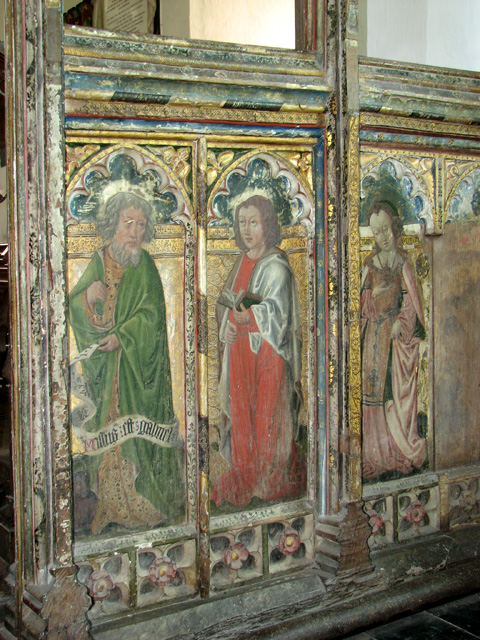
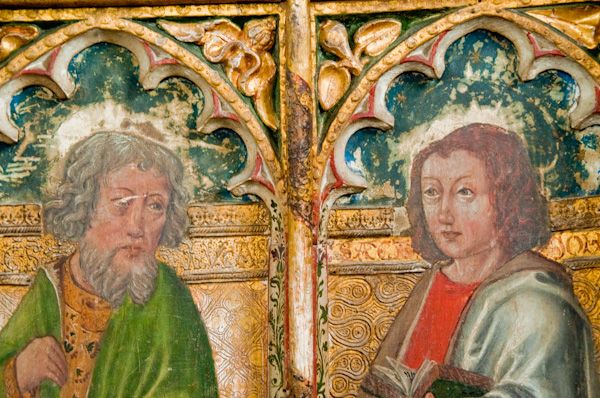
hhhh) as depicted (at left, followed by St. John and by St. Mary Magdalene) on the probably early sixteenth-century rood screen in the church of St. Andrew, Bramfield (Suffolk):

 http://s0.geograph.org.uk/geophotos/02/49/83/2498399_849948f4.jpg

Detail view:

 http://www.britainexpress.com/images/attractions/editor/Bramfield-4706.jpg


iiii) as portrayed (with his calf / ox) in an earlier sixteenth-century polychromed wooden statue (c. 1500-1520) in the Kirche St. Thomas in Hirschzell, a _Stadtteil_ of Kaufbeuren:

 http://tarvos.imareal.oeaw.ac.at/server/images/7017753.JPG


Subsequently John Dillon added two more images:
An even earlier image of St. Luke:
α) as depicted in the recently re-dated late fourth- to later sixth-century Garima 2 Gospels in Ge'ez (c. 390-570) from the Abba Garima monastery in northern Ethiopia, seemingly the oldest Christian book bearing paintings on its pages:

 https://ethioicons.files.wordpress.com/2015/06/252-mb-ne-garima-gospel-01.jpg?w=500&h=645&crop=1


And for those already sated with images of St. Luke, herewith a view of his earlier fourteenth-century depiction (1330s) on a pendentive in the church of the Hodegetria in the Patriarchate of Peć at Peć in, depending upon one's view of the matter, either Serbia's province of Kosovo and Metohija or the Republic of Kosovo:
http://tinyurl.com/ohg8jmv


Monday, 11 May 2015

St Majolus of Cluny


Today is, I learn from the Medieval Religion discussion group, the feast day assigned to St Majolus (Mayeul) of Cluny, on eof the four great early abbots of that great and influential house. There is a good and detailed online life of him, including details of incidents that indicated his saintliness, here.


Wednesday, 8 January 2014

A crime against Humanity


The other day I was looking on the Internet for some pictures of the remains of the abbey at Cluny in answer to an enquiry from a friend, and as I did so I was once more struck by the enormity of the destruction of the abbey in the years after the dissolution in 1790. Having visited Cluny last year that is all the more borne in upon me. The remains are an indicator of what has been lost, and the realisation of just what was once there. The scale of the destruction is, in its own way, quite awesome. It is also profoundly shocking. This led me back to a recurring line of thought with me when confronted by such wanton destruction, that is of just how wicked it is.

It was whilst thinking along these lines in the devastated remains of the great Norman abbey at Jumièges, also a casualty of the 1790s, in 2004 that an Anglican priest friend opined to me that it is not much comfort in such places to think that the perpetrators of such vandalism must surely be in Hell, and I agreed with him.

At Cluny as a result of the demolition which begn in the 1790s and continued into the 1820s  only the main south transept of what was for centuries the largest church in Christendom  - and then only surpassed by St Peter's in Rome - survives intact.There is an introduction to the history of the house at  the online account Cluny Abbey

Today we often hear the phrase "crime against Humanity" about massacres and political violence, and yes, such they may indeed be, but crimes can also be committed against Humanity which do not involve the loss of human life or physical injury. There are crimes against Humanity which involve the destruction of the things of the spirit and of objects of beauty. By doing so, and the destruction of Cluny and Jumièges are classic examples, future generations are impoverished of great and wonderful things that could and no doubt would have enriched their souls and minds. This is not just loss for the art historian or the heritage-minded - it is a loss for all of Humanity.


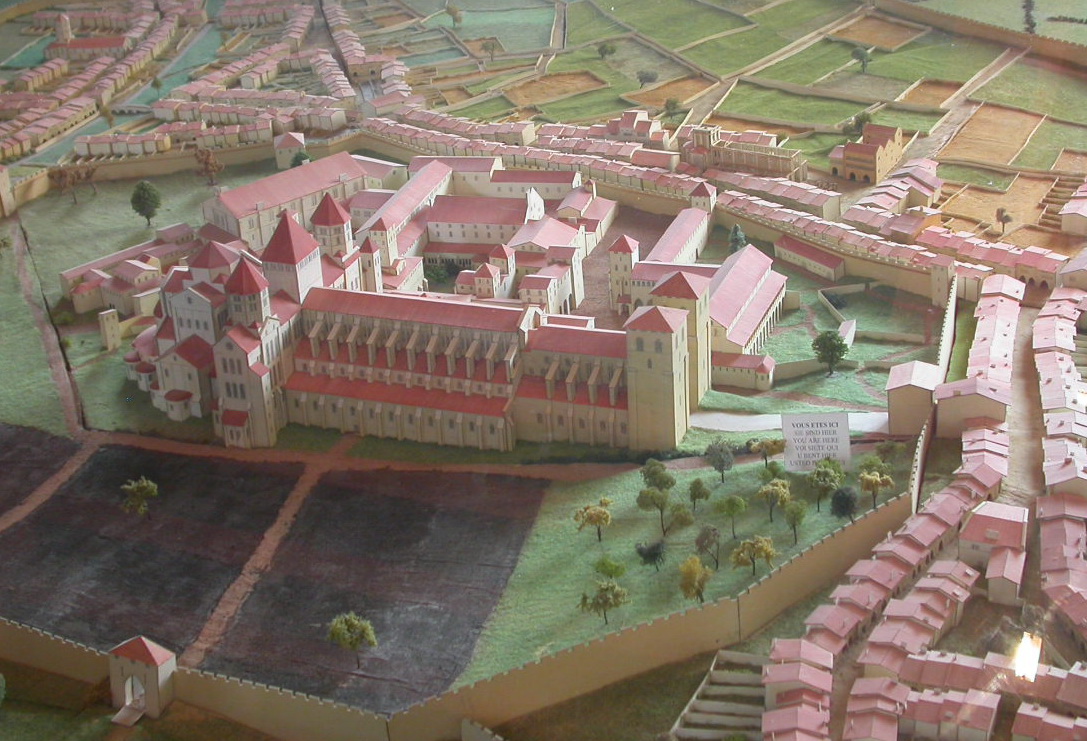
A model of the abbey of Cluny in its complete state

Image: Wikimedia


View of Cluny today through the bases of the western towers and the site of the narthex and nave to the surviving south transept

Image:panoramio


Monday, 4 November 2013

Hollister's biography of King Henry I


Over the weekend I finally finished reading C.W.Hollister's Henry I , which is published by Yale UP in their series on English Monarchs, and which I been reading for over two years in fits and starts - it is a substantial volume.


The original text of the volume was completed in 1990, but that year the print-out, back-up computer copies, notes, library and home of the author were destroyed in a forest fire in California. By the summer of 1997 he had re-written the bulk of the book, together with drafts of the remaining chapters when he suffered a fatal heart attack and the completion of the volume was left to a former research student, Amanda Clark Frost, who has done a splendid job in editing it all together plus filling in the missing chapters - notably on the King's support for the abbey of Cluny and its place in the religious culture of the era.

This is a very readable biography which presents a convincing, humane portrait of an able king who has not always been so clearly understood as he was by Hollister. For him King Henry is an able pragmatist, and reading the book one appreciates both the King's skill in the art of governanace and Hollister's skill in the art of history.

This is a big and comprehensive study which opnes up to the reader the challenges and possibilities facing a ruler in the early twelfth century, and it treats its material in a clear-sighted way - you appreciate the realities of the issues King Henry faced and the means by which he dealt with them.

A book very well worth reading, and well worth going back to pursue particular fields of study and interest. Written by an expert it is not just a book for other experts - anyone with an intererst in the period can gain from looking at it.


Thursday, 25 July 2013

The Botafumeiro of Santiago


Yesterday's terrible train crash just outside the city will clearly overshadows celebrations in santiago de Compostela for St James' feast today. The vistims and their relatives are definitely people to keep in our prayers.

On a happier theme celebrations at Santaigo are noted for the use of the botafumeiro in the cathedral - the great thurible that fills the cathedral with incense. The great twelfth century church was inspired in its design by the abbey and traditions of Cluny.

In a sense the botafumeiro - Galician for thurible - is every thurifer's delight, and asuitably estravagent piece with which to celebrate a great festival.

There are various videos of the botafumeiro in action on YouTube. From those I have selected three to illustrate the use of this wonderful piece of liturgical paraphanalia:


Here is another video, with the clergy vested in red as for St James:


The third is a record of the visit of Pope Benedict XVI during the Santiago Holy Year and includes some good aerial shots of the cathedral:

Thursday, 18 July 2013

Cluny


From Paray we travelled back in the direction of Ars to visit Cluny and the remains of the abbey. When we were planning this pilgrimage I put in a plea that we should visit Cluny, and I think that was fully justified, and appreciated by the other members of the group.

I have long wanted to visit Cluny, as the medieval priory in my home town of Pontefract was a Cluniac foundation and I was also fascinated by the thought of the great church at Cluny - Cluny III as historians refer to it - built in the late eleventh and early twelfth century, and until St Peter's in Rome was rebuilt in the sixteenth century, the largest church in Christendom. A seminal building in terms of Cluniac art and of the art of the western church nine tenths of it was destroyed in the years from the 1790s until 1821, and only in the twentieth century was it been excavated and conserved. Rebuilding it might be an act of reparation by the French for the impieties (to put it mildly) and vandalism of the revolution.

This then was a particular treat for me, but no amount of anticipation or reading prepared for the scale of what Cluny once was, or indeed of the scale of systematic destruction of so great a building. You realise the scale when you stand in the remians of the narthex and look at the jambs of the west door.


http://mw2.google.com/mw-panoramio/photos/medium/4339381.jpg

The west end of the abbey 
The stone buildings on either side are the bases of the western towers of the narthex
The lefy jamb of the west door can be seen, and in the middle distance the surviving south transept

Image: panoramio


http://www.guideoftravels.com/wp-content/uploads/2011/10/Cluny-Abbey.jpg 

The fourteenth century rebuilding of the palace of Pope Gelasius II, who died at Cluny in 1119
This is the entrance to the site. The remains of the south wall of the narthex are on the left.

Image:guideoftravels.com
Today it is administered and cared for by the state and done so very well, with an excellent guide book shop ( not as common in France as England), an excellent 3D introductory film, displays of surviving sculpture, the actual remains - essentially the south transept - and the eighteenth century rebuilding of the conventual buildings, and the remains of the medieval Chapter House, plus more sculpture and the slab of the high altar in one of the former granaries of the abbey. modern tecnology is skillfully used to evoke the vanished building.

Cluny itself has streets of fine medieval houses, but we did not have time to explore these, or the medieval parish church. The last museum display we visited concentrates on the sculpture recovered from the excavations and is housed in lodgings built by one of the later medieval abbots. 


http://www.france-travel-info.com/images/Cluny-5.jpg

The interior of the south transept
Image:france-travel-info.com

The  scale of what survives is an indicator not only of the sheer size of the building, but also of its beauty and the skills involved in creating it, and the marvellous inventiveness of the design and the delight in God's creation which the monks celebrated in prayer and liturgy, in art and music.


Cluny Abbey, Burgundy Region France

The transept from the south east 

Image:france-travel-info.com


I think we all felt we needed longer to appreciate the place, and I would certainly hope to return on another occasion, and allow more time. Whilst raiding the bookshop - the euros were finally burning their way out of my pocket - I was delighted to find in a book on Cluniac houses across Europe ( a theme that is emphasised at Cluny and through associations and websites ) a page, and indeed a photograph, on the site of the priory at Pontefract, complete with the a contact address of a friend there.


http://www.shafe.co.uk/crystal/images/lshafe/Cluny_Abbey_model.jpg


A card model of Cluny you can buy to make up at the abbey - or via the Internet.
I did not get one, although I was tempted, but maybe a way of whiling away the winter evenings....
Image:shafe.co.uk

Unfortuntely we did not have time to stop to look at the abbey's Chapelle des Moines at Berzé-la-Ville, a few miles away - I did spot the building from the road as we drove past - which has wonderful examples of wall paintings from the time of St Hugh the Great, for whom it was a retreat from the life of the abbey. Another reason for returning to the area another year. There are expandable pictures of the Berzé paintings here.

Back at Ars we were entertained after dinner by some of our fellow guests at La Providence. They are from Tahiti and arrived yesterday; with their French priest they are on an extended pilgrimage that includes Rome, Fatima and Lourdes as well as Ars. They are easily distinguished by their  tee-shirts in flourescent orange or green. The young men and boys gave us a haka, being in the same tradition as the New Zealand Maoris, and one of the women, complete with a wreath of flowers in her hair, performed a traditional dance. This was followed by two of the sisters from La providence performing a traditional Vietnamese dance. Fortunaely we were not called upon to give a traditional English dance - our Morris dancing is simply not up to it.

Afterwards we walked down towards to watch a Rosary procession of Roma gipsies from the Monument de la Rencentre to the Basilica. With them were the sisters and assistants from the shrine, carrying loud speakers on the shoulder holders usually reserved for statues, and also the Bishop of Bellay-Ars. Afterwards we walked up to the monument for a final visit.

So here we were with Tahitians and Roma, not to mention Vietnamese, Germans and Americans in the heart of France - a very real reminder of the universality of the Church and of the appeal of St Jaen-Marie.

Saturday, 8 June 2013

Popr Gregory VII and liturgical reform


I was interested to read in a recent post on the Medieval Religion discussion group that Pope Gregory VII started to mandate a standardisation of the liturgical rite in early 1074.  His letters in March 1074 to King Alphonso VI of Castile and Leon and King Sancho IV of Navarre are clear that the kings need to get the liturgical life of their realms aligned with Rome (he mentions that the Toledan/Mozarabic order will not be sufficient - it must be the Roman order).  He returns to the subject in a letter to King Alphonso VI in 1081, praising him, and holding him up as an exemplar, for restoring the Roman rite.  In that he can perhaps be seen as a precursor of King Philip II and his insistence that the decrees of the Council of Trent be enforced in his realms in the later sixteenth century.

With regard to the Hildebrandine reform, as the MR contributor points out, these letters, if nothing else, gives us a significant indicator at a starting point for the attempt at standardisation - and that it was tied, from the Pope’s perspective,  to his broader reform programme. It is also an answer, in part, to those who claim that such Papal initiatives are a modern thing, and indeed, that they are unjustified and unprecedented actions.


Pope Gregory VII

Image: uncouthreflections.wordpress

There is an online account of King Alfonso VI here and for those with Spanish there is a fuller version here.   The King was a notable patron of the abbey of Cluny and encouraged the Cluniac presence in his kingdom along the pilgrimage route to Compostella.

King Sancho IV was to be a victim in 1076 of the fratricidal tendencies not infrequently displayed in these years by the Iberian royal houses as can be seen in the online account of him here.


King Alfonso VI
Twelfth century minaiture at Santiago de Compostella cathedral

Image: Wikipedia

Wednesday, 15 February 2012

Medieval Navarrese and Scandinavian churches


The Medieval Religion discussion group has pointed me to two very interesting websites.

The first is about Romanesque architecture and sculpture in Navarre. Entitled Arte Románico en Navarra it is in Spanish but easily understood and can be accessed here. There is also an index page here so that one can click on the individual recorridos.

It is not only an indication of the fine things to be found in this part of Spain but areminfder of the flow of Romanesque art along the routes of the camino to Santiago and in particular the spread of Cluniac ideas in the eleventh and twelfth centuries as pilgrimage and the reconquista developed.
From Scandinavia there is an excellent web site with a great series of images of churches and monastic remains in Sweden and Denmark, as well as some other examples, including some in Scotland and Spain- and well worth exploring by clicking on the links on the sidebar. It is entitled Medeltidmed fokus på Skåne och Stockholmsområdet and can be found here. The text is in Swedish but comprehensible I think as to dates, places and patrons.

The churches illustrated are a reminder of how fully later medieval Scandinavia was integrated into the culture of medieval Christendom. Lutheranism did not prove so destructive of the artistic heritage of preceding centuries as did Calvinism or the various strands of reformist religion in England. In particular parish churches often preserved under whitewash whole cycles of paintings illustrative of late medieval folk piety.

Both sites are well worth looking at,or - putting it another way -jolly good timewasters.

Wednesday, 10 August 2011

Cluniac art at Berzé-la-Ville


Regular readers will know that one of my continuing interests is in the Cluniac tradition. Today I was pointed by a post on the Medieval Religion discussion group to some pieces about the Cluniac priory of Berzé-la-Ville, near to Cluny, and noted for its spectacular, well preserved Romanesque wall paintings. They were rediscovered under whitewash in 1887. They appear to have been the work of Abbot St. Hugh (d.1109).

photo

The chapel at Berzé-la-Ville

Image: vdbann'sphotostream on Flickr


There is an article about the paintings and their artistic inspiration here, and to mark the fact that today is the feast of St Lawrence here is the painting of his martyrdom from Berzé:


Berzé gives us some idea of how the great church of Cluny and its daughter houses would have been decorated.


Monday, 16 May 2011

Lewes Priory


Following on from my post referring to Lewes Priory in my piece about St Pancras Stephanie Mann of Supremacy and Survival has posted about the Priory, with links to the website of Lewes Priory Trust:


More on Lewes Priory

https://blogger.googleusercontent.com/img/b/R29vZ2xl/AVvXsEjk49vbgdm0I7Ea3eVYd_u6ew0oVsnhyphenhyphen8oCHNsQbzUtMiPZBPbhrLUMKKFXO5QiM9OEHDlO0ovblg3LrLYRuoD03HTW3LffstDos_iIOAyojAt1v23Y6IZ2jR8z_asoBJBzQnKzEVPGn3__/s1600/resizer.jpg


The post on St. Pancras led me to this site for the Lewes Priory Trust, which includes the illustration above (Illustration © Andy Gammon 2010) which depicts what it might have looked like. According to the site:

Lewes Priory was founded by William de Warenne and his wife Gundrada between 1078 and 1082 on the site of a Saxon church dedicated, like the Priory, to St Pancras. William was a leading Norman baron with extensive lands in Sussex and elsewhere in England. He also founded Castle Acre Priory in Norfolk. Lewes was the first Priory in England belonging to the reformed Benedictine Order of Cluny, based in France. It became one of the wealthiest monasteries in England. However, in spite of its wealth it played little role in national affairs, except at the time of the Battle of Lewes in 1264 when it was occupied by the troops of King Henry III.

The main buildings, including the great Priory church, were put up in Quarr limestone in the Romanesque style between c1082 to c1100 and in Caen limestone from c.1145 to the 13th century. Repairs and additions continued up to the monastery's dissolution in November 1537. At this time it owned over 20,000 acres in Sussex with other lands elsewhere, was the patron of 19 parish churches in the county and owned two houses for the poor in Lewes. A number of daughter priories were dependent on Lewes. There were only 24 monks at the time of its dissolution, compared with as many as 100 in the 12th and 13th centuries.

The site also includes links and information about Cluny and the religious houses that were dependent upon Lewes in England.

To Stephanie's post I would add I have always been fascinated by reconstructon drawings that evoke what was once in existence, and this is the first I have seen of the great church and priory at Lewes.

In the light of what the post says about there already being a church dedicated to St Pancras which was taken over to establish the priory might suggest I was going beyond the historical evidence in suggesting that William and Gundrada were referring to Harold Godwinson's oathbreaking in their foundation, but the possibility is intruiging. St Pancras may well have seemed a very suitable patron, and here was a church dedicated to him ready to be expanded into amonastic house

My interest in Lewes Priory comes from three things - as a Cluniac foundation it was of the same family as the priory in my home town of Pontefract, the Warrenne family held the neighbouring lordship of Wakefield (where I was born) from the Conquest until the mid-fourteenth century, and some of my ancestors lived near Lewes - although whether they were there when the priory was in existence I do not know.

Monday, 7 March 2011

Adding to the blogroll


I have added two additional sites to the list at the side.

One is Sancta Missa
which is a series of resources for those using or interested in the Extraordinary Form of Mass. It is produced by the Canons of St John Cantius in Chicago, where they are restoring a church and using the traditional liturgy. I met one of their number at the CIEL conference at Merton a few years ago, and impressed by what they were doing.

The other is that of the
Society of St Hugh of Cluny which is also concerned with promoting the use of the usus antiquior. Based in Connecticut many of its posts are specific to the US, but it has articles of interest to those of us further afield.


Friday, 14 May 2010

Cluniacs in Scotland


Dom Donald at Nunraw has copied my post on Cluny on his blog, and I will repay the compliment by circulating his post on Scottish Cluniac houses.

Cluniac 11th Centenary

Celebrating Scotland ’s place in Europe ’s Cluniac heritage on the 1,100th anniversary of the founding of the Abbey of Cluny, Burgundy.

The Programme

14th - 16th May, 2010

Craft Fair, Medieval Fair,

Children’s bowling competition,

Concerts, Coach tours, Exhibitions,

Conference, Historic re-enactments


Paisley Abbey

Paisley Abbey was founded in 1163 by Walter FitzAlan, an Anglo-Breton who brought monks to establish the community around the shrine to a local saint, St. Mirin. (St. Mirren – Scottish Football League).

For more information…

Saturday 15th May: Concert with organ and choir The glorious interior of Paisley Abbey will be the backdrop for a concert with a strong French theme.


Sunday 16th May: Service

Morning Service for Ascensiontide celebrating Cluny 2010

Guest Preacher
The Right Reverend Philip Tartaglia Roman Catholic Bishop of Paisley

Choral Music to include:
Te Deum (Howells – Collegium Regale)
God is gone up Finzi

Crossraguel

Historical Background

In 909 or 910, William the Pious, Duke of Aquitaine, founded a Benedictine abbey at Cluny in Burgundy . Two hundred and fifty years later the abbey was at the head of some 1,400 Cluniac establishments in France , Italy , Germany , Switzerland , Spain , Portugal , Belgium , England and Scotland .

For anyone interested in the history of Europe , the work of the Cluniacs cannot be overlooked. Their values remain relevant today: actions to promote peace, caring for the socially deprived and excluded, a sense of beauty. Varied architecture, a distinctive musical form, sculptures and paintings all form part of the fabulous heritage handed down to us by the monks.

La Fédération des Sites Clunisiens (Federation of Cluniac Sites) was founded in 1994 with a threefold objective: to forge close links between sites, enhance their Cluniac heritage and support their initiatives through action in the fields of education, culture and tourism. Several hundred people – elected representatives and private owners, cultural and tourism associations – are actively involved in the pursuit of these objectives. The Federation gives its backing to all their activities with the help of an international patronage committee bringing together researchers, archaeologists and historians. The Cluniac sites belonging to the Federation have now been organised into trans-regional and transnational itineraries.

As a result, a new European cultural and tourist network is growing, following in the footsteps of the monks of Cluny . Scotland ’s two sites, Paisley , founded in 1163 and Crossraguel in Ayrshire, founded c.1250, will be the focus of Scottish celebrations.

Today, Paisley Abbey is a living Christian community in the cherishing care of the Church of Scotland.

Crossraguel Abbey which was the last monastery to survive the Reformation of 1560 (the last monk died in 1601), is in the scrupulous care of Historic Scotland.


________________________________________________

On Tuesday we celebrated the Mass in Memory of the Holy Abbots of Cluny.
It is the eleventh centenary of the foundation and this year is marked by plentiful historical studies, Internet Links, and memorial events, not only of Cluny itself in Burguny, but of Cluniac sites over Europe.
In Scotland, Paisley Abbey is the main centre of celebrations.


May 11th.

THE HOLY ABBOTS OF CLUNY.
Night Office Reading

Abbot Berno, together with the Duke of Aquitaine, founded Cluny on

  • 11th September 909. Within several decades it was in a flourishing condition. It was a monastery where monastic ideals were held in esteem and where the observance was good; a solitude where a monk could seek God and find God in prayer, penance and study. Such a house was rare indeed in the decadent years of the 'early tenth century, when monastic discipline had all but disappeared.

  • An important factor in the growth of Cluny was that it was ruled during its first two centuries by a succession of great abbots. These men were both saints and administrators; they shaped the destiny of their house with wisdom and prudence. Five of them stand out in bold relief: Odo, Mayeul, Odilo, Hugh and Peter the Venerable. Odo gave the house its spiritual character, his dynamic personality established the course it was to take. Before he died he appointed an abbot-coadjutor to help him in his duties; this was Aynard, who was duly elected abbot after Odo'sdeath. There was precedent for this, for Odo himself had been appointed by Berno a little before he died. Aynard in his turn appointedMayeul to be coadjutor and his successor with the approval of the community. Mayeul nominatedOdilo to succeed him. Odilo died without appointing a successor and Hugh, his prior for some years, was elected by the community, thus bringing to an end a practice which, although directly counter to theRule of St. Benedict, gave Cluny a succession of outstanding spiritual leaders. Hugh was to rule for sixty years. After a lapse of thirteen years, during which Pons was abbot followed by Hugh II, the community elected Peter the Venerable, who was a worthy successor of Hugh I. He united both the spiritual leadership and the outstanding human qualities of his predecessors. He ruled as abbot from 1122-1156.

  • Cluny was still a flourishing community after the time of Peter the Venerable in the second half of the twelfth century. To the abiding value of its monastic ideal and its way of life at that time we could scarcely find a more impartial or more appreciative witness than the Carthusian monk-Bishop, St.Hugh of Lincoln . His biographer Adam tells us that, after the Carthusians, the monks of Cluny were the dearest to him because they cultivated the silent life of the cloister and turned their busy leisure to spiritual profit.
    When in old age he visited Cluny in 1200, he was struck by the good Order that reigned there in the choir, in the cloister and in the refectory. He was admitted to share their life in community for three days, to celebrate Mass and before he left he said to the Abbot: ‘
    Truly, if I had seen this place before I fell in love with the Carthusians, I should have become a monk of Cluny .