John Dillon posted on the Medieval Religion discussion group the following piece about one of the Holy Abbots of Cluny - a monastic tradition which has always held a great interest for me, coming as I do from a town which once had a Cluniac priory:
Maiolus (in modern French: Maïeul, Mayeul) was the fourth abbot of
Cluny. Previously archdeacon of Mâcon, from 954 he was the coadjutor of
Cluny's by then blind abbot Aymard, whom he succeeded in perhaps 963.
Both the abbey and its larger community flourished under his rule.
Maiolus traveled widely, reforming Benedictine houses in today's France,
Germany, and Italy. In 972 he was seized by Muslims from Africa who
had settled in Provence, was wounded while defending one of his
traveling companions, and was briefly held until he was ransomed at
great expense (a letter from Maiolus appealing to Cluny for his ransom
and describing his captors survives). Maiolus died on this day in 994
at Cluny's priory in Souvigny (Allier) and was laid to rest in its
church, now the église prieurale Saint-Pierre-et-Saint-Paul. His cult
was immediate. Maiolus' tomb at Souvigny quickly became a pilgrimage
destination. One of its earliest recorded visitors is St. Fulcramnus /
Fulcrannus (d. 1006). The first of Maiolus' numerous Vitae (BHL
5177-5185) was written by Cluniac monks by the end of the tenth century
and went through several revisions. Another was written in 1033 by
Maiolus' immediate successor, St. Odilo of Cluny (d. 1049).
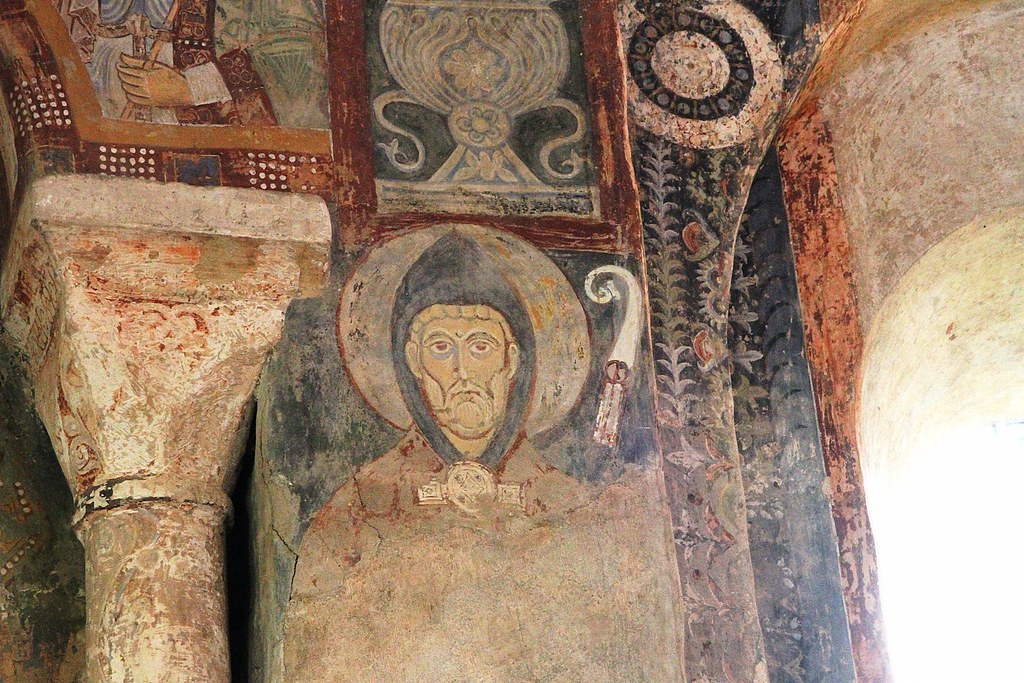
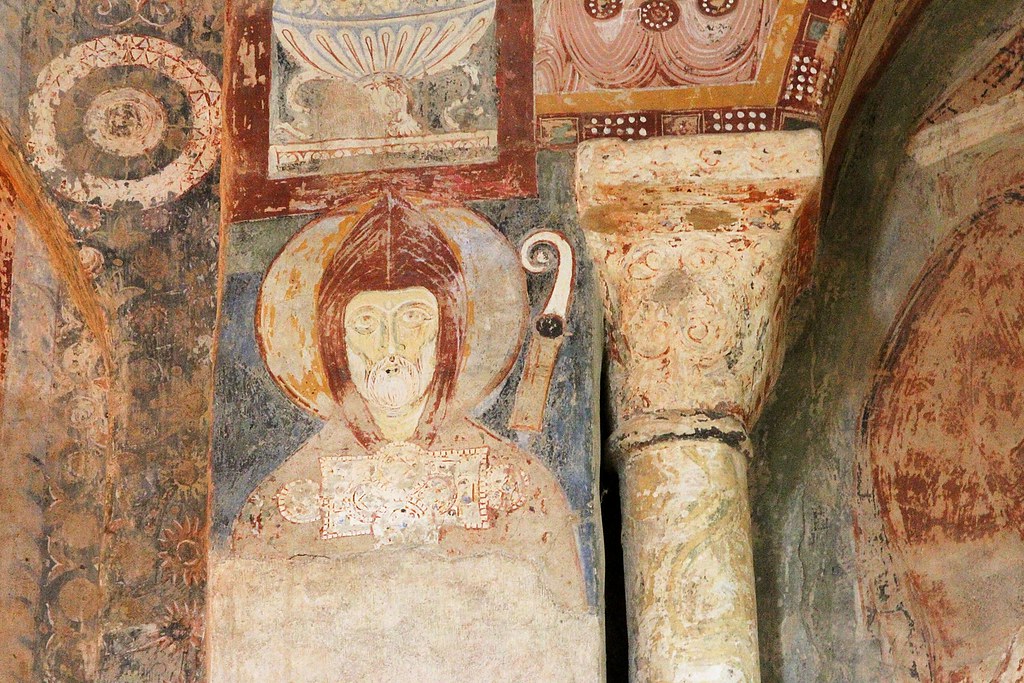
Some period-pertinent images of Maiolus of Cluny (or at least [item a] reasonably supposed to be of him):
a)
as probably depicted in one of a pair of twelfth-century frescoes of
sainted abbots in the chapelle des Moines at Berzé-la-Ville
(Saône-et-Loire), a former dependency of Cluny:
https://farm8.staticflickr.com/7340/9905525633_391874959e_b.jpg
The corresponding fresco is thought probably to depict St. Odilo:
https://farm6.staticflickr.com/5529/9905518653_ace2929edf_b.jpgb)
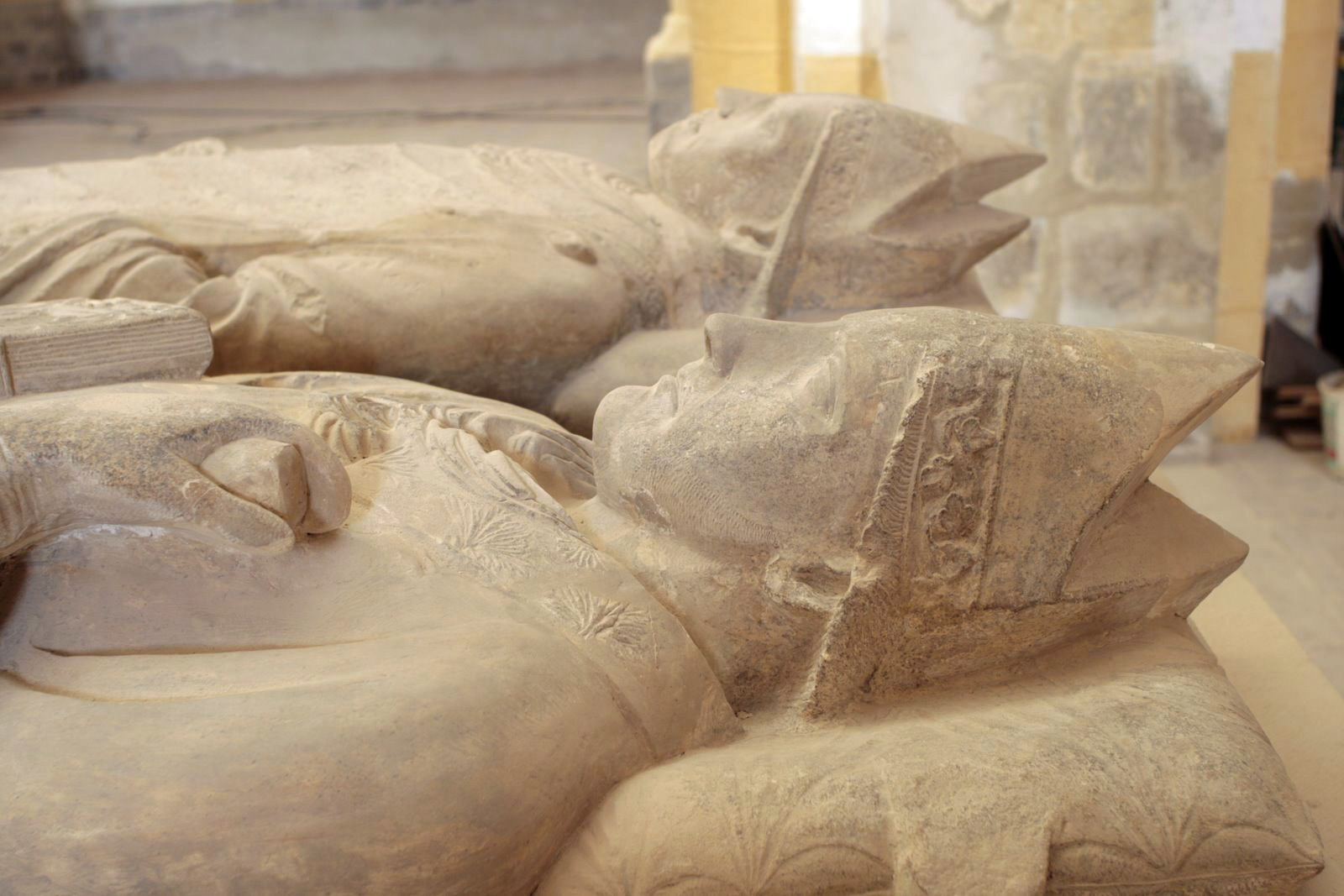
as portrayed in one of two thirteenth-century gisants on his and St.
Odilo's double tomb in the église prieurale Saint-Pierre-et-Saint-Paul
in Souvigny, shattered during the Revolution and recently reconstructed
from surviving fragments (one doesn't know which figure represented
Maiolus):
http://www.moulins-tourisme.com/wp-content/uploads/2016/02/stmayeulodilon3.jpg
That
photo seems to be from the early 2000s. As the reconstruction
progressed the figures were filled in. Some more recent views:
http://tinyurl.com/zeyvpnj
http://www.panoramio.com/photo/102473571
http://www.ipernity.com/doc/philippe_28/34920861
Two informative French-language articles on the double tomb and its reconstruction:
1)
Pascale Chevalier, "Les Gisants des saints Abbés Mayeul et Odilon
découverts à Souvigny", in Annie Regond et Pascale Chevalier, eds.,
Sculptures médiévales en Auvergne: création, disparition et
réapparition (Clermont-Ferrand: Presses Universitaires Blaise Pascal,
2008, pp. 63-71):
http://tinyurl.com/zs6w7ua [Google Books preview; scroll down to p. 63]
2)
Pascale Chevalier et Arlette Maquet, "La fouille des tombeaux des
saints abbés de Cluny, Mayeul et Odilon et les pèlerinages à Souvigny",
Bulletin Monumental 162 (2004), 87-100:
http://www.persee.fr/doc/bulmo_0007-473x_2004_num_162_2_1601c)
as depicted in a mid-fifteenth-century painting (c.1440-1450) on a
door of the monumental cabinet for his relics and those of St. Odilo in
the église prieurale Saint-Pierre-et-Saint-Paul in Souvigny:
http://tinyurl.com/zpol2gp
Distance view (Maiolus at left, Odilo at right):
http://www.veveri.it/img/maiolo/1.jpgThe reliquary as a whole:
http://www.ville-souvigny.com/Tourisme/Eglises_Retable_Armoire_Anglais.htmld)
as depicted in two illuminations in a later fifteenth-century
Libellus
missarum sancti Maioli (1465-1466; Chambéry, Bibliothèque municipale,
ms. 7, fols. 1r and 15r):
http://tinyurl.com/27ags4dhttp://tinyurl.com/26vzv8ge)
as portrayed in a later fifteenth-century limestone reliquary bust (c.
1480; from the former priory of Souvigny dedicated to him in Veurdre
[Allier]) in the Musée Anne de Beaujeu in Moulins:
http://tinyurl.com/gnnwnugf)
as depicted (scenes) in a set of eight early sixteenth-century frescoes
(c. 1515; attributed to Bernardino Lanzani) in Pavia's formerly
Cluniac basilica di San Salvatore:
http://tinyurl.com/oucxgehttp://tinyurl.com/q7stnfhttp://tinyurl.com/or58yvhttp://tinyurl.com/r2vhlu
It is good to see the saint's tomb being reconstructed.