Once I was a clever boy learning the arts of Oxford... is a quotation from the verses written by Bishop Richard Fleming (c.1385-1431) for his tomb in Lincoln Cathedral. Fleming, the founder of Lincoln College in Oxford, is the subject of my research for a D. Phil., and, like me, a son of the West Riding. I have remarked in the past that I have a deeply meaningful on-going relationship with a dead fifteenth century bishop... it was Fleming who, in effect, enabled me to come to Oxford and to learn its arts, and for that I am immensely grateful.


Showing posts with label Reading Abbey. Show all posts

Wednesday, 28 May 2025

Marian pilgrimage - Our Lady of Reading


The Pilgrimage remains on the banks of the Thames as it travelled west to Reading and the great Abbe founded in the Cluniac tradition by King Henry I. 

Tragically, very little survives of this one’s great building which was a focus for pilgrims to the relic collection and also the setting for numerous royal events in the middle ages.
Nonetheless, a visit to the ruins is a evocative experience given the rich history of the abbey.

My previous posts about the shrine can be accessed from Marian Pilgrimage - Our Lady of Reading

May Our Lady of Reading pray for Pope Leo XIV
.

Friday, 16 September 2016

Another car park, another King


Digging up or looking for English medieval Kings appears to be all the rage amongst archaeologists these days - not that I am objecting to such research being undertaken.

Following upon the recovery of King Richard III at Leicester and a tentative identification of either King Alfred or King Edward tbe Elder at Hyde Abbey in Winchester - well, of one possible bone - and now attention has turned to looking for King Henry I on the site of Reading Abbey.

In the abbey he held pride of place as founder and the abbey received quite a few other royal burials down to the later fourteenth century, when King Richard II ordered the Abbot to restore King Henry's tomb in return for a charter of confirmation of privileges.

No effort appears to have been made to rescue his remains at the dissolution of the Abbey in 1539, and the site became lost of the fragmentation of the monastic site.

The Daily Telegraph has a report about the early stages of the investigation which can be read at

http://www.telegraph.co.uk/news/2016/09/13/another-car-park-another-king-henry-is-remains-found-beneath-tar/


Related image

The twentieth century memorial on the site of Reading Abbey

Image:hylbom.com

Monday, 13 June 2016

A Lenten and Holy Week visit in 1466 to Reading and Salisbury


This is a post I originally planned to publish at Easter or soon after but it has taken time to get it together.

In 1466 an embassy from King George of Bohemia - George of Poděbrady - which was travelling round teh courts of Europe promoting the King's plan for a union of the various kingdoms and territories ( strangely topical n'est pas? ) spent the latter part of Lent and Holy Week in England and met King Edward IV.

The King of Bohemia was Hussite and was anxious to ease his quarrel with the Papacy and between 1465 and 1467 sent this embassy led by his brother-in-law, Jaroslav Lev of Rosental (c1425-1486). In contrast to the King, who was elected to the throne in 1458, Lev was a devout Catholic and they were thus in opposing camps in the complexities of mid-fifteenth century Bohemian politics. However Lev's sister Johana of Rožmitál had married George Poděbrad in 1450, and  Lev was loyal to his royal brother-in-law. Jaroslav was leader of a delegation of 40 nobles and knights with 52 horses.

Two contemporary accounts of the embassy can be read in  Malcolm Letts (ed) The Travels of Leo of Rozmital through Germany, Flanders, England, France, Spain, Portugal and Italy 1465-1467, and published for the Hakluyt Sociey by Cambridge University Press. One is in Czech by Schascko or Schaseck, who was armour bearer or squire to Jaroslav Lev, and the other is is German by Gabriel Tetzel from Nuremberg. I have differentiated the two by an S or a T and added notes in italics in [ ]

After visiting the court at Windsor, where they venerated the heart of St George and other relics, and where the Bohemian men's long tresses excited wonder and comment - almost a century earlier the Emperor Charles IV was depicted with long hair - was it a Bohemian style? - and the party now moved westward to set sail for France:

S p56
" Windsor is twenty miles from London and Reading sixteen miles from Windsor. It is a village with a large and elegant monastery where dwell priests of the rule of the Virgin Mother of God.
In that church is a picture on the altar and an image of the Mother of God most beautifully executed. So much so that I have never seen its equal nor shall I ever see one to compare with it if I progress to the ends of the earth. No image could be more lovely or more beautiful." [ Alas the painting from Reading abbey is entirely lost - was it perhaps brought from the continent or was it a product of an English atelier? ]

 Image result for REading Abbey

A modern reconstruction of Reading Abbey

Image: Reading Museum

Image result for REading Abbey

 Part of the ruins of Reading Abbey today

Image: Alamy/Daily Mail

S p60
" I have never seen more elegant churches or monasteries than in England. All are roofed with lead and tin, and within they are marvellously adorned "
 Image result for Salisbury cathedral Hollar

 Salisbury Cathedral from the west
The detached bell tower is on the left

Wenceslaus Hollar 1607-77

Image: Salisbury Museum

p61
" Salisbury is an open town but large. There we found another of the King's brothers named George. There is a very large and beautiful monastery [ i.e the cathedral which had a secular and not a monastic chapter ]. When one considers the elegance of the structure both within and without, it is second to none. The tower adjoins it and is built with great skill [ i.e. the detached bell tower destroyed in 1792 - see my post from 2011 Vandalism at Salisbury Cathedral ]  I have nowhere seen more elegant figures. One represents the Mother of God, holding the infant Christ in her arms while the Three Kings offer gifts. The other shows the Angels opening the Sepulchre with Christ rising from the dead, holding a banner in his hand. Both scenes are so represented that they do not appear to be fashioned but alive and actually moving before our eyes. It will not be out of place to mention that they have no lights on the altar at the celebration of the mass, a reminder that the country had three times departed from the Christian faith. [This reference is not clear] The following custom is also observed in this country. On Easter Day and the day preceding, in glorious memory of the Lord's Supper, all take the sacrament in the church and on each altar mirrors are set up." [ ? are these reliquaries]

There follows a description of the Royal Maundy ceremony

Image result for Salisbury cathedral Hollar

Salisbury Cathedral from the north

Wenceslaus Hollar engraving published 1672

Image:TheSaleRoom.com

S p62
"We arrived at Salisbury on the Friday before Palm Sunday. On Palm Sunday my lord with all his company was invited by the Duke [of Clarence] to a banquet which was served most sumptuously as is their custom. Among other courses they served a bird like a duck which is produced in the sea, and which takes no food, but lives only on air."[ Barnacle Goose ]


Image result for Salisbury cathedral Hollar

Salisbury Cathedral from the east, with the bell tower on the right

Wenceslaus Hollar 1607-1677

Image:junglekey.co.uk

T p57
" After this my lord was taken to see several abbeys of the Benedictine Order which are in England. [ CB - Reading pres. ] We saw two churches which are splendid beyond measure, also two splendid pictures and altars, as well as a great golden shrine in which lies St Sigmund [ St Osmund - canonised 1457. The  1536 Treasurer inventory lists ' a great ymage of the holy Seynt Osmund, all of silver and gilt, ornate with stones of divers coloured and weighing 83 ounces ' ] They showed us also a stone which came from Jerusalem wherein is the imprint of Our Lord's foot. It came from the Mount of Olives, from the place where Our Lord used to pray. They showed us also many other famous relics. We saw also some fine carved figures which were so worked with weights that they moved as if to show how the Three Holy Kings brought gifts to our Lady and her Babe, how our Lord reached out to take the gifts, and how our Lady and Joseph bowed and did obeisance to the Three Kings, and how they took their leave. All this was presented with rare and masterly skill as if they were alive. There was also a similar carving showing our Lord rising from the tomb and the Angels ministering to him. This was a splendid and praiseworthy thing to see. [ Malcolm Letts suggest these may have been the work of  Bishop Ralph Erghum before he was translated to Wells in 1388, and where the mechanical clockstill have two jousting knights to mark the hours. If the figures were related to the clock then there is background material on that at Salisbury cathedral clock and Medieval Clock | Salisbury Cathedral] The Abbot [ i.e.Bishop of Salisbury ] showed my lord great honour [p58] and reverence, and gave him a splendid repast in his palace which was hung with tapestries and other priceless things. He conducted my lord also into the choir, where we heard the choir singing which was delightful to hear. [ Bishop Richard Beauchamp 1450-81 ]


King Edward IV and Bishop Richard Beauchamp

Roof Boss at St George's Windsor

Image: St George's Windsor

After this my lord was conducted to the King of England's brother, called Duke of Klaris who was then in England. [ George Duke of Clarence was a member of the cathedral fraternity; at the time he was 17 ]. At this my lord was much pleased and showed the Duke honour and respect. We spent Palm Sunday there and saw a splendid procession showing our Lord's entry into Jerusalem. The Duke himself went in procession and made my lord walk beside him. Afterwards my lord and his attendants had to dine at court, and the Duke and my lord ate together, while my lord's attendants sat with the counts and gentlemen. They provided for us an unbelievably costly banquet lasting three hours, and among other dishes they gave us to eat what should have been a fish, but it was roasted and looked like a duck." [The Barnacle goose again ]


Image result for George Duke of Clarence

George Duke of Clarence

A late sixteenth century portait, arguably from an older source

Image: Wikipedia

This royal entertainment was presumably at Clarendon Palace, which lay two miles east of the city. There are online accounts of it at Clarendon Palace and at Clarendon Park and Palace


Wednesday, 6 April 2016

Visitors for Passiontide and Easter at Salisbury in 1466


Easter Day 1466 fell on April 6th and in the days leading up to Palm Sunday and into Holy Week the city and cathedral at Salisbury were host to a Bohemian embassy led by Jaroslav Lev of Rozmital
[ Rosental ], the brother-in-law of George of Prodebrad [Prodebrady] King of Bohemia 1458-70, whose wife Joanna was Jaroslav's sister. The embassy, which comprised some 40 nobles and gentry, with 52 horses, was travelling around the courts of Europe outlining King George's idea of, well, let's be topical, a European Union.

King George was a moderate Hussite, of whom an online biography can be found at George of Poděbrady, whilst his brother-in-law was a Catholic. There is a biography of him online at Jaroslav Lev of Rožmitál 

The embassy is recorded in two accounts which  have survived and are most easily accessible in The Travels of Leo of Rozmital through Germany, Flanders, England, France, Spain, Portugal and Italy 1465-1467, edited by Malcolm Letts for the Hakluyt Society ( CUP 1957).  Leo of Rozmital is the latinate form of Jaroslav's family surname.


One account was originally written in Czech by Schascko or Schaseck, Jaroslav's armour bearer or squire and the second, of which the manuscript still survives is in German and by Gabriel Tetzel from Nuremberg. As visitors they not always understand local conditions and pronunciation, but this is still a fascinating account. At Salisbury they recorded features otherwise unknown - and in some cases, ones that are well-nigh inexplicable. I have added some explanatory notes in [ ].

At Windsor the party was shown heart of St George and other relics and then travelled westwards:
Schascko wrote that:
"Windsor is twenty miles from London and Reading sixteen miles from Windsor. It is a village with a large and elegant monastery where dwell priests of the rule of the Virgin Mother of God.
In that church is a picture on the altar and an image of the Mother of God most beautifully executed. So much so that I have never seen its equal nor shallI ever see one to compare with it if I progress to the ends of the earth. No image could be more lovely or more beautiful." [p56]


A reconstruction of Reading Abbey

Image:skyscrapernews.com 

 Reading Abbey was almost entirely destroyed at the dissolution of the monastery in 1539. the fate of the painting which so entraptured Schascko is unknown, as is its origin.

 http://i.dailymail.co.uk/i/pix/2013/02/05/article-2273773-175C8739000005DC-761_634x464.jpg

The remains of the south transept of Reading Abbey

 Image:dailymail.co.uk

Schascko admired English churches:
" I have never seen more elegant churches or monasteries than in England. All are roofed with lead and tin, and within they are marvellously adorned " [ p60 ]

The party travelled on via Andover to Salisbury


 Salisbury Cathedral from the east by Wenceslas Hollar

The chantry chapels flanking the eastern Trinity Chapel and the detached bell tower were destroyed in the late eighteenth century

Image: Wikimedia
" Salisbury is an open town but large. There we found another of the King's brothers named George
[ Duke of Clarence]. There is a very large and beautiful monastery [Salisbury cathedral which had canons not a monastic chapter. The cloister may have misled teh visitor into thinking it was an abbey]. When one considers the elegance of the structure both within and without, it is second to none. The tower adjoins it and is built with great skill [Presumably the tower and spire at the crossing rather than the detached bell tower]. I have nowhere seen more elegant figures. One represents the Mother ofGod, holding the infant Christ in her arms while the Three Kings offer gifts. The other shows the Angels opening the Sepulchre with Christ rising from the dead, holding a banner in his hand. Both scenes are so represented that they do not appear to be fashioned but alive and actually moving before our eyes. It will not be out of place to mention that they have no lights on the altar at the celebration of the mass, a reminder that the country had three times departed from the Christian faith [This is unexplained - the sarum Use clearly had candles. Was this a Lenten practice?] . The following custom is also observed in this country. On Easter Day and the day preceding, in glorious memory of the Lord's Supper, all take the sacrament in the church and on each altar mirrors are set up." [ This obscure reference might indicate the use of mirrors to amplify the candles on great feast days. My friend Andrew Knowles suggests this may be a confused description of reliquaries]  [p61]

Schascko then describes the Royal Maundy ceremony, although that would have been at the King's Court on Maundy Thursday when the Czechs were elsewhere, heading towards Poole

Schascko adds that: 
"We arrived at Salisbury on the Friday before Palm Sunday. On Palm Sunday my lord with all his company was invited by the Duke to a banquet which was served most sumptuously as is their custom. Among other courses they served a bird like a duck which is produced in the sea, and which takes no food, but lives only on air." [This is barnacle goose, which intrigued both of Rozmital's chroniclers] [p62]


Salisbury Cathedral and bell tower from the west by Wenceslas Hollar

Image:salisburymuseum.org.uk

Tetzel's account of the same journey is as follows:

" After this my lord was taken to see several abbeys of the Benedictine Order which are in England.
 [ Reading must be one of these but is not named ] We saw two churches which are splendid beyond measure [ i.e.Reading and Salisbury], also two splendid pictures and altars, as well as a great golden shrine in which lies St Sigmund [ i.e. St Osmund of Salisbury - recently canonised in 1457. In 1536 the cathedral Treasurer's inventory includes ' a great ymage of the holy Seynt Osmund, all of silver and gilt, ornate with stones of divers coloured and weighing 83 ounces ' ] They showed us also a stone which came from Jerusalem wherein is the imprint of our Lord's foot. It came from the Mount of Olives, from the place where our Lord used to pray. They showed us also many other famous relics. We saw also some fine carved figures which were so worked with weights that they moved as if to show how the Three Holy Kings brought gifts to our Lady and her Babe, how our Lord reached out to take the gifts, and how our Lady and Joseph bowed and did obeisance to the Three Kings, and how they took their leave. All this was presented with rare and masterly skill as if they were alive. There was also a similar carving showing our Lord rising from the tomb and the Angels ministering to him. This was a splendid and praiseworthy thing to see. [ the editor suggests this may have been commissioned by Bishop Ralph Erghum before his translation to Wells in 1388, where there still survives a mechanical clock with two knights who joust as the clock strikes] The Abbot [i.e. the Bishop, Richard Beauchamp 1450-81 ]  showed my lord great honour  and reverence, and gave him a splendid repast in his palace which was hung with tapestries and other priceless things. He conducted my lord also into the choir, where we heard the choir singing which was delightful to hear.
After this my lord was conducted to the King of England's brother, called Duke of Klaris who was then in England. [ Clarence who was in his seventeenth year, was a member of cathedral fraternity ]. At this my lord was much pleased and showed the Duke honour and respect. We spent Palm Sunday there and saw a splendid procession showing our Lord's entry into Jerusalem [preseumably at the cathedral]. The Duke himself went in procession and made my lord walk beside him. Afterwards my lord and his attendants had to dine at court, and the Duke and my lord ate together, while my lord's attendants sat with the counts and gentlemen. They provided for us an unbelievably costly banquet lasting three hours, and among other dishes they gave us to eat what should have been a fish, but it was roasted and looked like a duck." [this was presumably at Clarendon Palace, which was two miles east of the city]  [pp 57-8]

The Czechs moved on to Poole, where they spent Easter itself before a stormy crossing to Guernsey and then Brittany.

There is an authoritative detailed online account of the fabric of salisbury cathedral at Tim Tatton-Brown, David Lepine & Nigel Saul (2013) ‘Incomparabilissime Fabrice’: The Architectural History of Salisbury Cathedral c. 1297 to 1548, Journal of the British Archaeological Association, 166:1, 51-98, DOI: 10.1179/0068128813Z.00000000016
To link to this article: http://dx.doi.org/10.1179/0068128813Z.00000000016

The famous clock of Salisbury cathedral, usually claimed to date from before 1386, though some consider the mechanism somewhat later, when it was housed in the detached bell tower, is discussed in dating_salisbury [Clocknet UK].  

The fate of the bell tower is discussed in my 2011 post Vandalism at Salisbury Cathedral  - I see two of my illustrations there have expired, but one remains and can be supplemented by the following one:


 Print Showing the old belfry


                           Salisbury Cathedral in 1759
                                            Image:clocknet.org.uk


This beautifully carved and brightly coloured roof boss, to be found in the easternmost bay of the South Quire Aisle, depicts one of St George’s Chapel at Windsor’s most famous relics, the Cross Gneth. Kneeling on either side of this Celtic cross are King Edward IV and Richard Beauchamp, Bishop of Salisbury, 1450-1481, Dean of Windsor, 1478-1481, and Chancellor of the Order of the Garter, 1475-1481.

Image: St George's Chapel Windsor


https://upload.wikimedia.org/wikipedia/commons/8/8b/George_Plantagenet,_Duke_of_Clarence.jpg 

George Duke of Clarence  

Image:Wikipedia 

Alas we can no longer marvel at the ingenuity of the mechanical figures at Salisbury, which are long gone - presumably at the reformation - but let us be thankful for Schascko and Tetzel, for without them we would know nothing of their existence at all.


Saturday, 25 July 2015

St James the Great


Today is the feast day of St James the Great.

Here in the Thames Valley Reading Abbey was given a relic of him in form of one of his hands by the Empress Matilda. The Empress had brought this back to England after the death of her first husband the Holy Roman Emperor Henry V, and although it properly belonged to the Imperial collection she, her son King Henry Ii and the monks of Reading ensured it stayed in England. Today it is now preserved in the Catholic church in Marlow. I have posted about this previously in The Hand of St James and in More on the Holy Hand of Reading.

There is more about it in an illustrated post from a blogger here, and a piece about both the hand and other aspects of medieval English devotion to St James here

Gordon Plumb has posted on the Medieval Religion discussion group site more of his photographs of medieval stained glass images of St James the Great:

Chartres, Cathédrale Notre Dame, Bay 5, St James window set of images:

Acaster Malbis. Holy Trinity, Yorkshire, east window, 3d-4d:

Barton upon Humber, St Peter, east window( ex, at present in storage with English Heritage in York awaiting conservation - which is where I photographed it):
and detail:

Oxford, Merton College Chapel, west window:

North Tuddenham, St Mary, Porch, Norfolk, porch, west window, 1b-3b:
detail:

York, St Mary Castlegate, sIII, 2b:
and detail:

York Minster, wI, 5f-7f, 1340's (right-hand figure):

Harpley, St Lawrence, Norfolk, wI, A4:

York, All Saints North Street, sVI, 2a-3a:
and detail:

Stamford, Browne's Hospital, sII, 9a-11a:

Icklingham, All Saints, Norfolk, sII, 2b (figure on right):

Langport, All Saints, Somerset, east window, c2:

Bourges, Cathédrale St Étienne, Bay 27 father and mother of Pierre Trousseau presented by St James the Great, :

Bourges, Cathédrale St Étienne, Bay 25, Annunciation with St James and St Catherine:

Tattershall, Holy Trinity, Lincolnshire, east window, 3b:

Gloucester Cathedral, east window (figure on left)

Doddiscombsleigh, St Michael, Devon, nIII, 2a:
and detail:

Saturday, 30 May 2015

Plan to explore the past of Reading Abbey


Stephanie A. Mann has an interesting piece on her excellent blog Supremacy and Survival: The English Reformation about the possibilities of further excavations at the site of Reading Abbey, and in particular the search for the remains of the founder King Henry I. She also writes about the fate of the last Abbot Bl.Hign Cook of faringdon who was martyred in 1539.


Friday, 24 April 2015

Exploring in Buckinghamshire


Last Saturday I had a day out visiting friends in Buckinghamshire. It was a splendid spring day on which to travel out on the bus from Oxford, with the trees and hedgerows displaying an increasing and varied range of greenery in the bright sunshine.

The route took me through Thame, an historic town and with a handsome medieval parish church and a striking collection of old buildings. I keep promising myself whenever I am passing through the town to have aday exploering it.

I had arranged to meet my friend in Stone, which lies just west of Aylesbury. He was armed with Pevsner's Buckinghamshire and we went to have a look in the village church of St John the Baptist, where several parishioners were doing cleaning and gardening tasks. The church is medieval, though obviously restored in the nineteenth century, but with an attractive twelfth century north nave arcade.

http://www.churchpics.co.uk/Buckinghamshire/Stone_St_John_the_Baptist.jpg

 St John the Baptist Stone

Image:churchpics.co.uk

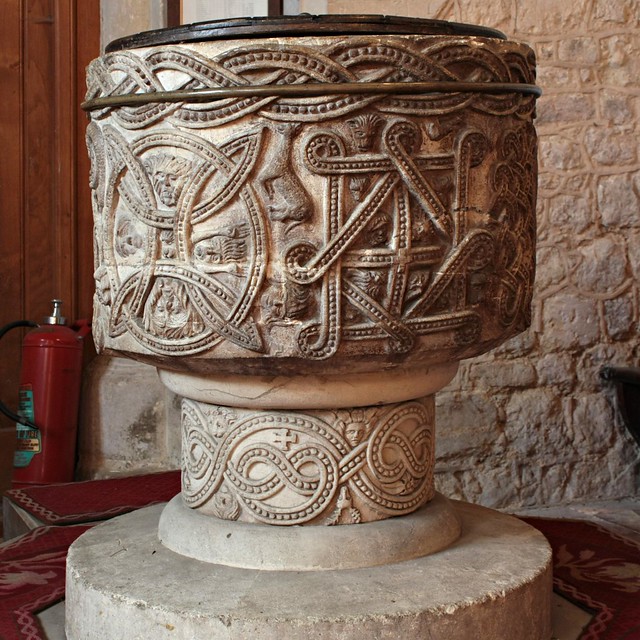
The great feature is the twelfth century font, originally at the church of St Mary the Virgin Hampstead Norreys near Newbury in Berkshire, from whence it was thrown out in 1767. Having been spotted by an FSA it was moved in about 1845 to Stone and restored.

Stone, Buckinghamshire, Church of St John the Baptist, Font 

The font in Stone Church
The stem is nineteenth century

Image: Eric Hardy on Flikriver.com

There is a technical description of it, and the other carvings of the same era in the church, at St John the Baptist, Stone, Buckinghamshire · The Corpus of Romanesque Sculpture in Britain and Ireland

The real questiuon that arises is that of how to interpret the sculpture. This is set out  at the following site, with links to both of the alternatives set out by scholars, at Buckinghamshire Archaeological Society - Font at Stone

Carving on the font at Stone
The panel with figures - Heracles or Christ?

Image: Buckinghamshire Archaeological Society

Ellen Ettinger's article from 1964, arguing that the image originates with the story of Heracles, can also be read at THE FONT AT STONE* - Buckinghamshire Archaeological Society

However the information on display in the church follows the interpretation of the late Mary Curtis Webb in her study Ideas and Images in 12th century sculpture, and which is linked to from the first site.

I am much more inclined to accept her interpretation, which can be summarised as follows. She dates the font to 1140-50 and produced under the influence of Reading Abbey, founded by King Henry I  with Hugh of Boves as its first Abbot from 1123. A Cluniac monk he had studied under Anselm of Laon - for whom see Sir Richard Southern's first volume on Medieval Humanism and Christian culture - and was especially indebted to the ideas of High of St Victor of whose De Sacramentis Christianae Fidei there were three copies at Reading and one at its daughter house at Leominster. This states that "There are two works under which all things may be subsumed: these are the Work of Foundation (or Creation) and the Work of Restoration ( or Salvation)." 

The interlace patterns represent the Cosmic harmony of macrocosm and microcosm, and ideas deriving from Boethius' translation of the Introduction to Arithmetic of Nicomachus of Gerasa and Plato's Timaeus

The panel with figures derives from St Gregory's Moralia in Job  and the apocryphal Gospel of Nicodemus. This is the ransom theory of Salvation whereby God deceived Satan with the bait of mortal flesh, whereby the Evil One was caught on the " Hook of Divinity." Each detail on the font is to be found in early versions of the Gospel of Nicodemus.

The naked figure of Christ descends alone to Hades, where He encounters two aspects of Hell - Death as a Wolf and Satan as a Dragon. Christ offers His left hand as bait to the jaws of the dragon whilst He points with his knife at Leviathan rising for the triple bait. Leviathan is fated to have his flesh sold  as meat in the streets of Jerusalem at the coming of the Messiah.

A salamander representing the powere of Christ to withstand teh fires of temptation nestles against teh leg of the Redeemerv who tramples the serpent (the Tempter) underfoot. Meanwhile the "Dear Bird from Heaven" - from the Anglo-Saxon poem of Cynewulf  - pecks at the monster.

Adam, wearing the "Helmet of Salvation" stands on aleaf between God Incarnate and the Devil - a frerence to St Gregory's comment in the Moralia "What is man but a leaf who fell from Paradise from the Tree (of Life)"

The large bread roll being regurgitated by the Wolf, the jaws of Death, is a reference to afourth century  hymn of St Ephraim " To others he multiplied bread but my bread from my mouth  he steals it " There was avolume of St Ephraim's writings in the Reading Abbey library.

In the second half of the twelfth century the Cur Deus Homo of St Anselm (d. 1109) and the rising interest in Aristotle displaced the thought of Plato and Number theory, and theology moved in new fditrections, other than those of the makers of this font.

On this approach the font does indicate the complex level of theology that was being made available to rural parishes in the mid-twelfth century through the patronage and influence of monastic houses. I presume that it was painted originally, which would have enabled teh ideass to be brought out more distictly.

Being abear of small brain I am having difficulty transferring the photographs I took with my mobile phone to the blog - if I can do so I will post again about this remarkable font.

From Stone we went through Wendover and Hale, the birthplace of John Colet, to my friend's house for lunch with him and his wife and children - which was very agreeable indeed.

On the way back to drop me off for the Oxford bus we stopped to look at the church of St Mary in Haddenham. This has an impressive thirteenth century tower and work of several succeeding centuries. This may in part reflect the fact that the manor belonged to the cathedral priory at Rochester in the middle ages.

St. Mary the Virgin, Haddenham

St mary the Virgin Haddenham

Image:odg.org.uk


The church is adjacent to - indeed rises above - a duck pond which is, as I understood it, home to a flock of true Aylesbury ducks.


Image: myblog.uk.co

There are also some fine examples of both timberframing and of the local building material wychert, a type of cob construction. It is one of only three wychert (or whitchet) villages. Wychert describes a method of construction using a white clay mixed with straw to make walls and buildings, which are then thatched or topped with red clay tiles.


A fifteenth century house next to the church

Image:rightmove.co.uk 


This was a most enjoyable day out, seeing friends I value and places of historic interest in pleasant countryside illuminated by the spring sunshine.

Saturday, 15 November 2014

Martyred Benedictines of 1539


Today is the 475th anniversary of the martyrdoms by hanging, drawing and quartering of the last abbots of Glastonbury and Reading and their companions, two monks at Glastonbury, John Thorne, the Treasurer and Roger James, the Sacrist, and at Reading another monk John Rugge and John Eynon, priest of St Giles church in the town. There is amodern plaque to his memory in that church.

The other year I posted biographies of the two abbots in my posts Bl.Richard Whiting, Abbot of Glastonbury and Bl.Hugh Cook or Faringdon, last Abbot of Reading


Reading Abbey from the River Kennet. Drawing by R.W.Ford (1998.180.32)

Reading Abbey from the River Kennet

A reconstruction drawing by R.W.Ford

Image;readingmuseum.org.uk


Reconstruction model of Reading Abbey

The model was made by Mr R W Ford which is on display in the Museum of Reading and shows the Abbey as it was around 1500.   

Move your cursor over the picture of the Abbey above. Click when it turns into a hand to show that there is a link to another page. You will then jump to a page telling you about the part of the Abbey you have clicked on.
You may like to use the page on the buildings of the Abbey clearly numbering and naming the different parts - click here.

 Image:readingabbey.org.uk/Copyright Reading Museum Service (Reading Borough Council). All rights reserved.

Model of Glastonbury Abbey

Reconstruction model of Glastonbury Abbey

This is on display in the Abbey Visitor Centre and shows the Abbey as it may well have appeared at the time of the dissolution

Image:All rights reserved.Copyright Holder - GNU License/skyscrapernews.com

There is more about the fate of Bl. Richard Whiting and the possible survival of some of his bones, now at Prinknash Abbey, at the postvfrom the blog Clas Merdin at The Bones of Richard Whiting
 

photo

In the modern Catholic church of the Shrine of Our Lady of Glastonbury is atapestery hanging on either side of the Statue of Our Lady, and which depicts various saints and Blesseds associasted with Glastonbury.
On the left are Blesseds Richard Whiting, John Thorne, and Roger James. Below them is St Dunstan (depicted with the Devil caught by his nose with pincers) and Blessed Richard Bere - he was a nephew of Abbot Whiting's predecessor and was one of the London Carthusians who died in prison.
On the right ate St Joseph of Arimathea, St David, St Patrick and St Brigid (depicted with a cow and a milking stool) 


Image:Glass Mouse on Flickr

At Colchester on December 1st that year the Abbot of Colchester, John Beche, was similarly executed. I posted about him in The last Abbot of Colchester

According to the Wilipedia entry on him his rectoral cross was rescued by the Mannock Family of Stoke-by-Nayland in Suffolk, who eventually gave it to Buckfast Abbey in Devon.

There is something about the late medieval and Tudor nature of Colchester in Medieval English urban history - Colchester - Map


Tuesday, 15 November 2011

Martyr Abbots


Yesterday was the anniversary of the martyrdom of Abbot Hugh Faringdon of Reading and his companions and today that of the martyrdom of Abbot Richard Whiting and his companions in 1539. My posts from last year about Bl. Hugh Cook or Faringdon, last Abbot of Reading and about Bl.Richard Whiting, Abbot of Glastonbury give an accouint of their lives and witness in blood for the Catholic faith.

Sunday, 9 October 2011

Bl.Dominic Barberi plaque in Reading


Thanks to my friend the Catholic Schoolmaster who attended the ceremony of dedication and took the photograph I can post a picture of the plaque commemorating Blessed Dominic Barberi which was unveiled in Reading yesterday.

The site is cloae to Reading station on Caversham Road

May Bl. Dominic Barberi continue to pray for the conversion of England.


This is a photograph he took of a window from the Church of St James in Reading (next to the site of Reading abbey and, indeed of Reading Gaol), which commemorates Cardinal Newman, Blessed Dominic Barberi, and the anniversary of the Church.

Sunday, 31 July 2011

More on the Holy Hand of Reading


Further to my post about the Holy Hand of Reading I see that last weekend the relic was on display for veneration in St James' Catholic church in Reading, which adjoins the site of the north transept of the abbey church. Therte is an article from the Reading Chronicle about the occasion here. I feel rather disappointed that I did not know beforehand about the visit of the relic and the accompanying lecture and other events as I would have tried to get to Reading to participate in the pilgrimage. Maybe another time.


The Holy Hand today

Image: Reading Chronicle

Here are two pictures of the 1467 reliquary of the hand of St Babylas in the Guelph Treasure in Brunswick, which gives an idea of how the relic might have been displayed in the middle ages.

http://www.kornbluthphoto.com/images/PMAArmRel1.jpg

http://www.kornbluthphoto.com/images/PMAArmRel3.jpg


Images: Genevra Kornbluth www.kornbluthphoto.com/Saints1.html


Monday, 25 July 2011

The Hand of St James


Today is the feast of St James the Great. In addition to the great pilgrimage centre of Santiago de Compostella there is also the English devotion to him centred on the Hand of St James from Reading Abbey.

The relic came to there from the Empress Matilda, daughter of the founder of the abbey, King Henry I. She had been married to the Holy Roman Emperor Henry V and following his death in 1125 Matilda returned to England bringing with her the relic of the hand, which hitherto had been part of the Imperial treasure.

File:Matilda jidnrichInem.jpg

Emperor Henry V and Matilda

Image: Wikipedia

The King had founded the abbey of the Virgin and St John in 1121 with Cluniac monks, and endowed it with a formidible collection of relics. The Empress presented the apostle's hand to Reading where it became the principal one, being that of an apostle, the brother of St John the co-patron and a link with the Cluniac inspired pilgrimage to Santiago. From the relic came the use of the shell as an heraldic symbol by the abbey and town of Reading.

The story of the relic and the unsuccessful attempts of the Emperor Frederick I to regain it from King Henry II are retold by the late Prof. Karl Leyser in a splendid essay reprinted in his Medieval Germany and her neighbours. For an excellent biography of the Empress I would recommend Marjorie Chibnell's 1991 Empress Matilda: Queen Consort, Queen Mother and Lady of the English.

Reconstruction of Reading Abbey - © Nash Ford Publishing

A reconstruction of Reading Abbey

Image:www.berkshirehistory.com/churches

The relic remained at Reading until the destruction of the abbey in 1539. There is more about the abbey on the website of the Friends of Reading Abbey. In 1786 workmen found what appears to be the holy hand in the ruins of the abbey - there is more about that here. The relic is now held at St Peter's Catholic church in Marlow.


The Holy Hand


Sunday, 14 November 2010

Bl. Hugh Cook or Faringdon, last Abbot of Reading


November 14th is the annversary of the martyrdom in 1539 of Abbot Hugh Cook, or Faringdon, the last Abbor of Reading, and his companions John Rugge and John Enyon.

Antique print of Hugh Cook of Faringdon, Abbot of Reading - © Nash Ford Publishing
This picture of Bl.Hugh Cook is from David Nash Ford's Royal Berkshire History website. I do not know its source.

The most recent account of the life of the Abbot I can find is that in the Oxford Dictionary of National Biography and it can be read here.

Reading Library website has a biography which I have copied and edited slightly adding information from other sites, including the DNB and the new ODNB and combined it with an article in the Douai Oblate newsletter for October 1998:

Blessed Hugh Faringdon (d. 1539), Last Abbot of Reading Abbey

“Not fearing openly to profess that which Henry’s laws made it treason to hold - fidelity to the See of Rome which he declared was but the common faith of those who had the best right to know what was the true teaching of the English Church.”
- Attributed last words of Hugh Faringdon

Possibly originating from Faringdon in Berkshire, hence his name in religion, his original name was Hugh Cook. As he later used the arms of the Cook family from Kent there may be a connection with them, although assuming the arms of a family with the same surname, but no actual familial relationshio was far from unknown. He probably entered the abbey before 1500 and was the abbey’s sub-chamberlain when he was elected Abbot in 1520 following the death in July that year of Abbot Thomas Worcester. Faringdon kept the abbey in good order and encouraged the grammar school attached to the Abbey, attracting better staff and noble pupils. These included James Bassett, the stepson of Arthur Plantagenet, Viscout Lisle, the illegitimate son of Edward IV. In his last months of freedom in 1539 the abbot concluded a new teaching agreement between the abbey and Cox.

The chronicler Edward Hall described Faringdon as "a stubborn monk and utterly without learning," but this may be the prejudice of a quasi-official government propagandist. Browne-Willis refers to the abbot's letters in the Register of the University of Oxford, which, however, were not necessarily composed by him. The specimens of his correspondence preserved in the Public Record Office are short and in English. He was certainly a patron of learning. About 1524 Edward Cox, the Reading Grammar school's humanist master, published a treatise, The Arte or Crafte of Rhethoryke, which he dedicated to the Abbot as to one who "hathe allwayes tenderly favored the profyte of yonge studentes". Further, the expression of a correspondent of Lord Lisle's that the Abbot "makes much of James Basset and plieth him to his learning both in Latin and French", does not convey the impression that he considered Faringdon illiterate.

He also fulfilled local government responsibilities including acting as a Justice of the Peace. Despite his resistance to Protestant ideas, signified by his refusal to allow anyone connected to these new ideas to be attached to the abbey, as a member of the House of Lords he consistently supported the government. He signed petitions to the Pope supporting Henry VIII’s divorce, even offering to search the abbey’s library to find a stronger case. He frequently entertained Henry at the abbey, and was called by Henry “his own abbot”, being made a Royal Chaplain in 1532.

Abbot Hugh was staunchly opposed to the new heresies, especially Lutheranism. One of his monks was Dom John Holyman, also strongly opposed to Lutheranism, who had been a fellow of New College, Oxford, before becoming a monk. In 1530 he was due to preach a University sermon for his doctor's degree; Abbot Hugh asked that he be permitted to preach the sermon in London instead, so as to counter the growing tide of Lutheranism there.

In 1535 the Abbot, it is said, intended to have resigned in favour of the Prior of Leominster, a cell of Reading, but changed his intention following the passing of the Statute of Abatement of Pensions.

Faringdon signed the articles of faith in 1536 which acknowledged the royal supremacy of the church, but according to a contemporary writer he had added in conscience "of the temporal church but not of the spiritual." Moreover he maintained he would pray for the Pope as long as he lived and would say Mass for him once a week.

In 1536 he took the oath of Royal Supremacy and also agreed with the dissolution of the lesser monasteries. Politically Faringdon supported the King and contributed men to fight against the Northern rebellion of 1536, the Pilgrimage of Grace, although some townspeople of Reading had been in touch with the leader of the rebellion, Robert Aske. In October 1537 the Abbot sang a requiem Mass at Queen Jane Seymour’s funeral, but in December that year a rumour reached Reading that the king was dead, which Faringdon repeated in letters to some of his neighbours. This could be construed as treason. However, the king graciously pardoned him.Through these years the Abbot appears to have been steering a careful political course, presumably hoping that events would take a turn for the better.

Despite his royal patronage, the Abbot’s fall in 1539 was rapid, after Faringdon refused to obey hints to dissolve Reading Abbey. In August 1538, Dr John London, royal commissioner for the visitation of monasteries under the authority of Thomas Cromwell had arrived in Reading. On September 13 Greyfriars, Reading, was surrendered to the Crown: on September 17 the shrine of Our Lady at Caversham was destroyed: in both cases the riches were confiscated by the Crown, the silver statue of Our Lady was nailed in a chest and sent by barge to Cromwell's house in London. At the same time Dr London visited the Abbey and made an inventory for Cromwell. The abbot was not willing to surrender the abbey.

On May 19, 1539 an act granting to the king all abbeys which "hereafter shall happen to be dissolved, suppressed, renounced, relinquished, forfeited...or shall happen to come to the King's Highness by Attainder of Treason." Faringdon still refused to surrender the abbey, so a charge had to be invented.

The charge was loyalty to the Holy See which implied a denial of the King's supremacy and was therefore equivalent to treason. He was also alleged to have sent money to the northern rebels. Accordingly Faringdon was arrested at his manor house of Bere Court at Pangbourne on September 17, and imprisoned in the Tower of London. There were rumours he was connected to the Exeter Conspiracy of the previous year, and his fellow Reading victim John Rugge had connections to that aristocratic circle through the cathedral at Chichester. However the charges laid against the Abbot were of upholding papal supremacy on three separate occasions.

In the Tower were also the Abbots of Glastonbury and Colchester, and they communicated and encouraged each other by means of a blind harpist called William Moore. As a peer of the realm, charged with treason, Faringdon should have been brought before parliament. No trial took place, only questioning in the Tower which may have produced incriminating evidence. He was sent back to Reading for a public trial. It was to be a show trial, the result was determined beforehand. In a note in Cromwell's own hand is written “The Abbot of Redyng to be sent down to be tried and executed at Redyng with his complices...see that the evidence is well sorted and the indictments well drawn."

In 1960 the official report of the trial and indictment was discovered in the Public Record Office and it is now clear that he was tried on November 13, 1539 in the great hall over the Gateway of the Abbey on a charge of high treason for denying the royal supremacy of the English Church. (This great hall still exists). The abbot was allowed no defence and a sworn jury declared that he was guilty of the charges. Two others, John Enyon who was a priest at St Giles Church, Reading, a friend of Faringdon's and John Rugge (or Rudge) a former prebendary of Chichester, who had been living in retirement in the Abbey were also found guilty with him. Enyon was alleged to have circulated a letter in support of the Pilgrimage of Grace, and Rugge of possessing the relic of the hand of St Athanasius in despite of the King's representitive having been sent to suppress such idolatry. Reading as an abbey had from its foundation a famed collection of relics - most notably the hand of St James the Great All three were sentenced to the death of a traitor, that of hanging, drawing and quartering, no exception being made in the abbot's case, despite his being a lord spiritual of the realm.

The next day, November 14, after being dragged round the town, and refusing to recant his loyalty to Rome, he and the two other local clergy, were hung, drawn and quartered in the Forbury before the Abbey Gateway. The exact site of the executions is not enirely clear as they may have taken place been in front of the gateway facing the market place or that which still survives which linked the abbey outer court to the monastic buildings. Marillac, the French ambassador, writing to Francis I on November 30, said the abbot's remains were hung up in chains.

After his death the Abbey was dissolved, its lands and goods confiscated by the Crown.

Together with John Rugge and John Enyon he was beatified in 1895. He gave his name to Blessed Hugh Faringdon Catholic School and is also commemorated in the Church of the English Martyrs, in Leibenrood Road. More recently a public house has been named after him. Bl John Eynon is commemorated in the much rebuilt St Giles church where he was priest.

The almost complete destruction of the abbey of Reading is perhaps surprising given that not only was it a royal foundation, but included the tombs of King Henry I and members of his family as well as late medieval members of the royal house, and had been the scene of royal weddings and state ceremonies. Situated at the western end of Windsor Forest and close to routes to the west an the midlands it had long been a foundation used by the Kings of England.

Today, apart from the gatehouse leading into what was the monastic enclosure from the outer court (and in which, incidentally Jane Austen went to school) only pitiful fragments of rubble core are to be seen of the church and chapter house. In the Museum in Reading, which is well worth visiting, are examples of the lavish Cluny inspired sculpture with which the church was decorated.

The website of the Friends of Reading Abbey gives an account of the site and of their meetings.

The Corpus of Romanesque Sculpture in Britain and Ireland site has an impressive array of pictures of the remains and can be found here.

I found this interactive picture of a model in theMuseum which gives some idea of the appearnce of the abbey, although given its Cluniac sources I would be inclined to imagine loftier spires on the towers - perhaps rather like those at Southwell Minster in Nottinghamshire


Move your cursor over the picture of the Abbey above. Click when it turns into a hand to show that there is a link to another page. You will then jump to a page telling you about the part of the Abbey you have clicked on.

You may like to use the page on the buildings of the Abbey clearly numbering and naming the different parts - click here.

The picture is of the model of the Abbey made by Mr R. W. Ford which is on display in the Museum of Reading. It shows the Abbey as it was around 1500.
Copyright Reading Museum Service (Reading Borough Council). All rights reserved.
See also:
www.berksarch.co.uk/fora/lesabbey/discovering.htm

When I was dining at Magdalen here in Oxford on Friday I was reminded that the panelling in the Hall there is said to come from Reading Abbey.