Once I was a clever boy learning the arts of Oxford... is a quotation from the verses written by Bishop Richard Fleming (c.1385-1431) for his tomb in Lincoln Cathedral. Fleming, the founder of Lincoln College in Oxford, is the subject of my research for a D. Phil., and, like me, a son of the West Riding. I have remarked in the past that I have a deeply meaningful on-going relationship with a dead fifteenth century bishop... it was Fleming who, in effect, enabled me to come to Oxford and to learn its arts, and for that I am immensely grateful.


Showing posts with label Avignon Papacy. Show all posts

Wednesday, 30 April 2025

Another Avignon Papacy?


There were reports a few days ago that President Macron had been on the telephone to the five French Cardinals with a vote urging them to block the election of Cardinal Sarah in the forthcoming Conclave. This story seemed to be well-attested and was being taken seriously by various websites.

One might just add that in 1904 the recently elected Pope Pius X abolished the claimed right of Veto which had been used against the leading  candidate, Secretary of State Cardinal Rampolla, by the Cardinal Archbishop of Krakow on behalf of the Emperor of Austria. There is more about that at 1903 papal conclave

Now it is interesting that the so emphatically  secular “French Republic” was taking such interest in such an ecclesial event, although one should remember that the post-1905 French state still has the right to bestow its approval for appointments to dioceses by the Holy See,  and, of course, M. Macron is, ex officio, a canon of the Lateran ….

One might note that none of these five Cardinals occupy sees such as Paris, Rouen, Bordeaux, Reims or are the current Archbishop of Lyons, such has been the curious way in which the late Pope bestowed red birettas.

Now if we  add to this instance of state intervention through a somewhat curious grouping of Cardinals, the warning given by Cardinal Gerhard Müller in his interview to The Times about the risk of schism if a Pope were elected who was perceived as being unorthodox, then we do seem to be moving into some very murky waters.

Being an historian my mind drifts back to pontificate of Pope Boniface VIII and his falling out with King Philip IV culminating in the events of 302-3, not to mention the period from 1305 until 378, if not indeed 1403 or thereabouts. Here was a succession of French Pope and antipopes until 1394. There have indeed been no subsequent Popes from the Eldest Daughter of the Church, Ancien Regime  Gallicanism did not produce any.

If you want an insight tnto the machinations of Franco-Papal dealings in the latter phase of the Avignon Papacy I suggest glancing at the Wikipedia biography of Antipope Benedict XIII

Maurice Druon’s The Royal Succession gives a very entertaining account of the Papal election of 1316, when,after two years of stalemate, Pope John XXII, emerged as the Vicar of Christ. How accurate it is I am not sure but it, and the 1970s television adaptation, are very entertaining.

There were good reasons why the Popes remained in Avignon for so long - it was safer than Rome or Italy, more convenient for governing the Western Church, better placed to exercise influence in European affairs, and in the thirteenth century the Popes had only been in Rome for half of the time. Nonetheless the Bishop of Rome as an absentee prelate whilst the Eternal City went to wrack and ruin was not the best image, and the idea that these French born Popes were puppets of the Kings of France gave out all the wrong impressions to Italians and to people like the English who were at war with France.

The Palais des Papes is standing there unoccupied in Avignon. Could it get a new occupant?


Wednesday, 26 February 2025

The ladies of Avignon


One of my regular readers has shared with me an article from Phys.org, which in turn originated as an article on The Conversation.  It is one that I had not seen elsewhere which made it an all the more welcome addition to my in-box.

It summarises research on the role of women in the life of the Papal court and city of Avignon  when the Popes resided in the city from 1309 until 1367, and again from 1370 to 1376. In those decades the city was not only the administrative centre of the Church but a centre for diplomacy and intrigue as well as a centre for artistic and literary achievement.

As the article shows women were involved in all - and I do mean all - the trades and professions a traditional society offered them. Indeed the view of historians tends towards the view that across Europe women had greater agency ( to use a fashionable word ) in a wide range of socio-economic matters in the later medieval era than did their sixteenth, seventeenth and eighteenth century descendants.


Saturday, 2 July 2016

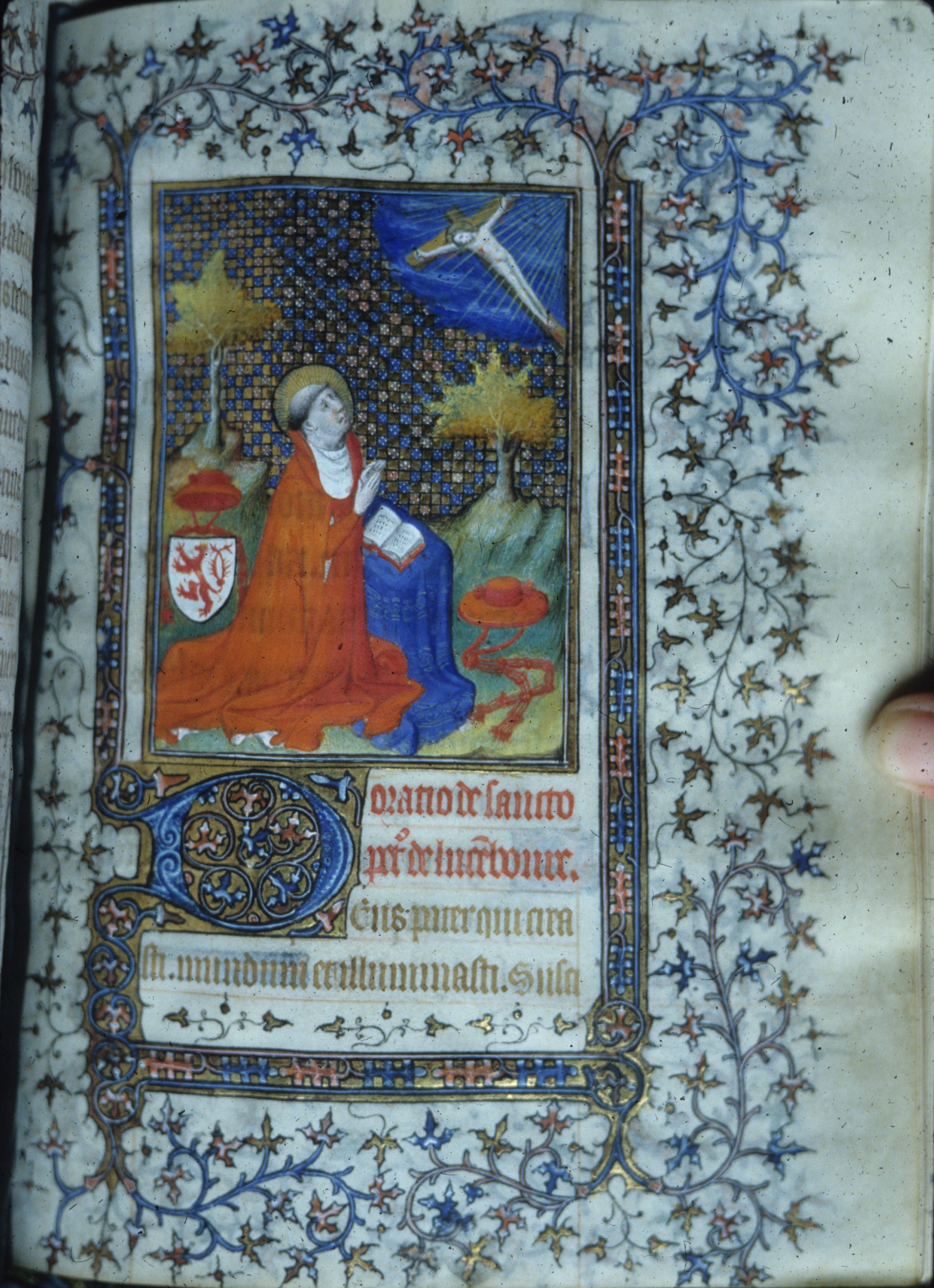
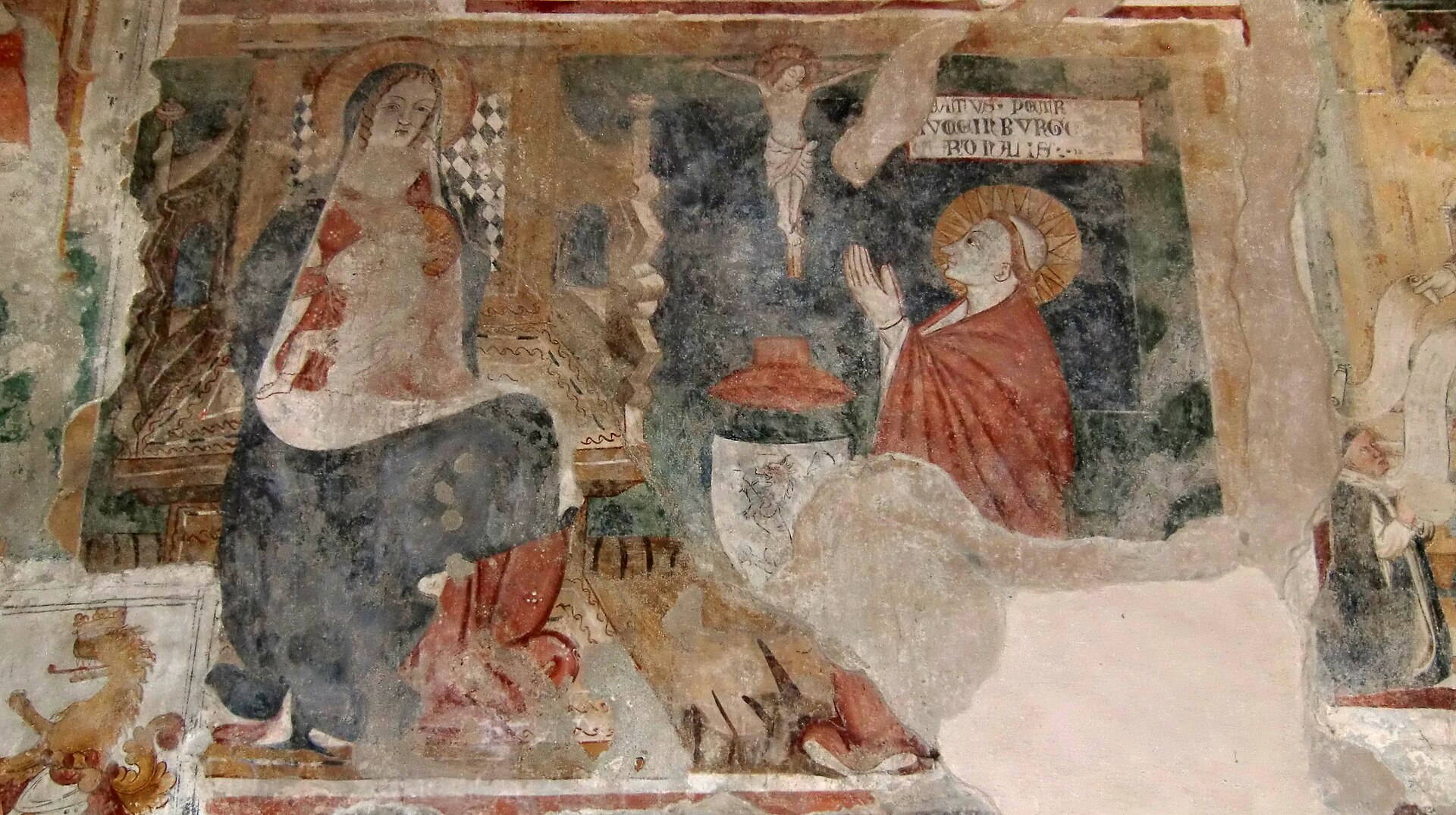
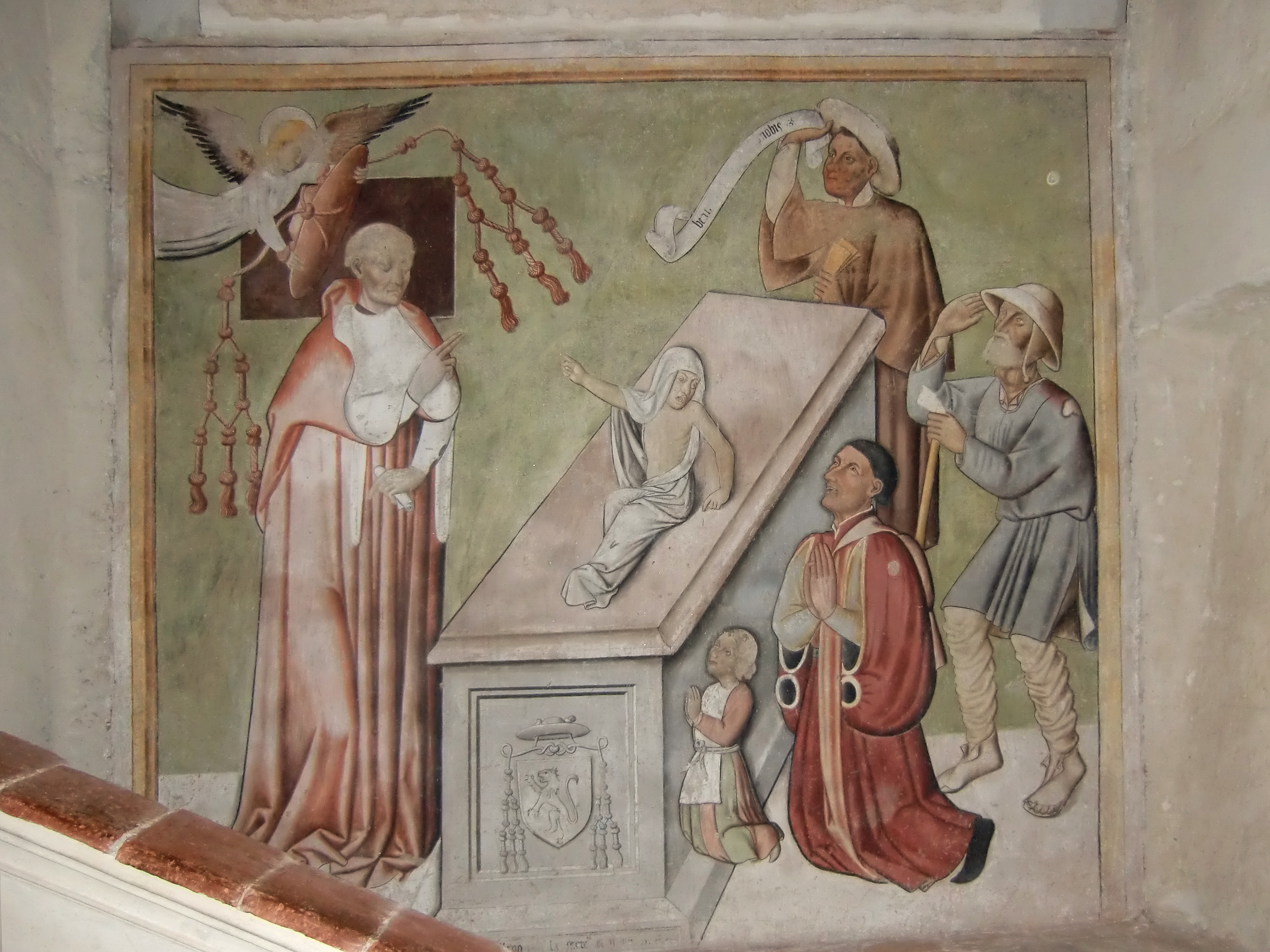
Bl. Peter of Luxembourg


John Dillon has posted on the Medieval Religion discussion group the following piece about Bl. Peter of  Luxembourg - who is an interesting example of later medieval piety and patronage. I have added my own comments in [ ]; the pictures can be seen in a larger size by clicking on the bottom right hand link :

A scion of one of later medieval Europe's great noble houses, Peter was born in 1369 at today's Ligny-en-Barrois (Meuse).  Orphaned early, he was brought up in an atmosphere of considerable piety and was educated at Paris, where among his teachers were Nicolas Oresme and Pierre d'Ailly and where he was made a cathedral canon in November 1378.  Appointments in the dioceses of Cambrai (Archdeacon of Brussels) and of Chartres (Archdeacon of Dreux) followed swiftly.  The first Clement VII (the one who ruled from Avignon) named Peter Bishop of Metz early in 1384; slightly over two months later the same worthy created him Cardinal Deacon of St. George in Velabro [ and remember who became Cardinal Deacon of that church in 1879 - Clever Boy].

Unable to establish himself in Metz against the candidacy of an adherent of  Pope Urban VI, Peter withdrew to Luxembourg.  In early 1386 the young cardinal of Luxembourg (as Peter was called in popular parlance) was called to Avignon.  There he lived out the brief remainder of his life as a visionary and extreme ascetic, dying on this day in 1387.  [For this see Andre Vauchez' book on sanctiity and canonisation. That might suggest that Peter was a somewhat 'troubled' teenager].  Peter was buried in Avignon's cemetery of St. Michael; miracles were ascribed to him, a cult arose, and a wooden chapel was built at his gravesite.  In 1393-1395 King Charles VI of France founded for the Celestinians a convent there and provided it with a church built over Peter's resting place.  The Celestinians adopted Peter as one of their own.

Early Vitae were written, various devotional texts in Latin were ascribed to Peter, and in 1402 he was proclaimed Avignon's patron saint.  Conciliar abolition in 1417 of the line of Papal claimants from Avignon, subsequent general acceptance of their characterization as schismatics, and Peter's beatification in 1527 by the [undisputed] Pope Clement VII who ruled from Rome (this occurred very shortly before the Sack) have led to his rather unusual styling as "Blessed pseudocardinal Peter of Luxembourg".  Today is Peter's day of commemoration in the Roman Martyrology.

Some period-pertinent images of Bl. Peter of Luxembourg:

a) as twice depicted in the late fourteenth- or very early fifteenth-century so-called Prayer Book of Cardinal Peter of Luxembourg (Avignon, Bibliothèque-Médiathèque Municipale Caccano, ms. 207):
1) Praying to the BVM and Christ Child (fol. 8r):

 http://www.enluminures.culture.fr/Wave/savimage/enlumine/irht2/IRHT_056307-p.jpg


2) Praying to the Virgin Annunciate (fol. 16v):

http://www.enluminures.culture.fr/Wave/savimage/enlumine/irht2/IRHT_056310-p.jpg


b) as depicted (his vision of Christ) in a fifteenth-century fresco in the chapelle Saint-Pancrace in Villar-Saint-Pancrace (Hautes-Alpes):

http://peintures.murales.free.fr/fresques/France/PACA/Hautes%20Alpes/Villars_Saint_Pancrace/archives/villardStPancrace_st-Pierre-de-Luxembourg-donateur.jpg


c) as depicted (his vision of  Christ's suffering on the Cross) by the Luçon Master in an early fifteenth-century book of hours for the Use of Rome (Paris, Bibliothèque Mazarine, ms. 491, fol. 244v):
 http://www.enluminures.culture.fr/Wave/savimage/enlumine/irht16/IRHT_05366-p.jpg


d) as depicted (his vision of  Christ's suffering on the Cross) by the Luçon Master in an early fifteenth-century book of hours for the Use of Paris (c. 1410; Baltimore, Walters Art Museum, Walters ms. W.232, fol. 93r):
 https://www.oneonta.edu/faculty/farberas/arth/Images/ARTH_214images/Manuscripts/15_century/WAM_232/f93_peter_luxembourg.jpg


e) as depicted (scene at right; his vision of Christ's suffering on the Cross) in an earlier fifteenth-century fresco in the pieve di San Lorenzo in Settimo Vittone, now part of the Città Metropolitana di Torino:
 https://upload.wikimedia.org/wikipedia/commons/thumb/8/81/Settimo_Vittone_Pieve_San_Lorenzo_Affreschi_10.JPG/1920px-Settimo_Vittone_Pieve_San_Lorenzo_Affreschi_10.JPG?1467429896013


f) as depicted (presenting a donor to the BVM and the Christ Child) in an earlier fifteenth-century panel painting in the Worcester Art Museum, Worcester, MA [ Unfortunately this will not copy, so please click on the link]:
http://www.flickr.com/photos/lmaish/6343323714/

g) as depicted (his vision of Christ's suffering on the Cross) in an earlier fifteenth-century copy of The Desert of Religion (1425; London, BL, Cotton MS Faustina B VI, vol. ii, fol. 23v)
 [ Unfortunately this also will not copy, so please click on the link]:  :
http://www.bl.uk/onlinegallery/onlineex/illmanus/cottmanucoll/p/zoomify75246.html

h) as depicted (his vision of Christ's suffering on the Cross) in the earlier fifteenth-century Hachette Hours (c. 1430-1435; Use of Paris) sold at auction by Millon et Associés in 2012 (fol. 165r):
http://www.liberlibri.com/ENLUMINURESLOWDEF/ENLUM_19Y.jpg

i) as depicted (his vision of Christ's suffering on the Cross) by the Masters of the Gold Scrolls in an earlier fifteenth-century book of hours for the Use of Rome with some variation for that of Rouen (c. 1440; Baltimore, Walters Art Museum, Walters ms. W.211, fol. 164v):

 http://www.thedigitalwalters.org/Data/WaltersManuscripts/W211/data/W.211/sap/W211_000332_sap.jpg


j) as depicted (his vision of Christ's suffering on the Cross) in a mid-or slightly later fifteenth-century panel painting (c. 1460) in the Musée du Petit Palais in Avignon:
http://www.petit-palais.org/uploads/assets/sfMediaManager/04-113_max.jpg

 http://www.wga.hu/art/m/master/avignon/luxembou.jpg


k) as depicted (operating a resurrection miracle) in a later fifteenth-century fresco in the cattedrale di Santa Maria Assunta in Ivrea, now part of the Città Metropolitana di Torino:

 https://upload.wikimedia.org/wikipedia/commons/9/90/Ivrea_Duomo_Affresco_Pietro_Lussemburgo.jpg


l) as depicted (his vision of Christ's suffering on the Cross) in a later fifteenth-century book of hours for the Use of Paris (c. 1470; Chambéry, Bibliothèque municipale, ms. 1, fol. 193r):

http://www.enluminures.culture.fr/Wave/savimage/enlumine/irht1/IRHT_035197-p.jpg


m) as depicted in a late fifteenth-century copy of the Diète de salut attributed to him (c. 1490; New York, Pierpont Morgan Library, Morgan Ms. M. 182, fol. 1r):


n) as depicted (his vision of Christ's suffering on the Cross) in an early sixteenth-century book of hours for the Use of Rome (c. 1510; Tours, Bibliothèque municipale, ms. 2104, fol. 156v):

http://www.enluminures.culture.fr/Wave/savimage/enlumine/irht2/IRHT_051190-p.jpg


Thursday, 4 December 2014

Pope John XXII


On this day in 1334, 680 years ago, there occurred the death of Pope John XXII. 

Born in 1249 as Jacques Duèze in Cahors he reigned as Pope from 1316 until 1334. A formidable and energetic Pope, the second to be based at Avignon, and where he further centralised Papal administration, published the collection of Decretals known as the Extravagantes,  and also played an active part in the political machinations of the age, clashed with the Holy Roman Emperor Louis IV, strenuously opposed the more extreme brands of Franciscan thought on Apostolic poverty, and raised a storm around himself in his last months with his views on the Beatific Vision. Today he is familier to the wider reading public through Maurice Druon's The Royal Succession and Umberto Eco's The Name of the Rose.

There is a modern online life of him at Pope John XXII and the old Catholic Encyclopaedia biography, which is fuller and more academic in its detail can be read in the New Advent online version at Pope John XXII

There is a short article about the circumstances of the Conclave that elected him in 1316 here,
and the account in Druon's novel of those events is extremely entertaining. 


Pope John XXII approves the Carmelite Rule
Pietro Lorenzetti 1290-1347

Image:New Liturgical Movement

There is an illustrated article about the altarpiece of which this is a panel in a post from this year on the New Liturgical Movement at  The Feast of St Elijah the Prophet

In many respects his pontificate marks the settlement of the papacy at Avignon and the concentration of its administrative machinery there, as opposes to the more peripatetic rule of his predecessor Pope Clement V, who had died in 1314.


Pope John Xxii, Together With Clergymen Photograph


Pope John XXII in Consistory

Imagefineartamerica.com


The tomb of Pope John XXII in Avignon Cathedral

Image:Wikipedia 


Tomb of Pope John XXII, Avignon Cathedral

The tomb from the side

Image;marvellous-provence.com
The tomb was damages during the French Revolution - what in France wasn't one might add - and the effigy on it today has a head that is not the original. One book I have read, Herbert Norris's history of vestments suggests the original carved head survives in a museum on Avignon. This has the Pope wearing the tiara rather than a mitre, as on the effigy in the cathedral.


Wednesday, 27 March 2013

The death of Pope Gregory XI in 1378


Today is the 635th anniversary of the death of Pope Gregory XI in 1378. It was to prove an event which can be seen as marking a significant historic landmark in the history of the Papacy and of later medieval Europe.


Gregory XI

Pope Gregory XI - a later portrait now in the Palace of the Popes in Avignon

Image: hoocher.com

 
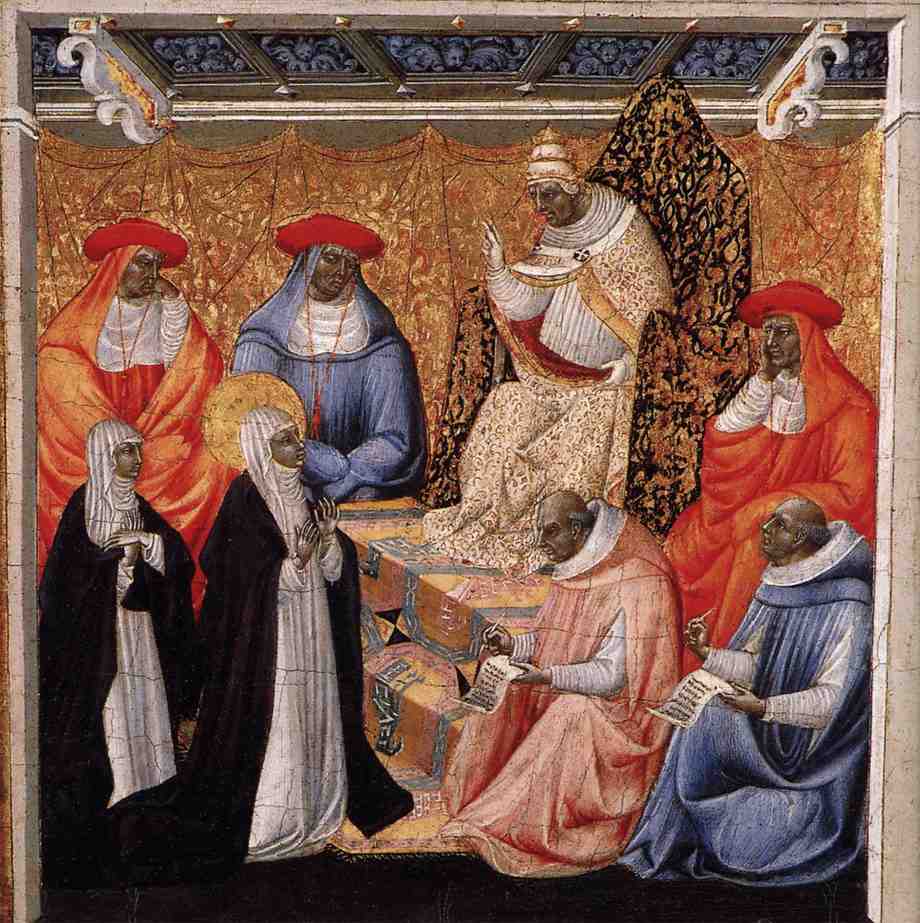
Born as Pierre Roger de Beaufort  in 1329/30  he was the nephew of Pope Clement VI (1342-52) and had been elected to the throne of St Peter in 1370, having been a cardinal since 1348. Srrongly supported in his resolve to do so by St Catherine of Siena, as in her Letter to Pope Gregory XI ,and against considerable opposition, he insisted, now that it was deemed safe amd practicable, on returning from Avignon to resume papal residence in Rome in 1377, entering Rome on January 17th. 


St Catherine of Siena and Pope Gregory XI

Painting of circa 1460/61 by Giovanni di Paolo (1403-1482)
Museo Thyssen Bornemisza, Madrid

Image: Wikipedia

He was the second of the Avignonese Popes to return to Rome, his predecessor Pope Urban V having lived there from 1367 until 1370 when he returned  to Avignon and died shortly afterwards.


Fichier:07 Grégoire XI (Avignon) 01.jpg

Pope Gregory XI returns to Rome in 1377 

A detail from a painting by Girolamo di Benvenuto (1470-1525) in  the Hospital of Santa-Maria della Scala Siena

Image:fr.wikipedia

However Pope Gregory died on this day in 1378. This was to set in motion the events that led to the Great Schism of that year, as I will show in future posts. It is not clear if Gregry might. like Urban V before  him have returned to Avignon, but his death in Rome and subsequent events bled to the return of the papacy to its historic base, even if that was not firmly re-established until after 1447.

Tomb of Gregory XI in the Papal Palace, Avignon

A reproduction in the Papal Palace at Avigon of the tomb of Pope Gregory XI in Rome

Image: corbisimages.com

There is an online life of Pope Gregory here, and there are also online lives of his cousins the brothers Pierre de Murat de Cros and Jean de Murat de Cros, which give further insights into the era. Pope Gregory XI was to be the last French occupant to date of the Papacy.


The arms of Pope Gregory XI

Image: Wikipedia