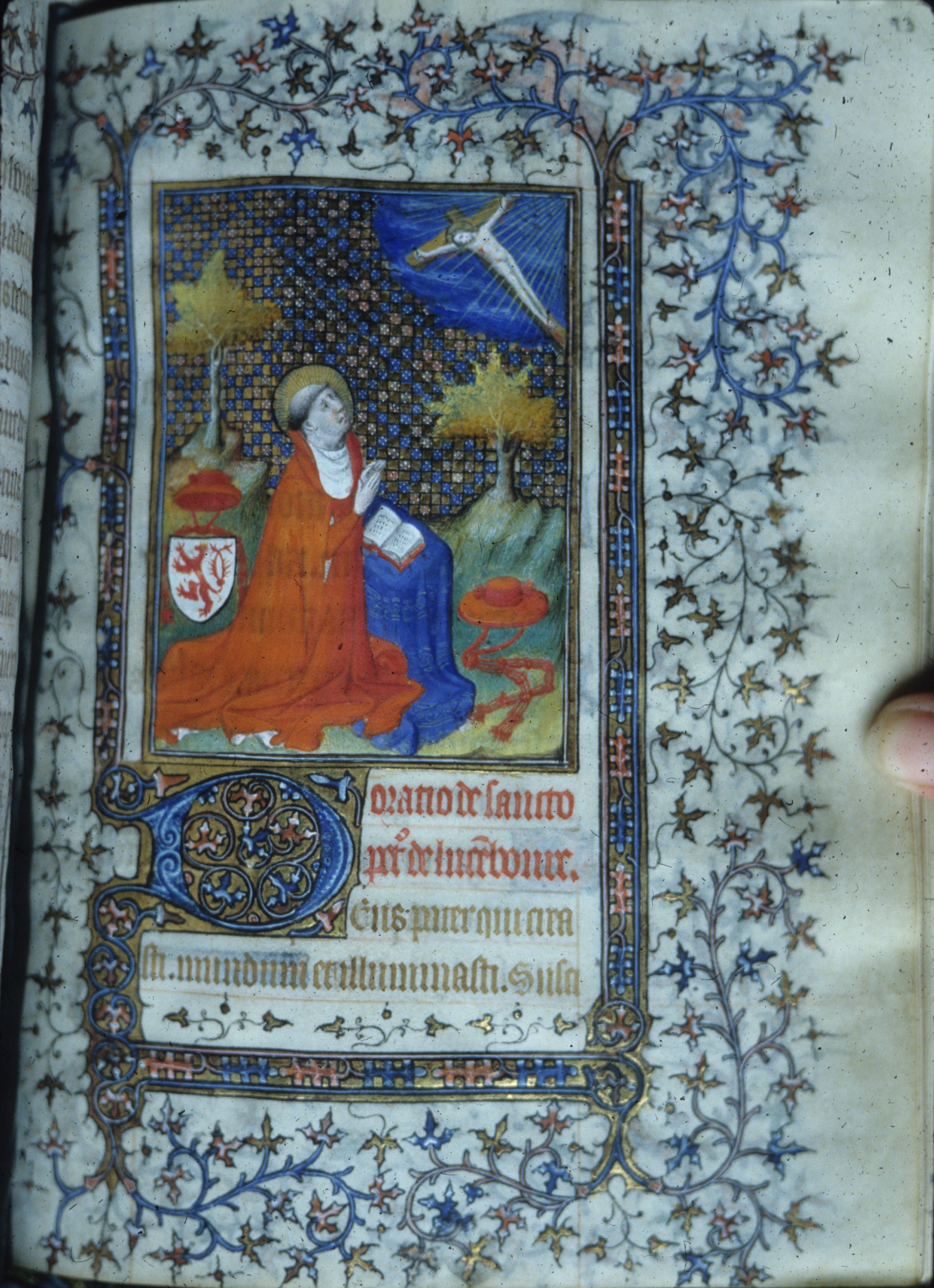
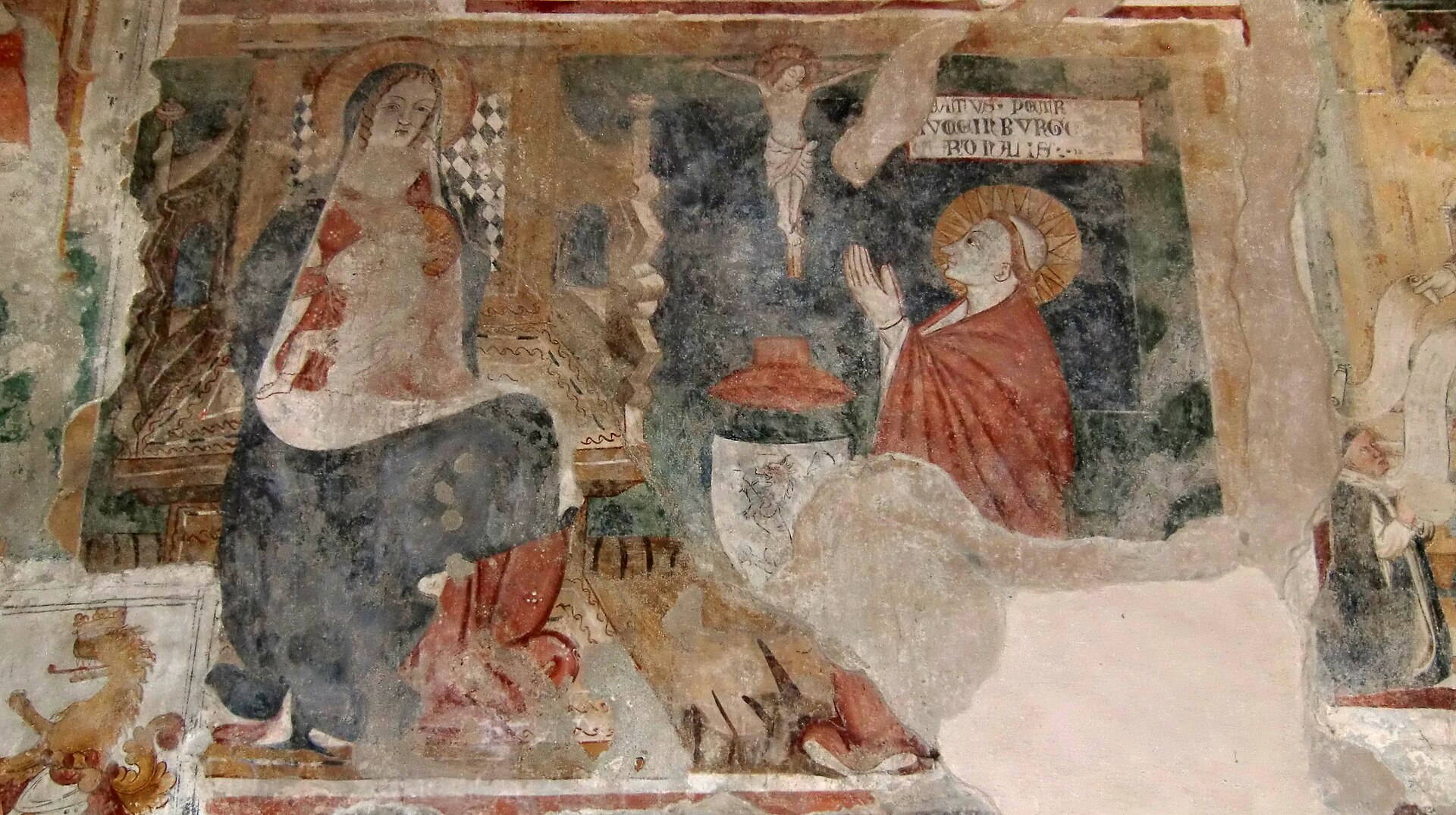
John Dillon has posted on the Medieval Religion discussion group the following piece about Bl. Peter of Luxembourg - who is an interesting example of later medieval piety and patronage. I have added my own comments in [ ]; the pictures can be seen in a larger size by clicking on the bottom right hand link :
A scion of one of later medieval Europe's great noble houses,
Peter was born in 1369 at today's Ligny-en-Barrois (Meuse). Orphaned
early, he was brought up in an atmosphere of considerable piety and was
educated at Paris, where among his teachers were Nicolas Oresme and
Pierre d'Ailly and where he was made a cathedral canon in November
1378. Appointments in the dioceses of Cambrai (Archdeacon of Brussels)
and of Chartres (Archdeacon of Dreux) followed swiftly. The first
Clement VII (the one who ruled from Avignon) named Peter Bishop of Metz
early in 1384; slightly over two months later the same worthy created
him Cardinal Deacon of St. George in Velabro [ and remember who became Cardinal Deacon of that church in 1879 - Clever Boy].
Unable to establish
himself in Metz against the candidacy of an adherent of Pope Urban VI, Peter
withdrew to Luxembourg. In early 1386 the young cardinal of Luxembourg
(as Peter was called in popular parlance) was called to Avignon. There
he lived out the brief remainder of his life as a visionary and extreme
ascetic, dying on this day in 1387. [For this see Andre Vauchez' book on sanctiity and canonisation. That might suggest that Peter was a somewhat 'troubled' teenager]. Peter was buried in Avignon's
cemetery of St. Michael; miracles were ascribed to him, a cult arose,
and a wooden chapel was built at his gravesite. In 1393-1395 King Charles VI
of France founded for the Celestinians a convent there and provided it
with a church built over Peter's resting place. The Celestinians
adopted Peter as one of their own.
Early
Vitae were written,
various devotional texts in Latin were ascribed to Peter, and in 1402 he
was proclaimed Avignon's patron saint. Conciliar abolition in 1417 of
the line of Papal claimants from Avignon, subsequent general acceptance
of their characterization as schismatics, and Peter's beatification in
1527 by the [undisputed] Pope Clement VII who ruled from Rome (this occurred very shortly
before the Sack) have led to his rather unusual styling as "Blessed
pseudocardinal Peter of Luxembourg". Today is Peter's day of
commemoration in the Roman Martyrology.
Some period-pertinent images of Bl. Peter of Luxembourg:
a)
as twice depicted in the late fourteenth- or very early
fifteenth-century so-called Prayer Book of Cardinal Peter of Luxembourg
(Avignon, Bibliothèque-Médiathèque Municipale Caccano, ms. 207):
1) Praying to the BVM and Christ Child (fol. 8r):
2) Praying to the Virgin Annunciate (fol. 16v):
b)
as depicted (his vision of Christ) in a fifteenth-century fresco in the
chapelle Saint-Pancrace in Villar-Saint-Pancrace (Hautes-Alpes):
c)
as depicted (his vision of Christ's suffering on the Cross) by the
Luçon Master in an early fifteenth-century book of hours for the Use of
Rome (Paris, Bibliothèque Mazarine, ms. 491, fol. 244v):
d)
as depicted (his vision of Christ's suffering on the Cross) by the
Luçon Master in an early fifteenth-century book of hours for the Use of
Paris (c. 1410; Baltimore, Walters Art Museum, Walters ms. W.232, fol.
93r):
e)
as depicted (scene at right; his vision of Christ's suffering on
the Cross) in an earlier fifteenth-century fresco in the pieve di San
Lorenzo in Settimo Vittone, now part of the Città Metropolitana di
Torino:
f)
as depicted (presenting a donor to the BVM and the Christ Child) in an
earlier fifteenth-century panel painting in the Worcester Art Museum,
Worcester, MA [ Unfortunately this will not copy, so please click on the link]:
http://www.flickr.com/photos/lmaish/6343323714/
g)
as depicted (his vision of Christ's suffering on the Cross) in an
earlier fifteenth-century copy of
The Desert of Religion (1425;
London, BL, Cotton MS Faustina B VI, vol. ii, fol. 23v)
[ Unfortunately this also will not copy, so please click on the link]: :
http://www.bl.uk/onlinegallery/onlineex/illmanus/cottmanucoll/p/zoomify75246.html
h)
as depicted (his vision of Christ's suffering on the Cross) in the
earlier fifteenth-century Hachette Hours (c. 1430-1435; Use of Paris)
sold at auction by Millon et Associés in 2012 (fol. 165r):
http://www.liberlibri.com/ENLUMINURESLOWDEF/ENLUM_19Y.jpg
i)
as depicted (his vision of Christ's suffering on the Cross) by the
Masters of the Gold Scrolls in an earlier fifteenth-century book of
hours for the Use of Rome with some variation for that of Rouen (c.
1440; Baltimore, Walters Art Museum, Walters ms. W.211, fol. 164v):
j)
as depicted (his vision of Christ's suffering on the Cross) in a
mid-or slightly later fifteenth-century panel painting (c. 1460) in the
Musée du Petit Palais in Avignon:
http://www.petit-palais.org/uploads/assets/sfMediaManager/04-113_max.jpg
k)
as depicted (operating a resurrection miracle) in a later
fifteenth-century fresco in the cattedrale di Santa Maria Assunta in
Ivrea, now part of the Città Metropolitana di Torino:
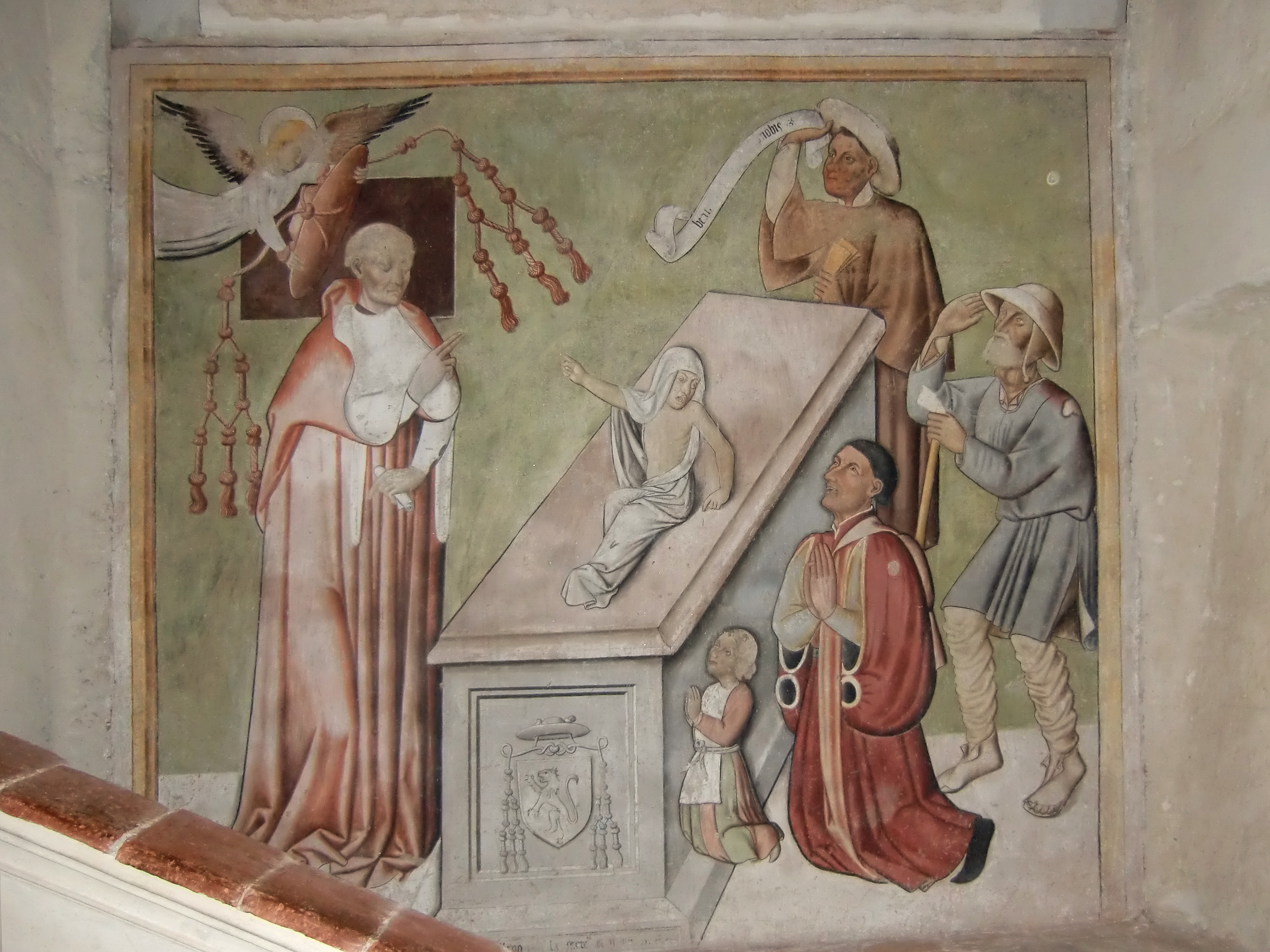
l)
as depicted (his vision of Christ's suffering on the Cross) in a
later fifteenth-century book of hours for the Use of Paris (c. 1470;
Chambéry, Bibliothèque municipale, ms. 1, fol. 193r):
m)
as depicted in a late fifteenth-century copy of the
Diète de salut
attributed to him (c. 1490; New York, Pierpont Morgan Library, Morgan
Ms. M. 182, fol. 1r):
n)
as depicted (his vision of Christ's suffering on the Cross) in an
early sixteenth-century book of hours for the Use of Rome (c. 1510;
Tours, Bibliothèque municipale, ms. 2104, fol. 156v):