Once I was a clever boy learning the arts of Oxford... is a quotation from the verses written by Bishop Richard Fleming (c.1385-1431) for his tomb in Lincoln Cathedral. Fleming, the founder of Lincoln College in Oxford, is the subject of my research for a D. Phil., and, like me, a son of the West Riding. I have remarked in the past that I have a deeply meaningful on-going relationship with a dead fifteenth century bishop... it was Fleming who, in effect, enabled me to come to Oxford and to learn its arts, and for that I am immensely grateful.


Sunday, 6 August 2023

The Office for the Transfiguration


Before we leave the subject of today’s feast I see that the New Liturgical Movement has an informative article by Gregory Di Pippo about the psalmody of the Roman Breviary. In it he illustrates how the theology of the Transfiguration links that of the Incarnation to that of the Passion, and that this is indicated by the choice of particular psalms for Mattins. He also emphasises the fact that, uniquely in the events of Our Lord’s life between the narratives of His birth and Passion, the Transfiguration is assigned its own specific commemoration in the calendar. That is because it links and expounds those two salvific events.

The article can be read at The Psalms of the Transfiguration


The Transfiguration at Westhall in Suffolk


Following my previous post I received a generous note from Dr Simon Cotton drawing my attention to his article in the most recent edition of The Portal, the magazine of the Ordinariate. I had not got round to reading my own copy, mea culpa, but it is an attractively produced magazine that is well worth subscribing to online.

In the article he describes and places in historical and liturgical context the only surviving medieval English painting of the Transfiguration. This is on the rood screen at the church at Westhall in north-east Suffolk and is dated to about 1490. Amongst other things it suggests how quickly parishes appear to have responded to liturgical changes made at a national level.

Wikipedia has an account of what is clearly a very interesting church, including details of the surviving screen paintings, at St Andrew's Church, Westhall

The illustrated article about the painting in The Portal can be found by going to the magazine website and scrolling down to page 19 at https://www.portalmag.co.uk/portal/portal-2023-08.pdf  


The Transfiguration


Today is the Feast of the Transfiguration of Our Lord.

The history of the celebration is outlined by Wikipedia in Feast of the Transfiguration

The New Liturgical Movement recently had an article by Michael P. Foley about the traditional liturgical prayers for the Transfiguration which expound the theology of the event. It can be seen at The Orations of the Feast of the Transfiguration

The fourth, fifth and sixth lections at Mattins in the traditional Breviary include three readings from the sermons of Pope St Leo the Great, whose pontificate was from 440 to 461.

The Lord taketh chosen witnesses, and in their presence, revealeth His glory. That form of body which He had in common with other men, He so transfigured with light, that His Face did shine as the sun, and His raiment became exceeding white as snow. Of this metamorphosis the chief work was to remove from the hearts of the disciples the stumbling at the Cross. Before their eyes was unveiled the splendour of His hidden majesty, that the lowliness of His freely-chosen suffering might not confound their faith. But none the less was there here laid by the Providence of God a solid foundation for the hope of the Holy Church, whereby the whole body of Christ should know with what a change it is yet to be honoured. The members of that body whose Head hath already been transfigured in light may promise themselves a share in His glory.

For the strengthening the Apostles and bringing them forward into all knowledge, there appeared unto them Moses and Elias that is, the Law and the Prophets talking with Him. Before five witnesses did His glorification take place, as though to fulfill that which is written: At the mouth of two witnesses, or at the mouth of three witnesses, shall the matter be established. (Deut. xix. 15.) What can be more certain, what can be better attested than this matter, which is proclaimed by the trumpets of both the Old and the New Testaments, and concerning which the witness of ancient testimony uniteth with the teaching of the Gospel? The pages of either Covenant strengthen one another, and the brightness of open glory maketh manifest and distinct Him Whom the former prophecies had promised under the veil of mysteries.

The unveiling of such mysteries roused the mind of the Apostle Peter to an outburst of longing for the things eternal, which despised and disdained the things worldly and earthly overflowing with gladness at the vision, he yearned to dwell with Jesus there, where the revelation of His glory had rejoiced him. And so he said Master, it is good for us to be here if Thou wilt, let us make here three tabernacles, one for thee, and one for Moses, and one for Elias. To this proposal the Lord answered nothing, this signifying, that what Peter wished was not wrong, but out of place, since the world could not be saved but by the death of Christ. And the Lord's example was to call the faith of believers to this, that albeit we are behoven to have no doubts concerning the promise of eternal blessedness, yet we are to understand that, amid the trials of this life, we are to seek for endurance before glory.

The seventh lection from St John Chrysostom, who died in 407, includes a similar theme:

 that the Son of Man should come in the glory of His Father, and reward every man according to his works. ( Matth. xvi. 25, 27.) Therefore, to assure them by their own eyes, and show them what the glory is wherein He will come, He manifested and unveiled it to them, as far as in this life they were able to grasp it, lest they and especially Peter should grieve over their own deaths, or the death of their Lord.

With acknowledgments to Divinum Officium

Little more than a century after St Leo the apse of the church of St Catherine’s Monastery on Mount Sinai was decorated with what is now the earliest surviving depiction in the Eastern Orthodox tradition of the Transfiguration. Dated to 565-6, at the very end of his reign it was probably commissioned by the Emperor Justinian:


The Transfiguration as depicted in St Catherine’s Monastery

Image: Wikipedia 

The history of the Transfiguration in Christian art, not least the sheer difficulty of representing it, is outlined on Wikipedia in Transfiguration of Jesus in Christian art


Saturday, 5 August 2023

The Comper Reredos at Wymondham


Christopher Howse in his Sacred Mysteries column in today’s Daily Telegraph writes about the wonderful reredos designed in 1913 by the architect and designer Sir Ninian Comper (1864-1960) for Wymondham Abbey in Norfolk. Dedicated as a War Memorial in 1921 the gilding was not completed until 1934. 

Wikipedia has an history of the monastic foundation and of the church - including a good photograph of the reredos - at Wymondham Abbey and also a life of the designer at Ninian Comper

Wymondham Abbey | No 10 The Abbey

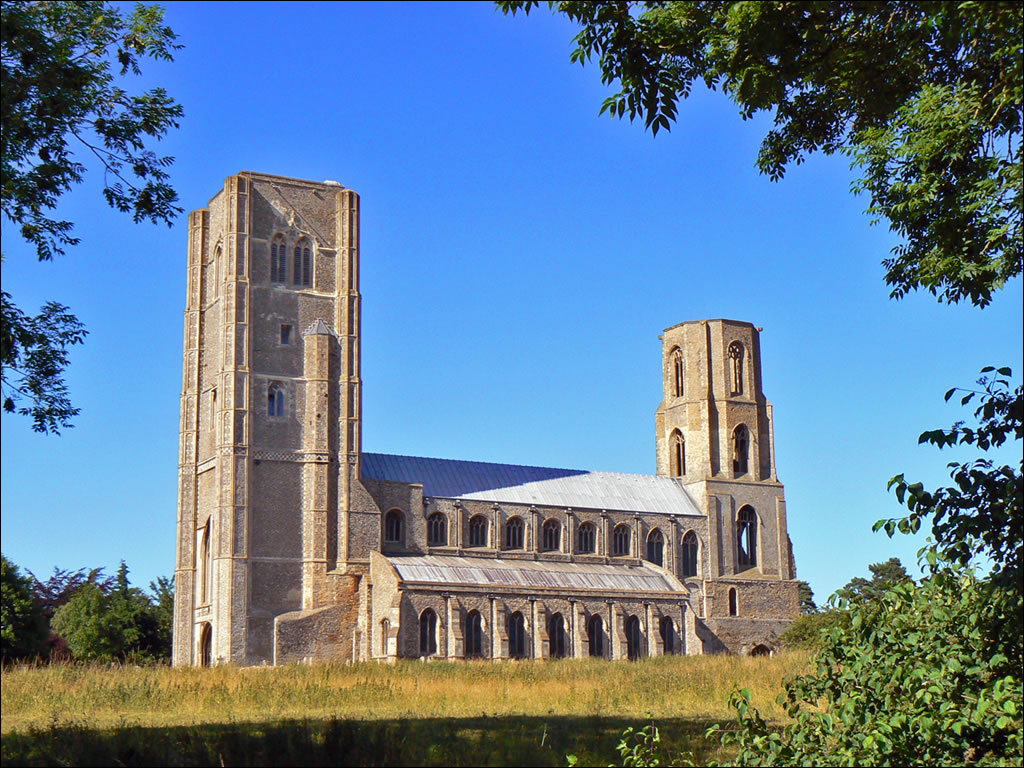
Wymondham Abbey from the south west

Image: Number10theabbey.co.uk

The western tower, parochial nave and the shell of the central tower is all that survives of what was a sizeable priory of St Albans Abbey, and well worth seeing for its Norman and later medieval architecture. However what does make a visit to Wymondham special, as Christopher Howse found recently and as I did with my mother in 1970, is Comper’s recreation of a late medieval reredos. This is undoubtedly a piece designed for Christian worship as it ought to be.


Wymondham Abbey Reredos

Image: Wymondham Abbey

Howse sees its source in the Islip Roll depicting the High Altar of Westminster Abbey at the beginning of the sixteenth century. Whilst that may well be true it is also very much in the tradition of the altar screens at Winchester, St Albans and Southwark from the same period and the rather earlier college chapels at New, All Souls and, later, Magdalen in Oxford. The interconnected relations of founders and patrons and the see of Winchester make these something of a family or group.

Another source must surely have been the well-known medieval drawing of the High Altar of St Augustine’s Abbey in Canterbury which shows a figure of Christ enthroned in a mandorla - indicating the Two Natures - as Comper recreated at Wymondham.


Engraving circa 1790 from Hasted’s Kent of the medieval drawing of St Augustine’s High Altar and reliquaries 

Image: albion-prints.com


I do have to sadly agree with Christopher Howse that one cannot really see such a work being commissioned today. Far too many historic cathedrals and churches have been beguiled into installing curious creations in metal and other materials conceived by a local technical college lecturer that are, we are told, “relevant”.

I am sure there are still the designers and craftsmen to create work like that of Comper, but where are the patrons with the taste and discernment to commission them?


Friday, 4 August 2023

You read it here - the latest from the Pope


When I read the following article from the Catholic Herald I felt obliged to check the date and that it was not April 1st. It isn’t. The Catholic Herald is a respected journal, and, as it suggests in the piece, so is its Spanish source. So we must believe that this is what the Pope thinks. 

You can read these latest Papal ruminations at
Don’t forget the youthful bishop who is the organiser of World Youth Day in Lisbon - and recently rewarded with a Cardinal’s hat - was quoted as saying it was not the aim of WYD to convert young people …..

Clearly football boots and no religion are the way forward for the Franciscan Church.

Our Lady of Fatima, pray for the Church


A facelift for the White Horse


The BBC News website reports that the White Horse on the hillside above Uffington in Berkshire is to receive something of a facelift as sections of it - notably the head and neck - have diminished in width in recent years. Work has been undertaken to confirm this narrowing and remedial work will be undertaken.


There is an introduction to the history of this great chalk figure, which does appear to have been maintained throughout its history by the local community, from Wikipedia at Uffington White Horse

The history of the horse is also mentioned alongside that of the village of Uffington in the entry on Wikipedia at Uffington, Oxfordshire

The same site also has an introduction to the mythology and significance of the white horse in various cultures at White horses in mythology

I am no prehistorian but the White Horse does strike me alongside the many other survivals of  what we group together as being prehistoric as evidence for a high degree of social organisation in what might be termed political or religious structures. To create the great earthworks, the stone circles, the major burial complexes or the White Horse suggests considerable social organisation and motivation. About these we can only make hesitant guesses in the absence of the written records which only begin with chance references to late Iron Age events in Roman sources. Nevertheless what survives after so many centuries as part of the landscape is a powerful indicator of a complex series of societies across these islands.

The best view I have had of the White Horse was across the valley from a train heading westwards from Reading. On that occasion it was on a damp winter day, and my one visit to Ufington was on a very wet midsummer day with the landscape looking especially verdant and lush. Given that and the benign, if brooding, presence of the White Horse and the other ancient sites that accompany it the Vale has a sense of otherness and atemporality that makes it distinctive and atmospheric.


Tuesday, 1 August 2023

St Peter ad Vincula


Traditionally today is the feast of St Peter ad Vincula. The New Liturgical Movement has an excellent and informative article about the origins of the feast, the story of the two chains of St Peter which miraculously became one, and the history of the liturgy that evolved for the celebration of the day.
 
As the article shows the feast was a regrettable casualty, along with others that seemingly emphasised the miraculous, of the changes made to the Calendar in 1960, when they were omitted. 

The illustrated article can be seen at Liturgical Notes on the Feast of St Peter’s Chains


Lammas


Today, August 1st, is Lammas Day - ‘Loaf Mass’ - marking the beginning of the medieval grain harvests, vital to the lives of their communities.

The New Liturgical Movement recently had an article about the traditions associated with the day which are as much cultural as religious, but originating in an integrated culture. The piece be read at Lammas Day