Once I was a clever boy learning the arts of Oxford... is a quotation from the verses written by Bishop Richard Fleming (c.1385-1431) for his tomb in Lincoln Cathedral. Fleming, the founder of Lincoln College in Oxford, is the subject of my research for a D. Phil., and, like me, a son of the West Riding. I have remarked in the past that I have a deeply meaningful on-going relationship with a dead fifteenth century bishop... it was Fleming who, in effect, enabled me to come to Oxford and to learn its arts, and for that I am immensely grateful.


Sunday, 5 September 2021

National Maritime Museum succumbs to the woke


For the sake of my emotional well-being, my peace of mind, blood pressure and those around me I usually merely take note rather than react to the assault of the woke upon statues and art objects. However I came across such a crass example of authorities bowing before this iconoclastic nonsense that I feel compelled to share it. 

The story is on the Telegraph website and concerns an item in the splendid National Maritime Museum at Greenwich. One must hope that publicity will lead to a rethink there. That said one does wonder when this cultural war against harmless objects in museums and elsewhere will stop. We hear politicians and experts criticising such craven behaviour but when will someone do something to redress the balance?


Saturday, 4 September 2021

Revealing the medieval cathedral in Bath


By chance I came across an online article from Current Archaeology from 2019 about excavations within the building at Bath Abbey as part of the installation of a new heating system. What was revealed were portions of the previous cathedral. 

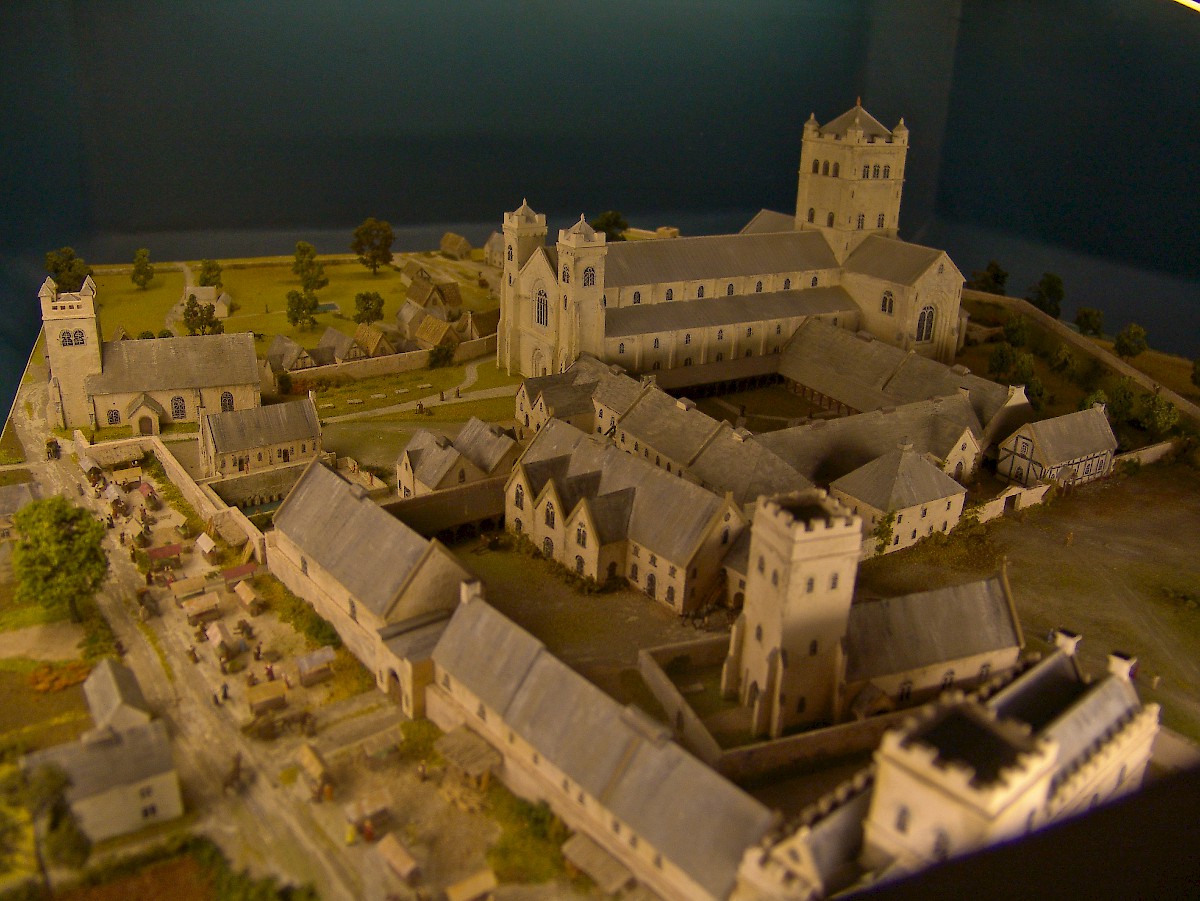
At Bath the medieval church of the Benedictine cathedral priory was replaced in the early sixteenth century by a new church at the instigation of Bishop Oliver King - of whom
Wikipedia has a biography at Oliver King. This new church only occupied the site of the nave of its medieval predecessor, the crossing and eastern portions of which may have remained in a ruined state for some years afterwards. The roofing of the present church was not completed until the early seventeenth century.

Quite how Bishop King and his architect envisaged fitting the new cathedral with the existing plan of the medieval monastery is unclear, nor indeed why a church so significantly smaller than its predecessor was commissioned. The design looks to have some similarities to St George’s Windsor where the Bishop, Secretary to its builder King Edward IV, held a canonry from 1480 until his death in 1503.

Bath Abbey, as it is usually known, has an odd status. The co-cathedral of the diocese with Wells from the early thirteenth century and still included in its episcopal title it possesses a cathedra for the Bishop. On the first Sunday after his enthronement at Wells it is the custom - I am not sure how old a one it is - for the new Bishop to visit and occupy his throne. However Bath has no Dean and Chapter, and never had one to replace the medieval cathedral priory after 1539. it is simply a parish church. In that it survived it fared better than the equivalent monastic cathedral in Coventry.

Some years ago the plan of the apsidal east end and ambulatory and chapels of the Norman cathedral were recovered by excavation. The work inside the present church revealed more Norman masonry used to underpin the sixteenth century building and also the remains of a very fine tiled floor with heraldic designs. This is interpreted as early fourteenth century work from a restoration carried out by Bishop John Drokensford.


Since then other associated excavations outside the present Abbey have revealed remains of the Anglo-Saxon monastic complex. These may be as early as the time of King Offa in the late eighth century or be from the tenth century when the abbey at Bath was the setting for the coronation of King Edgar at Pentecost 973. These discoveries are reported upon in another Current Archaeology article from last year at Anglo-Saxon buildings beneath Bath Abbey

There is another account of the investigation from Wessex Archaeology at Bath Abbey in 3D


A reconstruction of the monastic cathedral before it was rebuilt by Bishop King

Image:reidsengland.com


Friday, 3 September 2021

Merlin manuscript recovered in Bristol


A discovery in the historic books collection of Bristol Central Library has revealed fragments of a thirteenth century manuscript of the Vulgate Merlin, with its tale of King Arthur’s magician.

The pieces seem to have ended up in Bristol thanks to the early seventeenth century Archbishop of York, Tobias Matthew, a benefactor to the original library in Bristol. They survived as part of the binding of the printed works of Jean Gersom, produced in 1494-1502. The Archbishop may have acquired them  during his time as Bishop of Durham.

What is now referred to as the Bristol Merlin and the analysis of the surviving portions has now been published in book form.

The ‘Vulgate Merlin’ was composed in the period 1220-25, and the copy whence came the Bristol fragments was made in the period  1250-75 in north or north-eastern France. It was in England by 1300-50 when a marginal note was added.

One suggestion is that this older version of the story went out of fashion with the publication of Sir Thomas Malory’s Morte d’Arthur at the end of the fifteenth century. As a result the manuscript was broken up and reused around 1500-20 for binding purposes.

The online article about this interdisciplinary project can be read at Bristol manuscript fragments of the famous Merlin legend among the oldest of their kind

The story is also recounted, in a slightly shorter form in the Daily Express at King Arthur breakthrough as Bristol manuscript fragments detail famous Merlin legend


Pagan carving from an Irish bog


Live Science has a report about the discovery in a peat bog in Roscommon of a very late pagan idol or statue that appears to only just pre-date St Patrick’s conversion of Ireland. I suppose, given its date they could even overlap as such processes take time.

The eight foot high oak figure had been deliberately cut in two and committed, presumably in a ritual way, to the bog, which was clearly a place of devotion for the people of the area. It appears likely that it was associated with a local centre of traditional lordship.


Shoe size for Sr Buonarroti


Live Science has an article about a pair of shoes and one slipper that are traditionally believed to have belonged to Michelangelo. Researchers have now investigated what they might reveal about his height. If they are correct he was not tall even, I imagine, by sixteenth century standards. 

I will say am always wary of statements about average height in past centuries. When presented as if the rise in human height was or is expedential ( as it does seem to have been in the twentieth century ) then everyone would have been the size of a garden gnome at some point within historic time…..  Many factors came into play in terms of health in infancy and childhood, nutrition, living conditions, social background and such like. There is evidence to suggest the process may have seen a decline at certain stages, such as the earlier phases of the Industrial Revolution. At the time of the American Revolution the average rebel colonial was taller than the British troops they faced. A few years later in France it has been suggested that the aristos were a head taller than the peasantry before the guillotine reduced the height of not a few…

That all said the notion of a five foot two Michelangelo Buonarroti snarling at his patrons and rivals does perhaps make sense. A vertically challenged genius might well have the edginess that was part of his makeup.


Afghanistan and its Monarchy


The recent events in Afghanistan have clearly revealed the failings in western policy as to the governance of that unfortunate country over the last twenty years. One of those failings, indeed a crucial one, was and is, in my opinion, the failure to restore the monarchy. A friend who has a similar set of views to myself has sent me the following article from The Critic about that failure. It can be read at thecritic.co.uk/could-monarchy-have-saved-afghanistan/?

Having written and posted this article I subsequently came across an online opinion piece article from The Independent which is not only a scorching indictment of current US policy but also discusses the failure to restore King Zahir Shah. It can be read at Afghans are paying the price for the hatred and regrets of one man


In defence of Latin Lections at Mass


Rorate Caeli has an excellent article by Peter Kwasniewski which sets out the wide range of reasons for retaining the use of Latin for the lections at Mass in the usus antiquior or TLM. 

It is a slight revision of an article he wrote some years ago, but now reissued with the added urgency necessitated by the threat to traditional usage posed by Traditionis Custodes. However the article, as one might indeed expect from so articulate and informed a commentator as Dr Kwasniewski, has much more to it than just a defence of Latin for the lections but touches on many other aspects of the mystical integrity of the Mass, linking believers across time and space in a metaphysical quest for the things of God.

The article, which I do recommend, can be read at In Defense of Preserving Readings in Latin


Wednesday, 1 September 2021

St Giles


Today is the feast day of St Giles. Here in Oxford that means the countdown to St Giles Fair, which is held on the Monday and Tuesday following the Sunday after St Giles Day, has begun.

My own link with St Giles is lifelong as I was baptised in the church dedicated to him in my home town of Pontefract and it was there that for several years I served as Parish Clerk. In those years I was able to supports efforts by the then Vicar to encourage awareness of St Giles as our patron and I gave some images of him - framed copies of two panels by the ‘Master of St Giles’ of about 1500 from a regrettably now-dismantled and dispersed reredos and also of a fourteenth century stained glass figure of the saint in the choir clerestory at Wells.

File:Master Of Saint Gilles - The Mass of St Gilles - WGA14485.jpg

The Mass of St Giles

Image: Wikimedia

The painting by the Master of St Giles of the Mass of St Giles, now in the National Gallery, is described and discussed on the Web Gallery of Art at The Mass of St Gilles by MASTER of Saint Gilles

Looking on the Internet today I came across a piece about him on the V&A blog which reproduces several medieval images and, despite an occasionally clunky style, gives an outline of the story of the saint. It can be seen at St. Giles • V&A Blog

There is a quite lengthy account of his life, legend and veneration from Wikipedia at Saint Giles

St Giles Pray for us