Once I was a clever boy learning the arts of Oxford... is a quotation from the verses written by Bishop Richard Fleming (c.1385-1431) for his tomb in Lincoln Cathedral. Fleming, the founder of Lincoln College in Oxford, is the subject of my research for a D. Phil., and, like me, a son of the West Riding. I have remarked in the past that I have a deeply meaningful on-going relationship with a dead fifteenth century bishop... it was Fleming who, in effect, enabled me to come to Oxford and to learn its arts, and for that I am immensely grateful.


Sunday, 13 March 2016

What would Edmund Burke think about the debate on Europe?


It occurred to me to wonder what Edmund Burke might think about the approaching referendum on membership of the European Union.


Edmund Burke, 1729-1797

Image: blogs.telegraph.co.uk


For all his claims to be a Whig, rather than the Tory many might assume him to be, or indeed because he was Whiggish, he would , I suspect have doubtless not been keen on referenda. His Reflections upon the Revolution in France would suggest grave doubts about such popularism.

On the other hand he might have considered the British capable of making a suitable decision within the bounds laid down by the Constitution he celebrated in his penetrating critique of the mounting disaster in France - and he was writing as early as 1790 remember.

As a politician who believed in reform as it was needed he might endorse the Prime Minister's package of changes. He might also endorse, either as a Europhile or as a Eurosceptic, the idea of continuing reform of the EU. Too often today is has rigidities which inhibit change - hence the limits to what the Prime Minister has been offered - or, as in regard of the Euro-crisis and the flood of refugees displays the sort of panic Burke scorned when he looked at France and its financial and electoral expedients in 1789-90.

Here for reflection are three quotations from Burke which are food for thought, and by that I mean serious thought, in the present discussions:

Those who don't know history are destined to repeat it."

"A state without the means of some change, is without the means of its own conservation." 

 "... the age of chivalry is gone; that of sophisters, economists, and calculators has succeeded, and the glory of Europe is extinguished forever."


Saturday, 12 March 2016

Celebrating St Gregory


Today is the EF feast of St Gregory the Great, and yesterday evening I attended an anticipated celebration of the day which was also the patronal feast at SS Gregory and Augustine in north Oxford. Fr John Saward offered a Missa Cantata in his church, which had put aside Lenten austerity and was suitably decorated with spring flowers in a style which complemented the Arts and Crafts style of the building.

A good occasion, if not quite as spectacular as the Mass of St Gregory...

 
The Mass of St Gregory 

 Image:cathcon.blogspot.uk


Wednesday, 9 March 2016

Walsingham Basilica


I see from the latest Ordinariate Newsletter that the Catholic National Shrine at Walsingham has been raised to the status of a Minor Basilica:


Ordinariate member involved in preparing Arms for the Basilica of Our Lady of Walsingham
David Pritchard, a member of the South-East Wales Ordinariate writes:-
One of our group, Dr David Woolf, has a longstanding interest in heraldry.
In December 2015 the Holy Father granted the Catholic National Shrine of Our Lady of Walsingham the very special honour of being raised to the dignity of a minor Basilica.

The Shrine has now been renamed the Basilica of Our Lady of Walsingham. A Basilica is a church which comes under the special protection of the Holy Father, in consequence of which a Basilica has some very specific rights and privileges. One such privilege is that a Papal ombrellino is placed in the Basilica waiting in anticipation of the arrival of the Holy Father. The ombrellino is decorated with the Arms of the Basilica.
Dr Woolf has been a longstanding pilgrim and supporter of the Shrine and remains a member of the Order of Our Lady of Walsingham. He was links with the Rector of the Basilica, Monsignor John Armitage, who has since asked him to ensure that heraldically suitable Arms might be adopted by the Basilica of Our Lady of Walsingham.
A manuscript dating from c.1510 records the Arms of the Priory of Walsingham as 'Argent on a cross sable five lilies slipped argent', i.e. a black cross on a white background, with five lilies superimposed on the cross. The Basilica is now the modern day successor of the Priory of Walsingham, and as such it is appropriate that the Basilica has assumed the Arms of the Priory. These Arms have been augmented to include the ombrellino and the Papal crossed keys: one gold, the other silver.

Depicted here is a rendition of these Arms now to be used by the Basilica of Our Lady of Walsingham. They have been painted under Dr Woolf's direction by the heraldic artist Tom Meek. A copy of these Arms has been sent to Rome for incorporation on the ombrellino which will be presented to the Rector of the Basilica.
It is a great honour that our Ordinariate group has such a direct link to the Basilica of Our Lady of Walsingham.  I have said from the very beginning that we in the Ordinariate do not come into Full Communion 'empty handed'. This is a tangible example of that fact.
I am sure that you will join me in thanking and congratulating David on this achievement, which illustrates what good things can happen when the Ordinariate involves itself fully in the life of the wider Church.

Tuesday, 8 March 2016

Enjoying Norwegian hospitality


On Monday I travelled up to London to meet up with my good friend Fr Martin Stamnestro. We first met in 2001 at Pusey House, and both are now converts to the Catholic Church. Fr Martin is now a parish priest and diocesan officer in his native Norway at Alesund. 

We arranged to meet at the London Oratory, which he was visiting to participate in their Forty Hours Devotion which begins today. He had booked an altar to say an EF Mass, and this turned out to be at at St Philip's Altar. as it was 5pm I and one other person formed the congrgation, with me responding to the Mass using an app on my mobile phone so to do ( I surprise myself sometime sat my technical skills these days) as I knelt at the communion rail.

With Fr Martin were the Administrator and the Cantor from the Catholic cathedral in Trondheim. This is currently the only Catholic cathedral being built in the world and one of the reasons for their visit to London was to do some practical reseach as to equipping the new building and to do some sacristy shopping - they were paying avisit to Messrs. Watts emporium today.

After the Mass we went by taxi to Rotherhithe, to the Norwegian church there. This church of St Olav is the official chapel to the Norwegian community in London, originating as the Seamans Mission. Here we met up again with the Chaplain, the Rev. Torbjorn Holt, whom I first met through Fr Martin when Torbjorn, then chaplain to Norwegian students in Britain, was based in Oxford. He is an excellent and generous host and we dined with him and the local Anglican Vicar, whom I had met on my last visit to St Olav's. Dinner was very convivial, with the conversation ranging over parish life an dpractice, mutual friends, shared history and the European Referendum.

I was invited to stayed overnight at St Olav's, and then this morning found that a bus from outside the church would take me almost right to the coach stop for Oxford in Victoria, so that I was back in good time to give a tour of the city.

A most enjoyable and enlivening interlude and an opportunity to catch up with good and valued friends.


Monday, 7 March 2016

The health of King Michael


The recent sombre news about the health of the King of Romania has occasioned a post from The Mad Monarchist which is perfectly fair in what it says, that is that words are cheap and actions speak louder. His post can be read at Hollow Words for the King of Romania

                                             
The Royal Arms of the King of Romania

Image: Wikipedia


Sunday, 6 March 2016

Russian Coronations


A friend whom I saw over the weekend when he was back in Oxford has given me the link to a very interesting, illustrated article on the Russian Imperial Coronation ceremony, and in particular the way it evolved to emphasis the quasi-sacerdotal or diaconal position of the Emperor, and the problems ( or indeed lack thereof) occasioned by the series of Empresses in the eighteenth century who acted in an otherwise exclusively male role at their coronations.

It can be viewed at http://www.pravoslavie.ru/english/print80559.htm


                       The Coronation of Emperor Nicholas II and Empress Alexandra in 1896
                                           The Dowager Empress Marie Dagmar is to the left
                                                                    Laurens Tuxen, 1898

St Agnes of Bohemia


March 6 is the feast day of St Agnes of Bohemia.

I have posted previously about her in pieces from 2012 hereand from last year, here
Both are based on posts by John Dillon, who again has a post today on the Medieval Religion discussion group about her with some illustrations of her and her cult:

Agnes of Bohemia (also Agnes of Prague; in Czech, Anežka Česká or Anežka Přemyslovna) was the youngest daughter of king Ottokar I of Bohemia.  A very devout person educated in Cistercian and Premonstratensian monasteries, she devoted herself to prayers and good works while waiting through a series of betrothals that never got as far as an actual marriage.  In 1231, with the assistance of Pope Gregory IX, Agnes extricated herself from the last of these to her unwelcome arrangements of state.  Agnes soon founded a hospital at Prague, next to which she established a convent of Poor Clares, entering it in 1233 or 1234 along with five other religious sent by St. Clare of Assisi, with whom she remained in correspondence.  In time she herself became its abbess, though she preferred to be called soror maior.

To manage and staff her hospital (which in 1252 moved to a new location), in 1233 Agnes founded a community of Franciscan-affiliated lay brothers, Fratres hospitalares.  The community was approved canonically in 1235, was raised to the status of an exempt Order in 1237, and in 1252 was authorized to use the differentiating symbol that made them the Crosiers of the Red Star (Ordo militaris Crucigerorum cum rubea stella; Kreuzherren mit dem Roten Stern).  Agnes died in 1282.  She was beatified in 1874 and canonized in 1989.  Her day of commemoration in the RM is March 6th, her dies natalis.

Herewith an illustrated English-language account of the deconsecrated churches and other buildings in Prague's Convent of St. Agnes of Bohemia (Klášter sv. Anežky České), built from the 1230s to the 1280s and now part of the National Gallery in Prague, housing its extensive collection of medieval art from central Europe:
http://tinyurl.com/7h3d9wh
A more detailed account is here (scroll down to "Object history"):
http://tinyurl.com/zvynu33
Other views:
http://tinyurl.com/dy3j6o


http://img.trivago.com/uploadimages/45/32/4532467_l.jpeg
https://www.flickr.com/photos/tjflex/8009594135/
http://tinyurl.com/j72a69o
http://tinyurl.com/grwclp8
http://tinyurl.com/hdpy6lq


Some period-pertinent images of Agnes of Bohemia:

a) Agnes as portrayed on a late thirteenth-century column capital (c. 1270-1280) from the church of the Holy Saviour (St. Salvator) in Prague's Convent of St. Agnes of Bohemia, on display in the National Gallery of Prague's exhibition devoted to her there:


b) Agnes as depicted (presenting a model of a church to Grand Master Lev) in the mid-fourteenth-century Breviary of Grand Master Lev (1356; Prague, Národní knihovna České Republiky, cod. XVIII. F6):
http://tinyurl.com/zphhnw9 [grayscale]


Detail images [in colour]:


http://www.praha.eu/public/1/57/96/839481_80681_anezka_rok_hleani_2.jpg

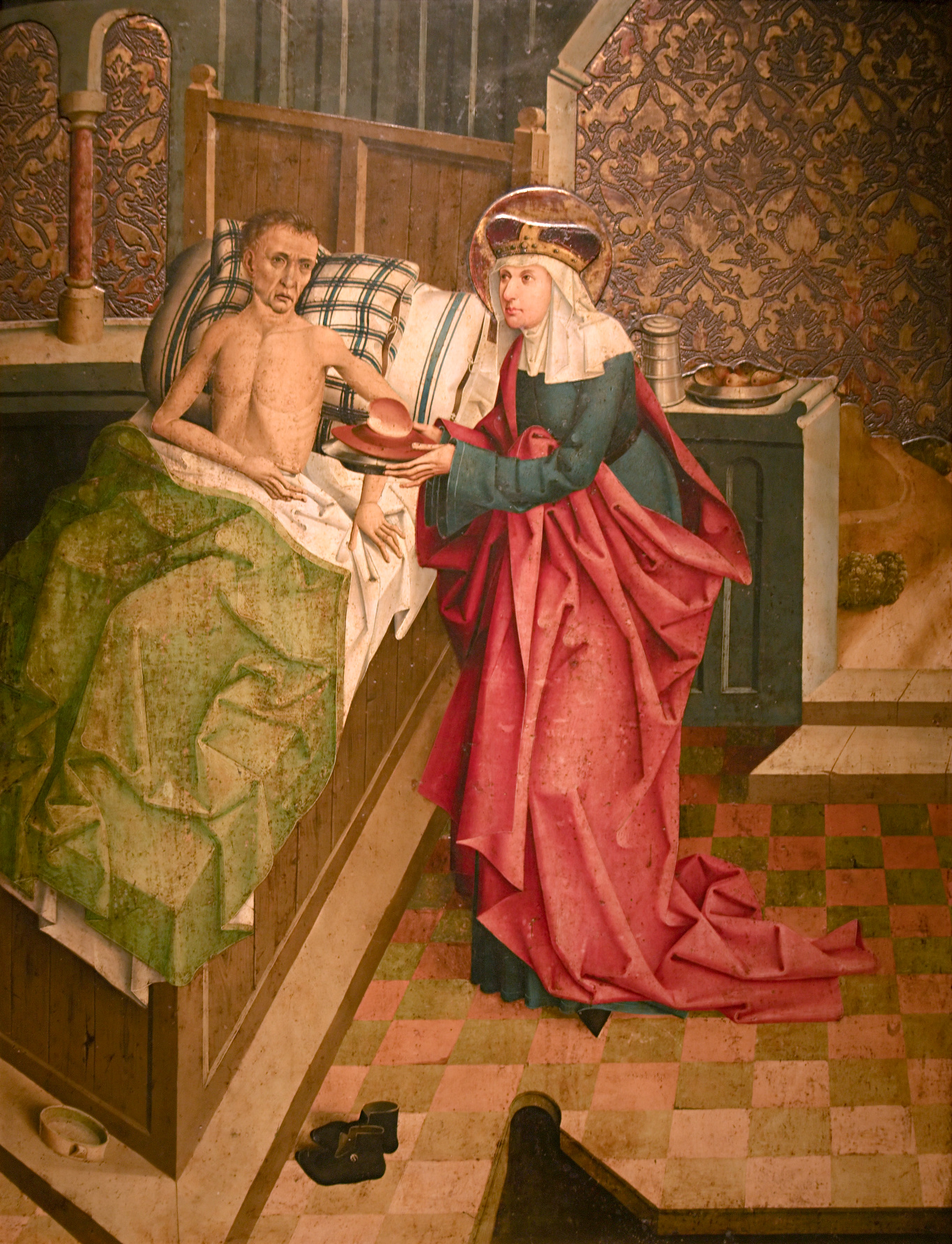
c) Agnes as depicted in two panels of the dismembered late fifteenth-century Nikolaus Puchner altarpiece (1482; also Crosiers' altarpiece) on display in Prague's Convent of St. Agnes of Bohemia:
1) ministering to a man sick in bed:


2) presenting a model of a church to Grand Master Nikolaus Puchner:


The surviving panels re-mounted:

http://tinyurl.com/havoyh9


Thursday, 3 March 2016

A Reasonable Alternative for the USA


With the American Primaries in full swing, and looking at the current state of the political process there a friend has forwarded to me the following piece, which is, I gather, going the rounds on the Internet :


 A MESSAGE FROM THE QUEEN


To the citizens of the United States of America from Her Sovereign Majesty Queen Elizabeth II.

In light of your failure in recent years to nominate competent candidates for President of the USA and thus to govern yourselves, we hereby give notice of the revocation of your independence, effective immediately. (You should look up 'revocation' in the Oxford English Dictionary.)
Her Sovereign Majesty Queen Elizabeth II will resume monarchical duties over all states, commonwealths, and territories (except North Dakota, which she does not fancy).
Your new Prime Minister, David Cameron, will appoint a Governor for America without the need for further elections.
Congress and the Senate will be disbanded. A questionnaire may be circulated next year to determine whether any of you noticed.
To aid in the transition to a British Crown dependency, the following rules are introduced with immediate effect:
-----------------------
1. The letter 'U' will be reinstated in words such as 'colour,' 'favour,' 'labour' and 'neighbour.' Likewise, you will learn to spell 'doughnut' without skipping half the letters, and the suffix '-ize' will be replaced by the suffix '-ise.' Generally, you will be expected to raise your vocabulary to acceptable levels. (look up 'vocabulary').
------------------------
2. Using the same twenty-seven words interspersed with filler noises such as ''like' and 'you know' is an unacceptable and inefficient form of communication. There is no such thing as U.S. English. We will let Microsoft know on your behalf. The Microsoft spell-checker will be adjusted to take into account the reinstated letter 'u'' and the elimination of '-ize.'
-------------------
3. July 4th will no longer be celebrated as a holiday.
-----------------
4. You will learn to resolve personal issues without using guns, lawyers, or therapists. The fact that you need so many lawyers and therapists shows that you're not quite ready to be independent. Guns should only be used for shooting grouse. If you can't sort things out without suing someone or speaking to a therapist, then you're not ready to shoot grouse.
----------------------
5. Therefore, you will no longer be allowed to own or carry anything more dangerous than a vegetable peeler. Although a permit will be required if you wish to carry a vegetable peeler in public.
----------------------
6. All intersections will be replaced with roundabouts, and you will start driving on the left side with immediate effect. At the same time, you will go metric with immediate effect and without the benefit of conversion tables. Both roundabouts and metrication will help you understand the British sense of humour.
--------------------
7. The former USA will adopt UK prices on petrol (which you have been calling gasoline) of roughly $10/US gallon. Get used to it.
-------------------
8. You will learn to make real chips. Those things you call French fries are not real chips, and those things you insist on calling potato chips are properly called crisps. Real chips are thick cut, fried in animal fat, and dressed not with catsup but with vinegar.
-------------------
9. The cold, tasteless stuff you insist on calling beer is not actually beer at all. Henceforth, only proper British Bitter will be referred to as beer, and European brews of known and accepted provenance will be referred to as Lager. South African beer is also acceptable, as they are pound for pound the greatest sporting nation on earth and it can only be due to the beer. They are also part of the British Commonwealth - see what it did for them. American brands will be referred to as Near-Frozen Gnat's Urine, so that all can be sold without risk of further confusion.
---------------------
10. Hollywood will be required occasionally to cast English actors as good guys. Hollywood will also be required to cast English actors to play English characters. Watching Andie Macdowell attempt English dialect in Four Weddings and a Funeral was an experience akin to having one's ears removed with a cheese grater.
---------------------
11. You will cease playing American football. There is only one kind of proper football; you call it soccer. Those of you brave enough will, in time, be allowed to play rugby (which has some similarities to American football, but does not involve stopping for a rest every twenty seconds or wearing full kevlar body armour like a bunch of nancies).
---------------------
12. Further, you will stop playing baseball. It is not reasonable to host an event called the World Series for a game which is not played outside of America. Since only 2.1% of you are aware there is a world beyond your borders, your error is understandable. You will learn cricket, and we will let you face the South Africans first to take the sting out of their deliveries.
--------------------
13.. You must tell us who killed JFK. It's been driving us mad.
-----------------
14. An internal revenue agent (i.e. tax collector) from Her Majesty's Government will be with you shortly to ensure the acquisition of all monies due (backdated to 1776).
---------------
15. Daily Tea Time begins promptly at 4 p.m. with proper cups, with saucers, and never mugs, with high quality biscuits (cookies) and cakes; plus strawberries (with cream) when in season.
God Save the Queen!

PS: Only share this with friends who have a good sense of humour (NOT humor)!